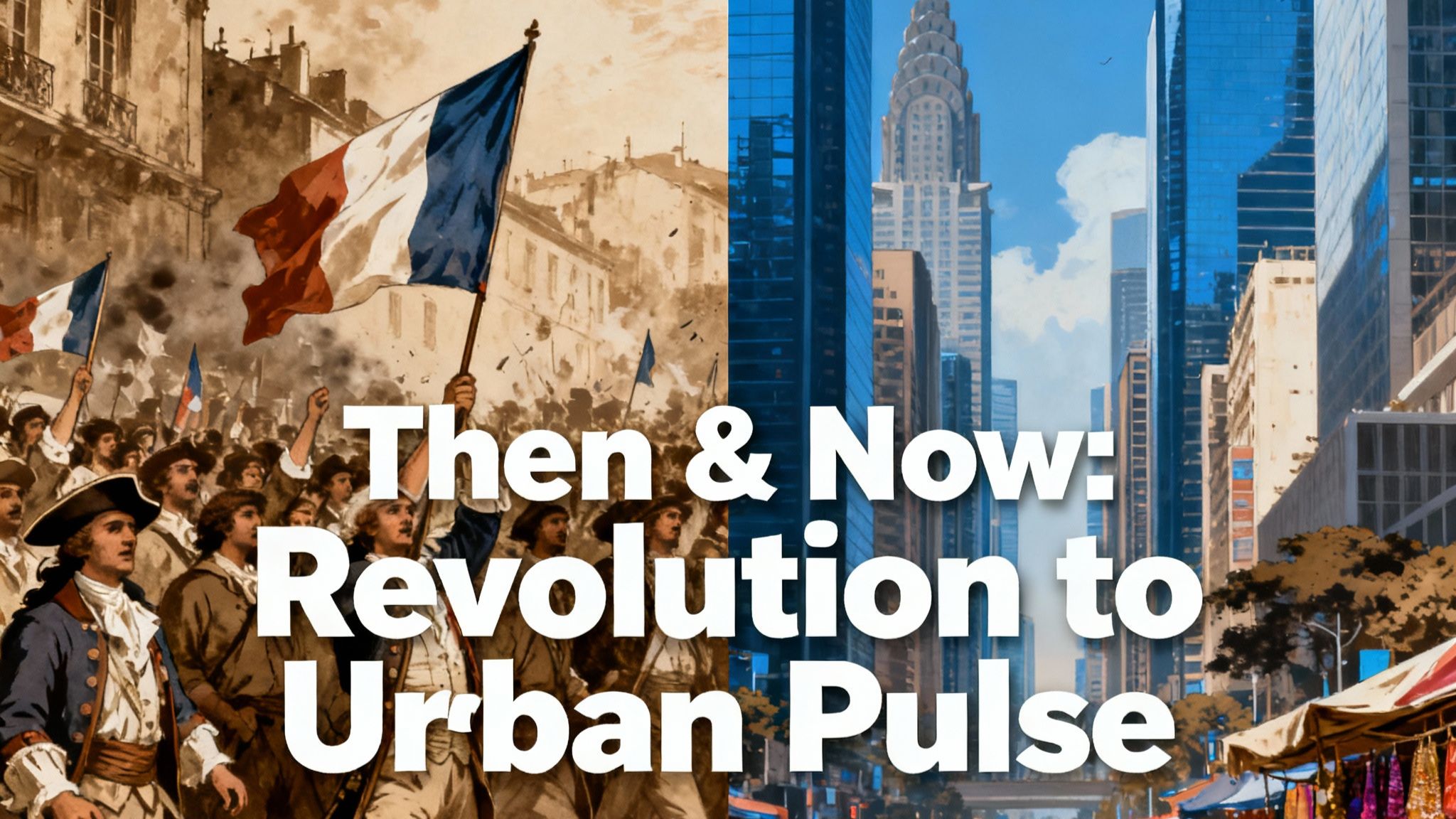
The Echoes of Revolution: Parallels Between Pre-Revolutionary France and Contemporary India
The striking similarities between the social conditions that precipitated the French Revolution of 1789 and the current socio-economic landscape of India reveal disturbing patterns that transcend time and geography. Both societies exhibit extreme wealth concentration, regressive taxation systems, rigid social hierarchies, and governance challenges that create fertile ground for social unrest. An examination of these parallels offers profound insights into how historical patterns of inequality and injustice can manifest across different eras and cultures.
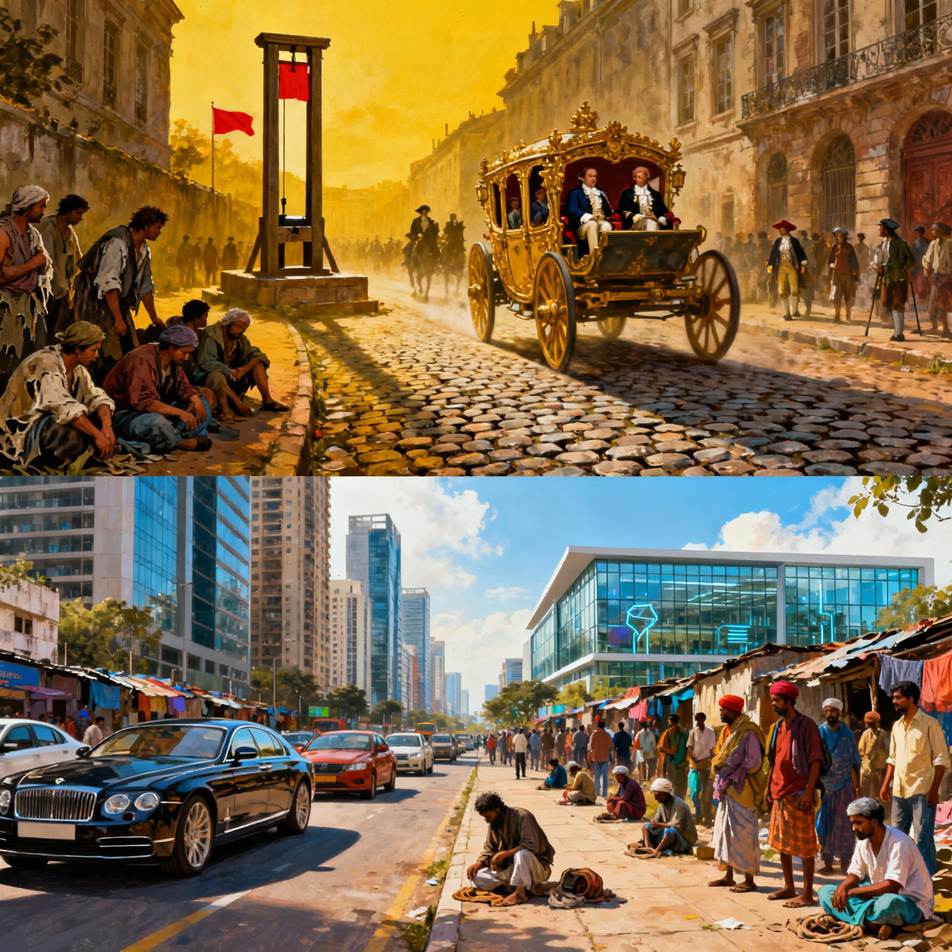
Artistic representation comparing pre-revolutionary France with contemporary India’s social conditions
The Architecture of Inequality: Social Stratification Then and Now
France’s Ancien Régime: The Three Estates System
Pre-revolutionary France was structured around the rigid Three Estates system that divided society into fundamentally unequal segments. The First Estate comprised the Catholic clergy, representing merely 0.5% of the population yet wielding enormous political and economic power. The Second Estate consisted of the nobility, making up just 1.5% of the population but enjoying extensive privileges and exemptions. The Third Estate encompassed the remaining 98% of French society, including peasants, artisans, merchants, and the emerging bourgeoisie, yet bore the overwhelming burden of taxation and social obligations. [1][2][3][4][5]
This system was characterized by hereditary privileges that made social mobility nearly impossible. As contemporary accounts noted, “if you were born poor in Ancien Régime France, you would most likely stay poor for the rest of your life”. The nobility and clergy not only avoided taxation but also enjoyed exclusive access to high-ranking positions in government, military, and religious institutions. [6][2][7][1]
India’s Contemporary Caste-Based Hierarchy
Modern India presents a remarkably similar pattern of social stratification rooted in the caste system. Despite constitutional protections and affirmative action policies, caste continues to profoundly influence social mobility and economic opportunities. The data reveals that 88.4% of India’s billionaire wealth is concentrated among Dominant castes, while Scheduled Tribes—among the most marginalized communities—have no representation among the country’s wealthiest individuals. [8][9][10][11]
The parallel extends to educational and occupational mobility. While Scheduled Castes constitute 19.3% of the workforce, only 11.4% own enterprises. For Scheduled Tribes, the disparity is even more stark: they represent 10.1% of the workforce but only 5.4% are enterprise owners. This pattern mirrors the rigid occupational restrictions of pre-revolutionary France, where birth determined one’s life trajectory. [9][10][8]
Comparative Analysis: Pre-Revolutionary France (1789) vs. Contemporary India (2025)
Wealth Concentration: The Mathematics of Inequality
The Economic Architecture of Pre-Revolutionary France
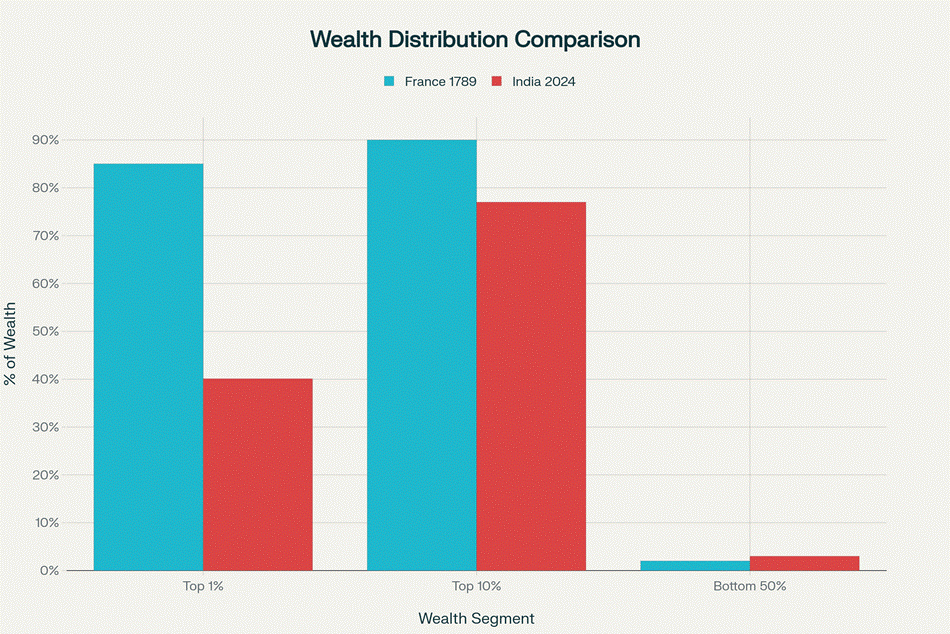
The distribution of wealth in pre-revolutionary France created a powder keg of social tension. The top 10% of the population controlled approximately 90% of national wealth, while the bottom 50% of the population held merely 2-3% of total wealth. The Catholic Church, despite representing less than 1% of the population, owned 10% of all land in France. Meanwhile, the majority of peasants—roughly 75-80% of the population—owned insufficient land to support their families and were forced into poorly paid agricultural labor. [2][4][12]
This concentration of wealth was maintained through a system of feudal obligations and privileges that prevented the redistribution of resources. The nobility collected feudal dues from peasants while simultaneously being exempt from most forms of taxation. The economic historian Simon Schama noted that this system created “massive social injustices that were one of the key factors leading up to the French Revolution”. [1][13][2]
India’s Modern “Billionaire Raj”
Contemporary India exhibits wealth concentration that researchers argue is “more unequal than the British Raj”. The top 1% of Indians control 40.1% of national wealth, while the bottom 50% hold merely 3%. This represents the highest level of inequality since data collection began in 1961. The comparison becomes even more striking when examining income distribution: the top 1% captures 22.6% of national income, surpassing even the peak inequality periods during British colonial rule. [8][14][15][16][17]
The rise of India’s billionaire class has been particularly pronounced since 2014, with the number increasing from 102 in 2020 to 166 in 2022, while the number of hungry Indians rose from 190 million to 350 million during the same period. This concentration of wealth among a tiny elite while masses struggle with basic necessities directly parallels the conditions that fueled revolutionary sentiment in 18th-century France. [16][18][8]
Wealth Distribution Comparison: France 1789 vs India 2025
The Burden of Taxation: Who Pays and Who Benefits
France’s Regressive Tax System
The taxation system of pre-revolutionary France exemplified the fundamental injustices of the Ancien Régime. The primary direct tax, known as the taille, was levied exclusively on the Third Estate, while the First and Second Estates enjoyed broad exemptions. This land tax became “a major source of royal income” while “exempted from the taille were clergy and nobles”. Even when reform attempts were made under Louis XV and Louis XVI, “so many concessions and exemptions were won by nobles and bourgeois that the reform lost much of its value”.[1][13]
The system was further complicated by regional variations and corrupt collection practices. Tax farmers—private contractors who collected taxes—often extracted whatever they could from the population, creating widespread resentment. The fundamental principle seemed to be that “only a fraction of the taxes could be realized as the people were too poor to pay them while nobles and the clergy who could pay were completely exempted from all the taxes”. [19][13]
India’s Contemporary Tax Burden Distribution
Modern India exhibits a strikingly similar pattern of regressive taxation that disproportionately burdens the middle class and poor. According to government data, approximately 64% of total Goods and Services Tax (GST) collections come from the bottom 50% of the population, while the top 10% contribute only 4%. This regressive structure is compounded by the fact that individual income tax collections now exceed corporate tax collections, meaning ordinary citizens contribute more to government revenues than large corporations. [15][18][20][21]
The middle class faces a particular burden, paying both income tax on earnings and GST on expenditures, while lacking the social safety nets available in developed countries. As tax policy analysts note, “salaried individuals get no refund on GST paid, but corporates get input tax credit,” creating a systematic disadvantage for individual taxpayers. Meanwhile, corporate tax rates were reduced from 30% to 22% in 2019, while indirect taxes on goods and services increased substantially. [18][21][22][23]
Corruption and Governance: The Erosion of Public Trust
Administrative Decay in Pre-Revolutionary France
The French monarchy’s administrative system was characterized by widespread corruption and inefficiency that undermined public confidence in governance. King Louis XVI was described as “an empty headed despot” who, along with Queen Marie Antoinette, “squandered money on their luxurious living and wasteful festivities”. High government positions were often “auctioned so inefficiency reigned supreme,” while “the whole administration was corrupt and each department had its own laws”.[19]
This systemic corruption extended throughout the bureaucracy, creating what historians describe as a “rotten system of administration” that left people “tired of such a rotten system” and wanting change. The lack of uniform laws and procedures created confusion and arbitrary rule that further alienated the population from their government.[24][19]
India’s Governance Challenges
Contemporary India faces similar challenges with corruption and governance that echo pre-revolutionary France. India’s ranking in the Corruption Perceptions Index has steadily declined from 85th in 2022 to 96th in 2024, indicating increasing levels of perceived corruption. With a score of 38 out of 100, India is classified among the world’s most corrupt countries. [25][26][27]
Political analysts note that India’s democratic institutions face increasing pressure, with concerns about the “growing nexus between big business and government” that facilitates “disproportionate influence” on society. The concentration of decision-making power and attacks on democratic institutions mirror the autocratic tendencies that characterized pre-revolutionary France. Parliamentary procedures have been weakened, with the “dominance of the executive, in particular the personal influence of the prime minister” marginalizing the legislature.[16][28][29][30]
Social Mobility and Economic Opportunity
The Closed System of Ancien Régime France
Pre-revolutionary France’s social system created virtually insurmountable barriers to upward mobility. The estates system meant that “social class was omnipresent” and “could make upward social mobility almost impossible”. While “the First and Second Estates” could “intermingle,” for “those born into the Third Estate, however, it was almost impossible to move up the social ladder”.[6]
This rigid system was maintained through legal restrictions, educational barriers, and economic structures that favored the privileged classes. The peasantry, representing the vast majority of the population, faced “numerous feudal obligations” and were subject to “renewed vigor by the nobles in the latter part of the 18th century” in collecting dues. Educational opportunities were largely restricted to the wealthy, perpetuating cycles of disadvantage across generations. [13][4]
Modern India’s Mobility Constraints
Despite constitutional guarantees of equality, social mobility in contemporary India remains heavily constrained by caste, class, and geographic factors. Research indicates that “individuals from privileged caste backgrounds, such as Brahmins and other higher castes, tend to enjoy higher levels of upward mobility compared to those from marginalized caste groups”. The study notes that “caste-based inequalities and structural barriers continue to pose challenges to mobility for marginalized caste groups”. [9]
Educational access, while legally equal, remains practically unequal due to economic constraints and quality differences. The persistence of caste-based discrimination in employment and social acceptance creates ongoing barriers to advancement. As sociologists observe, “despite efforts towards social reform and affirmative action, structural inequalities and discriminatory practices persist, hindering progress towards social justice and equality”. [10][11][9]
Economic Crisis and Popular Discontent
France’s Financial Catastrophe
The economic conditions preceding the French Revolution created a perfect storm of popular discontent. France’s involvement in multiple wars, including support for the American Revolution, had “broken her economy”. The “luxurious life led by the French King Louis XVI and his queen had made the matter still worse”. By 1789, the French government had “almost reached a state of bankruptcy”. [19][24]
The economic crisis was exacerbated by poor harvests and food shortages. The “severe famine in 1788-89” left the population desperate and angry. Rising bread prices and unemployment in urban areas created a volatile situation where economic grievances merged with political and social frustrations. [4][31][19]
India’s Economic Pressures
Modern India faces similar economic pressures that create popular discontent. Despite impressive GDP growth rates, the benefits have been “unevenly distributed, with certain states, and certain sectors benefiting disproportionately”. The COVID-19 pandemic worsened existing inequalities, with “the number of billionaires in India increased from 102 in 2020 to 166 billionaires in 2022” while “the number of hungry Indians has increased from 19 crores to 35 crores”. [18]
The middle class faces particular pressure from rising costs of education, healthcare, and housing while their real incomes stagnate. Healthcare costs alone push “63 million Indians into poverty each year”, while 74% of India’s population “could not afford a healthy diet”. These economic pressures, combined with limited social safety nets, create conditions reminiscent of pre-revolutionary France.[15][22][23]
The Catalyst for Change: Enlightenment Ideas and Democratic Aspirations
Intellectual Revolution in 18th Century France
The French Revolution was not merely a product of economic hardship but was also fueled by new ideas about governance, equality, and human rights. Enlightenment philosophers like “Voltaire, Rousseau, and Montesquieu” promoted ideas of “individual liberty, reason, and equality, inspiring a new wave of progressive thought”. These intellectual currents challenged the divine right of kings and the legitimacy of hereditary privilege. [24][32][4]
The spread of literacy and the circulation of pamphlets and books created an informed public that questioned traditional authority. The concept of popular sovereignty and representative government offered alternatives to absolute monarchy and inherited privilege. [32][24]
Contemporary India’s Democratic Discourse
Modern India similarly experiences tension between democratic ideals and persistent inequalities. The country’s constitution promises equality and justice, yet the reality of caste-based discrimination and economic inequality creates cognitive dissonance. Social media and improved communications have created greater awareness of these disparities, much as pamphlets and books did in 18th-century France. [9][10]
The rise of social movements, debates about reservations and affirmative action, and increasing political consciousness among marginalized groups reflect similar dynamics to those that preceded the French Revolution. The gap between constitutional promises and lived reality creates the same type of intellectual ferment that contributed to revolutionary sentiment in pre-revolutionary France. [8][10][9]
Conclusion: Lessons from History
The parallels between pre-revolutionary France and contemporary India are both striking and sobering. Both societies exhibit extreme wealth concentration, regressive taxation systems, limited social mobility, governance challenges, and growing popular awareness of systemic inequalities. While India’s democratic institutions provide peaceful channels for change that were absent in 18th-century France, the underlying social and economic tensions bear remarkable similarities. [8][16][17][25]
The French Revolution demonstrated that extreme inequality and social injustice are ultimately unsustainable. The concentration of 88.4% of billionaire wealth among upper castes while Scheduled Tribes have no representation, the regressive tax system where the bottom 50% pay 64% of GST while the top 10% pay only 4%, and the declining corruption rankings all suggest that India may be approaching a similar historical inflection point. [19][1][24][15][18][25][26][8]
However, India’s experience also demonstrates that change can occur through democratic processes rather than violent revolution. The challenge lies in whether the country’s institutions can adapt quickly enough to address these deep-seated inequalities before they reach the breaking point that characterized pre-revolutionary France. The lessons of 1789 suggest that ignoring such systemic imbalances carries profound risks for social stability and democratic governance.[1][24][17][19]
The comparison ultimately serves as both a warning and an opportunity. Just as the French Revolution transformed European society, India has the potential to address its inequalities and create a more just society. The question remains whether this transformation will occur through gradual democratic reform or whether the accumulation of grievances will eventually overwhelm the system’s capacity for peaceful change.
- https://courses.lumenlearning.com/suny-hccc-worldhistory2/chapter/taxes-and-the-three-estates/
- https://courses.lumenlearning.com/suny-hccc-worldhistory2/chapter/the-ancien-regime/
- https://www.worldhistory.org/article/1960/the-three-estates-of-pre-revolutionary-france/
- https://study.com/academy/lesson/the-causes-of-the-french-revolution-economic-social-conditions.html
- https://en.wikipedia.org/wiki/Estates_of_the_realm
- https://www.thecollector.com/ancient-regime-french-revolution/
- https://study.com/learn/lesson/ancien-regime-of-france.html
- https://www.ndtv.com/india-news/world-inequality-report-over-85-of-indian-billionaires-from-upper-castes-none-from-scheduled-tribes-5974949
- https://ijsi.in/wp-content/uploads/2024/05/18.02.016.20180304.pdf
- https://eduindex.org/2024/03/13/exploring-social-mobility-in-the-context-of-india/
- https://papers.ssrn.com/sol3/papers.cfm?abstract_id=5013919
- https://www.cadtm.org/The-evolution-of-wealth-inequalities-over-the-last-two-centuries
- https://kids.britannica.com/students/article/French-Revolution/274436
- https://en.wikipedia.org/wiki/Income_inequality_in_India
- https://www.drishtiias.com/daily-updates/daily-news-editorials/unjust-disparities-a-closer-look-at-inequality-in-india
- https://time.com/6961171/india-british-rule-income-inequality/
- https://wid.world/www-site/uploads/2024/03/WorldInequalityLab_WP2024_09_Income-and-Wealth-Inequality-in-India-1922-2023_Final.pdf
- https://visionias.in/current-affairs/monthly-magazine/2024-05-21/economics-(indian-economy)/high-income-and-wealth-inequality-in-india
- https://www.doubtnut.com/pcmb-questions/34106
- https://www.drishtiias.com/daily-updates/daily-news-analysis/rising-global-inequality
- https://www.indiatoday.in/business/budget-2024/story/union-budget-2024-nirmala-sitharaman-middle-class-income-tax-burden-data-corporate-tax-numbers-2570554-2024-07-23
- https://www.policycircle.org/policy/is-middle-class-paying-high-taxes/
- https://m.thewire.in/article/economy/indias-unequal-tax-structure-the-rich-pay-less-the-rest-get-less
- https://vajiramandravi.com/upsc-exam/french-revolution/
- https://www.rmnfoundation.org/transparency-index-reveals-corruption-increasing-in-india/
- https://www.drishtiias.com/daily-updates/daily-news-analysis/corruption-perceptions-index-2024
- https://testbook.com/ias-preparation/corruption-perceptions-index-cpi
- https://bti-project.org/en/reports/country-report/IND
- https://www.journalofdemocracy.org/articles/why-indias-democracy-is-dying/
- https://www.chathamhouse.org/2022/04/democracy-india
- https://revolution.chnm.org/exhibits/show/liberty–equality–fraternity/social-causes-of-revolution
- https://byjus.com/free-ias-prep/french-revolution-1789-1799/
- https://askfilo.com/user-question-answers-smart-solutions/the-unfair-tax-system-in-france-before-1789was-the-main-3334313830373938
- https://en.wikipedia.org/wiki/French_Revolution
- https://cepr.org/voxeu/columns/extractive-taxation-and-french-revolution
- https://en.wikipedia.org/wiki/Causes_of_the_French_Revolution
- https://www.coreknowledge.org/wp-content/uploads/2018/04/CKHG_G6_U4_French-Revolution-and-Romanticism_WTNK_C02_TheThreeEstates.pdf
- https://www.vedantu.com/question-answer/are-the-social-causes-of-the-french-revolutio-class-9-social-science-cbse-610cb84642eeb369b77117c7
- https://en.wikipedia.org/wiki/Ancien_régime
- https://www.indiatoday.in/business/personal-finance/story/india-income-inequality-now-worse-than-british-era-says-financial-analyst-2750041-2025-07-03
- https://www.cnn.com/interactive/2017/10/world/i-on-india-income-gap/
- https://en.wikipedia.org/wiki/Caste_system_in_India
- https://www.authorea.com/users/846220/articles/1235100-caste-and-economic-inequality-in-contemporary-india-analyzing-structural-barriers-to-social-mobility
- https://www.sciencedirect.com/science/article/abs/pii/S0143622824000729
- https://www.bbc.com/news/world-asia-india-35650616
- https://vajiramandravi.com/upsc-exam/caste-system-in-india/
- https://www.pib.gov.in/PressNoteDetails.aspx?NoteId=154837&ModuleId=3
- https://www.sociologylens.in/2024/05/emerging-tends-of-caste-mobility.html
- https://www.reuters.com/world/india/indias-richest-1-has-highest-concentration-wealth-decades-study-shows-2024-03-20/
- https://www.ijfmr.com/papers/2024/2/15201.pdf
- https://www.newindianexpress.com/business/2024/Nov/14/tax-burden-on-middle-class-reduced
- https://economictimes.com/news/politics-and-nation/government-didnt-participate-in-any-exercise-related-to-corruption-perception-index-centre-in-rs/articleshow/119250576.cms
- https://tradingeconomics.com/india/corruption-rank
- https://en.wikipedia.org/wiki/Politics_of_India
- https://www.youtube.com/watch?v=24AL-TeZa00
- https://www.transparency.org/en/cpi/2024
- https://pwonlyias.com/editorial-analysis/challenges-in-indian-political-system/
- https://www.reddit.com/r/india/comments/1i434rd/indian_middle_class_rising_financial_burden_whats/
- https://www.transparency.org/en/countries/india
- https://www.shivajicollege.ac.in/sPanel/uploads/econtent/df253a153f75b66cde572aee9fe21f10.pdf