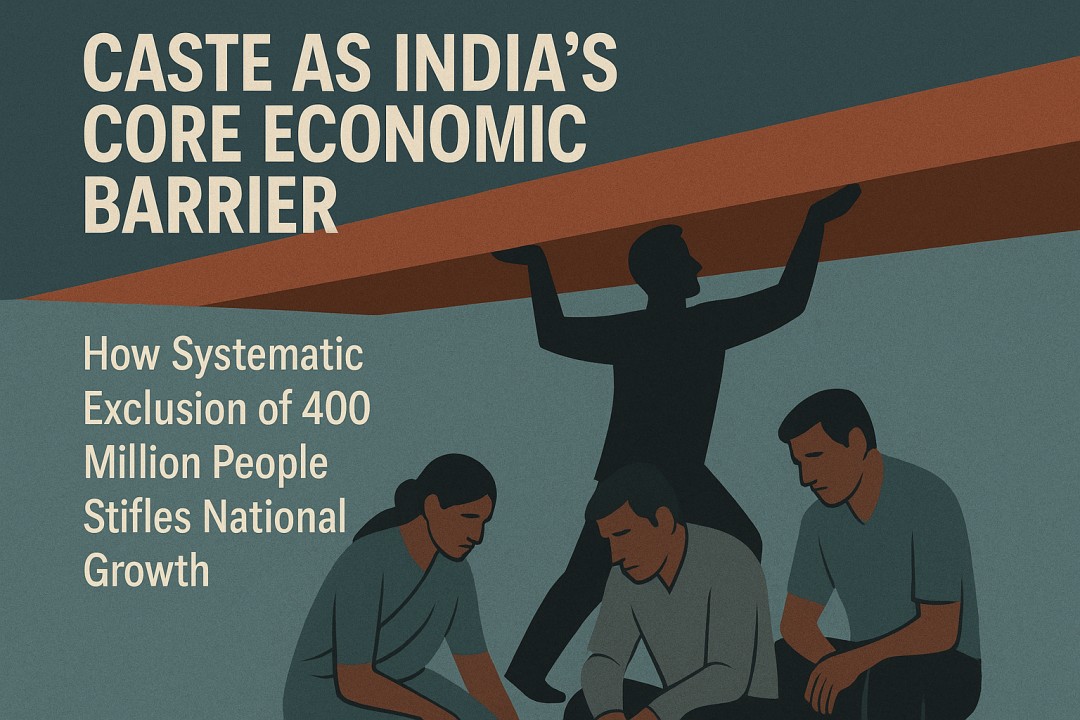
Caste as India’s Core Economic Barrier: How Systematic Exclusion of 400 Million People Stifles National Growth

India aspires to become a global economic powerhouse, yet a structural fault line runs deep through its economy—the caste system. This ancient hierarchy, which divides society based on birth rather than merit, continues to function as an invisible but powerful ceiling that blocks economic mobility for hundreds of millions. While India celebrates its entrepreneurial spirit and economic reforms, the stark reality is that approximately 400-500 million people—representing Scheduled Castes (SCs) and Scheduled Tribes (STs) who constitute 25.2% of the population—remain systematically excluded from wealth creation. This exclusion is not merely a social injustice; it represents India’s single largest economic roadblock, costing the nation an estimated 5.6% to 6% of its GDP annually. What was once an overtly discriminatory caste ceiling has transformed into a more insidious invisible barrier that operates through credit discrimination, hiring bias, social network exclusion, and institutional prejudice. As India seeks to compete globally, it cannot afford to waste the productive potential of nearly half a billion citizens trapped outside the economic mainstream by an accident of birth.[1][2][3][4]

This chart illustrates the stark economic disparities across caste groups in India, showing how Scheduled Castes and Scheduled Tribes lag significantly behind the General category in income, wealth, land ownership, business participation, and credit access.

Historical Foundations: How Caste Structured Economic Roles and Controlled Wealth

The caste system’s economic implications are rooted in millennia of institutionalized inequality. Ancient Hindu scriptures, particularly the Manusmriti and the Purusha Sukta from the Rig Veda, established a divine justification for occupational segregation based on birth. This hierarchical structure divided society into four varnas: Brahmins (priests and scholars), Kshatriyas (warriors and rulers), Vaishyas (traders and merchants), and Shudras (laborers and service providers). Each varna was assigned specific occupations, with the rigid expectation that individuals would remain within their caste-determined roles throughout their lives, regardless of personal aptitude or ambition.[5][6][7][8]

The Manusmriti went beyond mere occupational assignment to actively prevent economic mobility among lower castes. It warned that “even a hardworking Shudra should not be allowed to become wealthy,” explicitly stating the intent to maintain dominant-caste economic dominance. Shudras were restricted from accessing Vedic education, owning significant property, or engaging in commerce. The text prescribed that Shudras exist solely to serve the three upper varnas, creating what Dr. B.R. Ambedkar later identified as a transformation from “division of labour” into “division of labourers”—a system that subordinated individual capability to birth status.[9][7][10][5]

This occupational immobility created profound economic inefficiencies that persist today. Historical land ownership patterns reveal the depth of this exclusion: dominant castes accumulated vast landholdings while Downtrodden and Adivasis were systematically denied property rights. The system forced lower castes into stigmatized occupations such as manual scavenging, leather work, sanitation, and other “polluting” tasks, creating hereditary labor categories that trapped entire communities in poverty across generations. Even during colonial rule, when the British East India Company established trade monopolies and revenue collection systems, existing caste hierarchies were often reinforced rather than dismantled. The Zamindari system placed revenue collection power predominantly in dominant-caste hands, while peasants—disproportionately from lower castes—bore the burden of increased taxation and forced labor.[11][12][13][14][15][5]

The long-term consequence of these historical restrictions was the concentration of capital, land, education, and business networks within dominant-caste communities, creating cumulative advantages that compound across generations. By the time India achieved independence in 1947, centuries of systematic exclusion had left SC and ST communities almost entirely without the economic assets necessary for mobility—no land, no capital, no business connections, and limited access to education. This historical legacy continues to shape contemporary economic outcomes in profound ways.[16][17]

The Modern Caste Ceiling: From Overt to Invisible Discrimination

While India’s Constitution explicitly prohibits caste-based discrimination, the economic exclusion of marginalized communities has not disappeared—it has merely become more subtle and sophisticated. What was once overt discrimination enforced through explicit prohibitions has evolved into an invisible caste ceiling operating through multiple interconnected mechanisms that collectively maintain economic hierarchy without appearing overtly discriminatory.[18]

Credit Discrimination and Financial Exclusion

Perhaps the most quantifiable manifestation of the modern caste ceiling is systematic credit discrimination. Research analyzing the Micro, Small and Medium Enterprises (MSME) census data reveals that Downtrodden-caste entrepreneurs face borrowing constraints that are nearly twice as stringent as those faced by dominant-caste counterparts. Despite constituting 29.5% of the population, lower castes own less than 15% of businesses, and their credit access tells a stark story: SC/ST-owned firms receive only 4.7% of total credit despite needing it desperately, while dominant-caste firms command 75% of available credit. More troubling still, SC/ST entrepreneurs receive, on average, only half the credit amount that dominant-caste borrowers obtain from both commercial and cooperative banks.[2][19][4][20][21]

📊 Caste-Based Disparities in Business Ownership and Credit Access

MetricSC/ST GroupsDominant-Caste GroupsNotes
Population Share29.5%SC/ST share of total population
Business Ownership<15%SC/ST own less than 15% of businesses
Share of Total Credit4.7%75%SC/ST firms receive disproportionately low credit
Average Credit Amount (Commercial & Coop.)50% of dominant-caste borrowers100%SC/ST entrepreneurs receive half the credit amount on average

This credit apartheid is not explained by business viability—in fact, data shows that Downtrodden-caste firms demonstrate 25-30% higher average revenue product of capital (ARPK), indicating they would use capital more productively than their Dominant-caste counterparts. The disparity is most pronounced among small firms, where downtrodden-caste enterprises show ARPK values 52% higher than dominant-caste firms, yet they remain unable to scale due to capital constraints. Studies have documented both taste-based discrimination (prejudice against oppressed castes) and statistical discrimination (perceived higher default risk based solely on caste identity) in bank lending, particularly for production loans.[22][23][2]

The consequences ripple throughout the economy. Without collateral—which requires land and property that lower castes historically could not own—and without access to informal credit networks dominated by Dominant castes, aspiring Downtrodden and Adivasi entrepreneurs cannot start businesses or scale existing ones. Financial institutions, supposedly mandated to serve priority sectors, have gradually reduced their lending to SC households post-liberalization, with the gap increasingly filled by moneylenders charging exploitative interest rates.[24][25][26][22]

Hiring Bias and the Private Sector Caste Wall

The private sector, often touted as a meritocracy free from caste considerations, exhibits profound caste bias in employment practices. A landmark field experiment by Thorat and Attewell submitted identical job applications with only the names varied to signal caste identity. The results were unambiguous: applicants with Dalit or Muslim names received significantly fewer interview callbacks than those with dominant-caste Hindu names, despite identical qualifications. This “resume discrimination” operates as a first-level filter preventing qualified lower-caste candidates from even entering the hiring process.[27][28]

For those who do secure interviews, additional barriers emerge. The concept of “cultural capital” becomes crucial—interviewers assess whether candidates “fit in” with workplace culture, possess appropriate “soft skills,” and demonstrate fluency in English and dominant-caste social norms. Questions about family background—ostensibly to gauge “good families”—systematically disadvantage Bahujan candidates whose parents are more likely to be manual laborers than doctors, engineers, or lawyers. The emphasis on “formal” attire, particular types of shoes, specific speech patterns, and elite educational credentials creates a cultural screening mechanism that operates as a proxy for caste discrimination without explicitly mentioning caste.[28]

Network-based hiring further entrenches caste homogeneity in corporate spaces. When job openings are not publicly advertised but filled through employee referrals and “asking around” within social circles, the result is that firms draw employees from the same dominant-caste social groups. Research indicates that 75% of employees within a firm belong to the same caste as the owner, revealing how homosociality—the tendency to associate with similar others—perpetuates caste-based occupational clustering.[2][28]

🏛️ Caste Representation in Elite Indian Institutions (Faculty Positions)

Institution GroupGeneral Category (%)SC (%)ST (%)OBC (%)Notes
Top 5 IITs98Reservations for SC (15%), ST (7.5%), OBC (27%) largely unfilled
All 21 IITs8061.611.2Reflects broader national pattern across IITs
All IIMs82.8519.6Similar exclusionary trend as IITs
IIM Indore97.200Extreme disparity; no SC or ST representation

Data on caste representation in India’s elite institutions starkly illustrates this exclusion. At the top five Indian Institutes of Technology (IITs), 98% of faculty positions are held by dominant-caste individuals, with reservations for SC (15%), ST (7.5%), and OBC (27%) largely unfilled. Among the 21 IITs, General category faculty constitute 80% of positions, while SC representation is merely 6%, ST just 1.6%, and OBC 11.2%. The pattern repeats at Indian Institutes of Management (IIMs), where 82.8% of faculty belong to the General category, with SC at 5%, ST at 1%, and OBC at 9.6%. Some elite institutions show even more extreme disparities—IIM Indore has 97.2% General category faculty with zero SC or ST representation.[29][30][31][32]

This elite institution exclusion has cascading effects. These institutions serve as gateways to high-paying jobs in the private sector, and their overwhelming dominant-caste composition creates networks, mentorship patterns, and cultural norms that perpetuate exclusion downstream. When even highly educated Dalits enter the job market, many choose not to disclose their SC/ST status to avoid the negative stereotypes and discrimination they know will follow.[33][27][28][29]

The Network Disadvantage: Social Capital as Caste Capital

Economic success in modern markets increasingly depends not just on what you know but who you know. Social networks provide information about opportunities, facilitate resource exchange, enable risk-sharing, and offer reputational collateral. However, in India’s caste-stratified society, social capital functions as “caste capital”—networks that provide advantages to dominant castes while actively disadvantaging lower castes.[34]

Research demonstrates that network contacts are more extensive for high-caste, wealthy, and well-educated households. These networks facilitate job placement through Granovetter’s “strength of weak ties,” where casual connections provide valuable information about employment opportunities. dominant-caste individuals benefit from generations of accumulated social connections in business, government, and professional sectors. These networks provide not just information but also credibility, introductions to investors, business partnerships, and customer bases.[34]

Paradoxically, for Dalit entrepreneurs, increasing social capital—particularly “bridging” social capital that connects across groups—does not yield the same returns as it does for non-stigmatized communities. A nationwide survey found that while one standard deviation increase in social capital associates with a 17.3% increase in business income for non-stigmatized communities, the same increase yields only a 6% income gain for Dalit households. At higher levels of bridging social capital, the business income disadvantage that Dalits experience actually amplifies rather than diminishes. This occurs because Dalit business owners face frequent rejections, micro-aggressions, and the psychological burden of managing stigmatized identity in interactions with dominant-caste clients, suppliers, and partners.[35]

The lack of access to informal credit through community networks particularly handicaps Downtrodden (Dalit) entrepreneurs. While dominant-caste business owners can borrow from relatives, caste fellows, and social connections at reasonable rates, Downtrodden (Dalit)—lacking such networks and facing discrimination from those outside their community—must either forgo credit or accept exploitative terms from moneylenders. This network disadvantage extends to market access: dominant-caste-dominated markets often resist allocating prime commercial spaces to Downtrodden (Dalit) traders, relegating them to less advantageous locations with smaller shops.[19][24][22][26][36]

Quantifying the Economic Cost: How Much Growth Does Caste Kill?

The economic costs of caste-based exclusion are not merely theoretical—they can be quantified with precision, revealing the staggering price India pays for maintaining this hierarchical system.

India loses approximately 5.6% of its GDP annually due to caste-based economic exclusion, with 3.1% from capital misallocation and 2.5% from suppressed entrepreneurship among marginalized communities.

Aggregate GDP and Productivity Losses

Economic modeling based on entrepreneurship theory estimates that caste-specific borrowing constraints cost India approximately 5.6% to 6% of its GDP annually. To contextualize this figure: in an economy the size of India’s (approximately $3.7 trillion in 2023), a 6% loss represents roughly $222 billion in foregone economic output each year. This is not a one-time cost but an annual drain on economic potential, compounding over decades into trillions of dollars in lost development.[2][4]

This GDP loss decomposes into two distinct channels. First, at the intensive margin, the misallocation of capital from unproductive dominant-caste firms to more productive lower-caste firms accounts for approximately 3.1% of total factor productivity (TFP) loss and 34% of GDP losses. This represents pure inefficiency: capital sits underutilized in firms that could not be as productive, while firms that could deploy it more effectively are starved for resources. The evidence is clear in the ARPK data—lower-caste firms consistently demonstrate higher marginal returns on capital, meaning they would generate more output per unit of investment.[4][2]

Second, at the extensive margin, distortions that prevent productive but poor lower-caste individuals from entering entrepreneurship while allowing unproductive dominant-caste individuals to operate businesses account for an additional 2.5% of TFP and GDP losses. This represents latent entrepreneurial talent that never materializes because individuals who would be excellent business owners cannot access the capital, networks, and market opportunities to start ventures. Meanwhile, less capable entrepreneurs continue operating solely because they possess inherited advantages of caste.[2][4]

The Human Capital Waste

Beyond aggregate figures, the human capital waste is profound. India’s education system shows persistent caste gaps: SC literacy rates stand at 60%, ST at 55%, compared to 80% for the general population. These educational disadvantages stem from a combination of factors—poverty limiting access to quality schools, lack of educational infrastructure in SC/ST-dominated areas, discrimination within educational institutions, and the absence of role models and mentors from similar backgrounds. Lower educational attainment then translates into lower earning potential throughout life.[1][16]

Income disparities tell the story: SC households earn an average of ₹45,000 annually, ST households ₹40,000, while general category households earn ₹75,000—meaning SC/ST households earn approximately 60% of what general category households earn. These income gaps persist even after controlling for education, indicating that discrimination in the labor market adds an additional penalty beyond educational disadvantages. Research indicates that at least 30% of earnings inequality in India is determined by caste, gender, and family background rather than individual merit or effort.[16][37][38][1]

The poverty implications are stark: 34% of SC households remain below the poverty line compared to only 9% of general category households. Using multidimensional poverty metrics that account for deprivations in health, education, and living standards, five out of every six persons among SCs qualify as poor—an 83.3% poverty rate. When hundreds of millions of people are trapped in poverty primarily due to their caste identity rather than lack of capability, the economic cost manifests not just in current output but in generations of unrealized human potential.[16]

Sector-Specific Costs

The caste exclusion costs manifest differently across economic sectors. In agriculture, where land ownership remains central to wealth and status, the disparities are extreme. SC households hold an average of just 0.78 hectares compared to 1.05 hectares for general category households, and 71% of SC households are entirely landless. The 2015-16 Agricultural Census reveals that 92% of SC landholdings are marginal (0-2 hectares), comprising just 9% of total agricultural land despite SCs being 16.6% of the population. dominant castes own land at 1.5 times their population share, while SCs possess only 7.3% of land compared to 42.2% held by general category households.[11][39]

This land inequality creates agricultural inefficiency. Landless SC households must work as agricultural laborers for dominant-caste landowners, often under exploitative terms and with minimal bargaining power. Their marginal landholdings lack economies of scale, access to irrigation, or credit for inputs, resulting in lower agricultural productivity. Meanwhile, large dominant-caste landholdings may not be optimally cultivated, as historical entitlement rather than agricultural aptitude determined land distribution.[1][12]

In the manufacturing and service sectors, the exclusion appears as entrepreneurial suppression. While SCs constitute 16.6% of the population, they own only 11.4% of unregistered MSMEs, and not even one medium-sized MSME is owned by SCs. This indicates that Downtrodden (Dalit) enterprises remain confined to self-employment using only family labor and family resources, unable to scale into job-creating businesses. ST ownership is even lower at 5.4% of enterprises. These SC/ST businesses produce merely 8% of aggregate output, own 5.4% of total capital, and receive just 4.7% of total credit, while dominant-caste firms produce 60% of output, own 70% of capital, and receive 75% of credit.[2][19]

The inefficiency is evident in the “output-to-credit ratio”—lower-caste firms’ output-to-credit ratio is twice as high as dominant-caste firms, meaning they generate double the output per unit of credit received. This suggests massive misallocation: credit flows to firms that use it less productively while starving more productive firms. If credit were allocated based on productivity rather than caste, aggregate output would increase substantially.[2]

Regional Variations and Financial Development

The economic costs of caste discrimination vary significantly across India’s states, correlating strongly with regional financial development. In states with poorly functioning financial markets—Bihar, Jharkhand, and Uttar Pradesh—lower-caste firms have ARPK values double those of dominant-caste firms, indicating severe credit constraints. In contrast, states with better financial institutions show smaller cross-caste ARPK differences, suggesting that improved financial access disproportionately benefits credit-constrained downtrodden-caste firms.[2]

This regional variation offers policy insights: interventions that improve financial market functioning have larger impacts in regions where caste-based credit discrimination is most severe. However, even in the most financially developed Indian states, substantial caste gaps in credit access persist, indicating that discrimination rather than market imperfections drives much of the disparity.[20][2]

Caste’s Stifling Effect on Innovation and Entrepreneurship

Beyond aggregate economic losses, caste suppresses the very innovation and entrepreneurial dynamism that India needs to compete globally. Innovation requires that the most talented individuals, regardless of background, can access resources to develop and commercialize new ideas. Entrepreneurship requires that individuals with business acumen can enter markets, secure capital, build networks, and compete on merit. The caste system systematically violates both requirements.

Talent Suppression and Occupational Trapping

The caste system’s fundamental flaw is that it allocates economic roles based on birth rather than capability. Dr. Ambedkar identified this as economic organization’s worst form—forcing workers into occupations determined by social rules rather than natural aptitude leads to profound inefficiencies. A brilliant individual born into a community traditionally relegated to sanitation work faces enormous barriers to becoming an engineer, entrepreneur, or scientist, while a mediocre individual born into an elite caste enjoys access to capital, networks, and opportunities despite limited talent.[9]

Contemporary data confirms this talent suppression. Studies document that over 80% of bonded laborers in India come from SC, ST, and minority communities, and more than 80% of sanitation workers belong to SC/ST/OBC groups. Meanwhile, only 8% of the general category workforce engages in such work. This is not because SCs and STs naturally possess aptitude for sanitation work while lacking entrepreneurial or professional capabilities—it is because caste norms, discrimination, and lack of alternatives trap them in these occupations.[5][9]

The occupational trapping extends beyond manual labor. Even educated lower-caste individuals face “glass walls”—invisible barriers that channel them into specific occupations and out of others. While some occupational mobility has occurred, studies in Uttar Pradesh show that inter-generational mobility among lower castes remains largely restricted to low-paid, low-skilled jobs, with limited opportunities for advancement into highly paid service occupations. Hindu general castes continue to dominate Grade A and Grade B service jobs in both public and private sectors as well as large business and trade activities, while Hindu Downtrodden (Dalit) are concentrated in Grade C jobs, petty business, and non-agricultural labor.[28][40]

This occupational segregation wastes human capital on a massive scale. Entrepreneurial talent exists distributed across the population, not concentrated in particular castes. When structural barriers prevent talented individuals from historically marginalized communities from entering entrepreneurship while allowing less talented dominant-caste individuals to operate businesses based on inherited advantages, aggregate innovation and productivity suffer.

The Innovation Penalty

Innovation flourishes in environments characterized by open competition, meritocratic resource allocation, and diverse perspectives. The caste system undermines all three. When 98% of faculty at India’s top technical institutions come from dominant-caste backgrounds, the resulting homogeneity limits the diversity of thought, experience, and perspective that drives breakthrough innovation. When access to capital, education, and markets depends on birth rather than capability, the incentive structure for innovation becomes distorted.[29][30]

Research on business income disadvantages shows that stigmatized caste entrepreneurs earn approximately 16% less than non-stigmatized entrepreneurs even after controlling for business characteristics and human capital. This income penalty discourages entry into entrepreneurship—why take the risk of starting a business if you will earn less than equally capable entrepreneurs from privileged castes? The result is that talented potential entrepreneurs from marginalized communities opt for salaried employment (if they can find it) or remain trapped in traditional occupations, while entrepreneurship becomes increasingly caste-clustered.[2][19][35]

The digital economy offers a stark example of innovation suppression through caste. Despite increased mobile phone and internet access, deep digital divides persist along caste lines. SC, ST, and OBC individuals face substantial barriers in accessing digital technologies compared to other caste groups, driven by socioeconomic deprivation, lower educational attainment, and income constraints. For basic digital skills like sending messages, caste gaps are relatively small, but for advanced employment-enhancing skills—writing computer code, creating presentations, using spreadsheets—the gap between dominant and marginalized groups increases dramatically.[41]

In the 15-29 age group, dominant caste youth are three times as likely to possess advanced digital skills compared to marginalized caste youth. As India’s economy digitizes and tech-driven innovation becomes central to growth, this digital divide means that opportunities in the digital economy remain monopolized by a small section of dominant-caste individuals, perpetuating cycles of exclusion. The loss is not just to excluded individuals but to the nation, which misses innovations that talented but excluded individuals could have contributed.[41]

Entrepreneurship as Caste-Clustered Activity

Rather than functioning as a meritocratic arena, Indian entrepreneurship exhibits strong caste clustering. Particular castes historically occupied specific economic niches—trading castes like Banias and Marwaris in commerce, certain OBC castes in specific manufacturing activities, and SCs largely excluded from entrepreneurship except in stigmatized trades like leather work. These patterns persist because social networks that support entrepreneurship—providing information, credit, customers, and suppliers—operate predominantly within caste boundaries.[19][42][34][26]

Dominant-caste entrepreneurs benefit from what economists call “network externalities.” When one member of a caste succeeds in business, they create pathways for others from their community through hiring preferences, supplier relationships, customer referrals, and knowledge sharing. These networks sustained rural-urban migration during British rule and continue to support economic activity today. However, they function as barriers to outsiders, including downtrodden-caste aspiring entrepreneurs.[34][43][44]

The result is that entrepreneurship becomes a caste-reproduced activity rather than a meritocratic opportunity. The Malaysian affirmative action program recognized this problem and reserved 30% of business ownership for ethnic Malays to address wealth disparities. India has no comparable policy for the private sector, leaving caste-based entrepreneurship clustering largely unaddressed.[45][46]

Even government programs intended to promote SC/ST entrepreneurship face limitations. The National Scheduled Castes Finance & Development Corporation (NSFDC), established in 1989, suffers from being housed in the Ministry of Social Justice and Empowerment rather than Commerce or Finance, revealing a mindset that treats Downtrodden (Dalit) entrepreneurship as a welfare issue rather than an economic development priority. These narrow-mandate institutions often “straight-jacket Downtrodden (Dalit) entrepreneurs as supplicants of a governmental bureaucracy” rather than providing meaningful access to the financial system, networks, and markets that entrepreneurship requires.[26]

Policy Solutions: Breaking the Caste Ceiling Through Systemic Reform

Addressing caste-based economic exclusion requires interventions across multiple domains—financial access, education, entrepreneurship support, labor market regulation, and societal transformation. Half-measures and token gestures will not suffice; only comprehensive, sustained reform can dismantle centuries of accumulated disadvantage.

Financial Inclusion and Credit Access Reforms

Credit discrimination represents the most immediate barrier to economic mobility and therefore should be a priority for intervention. Policy reforms must address both the supply and demand sides of credit markets.

On the supply side, mandatory transparency in lending data is essential. Currently, private sector firms are not required to report the caste composition of their borrowers, making discrimination impossible to measure or address. Legislation should mandate that all financial institutions—commercial banks, cooperative banks, non-banking financial companies (NBFCs), and microfinance institutions (MFIs)—report disaggregated lending data by borrower caste category. This transparency would enable regulators to identify discriminatory patterns and hold institutions accountable.[27][28][25][21]

Priority sector lending norms should be strengthened with specific sub-targets for SC/ST borrowers that reflect their population share. Currently, while priority sector lending exists, there are no binding quotas ensuring that SC/ST entrepreneurs receive proportional credit access. Research shows that both commercial and cooperative banks discriminate against SCs and STs in credit access. Setting explicit targets—such as 16.6% of priority sector lending to SC borrowers and 8.6% to ST borrowers—would create accountability and pressure institutions to overcome unconscious or conscious bias.[22][20]

Collateral requirements should be reformed to reduce dependence on land and property ownership, which SC/ST borrowers disproportionately lack due to historical exclusion from land ownership. Alternative collateral models—such as inventory financing, receivables financing, and group lending models—should be promoted. Microfinance institutions have demonstrated that group lending with social collateral can achieve high repayment rates among poor borrowers, including SC/ST households. Scaling such models while ensuring they offer terms comparable to formal bank credit would expand access.[11][24][22]

The government should consider establishing a specialized SC/ST Business Development Bank, modeled on successful development finance institutions in other countries. This institution would focus specifically on providing capital, technical assistance, and market linkages to SC/ST entrepreneurs. Unlike existing programs housed in social welfare ministries, this bank should be under the Ministry of Finance or Commerce, signaling that SC/ST entrepreneurship is an economic development priority, not a welfare program.[26][47]

Caste-conscious credit scoring models should be developed that account for historical discrimination in credit histories. Many SC/ST entrepreneurs lack formal credit histories precisely because they have been excluded from formal credit markets. Credit scoring algorithms that penalize such individuals perpetuate discrimination. Instead, alternative data—such as utility payment histories, business cash flows, and supplier/customer references—should be incorporated to assess creditworthiness without bias.[25]

Education Equity and Human Capital Development

Breaking the caste ceiling requires addressing educational disparities that begin in early childhood and compound through higher education. Constitutional Article 21A mandates free and compulsory education for children aged 6-14, but implementation remains uneven, with SC/ST children often attending underfunded schools with inadequate infrastructure and poorly trained teachers.[18][48]

Investment in early childhood education in SC/ST-dominated areas should be a priority. Research consistently shows that early intervention has the highest returns, particularly for disadvantaged children. Building quality anganwadis (preschools), ensuring adequate nutrition through mid-day meal programs, and training early childhood educators specifically for disadvantaged communities would establish a stronger foundation for later learning.[48]

Reservation policies in higher education, particularly in elite institutions like IITs and IIMs, must be enforced rigorously. Current data showing that 98% of faculty at top IITs are from dominant castes, with reservation quotas systematically unfilled, represents a clear violation of policy. The government must hold institutions accountable for filling reserved faculty positions and impose penalties for non-compliance. Additionally, reservation implementation should extend to PhD admissions, postdoctoral fellowships, and research funding to build a pipeline of SC/ST/OBC scholars who can eventually fill faculty positions.[29][30][31]

Hostel facilities, financial support, and mentorship programs specifically for SC/ST/OBC students in elite institutions should be strengthened. Research indicates that even when students from marginalized communities gain admission, they often face discrimination, isolation, and lack of support that leads to poor performance or dropout. Establishing SC/ST/OBC student support cells with adequate staffing and authority to address discrimination complaints would improve retention and success rates.[33][49]

Skill development programs should be expanded and targeted to SC/ST youth, with a focus on emerging sectors. The Pradhan Mantri Kaushal Vikas Yojana (PMKVY) and SANKALP scheme aim to increase skill training, but implementation should ensure that SC/ST youth, particularly from rural areas, have access to training in high-demand skills rather than being channeled into traditional, low-paying occupations. Partnerships with industry should create pathways from skill training to formal employment with clear anti-discrimination provisions.[18]

Entrepreneurship Promotion and Business Development

Promoting SC/ST entrepreneurship requires interventions that address the multiple barriers these entrepreneurs face—capital constraints, network disadvantages, market access difficulties, and discrimination.

The Stand-Up India Scheme, which provides loans to SC/ST and women entrepreneurs, should be expanded in scale and improved in implementation. Current loan sizes and terms should be reviewed to ensure they meet the actual capital needs of entrepreneurs seeking to start or scale businesses, not just micro-enterprises. Technical assistance—business planning support, accounting training, marketing guidance—should accompany financial support to improve success rates.[18][47]

Government procurement policies offer a powerful lever for promoting SC/ST entrepreneurship. The SC/ST Hub initiative, launched to increase public procurement from SC/ST enterprises, should be scaled up with binding targets. Central and state governments should commit to procuring at least 16.6% of goods and services from SC-owned enterprises and 8.6% from ST-owned enterprises, reflecting their population shares. These targets should extend to government-owned corporations and eventually to private sector firms receiving government contracts or subsidies.[47]

Supplier diversity programs, modeled on successful initiatives in other countries, should be adopted by large corporations. These programs require corporations to actively diversify their supplier base to include businesses owned by historically marginalized groups. Companies should set targets for procurement from SC/ST/OBC-owned businesses, report progress publicly, and provide support (such as capacity building and financing) to help these suppliers meet quality standards. The Madhya Pradesh government’s supplier diversity initiative in 2002 demonstrated the potential of this approach.[50][45]

Business incubators and accelerators specifically focused on SC/ST/OBC entrepreneurs should be established in multiple locations. These incubators should provide not just physical space but also mentorship, network access, and connections to investors. Successful SC/ST entrepreneurs should be engaged as mentors to provide role models and practical guidance to aspiring entrepreneurs from similar backgrounds.[47]

Breaking caste monopolies in traditional sectors requires active intervention. Research documents that “castes already in control of trading and industrial spaces resisted the entry of others”. Market allocation policies should prevent dominant-caste-dominated markets from excluding SC/ST traders. When states allocate market spaces, they should ensure equitable location assignment rather than relegating SC/ST traders to disadvantageous spots. Anti-cartel regulations should be enforced to prevent dominant groups from using informal networks to exclude outsiders.[19][18]

Access to technology and digital skills, as discussed earlier, is crucial for participation in the modern economy. Specific programs to increase digital literacy and access to devices among SC/ST/OBC youth—particularly girls and women—should be implemented. Subsidized internet access, computer literacy training, and coding boot camps targeted at marginalized communities would reduce the digital divide that threatens to perpetuate exclusion in the digital economy.[41]

Labor Market Regulation and Private Sector Accountability

The private sector, which now employs more Indians than the public sector and is growing while public sector jobs shrink, must be brought within the ambit of anti-discrimination enforcement and affirmative action policies.

Legislation should mandate reservation in private sector employment, starting with large corporations. Several proposals have been made over the years, but resistance from industry stakeholders citing concerns about meritocracy and autonomy has stalled implementation. However, international experience—including in the United States with affirmative action, South Africa with Black Economic Empowerment, and Malaysia with Bumiputera policies—demonstrates that diversity policies need not undermine business performance and may enhance it.[51][52][46]

A phased approach could begin with requiring private firms above a certain size threshold (e.g., 100 employees or ₹100 crore revenue) to establish diversity targets for SC/ST/OBC hiring at all levels—not just entry-level positions but also in management and leadership. Firms should be required to report annually on their workforce composition by caste category and progress toward diversity targets. Initially, these could be voluntary targets with public reporting to create reputational incentives; if voluntary compliance proves insufficient, mandatory quotas could be implemented.[53][51]

Anti-discrimination training should be mandatory in all private sector firms above a certain size. This training should specifically address caste bias, covering topics such as unconscious bias in hiring, promotion, and performance evaluation; the impact of asking about family background in interviews; network-based hiring’s discriminatory effects; and how to create inclusive workplace cultures. Regular refresher training should be required, and firms should be held accountable for creating environments free from caste-based harassment and discrimination.[50]

Grievance mechanisms that allow workers to report discrimination without fear of retaliation should be established in all workplaces. These mechanisms should include both internal channels (such as ombudspersons or dedicated officers) and external channels (such as government labor offices or dedicated anti-discrimination tribunals). Cases of proven discrimination should result in significant penalties for firms and remedies for affected workers, including back pay, promotion, and damages.[50]

Transparent hiring processes should be mandated to reduce scope for discrimination. Job openings should be publicly advertised rather than filled through internal referrals and social networks. Interview panels should include members from diverse caste backgrounds. Structured interviews with standardized questions should replace informal conversational interviews where bias more easily operates. Resume screening should consider removing or anonymizing caste-identifiable information (such as names and addresses) until later stages of evaluation to reduce early-stage discrimination.[27]

Supply chain accountability should extend to caste discrimination. Multinational corporations sourcing from India should be required to conduct due diligence to ensure their supply chains are free from caste-based discrimination, forced labor, and exploitation. The Ethical Trading Initiative’s guidance on “Caste in Global Supply Chains” provides a framework for businesses to address caste discrimination. Companies should incorporate caste discrimination clauses in supplier agreements, conduct regular audits, and terminate relationships with suppliers engaging in discriminatory practices.[54][50]

Societal and Cultural Transformation

Policy reforms alone will not suffice without broader societal change to challenge caste norms and reduce stigma. This requires interventions in multiple spheres.

Media representation of SC/ST/OBC individuals in diverse, positive roles—as entrepreneurs, professionals, innovators, and leaders—can challenge stereotypes and provide role models for youth from marginalized communities. Broadcasting regulations could include guidelines encouraging such representation while discouraging reinforcement of caste stereotypes.[47]

Educational curricula should include the history and contemporary reality of caste discrimination, the contributions of Downtrodden (Dalit) and Adivasi leaders and thinkers, and the economic costs of exclusion. Teaching students about structural inequality and discrimination from an early age can build empathy and understanding while empowering students from marginalized backgrounds with knowledge of their rights and history.

Inter-caste marriage, which directly challenges caste boundaries, should be promoted through positive incentives and protection from violence. Several states offer financial incentives for inter-caste marriages involving SC/ST partners, but these programs remain small-scale. Expanded incentives coupled with strong legal protection against honor killings and violence targeting inter-caste couples would gradually weaken caste boundaries.[55]

Destigmatizing occupations associated with lower castes requires both economic transformation and cultural work. Manual scavenging, which forces primarily Downtrodden (Dalit) workers to manually clean sewers and septic tanks, should be completely abolished with strict enforcement of existing laws. Workers currently in such occupations should be provided with alternative livelihood training, capital for entrepreneurship, and priority in government employment. Mechanical solutions should replace manual labor in sanitation, and sanitation work should be professionalized with dignified working conditions and fair compensation.[5][52]

Professional associations, industry bodies, and business chambers should adopt diversity and inclusion commitments. Organizations like CII (Confederation of Indian Industry), FICCI (Federation of Indian Chambers of Commerce and Industry), and NASSCOM (National Association of Software and Service Companies) should establish diversity councils, develop best practices for inclusive hiring and promotion, and recognize corporations demonstrating leadership in diversity. Creating peer pressure and competitive incentives around diversity can accelerate change in the corporate sector.[46]

Conclusion: Caste as Economic Suicide

India cannot achieve its economic aspirations while maintaining a system that systematically excludes 400-500 million people from wealth creation. The evidence is overwhelming: caste-based discrimination costs India an estimated 6% of GDP annually—approximately $222 billion in foregone output. Lower-caste entrepreneurs, who demonstrate higher productivity than dominant-caste counterparts, receive only one-sixth of the credit they should based on their population share. SC/ST individuals earn only 60% of what general category individuals earn, and 34% of SC households remain below the poverty line compared to 9% of general category households. Elite educational institutions that should be gateways to opportunity have 98% dominant-caste faculty, systematically excluding marginalized communities from the knowledge economy.[1][16][2][4][29][30][31]

This is not simply a matter of social injustice, though the moral imperative alone should compel action. It is a matter of economic rationality. When capital flows to less productive firms because of caste rather than capability, when talented individuals are trapped in manual labor because of birth rather than aptitude, when brilliant minds are excluded from elite institutions because of names rather than merit, the economy operates far below its potential. Every lost invention, every failed business that could have succeeded with capital, every professional career never begun because of discrimination represents wealth that India will never create.[2][9]

The transformation required is profound but achievable. It requires dismantling financial barriers through credit access reforms, educational barriers through investment in SC/ST education and enforcement of reservations, employment barriers through private sector regulation and accountability, and entrepreneurial barriers through business development support and breaking of caste monopolies. It requires both policy reform and cultural change, both legal enforcement and societal transformation.[18][50][45][52]

Other nations have confronted structural inequalities and made progress. The United States, despite ongoing challenges, has reduced racial economic gaps through civil rights legislation, affirmative action, and cultural change. South Africa has undertaken Black Economic Empowerment to address apartheid’s legacy. Malaysia implemented Bumiputera policies to reduce ethnic wealth disparities. India, with its constitutional commitment to equality and its democratic institutions, has the tools to address caste-based exclusion if there is political will.[45][56]

The question is not whether India can afford to dismantle caste barriers—the question is whether India can afford not to. In a globalized economy where human capital and innovation drive growth, wasting the potential of one-quarter of the population is economic suicide. India’s competitors—China, Vietnam, Bangladesh, others—do not handicap themselves with birth-based hierarchies that prevent talent from reaching its potential. If India is to compete, it must unleash the full economic potential of all its citizens, regardless of caste.

The invisible caste ceiling must be shattered. The 400-500 million people currently kept outside the economic structure must be brought in—not as supplicants of welfare programs but as full participants in wealth creation. When credit flows to the most productive entrepreneurs regardless of caste, when hiring occurs based on capability rather than family background, when innovation comes from the best minds rather than those born into the right caste, India’s true economic potential will be realized. The cost of maintaining caste hierarchy is too high; the gains from dismantling it are too great. India’s growth depends on it.


  1. https://www.irjweb.com/A Study on Socioeconomic Status Of Scheduled Castes (SC) And Scheduled Tribes (ST) In India.pdf    
  2. https://voxdev.org/topic/macroeconomics-growth/macroeconomic-costs-caste-system-india             
  3. https://en.wikipedia.org/wiki/Scheduled_Castes_and_Scheduled_Tribes
  4. https://bse.eu/sites/default/files/working_paper_pdfs/1104.pdf     
  5. https://www.roundtableindia.co.in/manusmriti-to-modernity-caste-labour-and-the-unbroken-chain-of-exploitation/    
  6. https://vajiramandravi.com/upsc-exam/varna-system/
  7. https://egyankosh.ac.in/bitstream/123456789/84766/1/Unit-6.pdf 
  8. https://ijariie.com/AdminUploadPdf/THE_CASTE_SYSTEM_AND_ITS_RELATION_WITH_ECONOMICS_ijariie25895.pdf
  9. https://theanalysis.org.in/caste-remains-an-impediment-to-occupational-mobility-in-the-indian-society/   
  10. https://journals.library.brandeis.edu/index.php/caste/article/download/502/254/2727
  11. https://www.roundtableindia.co.in/caste-landownership-and-its-historicity-the-redistribution-question/  
  12. https://www.ideasforindia.in/topics/poverty-inequality/how-has-land-acquisition-impacted-dalits-a-case-study-from-maharashtra.html 
  13. https://en.wikipedia.org/wiki/Company_rule_in_India
  14. https://www.britannica.com/topic/East-India-Company
  15. https://vajiramandravi.com/upsc-exam/acts-and-regulations-under-east-india-company/
  16. https://journals.sagepub.com/doi/10.1177/2455328X211073207    
  17. https://cpim.org/problems-of-dalits/
  18. https://www.drishtiias.com/daily-news-editorials/caste-a-barrier-to-economic-transformation     
  19. https://gipe.ac.in/caste-and-enterprise-ownership-emerging-trendsand-diversification-in-india/     
  20. https://www.isec.ac.in/wp-content/uploads/2023/07/WP-478-Karthick-V-Final.pdf  
  21. https://eprajournals.com/pdf/fm/jpanel/upload/2024/June/202406-04-017399 
  22. https://ras.org.in/articles/370/text/article.html    
  23. https://www.isid.ac.in/~acegd/acegd2023/papers/RikhiaBhukta.pdf
  24. https://rhimrj.co.in/index.php/rhimrj/article/view/623  
  25. https://www.ijnrd.org/papers/IJNRD2301329.pdf  
  26. https://qz.com/india/306751/these-entrepreneurs-are-challenging-indias-cruellest-social-system-and-winning    
  27. https://www.roundtableindia.co.in/caste-discrimination-in-indias-urban-private-sector/   
  28. https://feminisminindia.com/2017/03/22/caste-bias-private-sector/     
  29. https://theprint.in/india/education/98-of-faculty-at-top-5-iits-are-upper-caste-reservation-not-implemented-says-nature-article/1312713/    
  30. https://www.instagram.com/reel/DFmVce2zMfy/   
  31. https://en.themooknayak.com/education/gen-category-occupies-90-of-faculty-in-iits-and-iims-why-is-reservation-being-tossed-aside-asks-aiobcsa  
  32. https://m.thewire.in/article/education/over-80-iit-iim-faculty-from-general-category-despite-reservation-mandates-rti-reveals
  33. https://www.newindianexpress.com/web-only/2023/Mar/31/is-elite-caste-syndrome-continuing-to-dog-top-indian-educational-institutions-2561364.html 
  34. http://www.vanneman.umd.edu/papers/vannemannd06.pdf   
  35. https://journals.plos.org/plosone/article?id=10.1371%2Fjournal.pone.0307660 
  36. https://www.iupindia.in/0920/Entrepreneurship Development/Entpl-Dev-Among-Dalits.asp
  37. https://pmc.ncbi.nlm.nih.gov/articles/PMC3379882/
  38. https://axa-research.org/get-research-insights/the-multiple-faces-of-inequality-in-india
  39. https://www.deccanherald.com/opinion/caste-still-decides-who-holds-agri-land-and-how-much-1130718.html
  40. https://www.theindiaforum.in/caste/caste-and-careers-limited-mobility-over-three-generations
  41. https://idronline.org/article/inequality/the-digital-wall-how-caste-shapes-access-to-technology-in-india/  
  42. https://emoryeconomicsreview.org/articles/2023/1/30/the-role-of-caste-based-networks-in-the-indian-economy
  43. https://journals.sagepub.com/doi/10.1177/0973174120954632
  44. https://voxdev.org/topic/labour-markets/caste-and-economic-mobility-india
  45. https://www.ideasforindia.in/topics/social-identity/entrepreneurship-or-survival-caste-and-gender-of-small-business-in-india.html   
  46. https://academic.oup.com/book/8833/chapter/155043866  
  47. https://www.indusedu.org/pdfs/IJRMEC/IJRMEC_756_81787.pdf    
  48. https://sprf.in/wp-content/uploads/2024/12/SPRF-2021_Caste-and-Education_Final_Updated.pdf 
  49. https://watchout.iitr.ac.in/2023/03/the-merit-myth
  50. https://idsn.org/addressing-caste-discrimination-in-indias-supply-chains-insights-from-ethical-trade-norways-seminar/    
  51. https://www.ijesat.com/ijesat/files/V23I12034_1750492913.pdf 
  52. https://www.impriindia.com/insights/caste-barriers/  
  53. https://www.drishtiias.com/mains-practice-question/question-8218/pnt
  54. https://goodbusinesslab.org/caste-and-its-chains-addressing-caste-discrimination-in-the-supply-chain/
  55. https://socialwelfare.vikaspedia.in/viewcontent/social-welfare/social-awareness/caste-system-in-india?lgn=en
  56. https://academic.oup.com/oxrep/article/40/3/443/7907278
  57. https://research-archive.org/index.php/rars/preprint/view/2620
  58. https://mospi.gov.in/sites/default/files/publication_reports/nss_Report-543.pdf
  59. https://openknowledge.worldbank.org/entities/publication/96136f00-53c7-5ded-a51b-8cb0392a979d
  60. https://www.drishtiias.com/daily-updates/daily-news-analysis/caste-census-in-india-need-and-challenges
  61. https://academic.oup.com/book/45827/chapter/400698740
  62. https://www.sciencedirect.com/science/article/pii/S0147596714001048
  63. https://restthecase.com/knowledge-bank/rules-for-buying-land-of-scheduled-caste
  64. https://sustainabledevelopment.un.org/content/documents/11145Social exclusion and Inequality-Study by GCAP India .pdf
  65. https://www.sciencedirect.com/science/article/pii/S0305750X18301943
  66. https://www.thenewsminute.com/features/how-equal-is-india-a-ground-reality-that-doesnt-match-the-statistics
  67. https://www.isec.ac.in/wp-content/uploads/2023/07/WP-361-Smritirekha-Singhari-and-S-Madheswaran-Final.pdf
  68. https://www.price360.in/articles-details.php?url=the-road-to-development-of-india-as-a-whole-is-no-longer-castecoded
  69. https://serein.inc/blog/people-and-culture/india-inc-and-caste/
  70. https://evidence.org.in/caste-discrimination-against-dalits-in-the-workplace-government-offices/
  71. https://www.ijfmr.com/papers/2025/3/46366.pdf
  72. https://dl.acm.org/doi/10.1145/3512927
  73. https://www.sciencedirect.com/science/article/pii/S0304393223000144
  74. https://www.sciencedirect.com/science/article/pii/S0167268123004638
  75. https://ijcms.in/index.php/ijcms/article/download/269/258
  76. https://www.reddit.com/r/india/comments/123aswf/how_caste_works_in_an_iit/
  77. https://vajiramias.com/mains-daily-questions/explain-how-trade-monopolies-of-east-india-company/5f8c6ef11d5def204771392f/
  78. https://rajras.in/ras/mains/paper-1/sociology/caste-and-class-in-indian-society/
  79. https://hinduinfopedia.org/manusmriti-criticism-unpacking-historical-and-modern-contexts/
  80. https://nios.ac.in/media/documents/secsocscicour/english/lesson-05.pdf
  81. https://digitalcommons.calpoly.edu/cgi/viewcontent.cgi?article=1043&context=socssp
  82. https://www.scribd.com/document/683146611/Manusmriti
  83. https://www.drishtiias.com/to-the-points/paper1/the-company-rule-in-india-1773-1858
  84. https://sleepyclasses.com/caste-system-in-india/
  85. https://www.facebook.com/groups/SBIPENSIONERSASSOCIATION/posts/3353620614756011/
  86. https://asparev.org/uploads/archives/4da40f59-5e5b-432a-aa56-1470f6b14278.pdf
  87. https://arisa.nl/wp-content/uploads/Caste-in-stone_November-2024.pdf
  88. https://theprint.in/global-pulse/a-caste-shaped-hole-in-india-incs-affirmative-action-policies-menace-of-digital-arrest-scam/2361804/
  89. https://journals.sagepub.com/doi/10.1177/00219096241230480
  90. https://www.niti.gov.in/sites/default/files/2023-06/NITI_policy-paper_BMID_2023-May.pdf