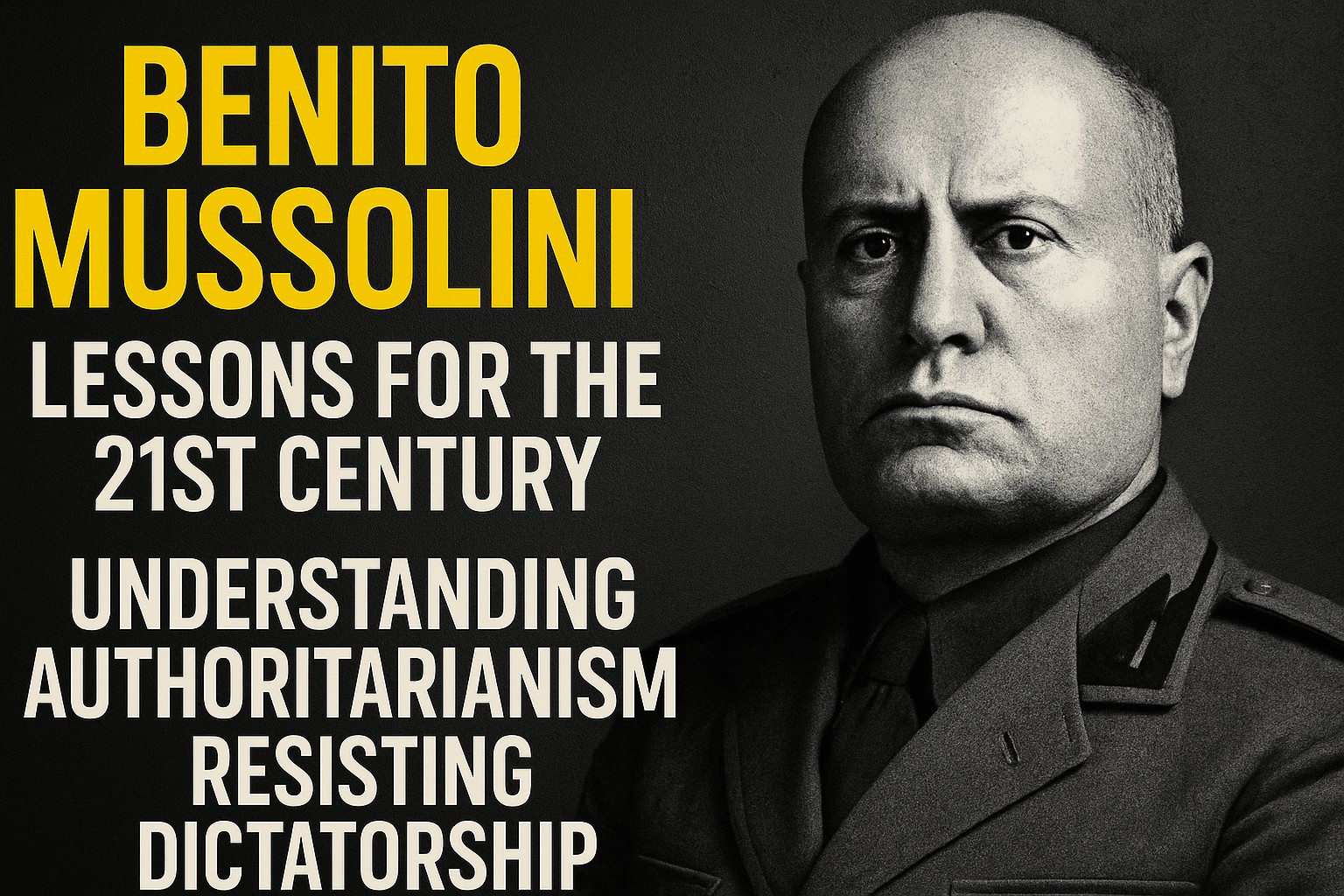
Benito Mussolini: Lessons for the 21st Century – Understanding Authoritarianism and Resisting Dictatorship
Overview
Benito Mussolini’s rise to power in 1922 and his two-decade dictatorship offer stark lessons about how democracies collapse and how authoritarian regimes exploit societal divisions, fear, and economic distress. Understanding his tactics—propaganda, violence, scapegoating, and institutional erosion—is essential for recognizing and resisting similar patterns today. This article examines Mussolini’s playbook, explores parallels with modern caste-based discrimination and authoritarian movements, and outlines strategies for protecting democracy and empowering marginalized communities to resist oppression.
Part 1: How Mussolini Rose to Power – The Blueprint of Fascism
The Context: Economic Crisis and Social Breakdown
Post-World War I Italy was devastated. By 1919, 2 million Italians were unemployed. Inflation ravaged the middle classes, whose savings became worthless. Workers, energized by the Russian Revolution, engaged in massive strikes and factory occupations in 1919-1920 (the “Biennio Rosso” or “Two Red Years”). Meanwhile, landowners, industrialists, and the middle class feared a communist takeover.
This was the fertile ground Mussolini exploited. Unlike earlier authoritarian leaders who seized power through direct military coups, Mussolini pioneered a “legal” path to dictatorship—he used democratic mechanisms and the law itself to dismantle democracy from within.
Building the Movement: Paramilitary Violence as Political Strategy
Mussolini founded the Blackshirts (Squadristi) in 1919, initially a ragtag militia of disgruntled war veterans and unemployed thugs. By the early 1920s, they had become a formidable paramilitary force numbering over 200,000. Their strategy was systematic terror:
- Targeted Suppression: They violently attacked socialist and communist organizations, trade unions, and leftist political meetings. Police often looked the other way or actively assisted them—corruption was normalized from the start.
- Climate of Fear: Through beatings, kidnappings, assassinations, and public violence, they created a climate where dissent became dangerous. Local governance shifted to fascist hands not through elections but through intimidation.
- Manufactured “Order”: Mussolini presented himself as the man who could bring “order” to Italy’s chaos. As workers grew exhausted by strikes and violence escalated, many middle-class Italians became willing to accept authoritarian control if it promised stability.
The “Soft” Coup of October 1922
Here’s the critical moment: In October 1922, Mussolini didn’t organize a traditional military coup. Instead, he threatened the government—marching 30,000 Blackshirts on Rome and declaring that unless the King invited him to form a government, the fascists would seize power by force.
The King capitulated. Mussolini boarded a train to Rome like a leisured traveler, was appointed Prime Minister, and within three years transformed himself into an absolute dictator. This was genius in authoritarianism: he used legal mechanisms and democratic institutions to destroy democracy itself.
Consolidation of Power: From Prime Minister to Dictator
Once in office, Mussolini moved strategically:
- Controlled Elections (1924): Fascists rigged elections through voter intimidation, electoral fraud, and violence. The Blackshirts stationed themselves at polling stations, discouraging opposition voters.
- Dismantled Opposition: He banned anti-fascist newspapers, required all journalists to be registered with the Fascist Party, and created a secret police force (OVRA).
- Centralized Power: He eliminated the power of local governments and parliament, concentrating all authority in his hands as Il Duce (“The Leader”).
- Created Parallel Institutions: The National Fascist Party became the state itself—there was no separation. This meant opposition to the government was treason; criticism of policy became ideological heresy.
Part 2: The Machinery of Fascism – How Mussolini Maintained Control
1. Propaganda as a Core Tool
Mussolini understood that controlling minds was as important as controlling bodies. He appointed himself as propaganda chief and used every available medium:
Press Control: By 1925, all newspapers were either directly controlled by the state or censored. Newspapers became vehicles for promoting Fascism as the doctrine of the 20th century, replacing “decadent” liberalism and democracy.
Radio: In 1924, Mussolini began broadcasting speeches through loudspeakers in public piazzas. By 1939, 1 in 44 Italian households owned a radio. The message was constant: Mussolini was the savior; the nation’s enemies were everywhere; only unity under the Duce could save Italy.
Cinema: The government funded and controlled films with explicitly pro-fascist messages. Filmmakers received state funding only if their scripts contained fascist ideology. Artists were co-opted through promises of resources, making them complicit.
Art and Architecture: Mussolini’s image was everywhere—depicted as a powerful hero, a new Caesar, a savior. Exhibitions like the “Exhibition of the Fascist Revolution” (1932-1934, which attracted 4 million visitors) rewrote Italian history to suggest fascism was Italy’s natural destiny.
Key Insight: Propaganda worked because it was multifaceted and consistent. The same messages appeared across newspapers, radio, cinema, art, and education. When a message repeats across all media, people begin to believe it’s simply “how things are,” not propaganda at all.
2. Cult of Personality
Mussolini created a deification of himself:
- He was Il Duce—not just a leader but The Leader, singular and irreplaceable.
- Myths were constructed about his origins and abilities.
- Citizens were trained to see him as infallible and beyond criticism.
- Mass rallies were organized to create a sense of collective worship.
This served a critical function: it transformed political loyalty into quasi-religious devotion. To criticize Mussolini wasn’t just political disagreement—it was spiritual betrayal.
3. Scapegoating and External Enemies
Fascism thrives on identifying enemies. Mussolini used:
- Communists and Socialists: The primary internal enemy, blamed for Italy’s weakness and chaos.
- Jews and Minorities: Influenced by Nazi Germany, Mussolini later adopted anti-Semitic laws, though initially this wasn’t central to Italian fascism.
- Foreign Powers: The Western democracies were portrayed as weak, decadent, and conspiring against Italy.
- The “Mutilated Victory”: The Treaty of Versailles was framed as a betrayal—Italy had sacrificed 600,000 soldiers but received insufficient territory. This national humiliation became a rallying cry.
Key Insight: By focusing anger on external or minority enemies, fascists prevented people from examining their own failures. Economic problems? Blame the communists. Unemployment? The “infiltrators” and minorities are stealing jobs. Violence? Necessary to protect the nation.
4. Suppression of Labor and Independent Organization
Mussolini recognized that independent labor unions were a threat to totalitarianism. His solution:
- Abolished Independent Unions: He replaced them with state-controlled “national corporations” that claimed to represent workers’ interests but actually enforced state policies.
- Wage Suppression: Without independent bargaining power, workers’ wages collapsed by 20-60%.
- Destroyed Collective Power: When workers cannot organize collectively, they cannot resist. Mussolini ensured fascist “unions” were propaganda tools, not advocates for workers.
This pattern appears in every fascist and authoritarian regime: the first target is always organized labor and civil society organizations that have independent power.
5. Cult of Militarism and Youth Indoctrination
Mussolini militarized society from the bottom up:
- Youth Organizations: The Balilla (for children 6-14) and Avanguardisti (for teenagers) indoctrinated young people into fascist ideology, military discipline, and absolute obedience.
- Military Glorification: Soldiers and military service were idealized. Strength, violence, hierarchy, and “heroic death” were celebrated as virtues.
- Mandatory Military Service: All men were conscripted, ensuring the regime could shape their values during formative years.
Key Insight: Authoritarian regimes invest heavily in controlling children and youth because they understand that once someone is indoctrinated young, that worldview becomes their default reality.
Part 3: Parallels Between Mussolini’s Fascism and Modern Caste-Based Discrimination
The Structural Similarities
While Mussolini’s fascism and India’s caste system have different historical origins, they operate on remarkably similar principles:
1. Hierarchical Classification of Humanity
Fascism: Divided humanity into racial hierarchies—Aryans at the top, deemed “naturally superior,” with inferior races below. This wasn’t incidental to fascism; it was foundational.
Caste System: Similarly creates rigid hierarchies—Brahmins at the top, deemed ritually pure and intellectually superior, with Dalits at the bottom, historically classified as “untouchable” and ritually polluted.
Both Systems’ Logic: They naturalize inequality by claiming it’s not oppression but the natural order. You’re poor not because of exploitation but because you’re inherently inferior.
2. Violent Enforcement of Hierarchy
Fascism: The Blackshirts beat, murdered, and terrorized political opponents and minorities.
Caste System: Contemporary anti-Dalit violence includes:
- Lynchings and brutal assaults
- Systematic social boycotts (denying access to water wells, markets, temples)
- Sexual violence, particularly against Dalit women
- Police collaboration with upper-caste perpetrators
According to research, about 80% of India’s 166.6 million Dalits live in rural areas where caste violence remains endemic. Many Dalit activists report that authorities either ignore complaints or actively participate in abuse.
3. Propaganda and Dehumanization
Fascism: Mussolini’s propaganda portrayed enemies as subhuman—vermin to be eliminated for the nation’s health.
Caste-Based Hate Speech: Modern India has seen the professionalization of communal hate speech as electoral strategy. Research reveals:
- A three-stage escalation model: fringe actors test boundaries → local leaders amplify → national leaders legitimize
- Dehumanizing language: Leaders have called for people to be “killed like insects,” “thrown in drains,” or “eliminated”
- Conspiracy theories: Terms like “infiltrator,” “love jihad,” and “land jihad” position minorities and lower-castes as existential threats
- Media amplification: Social media platforms (Facebook, YouTube, X) act as force multipliers, spreading hate speech at scale
4. Political Exploitation and Governance Through Division
Fascism: Mussolini used fear of communism to consolidate middle-class support while actually serving capitalist interests.
Modern Caste-Based Discrimination: Research shows that caste-based hate speech has become “infrastructure”—it builds worlds and shapes consciousness. Electoral hate speech:
- Distracts from governance failures and economic mismanagement
- Blurs socio-economic realities by substituting governance with identity warfare
- Creates fear that makes people accept authoritarian solutions
- Fractures interdependence at the community level (neighbors become enemies)
5. Institutional Capture and Police Complicity
Fascism: Mussolini corrupted the police through bribes and ideology. By 1922, many police officers were taking orders from fascist commanders rather than the state.
Caste System: Similar institutional capture occurs—police routinely:
- Refuse to register FIRs (First Information Reports) against upper-caste perpetrators
- Arrest or harass Dalit victims and their families
- Participate in torture and violence themselves
- Allow vigilante groups to operate without intervention
Part 4: The Downfall of Mussolini – Why Authoritarianism Fails
Understanding how Mussolini’s regime collapsed offers hope. In 1943, with Italy’s military humiliated in North Africa and Sicily under Allied invasion, the fascist system crumbled. The King had Mussolini arrested. The Blackshirts scattered. Two years later, Mussolini was captured by communist partisans and executed.
What happened? Several factors:
- External Military Defeat: The regime’s promise of national glory was shattered by military failure.
- Economic Exhaustion: Perpetual militarization and aggressive expansion depleted resources.
- Loss of Fear: As the regime weakened, people realized they could resist without being obliterated.
- Elite Fragmentation: Once the regime’s success seemed doubtful, formerly loyal elites abandoned Mussolini.
Critical Lesson: Authoritarian regimes appear monolithic but are actually fragile. They depend on:
- Continuous economic “success” (or at least the perception of it)
- An external enemy to focus fear on
- Unquestioning loyalty from key institutions (military, police, courts)
- Ordinary people’s willingness to collaborate or acquiesce
If any of these breaks, the regime becomes vulnerable.
Part 5: How to Recognize and Resist Authoritarianism in the 21st Century
Early Warning Signs – The “Slippery Slope” of Democratic Backsliding
Unlike 20th-century coups (which were transparent), modern authoritarianism is insidious. It operates through legal mechanisms and incremental institutional erosion. Warning signs include:
- Attacks on Independent Institutions
- Politicizing the judiciary by installing loyalists as judges
- Removing independence from election commissions, media regulators, central banks
- Weakening civil service protections so bureaucrats must obey political orders
- Assault on Free Press and Civil Society
- Suppressing dissenting media outlets
- Threatening journalists and activists
- Controlling information and creating monopolies on “truth”
- Election Rigging Through Legal Means
- Gerrymandering electoral boundaries
- Changing voting rules to favor the incumbent
- Using voter suppression tactics
- Manipulating electoral commissions
- Scapegoating and Hate Speech
- Identifying vulnerable minorities as enemies
- Normalizing dehumanizing language
- Encouraging vigilantism
- Using hate speech as electoral strategy
- Cult of Personality
- Personality-based loyalty replacing institutional loyalty
- Inability to criticize the leader
- Portrayal of the leader as uniquely capable
- Militarization and Paramilitary Groups
- Strengthening security forces with minimal oversight
- Allowing private militias to operate
- Glorifying violence and strength
- Economic Concentration
- Transferring public resources to loyalists
- Weakening labor organizations
- Creating oligarchies
Strategy 1: Strengthening Democratic Institutions and Checks and Balances
The most crucial defense is institutional resilience:
In Liberal Democracies:
- Protect judicial independence through constitutional safeguards
- Ensure the legislature can scrutinize and constrain the executive
- Create independent election commissions and media regulators
- Maintain a robust civil service insulated from political pressure
- Support opposition parties and parliamentary oversight committees
Why It Matters: The first thing autocrats do is capture these institutions. If they remain genuinely independent, they become obstacles that significantly delay or prevent democratic collapse.
In Electoral or Hybrid Democracies (where institutions are weaker):
- Build opposition coalitions that can contest elections credibly
- Strengthen monitoring of elections and election administration
- Document and publicly expose institutional attacks
- Use whatever institutional power exists (parliament, courts) to resist
Strategy 2: Building Broad-Based Resistance Movements
Research on successful resistance to authoritarianism shows that the most effective strategy is building diverse coalitions:
Key Elements:
- Bridging Across Differences:
- Bring together different opposition parties, civil society groups, and constituencies
- Focus on shared interest in defending democracy itself, not ideology
- Build relationships before crisis hits
- Strategic Sequencing:
- Use different tactics for different audiences (institutional strategies for elites, mass mobilization for ordinary people)
- Combine strikes, boycotts, civil disobedience, and electoral participation
- Innovate tactically to prevent regimes from predicting and suppressing movements
- Protecting Vulnerable Groups:
- Develop networks of mutual aid and protection
- Document abuses so perpetrators face consequences
- Create spaces where the marginalized can organize safely
- Building Alternative Narratives:
- Don’t just criticize the regime; offer a compelling vision of a better future
- Counter propaganda with truth-telling and fact-checking
- Use art, humor, music, and culture to express resistance
Strategy 3: Media Literacy and Information Resilience
The 21st century’s primary battlefield is information. Strategies include:
For Individuals:
- Develop critical thinking skills: Question sources, check facts, consider multiple perspectives
- Recognize propaganda techniques: emotional appeals, dehumanizing language, scapegoating, false dilemmas
- Diversify information sources; don’t rely on a single news outlet
- Before sharing information, verify it against reliable sources
- Understand how algorithms and social media platforms can create information bubbles
For Educators and Civil Society:
- Integrate media literacy into school curricula
- Teach students about the history of propaganda and how authoritarian regimes operate
- Conduct community workshops on fact-checking and source evaluation
- Work with local media to promote responsible reporting
- Support independent journalism
Why It Works: Research shows that people who have received sustained, classroom-based education on misinformation are significantly more resilient to propaganda. Institutions invested in media literacy education show students can learn to:
- Reduce belief in false information by 27%
- Improve misinformation discernment by 76%
- Decrease misinformation sharing by 100%+
Strategy 4: Empowering Downtrodden Communities – Countering Oppression Through Collective Action
For marginalized communities facing discrimination (whether caste-based, racial, religious, or economic), several strategies have proven effective:
1. Collective Organizing
- Form organizations that give voice to the voiceless
- Document abuses and create accountability mechanisms
- Conduct strikes, boycotts, and nonviolent civil disobedience
- Build networks of mutual support and solidarity
Historical Examples:
- The Civil Rights Movement in the US used organized nonviolent resistance to challenge racial hierarchies
- South Korean labor movements challenged authoritarian rule through strikes and civil disobedience
- Ukrainian activists organized to overthrow an autocratic president through the Orange Revolution
2. Intersectional Approaches
- Recognize that oppression operates across multiple identities (caste, gender, religion, class)
- Build coalitions across different marginalized groups
- Create spaces where the most vulnerable are centered and heard
- Address root causes of inequality, not just symptoms
3. Institutional Accountability
- Use courts and legal mechanisms to challenge oppression
- File cases documenting abuses
- Demand enforcement of constitutional protections
- Create public pressure for investigations and prosecutions
4. Community Education and Consciousness-Raising
- Teach history and political economy so people understand the roots of their oppression
- Create forums for dialogue and reflection
- Develop counter-narratives that affirm dignity and humanity
- Build pride in community identity and history
5. Strategic Alliances
- Build alliances with other oppressed groups
- Appeal to sympathetic elites and institutions
- Create international solidarity networks
- Engage media and civil society to expose abuses
Why This Works: When individuals organize collectively, they gain:
- Increased bargaining power
- Psychological benefits (confidence, agency, solidarity)
- Protection through numbers
- Capacity to challenge entrenched power
Part 6: Specific Lessons for India – Caste, Democracy, and Resistance
The Parallel Playbook
Modern caste-based discrimination increasingly operates using the fascist playbook:
- Scapegoating Minorities and Dalits: Portraying them as threats to the majority community
- Hate Speech as Electoral Strategy: Using dehumanizing language to consolidate majority votes
- Institutional Capture: Weakening police accountability, courts, and civil liberties institutions
- Media Monopolies: Controlling narratives through state media and allied outlets
- Youth Indoctrination: Teaching children that hierarchy and violence are natural
- Economic Exploitation: Denying resources and opportunities to marginalized groups
Counter-Strategies Specific to the Indian Context
For Dalit and Marginalized Communities:
- Document Everything
- Record instances of violence, discrimination, and abuse
- Create databases so patterns become visible
- Use documentation to demand accountability
- Build Dalits-Led Movements
- Don’t wait for upper-caste allies; organize independently
- Create all-Dalit spaces for consciousness-raising
- Develop leadership from within communities
- Engage Constitutional Protections
- India’s Constitution abolishes untouchability and discrimination
- File complaints with human rights commissions
- Demand implementation of reserved positions (reservations/quotas)
- Use courts when other mechanisms fail
- Build Cross-Marginality Coalitions
- Unite with religious minorities, women, and other oppressed groups
- Show how hate speech and violence affect all vulnerable communities
- Demonstrate that defending democracy requires defending everyone
- Counter-Narratives
- Tell stories of Dalit pride, achievement, and resistance
- Document history of Dalit struggle and contribution
- Create cultural expressions (art, music, literature) that affirm dignity
- Challenge the framing that Dalits are “naturally” inferior
- Demand Institutional Reform
- Investigate police complicity in caste violence
- Prosecute perpetrators effectively
- Hold media accountable for spreading hate speech
- Ensure election commissions protect all voters equally
For Concerned Citizens:
- Speak Out Against Hate Speech
- Don’t normalize it
- Interrupt it when you encounter it
- Support those targeted by it
- Examine Your Own Biases
- Caste and religious prejudices are deeply socialized
- Actively work to unlearn discrimination
- Build genuine relationships across caste and community lines
- Support Organizations
- Donate to groups fighting caste discrimination
- Volunteer in community organizing
- Amplify marginalized voices
- Demand Accountability
- Vote for candidates and parties that defend constitutional protections
- Hold elected officials accountable for hate speech
- Support independent media
- Demand strict enforcement of anti-discrimination laws
Part 7: What 21st-Century People Must Know to Avoid Falling Into Authoritarianism’s Trap
The Psychological Vulnerability
Research shows that ordinary people—not inherently “bad” people—participate in authoritarian systems because:
- Fear Makes People Desperate: Economic crisis, violence, and uncertainty make people willing to accept authoritarian “solutions.” This is why authoritarians deliberately create or exploit crises.
- In-Group Loyalty Overrides Ethics: Once someone identifies with a group (a political party, a nation, a religious community), they’re psychologically primed to:
- Believe their group is under threat
- Accept violence against “outsiders”
- Justify immoral behavior as necessary
- Incremental Normalization: Atrocities don’t happen overnight. They start small—a joke about a group, a dehumanizing metaphor, a minor restriction. Each step seems manageable, but eventually, people find themselves in a regime they would have found abhorrent years earlier.
- Bystander Effect: When violence is normalized and widespread, people convince themselves that if everyone else is accepting it, it must be right. Or they convince themselves they’re powerless to resist.
How to Inoculate Yourself and Your Community
- Know History
- Study how fascism rose in Italy, Germany, Spain
- Understand that it happened with ordinary citizens’ participation
- Recognize that “it can’t happen here” is exactly what people thought before it did
- Recognize Propaganda Techniques
- Emotional appeals instead of rational arguments
- Scapegoating rather than addressing root causes
- Dehumanizing language
- False dilemmas (you’re either with us or against us)
- Repetition until lies become “common sense”
- Maintain Healthy Skepticism
- Question authority, including from leaders you support
- Don’t assume your side is always right
- Seek out perspectives that challenge your views
- Distinguish between opinion and fact
- Prioritize Truth-Seeking Over Loyalty
- No leader or movement deserves unquestioning loyalty
- Be willing to criticize those you generally support
- Change your mind when evidence warrants it
- Defend Others’ Rights
- Free speech, freedom of religion, freedom of assembly matter for everyone—not just people you agree with
- Defend minorities’ rights even when it’s unpopular
- Remember: minority rights today become universal protections tomorrow
- Refuse Dehumanization
- No group of people is inherently “inferior” or “polluting” or a “threat”
- Reject language that reduces people to caricatures
- Build relationships across divides
- Participate in Democratic Institutions
- Vote
- Hold elected officials accountable
- Join civil society organizations
- Serve on juries and other civic bodies
- Attend local government meetings
Conclusion: Democracy Requires Constant Vigilance
Mussolini’s Italy demonstrates that democracy is fragile and requires constant defense. It also demonstrates that authoritarianism, for all its power, eventually collapses—but the cost is enormous. Millions suffered under fascism before it fell.
The 21st century’s authoritarians have learned from Mussolini. They operate more subtly, using legal mechanisms and institutional capture rather than obvious violence. They use propaganda at scale never before possible. They exploit social media algorithms and AI-generated disinformation.
But the counter-strategies are equally available: strong democratic institutions, media literacy, collective organizing, and a commitment to truth and human dignity remain powerful defenses.
For marginalized communities like Dalits facing caste-based oppression, the path forward combines:
- Independent organizing and consciousness-raising
- Demanding institutional accountability
- Building alliances with other oppressed groups
- Using courts and constitutional protections
- Counter-narratives that affirm dignity
- Refusing to accept oppression as inevitable
The history of social movements shows that ordinary people, when organized and determined, can challenge even entrenched power. The Civil Rights Movement, labor movements, independence movements—all were won by people like you, organizing collectively.
The lesson of Benito Mussolini is both a warning and a source of hope: authoritarianism is not inevitable, and resistance is possible. But both require that we remain educated, vigilant, and committed to democracy—not as a finished project but as an ongoing practice of defending freedom, equality, and human dignity.
The 21st century demands nothing less.