The Surendra Koli Curative Petition: When Justice Demands Correction of Its Own Verdicts
Introduction
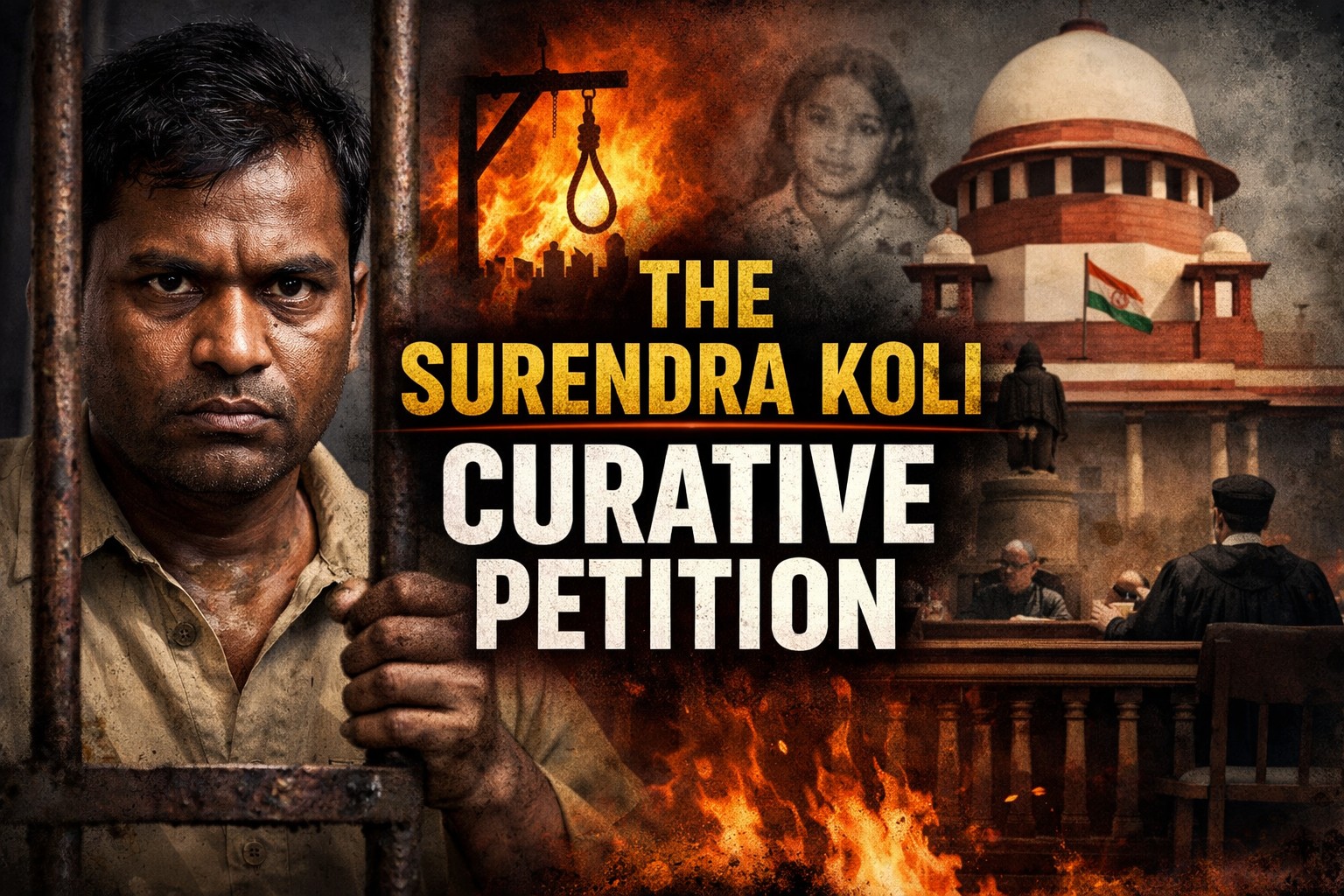
On November 11, 2025, the Supreme Court of India delivered a landmark judgment that underscores a fundamental principle: the courts must correct their own errors even when it challenges the finality of previous decisions. In Surendra Koli v. The State of Uttar Pradesh (2025 INSC 1308), a three-judge bench led by Chief Justice Bhushan Ramkrishna Gavai allowed a curative petition, setting aside the death sentence and conviction of Surendra Koli in the infamous Rimpa Haldar case while acquitting him entirely. This judgment represents a pivotal moment in Indian criminal jurisprudence, demonstrating how irreconcilable legal outcomes on identical evidentiary foundations demand intervention to preserve the integrity of the judicial process.
The case arose from the 2006 Nithari serial murders, one of the most horrifying criminal episodes in independent India’s history. Between 2005 and 2006, dozens of women and children disappeared from the Nithari village area in Noida, Uttar Pradesh. The discovery of skeletal remains and body parts near the residence of businessman Moninder Singh Pandher sent shockwaves through the nation and exposed deep social fault lines in how law enforcement treats crimes against the poor and vulnerable. Surendra Koli, a domestic helper employed by Pandher, became the central figure in multiple trials, facing 16 capital charges across different cases. However, the Supreme Court’s recent verdict reveals a troubling reality: the convictions were built on an evidentiary foundation that the same court later rejected in companion cases, a logical and constitutional impossibility that demanded correction.bbc
The Extraordinary Doctrine of Curative Jurisdiction
Before examining the Nithari case specifically, it is essential to understand the legal framework within which this curative petition operates. The curative petition represents an exceptional remedy available in the Indian judicial system after both trial and review have concluded. Unlike review petitions, which are constitutionally guaranteed under Article 137 of the Constitution of India, the curative petition is a judicially created mechanism designed to address cases where the conscience of the court is offended by a manifest miscarriage of justice that review could not cure.
The doctrine originates from the 2002 Supreme Court decision Rupa Ashok Hurra v. Ashok Hurra, where the Constitution Bench recognized that courts possess inherent powers flowing from Articles 129 and 142 of the Constitution to preserve the purity of their process and do complete justice. These constitutional provisions form the theoretical foundation for curative jurisdiction: Article 129 declares the Supreme Court a court of record with inherent powers to preserve procedural integrity, while Article 142 empowers the Court to make orders necessary for complete justice. The Supreme Court Rules, 2013, specifically Order XLVIII, codified the requirements for filing a curative petition, including certification by a Senior Advocate and circulation to the three senior-most judges along with the judges who delivered the impugned judgment.
However, the Supreme Court has consistently emphasized that the curative jurisdiction is not a second review. Finality remains the foundational principle of adjudication, and intervention is reserved exclusively for circumstances that strike at the legitimacy of the adjudicatory process itself. Justice Vikram Nath articulated this principle in the Surendra Koli judgment, explaining that the controlling test is whether the earlier decision produces a result that offends the conscience of the court due to a fundamental defect in process or a grave miscarriage of justice. Such defects may appear where outcomes are irreconcilably inconsistent on the same factual and evidentiary substratum, where material circumstances bearing on fairness and reliability were overlooked, or where the constitutional guarantees of equality and due process under Articles 14 and 21 are compromised.
The judgment identifies specific foundational circumstances that justify curative relief. The first is a violation of natural justice where a person is adversely affected without proper hearing or notice. The second is a case where a judge failed to disclose a connection with the subject matter or with a party that would give rise to a reasonable apprehension of bias. The Court emphasized that these instances are illustrative and not exhaustive—the guiding principle remains the fundamental duty to avert manifest injustice. Critically, even when curative jurisdiction is invoked, the Court does not reappraise evidence as if in a second appeal. Instead, it asks the narrow question: whether intervention is necessary to vindicate the rule of law and restore confidence in the administration of justice.
The Nithari Murders: A Case That Shook a Nation
The Nithari serial murders emerged from one of the most socially stratified neighborhoods in Delhi’s satellite city of Noida. House D5, Sector 31, belonged to Moninder Singh Pandher, a wealthy businessman, while the victims were primarily poor migrant workers and their children from the nearby Nithari slums. Beginning in early 2005, residents reported women and children missing. On March 2005, a human hand was discovered by children playing cricket in the narrow strip between houses D5 and D6. Further discoveries followed, and on December 3, 2006, another human hand was found during drain cleaning on the main road in front of the row of bungalows.
The investigation proceeded chaotically. On December 29, 2006, Surendra Koli was taken into police custody in connection with the disappearance of a victim named Payal. Notably, by the time police and designated witnesses (panchs) reached House D5, a large crowd had already gathered and excavation was underway—a procedural failure that would later become central to appellate scrutiny. Multiple skulls, bones, footwear, and clothing were recovered from the rear gallery and the storm water drain. A knife was recovered from beneath the terrace water tank. Thirteen different First Information Reports (FIRs) were registered on December 30, 2006, for different missing persons.
On January 9, 2007, investigation was transferred to the Central Bureau of Investigation (CBI). Forensic teams from Agra, the All India Institute of Medical Sciences, and the Central Forensic Science Laboratory conducted extensive searches and examinations between January and mid-January 2007. The investigation would ultimately lead to 19 criminal cases against Koli and Pandher. The CBI filed closure reports in three cases for insufficient evidence. Of the remaining 16 cases, Koli faced 16 trials, being convicted in 13 of them, including in the Rimpa Haldar case—the subject of this curative petition.
The First Round: The Rimpa Haldar Conviction and Appellate Affirmance
Rimpa Haldar was a fourteen-year-old girl who disappeared in 2005. The trial court, in a judgment dated February 13, 2009, convicted Surendra Koli under sections 302 (murder), 364 (kidnapping), 376 (sexual assault), and 201 (destruction of evidence) of the Indian Penal Code, 1860, and imposed the death sentence. The conviction was anchored on three evidentiary pillars: a confession recorded under Section 164 of the Code of Criminal Procedure, 1973; alleged discoveries and recoveries under Section 27 of the Indian Evidence Act, 1872; and circumstantial corroboration.
The confession, recorded on March 1, 2007, was extensive, running to several pages. In it, Koli allegedly stated that he had lured Rimpa Haldar into D5, strangled her with a chunni (scarf), engaged in sexual assault after death, dismembered the body, and disposed of parts in the rear gallery and storm water drain. The Trial Court found the confession voluntary and truthful, supported by corroboration from recoveries of skulls and bones, identification of the victim’s clothing by relatives, and DNA profiling by the Centre for DNA Fingerprinting and Diagnostics in Hyderabad, which matched remains with blood samples from Rimpa Haldar’s parents.
The High Court of Allahabad, in a judgment dated September 11, 2009, affirmed both the conviction and the death sentence. Critically, the High Court acquitted the co-accused, Moninder Singh Pandher, finding no substantive evidence connecting him to the crime. The High Court’s reasoning was that Koli’s confession was not admissible against a co-accused, that recoveries were pursuant solely to Koli’s disclosure, and that no overt act or presence of Pandher was proved. The High Court relied on Koli’s detailed admissions, his leading of police to where multiple remains were discovered, the seizure of a knife, the evidence of two witnesses who described Koli’s attempts to lure young girls (suggesting a modus operandi), and DNA analysis matching remains to the victim’s family.
On February 15, 2011, a two-judge bench of the Supreme Court dismissed Criminal Appeal No. 2227 of 2010, affirming the conviction and death sentence. This Court accepted the confession as voluntary and held that statutory safeguards had been observed. It noted Koli’s detailed admissions and his leading of police to the recovery sites. It referred to the evidence of witnesses PW-27 and PW-28 as indicative of modus operandi. It relied on DNA analysis and the role of doctors from AIIMS in assembling recovered parts. Characterizing Koli as a serial killer, the Supreme Court held that the case fell within the “rarest of rare” category and upheld capital punishment.
A review petition was filed against this judgment. On October 28, 2014, after an open-court hearing, the Supreme Court dismissed Review Petition (Crl.) No. 395 of 2014, reiterating the narrow compass of review under Article 137 of the Constitution. The Court declined to revisit findings on voluntariness or evidentiary appreciation. Subsequently, on January 28, 2015, in proceedings challenging the rejection of Koli’s mercy petition, the High Court commuted the death sentence to life imprisonment, citing inordinate delay in deciding the mercy petition. The conviction, however, continued to stand.
The Turning Point: The Twelve Companion Cases and the High Court’s Reassessment
Between 2010 and 2021, Surendra Koli was tried in twelve additional capital cases arising from the same circumstances in the Nithari area. Crucially, all these trials proceeded on the identical evidentiary foundation: the same confession recorded under Section 164 of the CrPC and the same category of alleged discoveries and recoveries under Section 27 of the Evidence Act. This uniformity of evidence across multiple trials would later become the linchpin of the curative petition.
The turning point came on October 16, 2023, when the High Court of Allahabad pronounced judgments in all twelve cases, acquitting Surendra Koli in each one. The High Court’s reassessment of the evidence was comprehensive and devastating to the prosecution’s case theory. The Court held that the confession under Section 164 of the CrPC could not be treated as voluntary or reliable for several legally significant reasons.
First, the High Court found that Koli had been kept in uninterrupted police custody for approximately sixty days before the confession was recorded. This prolonged period of police custody is fundamentally inconsistent with the voluntariness that Section 164 of the CrPC demands. The statute contemplates that an accused should be brought before a magistrate for recording of confession only after a brief period of investigation, not after two months of continuous police control.
Second, the High Court noted that there was no meaningful or private access to legal aid. The presence of adequate and independent legal representation is central to ensuring that a confession is not the product of coercion or inducement by police. When legal aid is perfunctory or arranged only at the moment of recording without prior consultation or opportunity for preparation, the voluntariness of the subsequent confession becomes highly suspect.
Third, the recording Magistrate did not express the clear, unqualified satisfaction on voluntariness that Section 164 requires. The statute mandates that a magistrate must record preliminary questions on voluntariness and satisfy himself that the confession is made freely. The High Court found that the magistrate’s satisfaction was not recorded with the requisite clarity and emphasis.
Fourth, the investigating officer was brought into the room at the outset and kept immediately available outside during the recording process. This proximity of the investigating officer undermined the environment of voluntariness that must surround confession-recording. The presence or ready availability of the police officer creates psychological pressure and the appearance that the confession is still within the police’s sphere of influence.
Fifth, the text of the confession itself repeatedly contained assertions of tutoring and references to torture and coercion. When a confession contains such admissions—that the accused was coached or told what to say—these internal inconsistencies directly negate the voluntariness assertion.
The High Court concluded that these facts collectively attracted the bar under Section 24 of the Indian Evidence Act, 1872. Section 24 provides that confessions made in consequence of any threat or inducement, promise, or danger perceived by the person making the confession as likely to occur, are inadmissible. The High Court found that the confession was legally inadmissible and could not form the basis of conviction.
The High Court further held that the alleged discoveries and recoveries under Section 27 of the Evidence Act were inadmissible and unreliable. Section 27 permits the admission of facts discovered as a result of an accused’s disclosure, but only when the disclosure is genuine and contemporaneous. The High Court found multiple fatal defects in the prosecution’s proof of discoveries. First, no contemporaneous disclosure statement was proved by the prosecution. The discovery process in law should be documented immediately and clearly, but here, the prosecution failed to produce contemporary evidence of Koli’s disclosure.
Second, material contradictions existed between the panchnama narrative (the official record of the search and seizure) and the remand papers. The remand papers recorded a joint disclosure by both Koli and Pandher, but the later panchnama narrative claimed that Koli alone led to the discoveries. These irreconcilable versions destroyed the narrative’s credibility.
Third, the evidence showed that members of the public and the police were already aware of body parts at the recovery site, and that excavation had commenced before Koli arrived. If the site was already known and already being excavated, then Koli’s “discovery” was not a genuine discovery at all—he merely pointed to what was already being revealed.
Fourth, the principal recovery site lay in an open strip behind D5 and D6 and in the drain on the main road, which was not under Koli’s exclusive domain. Discovery under Section 27 contemplates that the accused’s disclosure leads to the finding of something in a place under his exclusive control or knowledge. When the location was public or shared, the element of exclusive knowledge—essential to Section 27 admissibility—was absent.
On the forensic evidence, the High Court found an absence of corroboration with Koli’s alleged confessions. Expert searches of D5 did not yield human bloodstains or human remains consistent with multiple homicides and dismemberment inside the house. If Koli had killed multiple victims within D5, one would expect substantial forensic evidence—blood patterns, tissue, bone dust—inside the residence. The absence of such evidence contradicted the confession’s narrative.
There was no incriminating trace in the kitchen or on utensils that would be consistent with the alleged acts. The DNA work by the Centre for DNA Fingerprinting and Diagnostics linked certain remains to families of missing persons (which is what DNA matching should do), but did not connect Koli to the actus reus (the physical act of the crime) within D5. DNA matching to remains is probative of identity but not of authorship of the homicide.
The High Court found that the recoveries of a knife and an axe did not advance the prosecution case. Neither implement bore human blood or tissue. The prosecution did not establish that cut marks on bones were consistent with those implements or that these specific tools were used in the alleged crimes. There was no independent proof that Koli possessed the skill or capability to carry out the precise dismemberment alleged with those implements.
The High Court criticized the investigation as “botched and shifting” and noted that material avenues—including the organ-trade angle raised by a Ministry of Women and Child Development committee—were not pursued. The investigation had focused exclusively on Koli as a convenient suspect without adequately exploring alternative theories or other leads.
On July 30, 2025, the Supreme Court, through a three-judge bench, dismissed the State’s appeals against the High Court’s acquittals in all twelve cases, thereby affirming the acquittals and rendering them final. This created an extraordinary situation: the very same confession and the very same category of Section 27 evidence that the Supreme Court had once upheld as sufficient for death sentences were now rejected by the same court (in different benches) as legally unreliable and inadmissible across multiple cases.
The Paradox That Demanded Curative Relief
This was the paradox that faced Surendra Koli when he filed the curative petition. In the Rimpa Haldar case, decided on February 15, 2011, the Supreme Court had upheld his conviction and death sentence (later commuted to life imprisonment) based on the confession and Section 27 evidence. Yet, in the companion cases decided on July 30, 2025, the same Supreme Court rejected the identical confession and identical category of evidence as legally tainted and inadmissible. How could both outcomes be legally sustainable? This was not a question of factual disagreement or different interpretations of evidence. It was a fundamental logical and constitutional problem: if the confession was involuntary and inadmissible in the twelve other cases, it could not simultaneously be voluntary and admissible in the Rimpa Haldar case, since the defects were structural, not case-specific.
The Supreme Court’s response, delivered in the November 11, 2025 curative petition judgment, was principled and forceful. Justice Vikram Nath explained that the curative jurisdiction exists precisely to prevent such anomalies from hardening into precedent and from undermining public confidence in the administration of justice. When final orders of the Court speak with “discordant voices on an identical record,” the integrity of adjudication is imperilled.
The Court applied the standard established in Rupa Ashok Hurra: is there a fundamental defect in process or a grave miscarriage of justice? The answer was unequivocally yes. The defects identified by the High Court in its 2023 and 2025 judgments were not peripheral or case-specific. They were structural infirmities inherent in the mode of proof across all Nithari prosecutions. The prolonged police custody, the absence of meaningful legal aid, the Investigating Officer’s proximity during confession-recording, the repeated assertions within the confession of tutoring and torture, and the absence of contemporaneous disclosure documentation—these were not peculiarities of the Rimpa Haldar case. They were universal features of how the prosecution’s case had been built.
The Court found no principled basis on which the same confession could be treated as voluntary and reliable in the Rimpa Haldar case when it had been judicially discredited in all others. The Section 27 evidence—allegedly discoveries and recoveries—was built on the same architecture across cases: no contemporaneous disclosure, contradictions between documents, prior knowledge by police and public of the sites, and locations not under Koli’s exclusive domain. Legal conclusions could not change from case to case when the premise was identical.
Constitutional Imperatives: Article 14 and Article 21
The Supreme Court grounded its decision not merely on jurisprudential consistency but on constitutional imperatives. Article 14 of the Constitution guarantees equality before the law and equal protection of the laws. This guarantee demands that like cases be treated alike. When two prosecutions rest on identical evidentiary foundations and legal principles, they must yield like results. Arbitrary disparity in outcomes is inimical to equality.
Article 21 of the Constitution guarantees the right to life and liberty, but only through a fair, just, and reasonable procedure. This protection is at its acutest when capital punishment is involved, though in this case Koli’s death sentence had been commuted, the conviction itself carried grave consequences. To allow a conviction to stand on an evidentiary basis that the Court had since rejected as involuntary or inadmissible in the identical fact-matrix offended Article 21. It violated the fundamental right to a fair procedure and due process of law.
The Supreme Court emphasized in the curative petition judgment that criminal law does not permit conviction on conjecture or hunch. Suspicion, however grave, cannot replace proof beyond reasonable doubt. Courts cannot prefer expediency over legality. This is especially true when the accused is from a marginalized background—a poor Dalit domestic worker—and when the victims too were from impoverished slums. The absence of legal rigor in the prosecution’s case, though convenient to an investigation seeking closure, cannot be sustained when constitutional protections demand better.
The Critique of the Investigation
The Supreme Court’s judgment, while acquitting Koli, delivered a scathing critique of the investigation. Justice Vikram Nath noted that the crimes in Nithari were heinous and the suffering of families immeasurable. It is a matter of deep regret that despite prolonged investigation, the identity of the actual perpetrator was not established in a manner meeting legal standards. But the solution to this failure was not to convict an ill-proven suspect. Instead, the Court emphasized that it had abiding faith in the capacity of police and investigative agencies—when investigations are timely, professional, and constitutionally compliant, even difficult mysteries can be solved.
Unfortunately, in the Nithari case, negligence and delay had corroded the fact-finding process. The scene was not secured before excavation began. The alleged disclosure was not contemporaneously recorded. The remand papers carried contradictory versions. Koli was kept in prolonged police custody without a timely, court-directed medical examination. Crucial scientific opportunities were lost when post-mortem material and other forensic outputs were not promptly and properly documented. The investigation failed to adequately examine obvious witnesses from the household and neighborhood and did not pursue material leads, including the organ-trade angle flagged by a government committee. Each lapse weakened the reliability of evidence and narrowed the path to truth.
The Orders and Their Immediate Impact
The Supreme Court’s curative petition judgment issued several binding orders. First, the judgment dated February 15, 2011, in Criminal Appeal No. 2227 of 2010, and the order dated October 28, 2014, in Review Petition (Crl.) No. 395 of 2014, were recalled and set aside. These decisions, which had stood as the law for over a decade, were erased from the judicial record—a rare and extraordinary step.
Second, Criminal Appeal No. 2227 of 2010 was allowed, and the underlying judgments by the trial court (dated February 13, 2009) and the High Court (dated September 11, 2009) were set aside. Third, Surendra Koli was acquitted of all charges under sections 302, 364, 376, and 201 of the Indian Penal Code. All sentences and fines were quashed.
Fourth, Koli was to be released forthwith if not required in any other case or proceeding. The Registry was directed to immediately communicate the judgment to the jail superintendent and the trial court for compliance. Fifth, since Koli had been acquitted of the present charge, two Special Leave Petitions filed against the 2015 High Court judgment commuting his death sentence (SLP (Crl.) No. 1444 of 2016 and SLP (Crl.) No. 7456 of 2016) were disposed of as infructuous.
Implications for the Indian Criminal Justice System
The Surendra Koli curative petition judgment carries profound implications for Indian criminal jurisprudence and practice. First, it reaffirms that finality, while important, is not absolute. When a decision is revealed to rest on legally unsustainable foundations through subsequent judicial pronouncements on the same evidence, the higher court’s duty to uphold the rule of law supersedes the deference typically accorded to earlier decisions.
Second, it highlights the critical importance of proper procedure in recording confessions under Section 164 of the CrPC. The statute was designed with multiple safeguards—requiring magistrate satisfaction, preliminary questions on voluntariness, absence of police influence, and prior judicial custody remand—precisely because confessions are inherently suspect and prone to abuse. When these safeguards are neglected, as they were in the Nithari investigation, the confession loses its probative value entirely.
Third, it demonstrates that Section 27 of the Indian Evidence Act cannot be used as a shortcut to conviction when the foundational elements are absent. The prosecution must prove contemporaneous disclosure, genuine discovery by the accused, and facts discovered at locations under the accused’s exclusive control or knowledge. Mere seizure of items from known locations does not satisfy the section.
Fourth, it underscores the necessity of proper forensic documentation and chain of custody. When expert teams search a location, their findings must be scientifically recorded, contemporaneously documented, and preserved. The absence of incriminating traces—particularly the absence of human bloodstains inside a residence where multiple murders allegedly occurred—is powerful exculpatory evidence. Prosecutors cannot overcome such absence through speculative theories.
Fifth, the judgment warns against investigative tunnel vision. When an agency becomes convinced of a suspect’s guilt, the pressure to close a case can lead to the disregard of alternative leads, contrary evidence, and explanatory theories. The organ-trade angle mentioned in the government committee report should have been pursued. Obvious witnesses from the household and neighborhood should have been meticulously examined. The investigation’s single-minded focus on Koli as the perpetrator, without adequately exploring other possibilities, weakened the entire edifice of proof.
Sixth, the judgment carries a message about caste and class in the criminal justice system. Surendra Koli was a poor Dalit domestic worker. The victims were poor migrant families living in slums adjacent to wealthy neighborhoods. The perpetrator of these horrific crimes remains unidentified, but in the rush to close a notorious case, an ill-proven suspect became the scapegoat. The Supreme Court’s insistence on proof beyond reasonable doubt, even in cases involving heinous crimes, reflects a commitment to equality and fairness across caste and class lines.
Conclusion
The Surendra Koli curative petition judgment of November 11, 2025, represents a significant affirmation of judicial integrity and constitutional governance. It demonstrates that the Supreme Court of India, despite its emphasis on finality and its reluctance to disturb its own previous orders, will do so when consistency and principle demand it. The coexistence of irreconcilable outcomes on an identical evidentiary foundation imperils public confidence in the administration of justice and violates the constitutional guarantees of equality and due process. The doctrine of curative petition exists precisely for such exceptional circumstances.
The judgment is a sobering reminder that criminal convictions, especially those involving capital punishment, must rest on admissible, reliable, and constitutionally obtained evidence. Procedural safeguards protecting the rights of the accused are not impediments to justice; they are essential to it. When investigations are compromised, when confessions are tainted, when discoveries are not properly documented, and when forensic evidence fails to corroborate accusations, courts must have the courage to acquit, even in cases involving horrific crimes.
The Supreme Court’s candid acknowledgment that the true perpetrator of the Nithari murders remains unidentified is sobering. The families of the victims continue to seek justice for heinous crimes. However, justice cannot be served by convicting the wrong person through legally flawed evidence. The path to identifying the true offender lies through professional, constitutionally compliant investigation—not through the convenient conviction of a vulnerable, poor domestic worker whose confession bore the hallmarks of coercion and tutoring.
The Nithari case will continue to haunt the nation’s conscience, a symbol both of the depravity that humans are capable of and of the obligation of the state to uphold law and fairness even when emotions run high and closure is desperately sought. The Supreme Court’s curative petition judgment, in acquitting Surendra Koli and correcting its own earlier decision, takes a step toward fulfilling that obligation.