High Court of Delhi’s Bold Stand Against Deception and Matrimonial Fraud: A Critical Analysis of
Prabhat Kumar v. State of NCT Delhi
The High Court of Delhi’s judgment in Bail Application 4049/2025, pronounced on December 9, 2025, by Hon’ble Dr. Justice Swarana Kanta Sharma, represents a significant and progressive interpretation of matrimonial law, sexual consent, and the gravitas of deception in intimate relationships. The court’s decision to reject the bail application of Prabhat Kumar—an accused charged with serious crimes including bigamy, sexual assault under Section 376 IPC, dowry demands, criminal intimidation, and theft—establishes critical legal precedent regarding the vitiation of consent through deception and the protection of women from matrimonial fraud in contemporary India.
Case Overview and Factual Matrix
The present bail application arises from FIR No. 33/2025, registered at Police Station Crime Women Cell Nanak Pura, Delhi, on March 3, 2025, against Prabhat Kumar under Sections 498A (domestic cruelty), 406 (criminal breach of trust), 377 (unnatural offences), 376 (sexual assault), and 506 (criminal intimidation) of the Indian Penal Code, 1860. The gravity of these charges reflects the serious nature of allegations made by the complainant, who accused her husband of deceiving her about his marital status, coercing her into sexual relations on false promises, subjecting her to cruelty, theft of personal assets, and threatening to circulate intimate videos.[1]
The chronology of events is particularly revealing of the systematic deception employed by the accused. The complainant first came into contact with Prabhat Kumar in April 2022 while both were working environments where professional interactions evolved into intimate ones. What began as an apparently consensual adult relationship was built, according to the prosecution, on fundamentally dishonest foundations—the accused assured her of marriage while concealing his existing matrimonial status and the fact that he had fathered a child from his first marriage. This deception persisted for approximately two years, during which physical relations were established and maintained.[1]
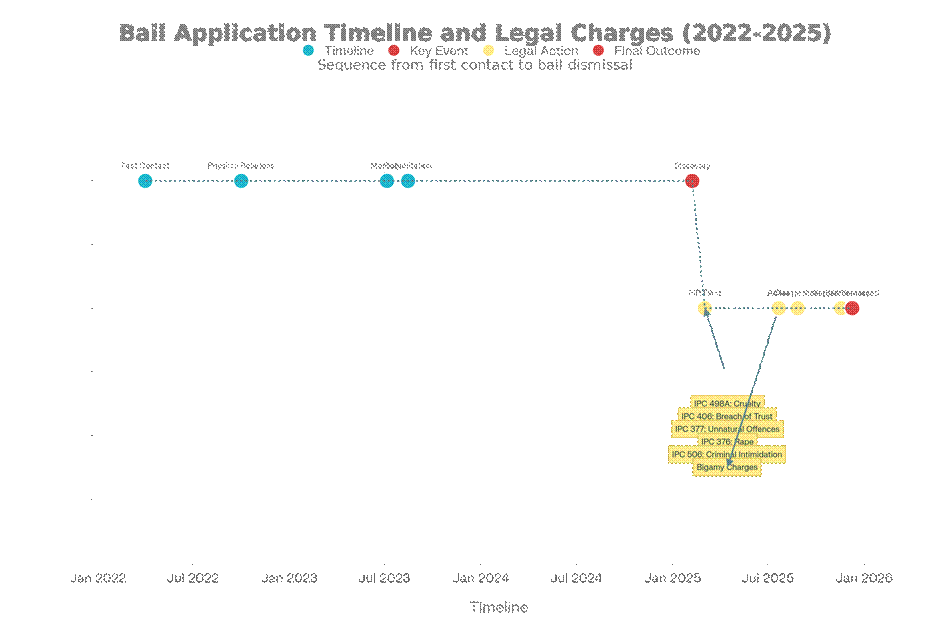
Timeline and Legal Progression in Prabhat Kumar Bail Application (BAIL APPLN. 4049/2025, High Court of Delhi)
The accused proceeded to formalize the relationship by solemnizing a second marriage with the complainant on July 6, 2023, at Vedic Arya Mandal Trust in Ghaziabad, with the marriage subsequently being registered. The complainant commenced cohabitation with the accused on August 1, 2023, at a rented accommodation in Ashok Nagar, Tilak Nagar, Delhi. A second social ceremony was performed at a temple on September 27, 2023, further cementing what the complainant believed to be a legitimate matrimonial union. Throughout this period, the accused allegedly took possession of her jewelry and a two-wheeler without her consent and subjected her to both physical and mental cruelty.
The discovery of the deception occurred on February 7, 2025, when the complainant found photographs in the accused’s mobile phone that revealed the existence of his prior marriage and the existence of a child from that relationship. Additionally, when questioned about a woman’s name tattooed on his back, the accused had falsely informed her that it was his niece’s name—a claim that proved to be equally deceptive. Following this discovery, the complainant filed a written complaint on March 3, 2025, leading to the registration of the FIR.[1]
Legal Arguments and Contentions
The Defence Argument: Consensuality and Cohabitation
The counsel appearing for the accused advanced a straightforward yet legally contentious argument: that the relationship between the parties had been consensual from its inception. The defence essentially rested on three pillars. First, it emphasized that the complainant, being a major and independent adult, had willingly accompanied the accused to various places and hotels prior to their marriage on June 6, 2023, which purportedly demonstrated the absence of coercion or inducement required for an offense under Section 376 IPC. This argument attempted to normalize the pre-marital physical relationship by highlighting the complainant’s apparent agency in participating in it.[1]
Second, the defence contended that the parties had cohabited peacefully in the rented accommodation throughout 2023 and into 2025, demonstrating the voluntary and consensual nature of their relationship. The argument here was that continued cohabitation and apparent harmony negated the criminal nature of the alleged conduct. Third, and most remarkably, the defence submitted that the complainant was fully aware of the accused’s previous marriage even in 2022 and had voluntarily chosen to marry him on July 6, 2023, despite this knowledge, thereafter living with him as husband and wife.[1]
The defence also made practical submissions regarding the chattels (moveable property) in question, asserting that the money allegedly borrowed from the complainant and the two-wheeler had already been returned, thereby vitiating the necessity for continued custody of the accused. The argument culminated in the submission that since the chargesheet and supplementary chargesheet had already been filed, further detention was unwarranted, and bail should be granted.
The Prosecution’s Stance: Deception Vitiates Consent
The APP (Additional Public Prosecutor) for the State presented a diametrically opposite interpretation of the facts. The prosecution argued that the accused had deliberately misrepresented material facts and induced the complainant into the relationship based on a false belief that he was unmarried and genuinely intended to marry her. The core of the prosecution’s case rested on the principle—deeply rooted in Indian jurisprudence—that consent obtained through deception about fundamental facts is vitiated and therefore cannot constitute a valid defense to criminal charges.[1]
The prosecution underscored that the accused had concealed the fact of his prior subsisting marriage and had deliberately led the complainant to believe that she was his legally wedded wife, when in fact he had committed bigamy by marrying her while his first marriage remained valid. It was submitted that the complainant, acting under this false impression created by the accused’s calculated deception, had maintained physical relations with him; however, the consent of the complainant was vitiated by the accused’s deception, and the allegations disclosed the commission of offences including the gravest charge under Section 376 IPC—sexual assault through deception about identity and marital status.[1]
The High Court’s Legal Analysis and Reasoning
Acceptance of the Deception Narrative
Justice Swarana Kanta Sharma’s judgment represents a thorough and nuanced analysis that ultimately sided with the prosecution’s interpretation. The court began by acknowledging the pivotal issue: whether the accused had disclosed to the complainant the fact that he was already married to someone else and had a child from that marriage. The judgment states with clarity that it is prima facie evident that the accused had not made such disclosure.[1]
The court’s reasoning proceeded on a crucial observation: had there been even prima facie material to suggest that the complainant was aware of the accused’s first marriage, the case could have been viewed as one arising out of a consensual long-term relationship between two adults. However, the record before the court did not indicate any such knowledge on the part of the complainant. This straightforward evidentiary assessment became the foundation for the entire judgment, establishing that the defence narrative was fundamentally contradicted by documentary evidence.
Rejection of the “Consensuality” Defence
Justice Sharma explicitly rejected the contention of the defence counsel that even if bigamy is presumed, it would make the offence less serious. The court stated that this argument “cannot be accepted in the peculiar facts of this case.” The judgment emphasized that the accused himself did not dispute that he had been married earlier and had a child from his first marriage. Nor did he dispute, even in the bail application itself, that he had established physical relations with the complainant and had thereafter married her, or that he had married the complainant on July 6, 2023, at Vedic Arya Mandal Trust, Ghaziabad, with the marriage subsequently being registered at the Marriage Registration Office, Ghaziabad.[1]
The photographs of the marriage between the complainant and the accused, submitted to the Investigating Officer, had been perused by the court and were not disputed by the defence counsel. This meant that the critical facts—the existence of a prior marriage, the existence of a child from that marriage, and the subsequent marriage to the complainant—were essentially admitted.
The Bigamy and Fraud Dimension
The judgment then delved into one of the most significant aspects of the case: the commission of bigamy itself and the fraud involved in solemnizing the second marriage. During investigation, the marriage certificate of the accused with his first wife was produced by the accused himself and verified by the Investigating Officer from Arya Samaj Vedic Sanskar Trust, Rajinder Market, Tis Hazari, Delhi. The court observed that these facts prima facie show that the accused not only concealed his first marriage from the complainant but also may have furnished a false affidavit at Arya Samaj Mandir and/or at the marriage registration office, declaring himself unmarried. Such false affidavits are critically important because disclosure of his subsisting marriage would have prevented the solemnization and registration of the second marriage, thereby making the entire second marriage void ab initio (void from the beginning).[1]
The Testimony about Deception
The judgment accorded significant weight to the consistent allegations made by the complainant regarding how she came to know of the deception. According to the judgment, the complainant had consistently alleged that she had initially seen the name of the accused’s first wife tattooed on his back and, when questioned, he had falsely informed her that it was the name of his niece. The complainant alleged that she came to know of the accused’s earlier marriage only on February 7, 2025, when she found photographs in his mobile phone. This narrative was particularly compelling because it demonstrated a pattern of calculated and sustained deception over a period of approximately two years.[1]
Corroboration through Digital Evidence
The judgment noted that the FSL (Forensic Science Laboratory) report regarding the mobile phone of the accused supported the prosecution’s case, as the device was found to contain certain inappropriate photographs and videos of the complainant. The existence of such images corroborated her allegation that the accused had threatened to circulate those images if she approached the police or any authority. This digital evidence thus served a dual purpose: it simultaneously confirmed the discovery of the deception through the mobile phone and provided evidence of the subsequent criminal intimidation and coercion employed by the accused to silence the complainant.[1]
The Decision and Its Implications
After thoroughly analyzing the facts, evidence, and legal submissions, Justice Swarana Kanta Sharma concluded that considering the overall facts and circumstances, including the nature of allegations and the material collected during investigation, the court did not find any ground to grant bail to the accused. The bail application was accordingly dismissed, with the court noting that charges in the present case were yet to be framed, trial was yet to commence, and the testimony of the complainant before the Trial Court was yet to be recorded. The court explicitly clarified that nothing expressed in the judgment should be construed as an expression of opinion on the merits of the case—a standard legal formulation that preserves the presumption of innocence during trial.[1]
Legal Significance and Jurisprudential Impact
The Vitiation of Consent Through Deception
This judgment carries profound implications for Indian matrimonial law and the law of sexual assault. The court’s reasoning effectively establishes that consent to sexual relations, even between adults in what appears to be a relationship of affection and trust, can be vitiated—rendered invalid and legally non-existent—when it is obtained through deception about fundamental matters such as the marital status of one party. This principle challenges a narrow interpretation of Section 376 IPC that might limit sexual assault liability only to scenarios involving physical force or the inability to consent due to intoxication or incapacity.
The judgment reflects an understanding that a woman’s sexual autonomy encompasses not merely freedom from physical force, but also the right to make informed decisions about intimate matters. When a man deliberately conceals his marital status while inducing a woman into sexual relations on false promises of marriage, he is violating her agency and dignity in a manner that the law must recognize as criminal.
Bigamy as a Precursor to Sexual Assault
The judgment implicitly recognizes the interconnection between bigamy, fraud in matrimonial matters, and sexual assault. By concealing his prior marriage and securing a second marriage through false affidavits, the accused created a legal fiction—the appearance of a valid marriage—which he then exploited to gain access to the complainant’s body and property. The crime was not merely infidelity or deception in an ongoing relationship; it was a calculated scheme involving fraud at the matrimonial registry level, leading to sexual assault and property crimes.
Protection of Women from Matrimonial Fraud
In a society where matrimonial status carries significant social, legal, and economic implications, false representations about one’s marital status constitute a form of predatory conduct. The judgment recognizes that women who choose to engage in physical relations based on genuine belief in the legitimacy of matrimonial bonds deserve protection from men who exploit this trust through calculated deception. The court’s reasoning affirms that the law must be concerned not merely with the moment of coercion, but with the entire scheme of deception that made the alleged sexual assault possible.
Procedural and Evidentiary Strengths
The investigation in this case appears to have been conducted with commendable thoroughness. Medical examination was conducted at Safdarjung Hospital, statements of the complainant and her parents were recorded under the appropriate sections of the Bharatiya Nyaya Sanhita (BNSS), and the complainant’s statement was recorded before the learned Magistrate. The supporting documents—including the marriage certificate, photographs of the marriage, the rental agreement, and the registration certificate of the two-wheeler—all corroborated the narrative of the complainant. The verification of the accused’s first marriage certificate by the Investigating Officer added significant evidentiary weight.[1]
The fact that a supplementary chargesheet was filed on November 18, 2025, after the initial chargesheet of August 27, 2025, suggests that the investigation unearthed additional evidence or identified additional offences that warranted inclusion in formal charges. This progression is not uncommon in complex matrimonial cases involving multiple offences.
Broader Implications for Matrimonial Jurisprudence
This judgment arrives at a particularly significant moment in Indian legal evolution, when courts have increasingly recognized the multifaceted nature of gender-based violence and matrimonial exploitation. The traditional framework that limited marital violence remedies to specific statutes addressing dowry and cruelty has progressively expanded to include sexual assault, criminal intimidation, and fraud-based offences.
The judgment also has implications for how courts interpret the interface between civil matrimonial law and criminal law. While a bigamously contracted marriage may be void ab initio under civil law, the judgment confirms that the commission of bigamy through deception carries criminal consequences distinct from the civil invalidity. This reflects a sophisticated understanding that the criminal law must address not merely the legal status of the marriage, but the predatory conduct involved in obtaining it through fraud.
Conclusion
The High Court of Delhi’s judgment in Prabhat Kumar v. State of NCT Delhi stands as a significant affirmation of the rights of women to sexual autonomy and informed decision-making in matrimonial matters. By rejecting the defence argument that apparent consensuality negates criminal liability when such consensuality was obtained through calculated deception about fundamental facts, the court has advanced jurisprudence that better protects women from a particularly insidious form of sexual predation—one that operates through manipulation and fraud rather than overt force.
The decision reflects the court’s recognition that the criminal law must be responsive to the actual harm experienced by women in contemporary Indian society, where matrimonial status continues to carry significant social meaning and where calculated deception about such status can result in profound violations of sexual autonomy, bodily integrity, and property rights. As the case proceeds to trial, the testimony of the complainant and the examination of digital and documentary evidence will be crucial. The judgment’s dismissal of the bail application indicates the court’s assessment that the prima facie case is sufficiently strong that the accused’s continued detention is justified pending trial.[1]
This judgment deserves careful study by legal practitioners, law students, and policymakers engaged with matrimonial law, sexual assault jurisprudence, and the protection of women’s rights. It represents a thoughtful judicial response to the complex realities of contemporary matrimonial fraud and demonstrates the courts’ evolving commitment to protecting women from deception-based sexual exploitation.