Rahul Gupta v. State of NCT Delhi:
A Landmark Bail Decision on Procedural Safeguards and Right to Speedy Trial
In a significant judgment delivered on December 8, 2025, the High Court of Delhi through Justice Amit Mahajan granted regular bail to Rahul Gupta (alias Ganja) in a robbery case that had been pending for nearly four years, establishing important precedents regarding bail jurisprudence, the weight of circumstantial evidence, and the constitutional right to a speedy trial under Article 21 of the Indian Constitution. The judgment addresses critical weaknesses in the prosecution’s case while emphasizing that prolonged incarceration without a timely trial cannot be justified merely by the seriousness of allegations, and that judicial efficiency demands release when investigative delays threaten fundamental rights.
Case Facts and Charges
The case originated from a complaint filed by Nitin Bhatia on December 15, 2021, with the e-police station at Patparganj Industrial Area, alleging that he was robbed by four persons on December 10, 2021. According to the First Information Report (FIR), the complainant accepted a lift in a car and within minutes, three of the accused persons, allegedly on gunpoint, snatched his mobile phone and Automated Teller Machine (ATM) cards. The incident allegedly resulted in the withdrawal of ₹50,000 from the complainant’s three different ATM cards—₹20,000 from an SBI card, ₹20,000 from a Punjab National Bank (PNB) card, and ₹10,000 from a Rajasthan Bank Limited (RBL) card.[1]
The applicant, Rahul Gupta, was arrested on January 1, 2022, along with three co-accused persons: Arun Kumar, Manish Gahlot, and another accused named Vipul. The police alleged that Rahul Gupta was driving the black Maruti Swift car (bearing registration number UP14BM4454) used in the commission of the offense, while his co-accused inflicted injuries on the complainant and threatened him to reveal his PIN code. The chargesheet was subsequently filed against all four accused persons under Sections 392 (punishment for dacoity), 397 (robbery or dacoity with attempt to cause death or grievous hurt), and 34 (common intention) of the Indian Penal Code, 1860 (‘IPC’).[1]
The Evidence Against the Applicant: A Critical Analysis
Justice Mahajan’s judgment reveals significant vulnerabilities in the prosecution’s case against Rahul Gupta. While the police claimed to have recovered certain items from the applicant, a detailed examination of these “recoveries” demonstrates that the prosecution’s case rested on weak circumstantial evidence rather than direct proof of involvement. The recovered items included a black Maruti Swift car (bearing the number not mentioned in the original FIR filed five days after the incident), and a plastic gun-shaped lighter allegedly used to intimidate the complainant.[1]
Critically, the ATM cards recovered from Rahul Gupta were not the victim’s cards but belonged to individuals named Sameer and Mohit, while the cards actually used to withdraw money belonged to Ravinder Kumar and were recovered from co-accused Arun Kumar. This fundamental discrepancy undermines the police theory of the applicant’s direct involvement in the robbery and subsequent withdrawal of funds. The judgment highlights that no ATM cards of the actual complainant were recovered from the applicant’s possession, which constitutes a significant gap in the prosecution’s chain of evidence. Furthermore, the alleged “pistol” used in the crime was merely a plastic gun-shaped lighter—an object insufficient to satisfy the elements of dacoity involving the use of a dangerous weapon.[1]
The Test Identification Parade Failure: Foundation for Doubt
One of the most compelling reasons cited by Justice Mahajan for granting bail was the failure of the complainant to identify the applicant during the Test Identification Parade (TIP) proceedings. During the TIP, the complainant clearly identified co-accused Manish Gahlot as the main perpetrator but failed to identify Rahul Gupta as well as another co-accused, Vipul. This failure of eyewitness identification, conducted under controlled procedural conditions designed specifically to establish an accused’s identity, creates a fundamental doubt about whether the applicant was present at the scene of the crime or participated in the robbery.[1]
Test identification parades serve a crucial evidentiary function in criminal proceedings—they corroborate eyewitness testimony by requiring witnesses to identify suspects from among individuals with similar physical characteristics under controlled conditions administered by judicial or executive magistrates. The inability of the very victim of the crime to identify Rahul Gupta among the parade members significantly weakens the prosecution’s ability to establish his presence and participation in the offense. Justice Mahajan properly recognized that while the failure to identify during a TIP does not conclusively prove innocence, it creates reasonable grounds for doubt about the accused’s guilt, particularly in the absence of stronger corroborating evidence.[2]
CCTV Footage and Identity Concealment
The judgment notes that the CCTV footage obtained from the State Bank of India branch on the date of the alleged incident merely shows two boys—one wearing a cap and the other wearing a mask—and crucially, their faces are not visible. The prosecution’s reliance on this footage to establish the applicant’s participation in the withdrawal of funds is weak, as the footage provides no identifiable visual confirmation of which specific individuals were withdrawing the money. The complainant’s failure to identify the applicant during the TIP further compounds the evidentiary weakness, as there is now no eyewitness testimony placing the applicant at the scene of the crime or connecting him to the subsequent bank withdrawals.[1]
Weaknesses in Procedural Compliance and Prosecution’s Case
Justice Mahajan identified several procedural and evidentiary lacunae in the prosecution’s investigation and case presentation. Most significantly, although the complainant in his FIR clearly stated that he was offered a lift by four people in a car, the original FIR filed on December 15, 2021 (five days after the alleged incident on December 10, 2021) contained no car registration number whatsoever. This omission becomes particularly significant given that a specific car (UP14BM4454) was later recovered from the applicant. The absence of the vehicle identification in the original FIR raises questions about how the police zeroed in on this particular vehicle and its connection to the incident.[1]
Furthermore, the judgment notes that the applicant is not even the registered owner of the black Maruti Swift car in question. Rather, the vehicle belonged to one Ms. Chanchal Pal, who merely claimed that the applicant used to use her car. Without evidence of explicit transfer of possession or control on the date of the alleged incident, establishing the applicant’s use of the vehicle becomes circumstantial and dependent entirely on the owner’s assertion.[1]
Bail Jurisprudence and Prima Facie Case Assessment
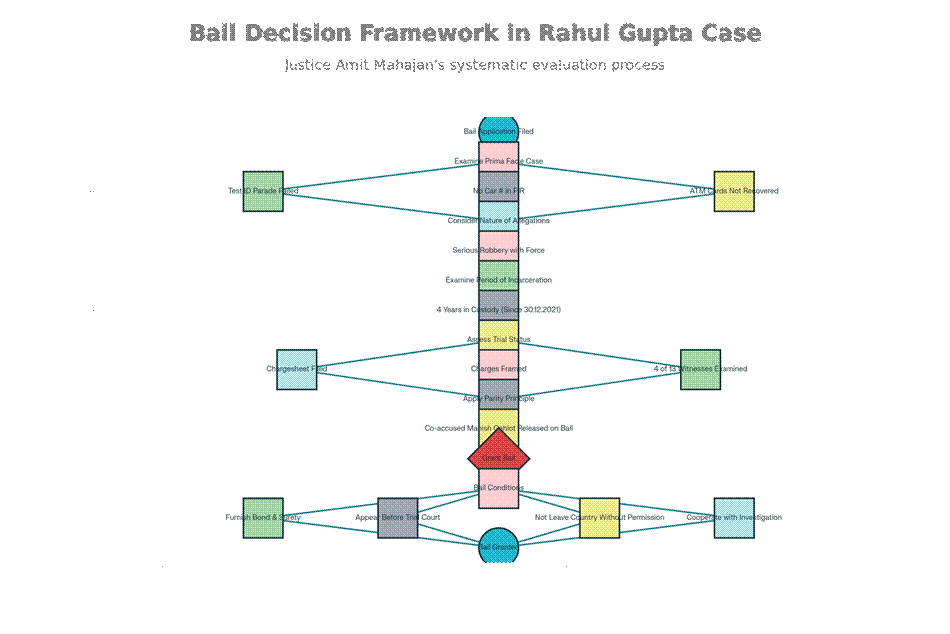
Bail Decision Framework in Rahul Gupta v. State of NCT Delhi (High Court of Delhi, December 8, 2025)
Justice Mahajan applied well-established principles of bail jurisprudence while deciding this case. The court emphasized that while considering bail applications, courts must examine whether there exists a prima facie case or reasonable grounds to believe that the accused has committed the offense. However, this examination is conducted at the preliminary stage and is not meant to preempt the ultimate determination of guilt or innocence at trial. The court clarified that a prima facie finding made at the bail stage is merely for the purpose of deciding the bail application and should not influence the outcome of the trial or be construed as an expression of opinion on the merits of the case.[1][3][4]
The court noted that the prosecution must establish through credible evidence that the accused’s involvement in the alleged offense is reasonably probable. In this case, the absence of direct evidence, the failure of the complainant to identify the applicant during the TIP, and the absence of the complainant’s ATM cards in the applicant’s possession collectively suggested that while the prosecution might have a prima facie case against the applicant, it was not so overwhelming as to justify indefinite detention.[1]
The Pendency of Other Cases: Not a Ground for Denial
Justice Mahajan addressed the prosecution’s argument that the applicant was involved in two other robbery cases of similar nature, contending that this fact alone should justify continued detention. Citing the Supreme Court’s landmark judgment in Prabhakar Tewari v. State of U.P. (2020) 11 SCC 648, the court held that mere pendency of several criminal cases against an accused person cannot by itself be the sole basis for refusal of bail. The court emphasized that a holistic view of the facts must be taken while considering the grant of bail, and that the mere multiplicity of charges does not justify incarceration.[5]
The judgment further noted that the applicant had already been enlarged on bail in one of the other criminal cases, demonstrating that courts had already found sufficient grounds to release him on bail in different proceedings. This fact further weakened the prosecution’s contention that the applicant was a flight risk or a danger to society.[1]
The Parity Principle and Consistency in Judicial Orders
Justice Mahajan applied the principle of parity—a doctrine ensuring equal treatment of similarly situated accused persons—in deciding to grant bail to the applicant. The court noted that co-accused Manish Gahlot, who was identified by the complainant during the TIP (making his role graver than that of the applicant), was released on regular bail by the High Court vide order dated April 10, 2024, passed in Bail Application No. 3738/2023. Since Manish Gahlot’s role in the alleged offense was attributed to be more active (as he was actually identified as the perpetrator by the victim), and he had already been granted bail, the principle of consistency and fairness required that Rahul Gupta, whose alleged role was merely as a driver (and who was not even identified during the TIP), should similarly be granted bail.[1]
The parity principle in bail jurisprudence operates on the foundational premise that if two accused persons stand on substantially similar footings with respect to the evidence against them, their culpability, and their roles in the alleged offense, they should ordinarily be treated similarly by courts. While courts have clarified that parity cannot be the sole ground for bail and that each case must be examined on its individual merits, parity functions as an important safeguard against arbitrary and inconsistent judicial orders. In this case, Rahul Gupta’s position—with an unidentified role during the TIP and no direct evidence linking him to the robbery—was actually weaker than that of Manish Gahlot, thereby creating a compelling case for bail on parity grounds.[6][5]
The Constitutional Right to Speedy Trial and Prolonged Incarceration
A cornerstone of Justice Mahajan’s reasoning was the principle that prolonged incarceration without a timely trial violates the fundamental right to personal liberty guaranteed under Article 21 of the Indian Constitution. The applicant had been in custody since December 30, 2021—a period of approximately four years from the date of the judgment. Despite the chargesheet having been filed and charges being framed, the trial had barely progressed, with only 4 out of 13 prosecution witnesses having been examined.[1]
The Supreme Court had laid down an important principle in Union of India v. K.A. Najeeb, AIR 2021 SC 712, holding that once it is obvious that a timely trial would not be possible and the accused has suffered incarceration for a significant period of time, courts would ordinarily be obligated to enlarge them on bail. Justice Mahajan invoked this principle, observing that the trial was unlikely to conclude in the near future given the slow pace of witness examination. The object of jail is to secure the appearance of the accused during the trial, not to serve as a form of pre-trial punishment or preventive detention.
This reasoning aligns with the constitutional principle established in several landmark judgments that gross delay in the disposal of criminal cases, resulting in prolonged pre-trial detention, violates the constitutionally protected right to life and personal liberty. The Supreme Court has repeatedly held that bail is the rule and jail is the exception, particularly in cases where investigative delays and judicial backlog make a speedy trial improbable.[7]
Conditions Imposed on Bail and Safeguards Against Tampering with Evidence
Justice Mahajan, while granting bail, imposed comprehensive conditions to address the prosecution’s concerns about witness intimidation and evidence tampering. The applicant was directed to be released on the furnishing of a personal bond for ₹25,000 with two sureties of the like amount, with the requirement that at least one surety be a family member of the applicant, subject to the satisfaction of the learned Trial Court.[1]
The conditions imposed included: (a) a prohibition against directly or indirectly making inducements, threats, or promises to witnesses or tampering with evidence in any manner; (b) an obligation to appear before the Trial Court as and when directed; (c) a restriction against leaving the country without permission of the Trial Court; (d) a requirement to provide his residential address and inform the police of any change; and (e) a mandate to keep his mobile phone switched on at all times and provide the number to the investigating officer.[1]
These conditions represent a balanced approach that protects the interests of justice while respecting the fundamental right to personal liberty. Rather than denying bail on the ground of witness intimidation fears, the court imposed specific, measurable conditions designed to mitigate these risks. This approach is consistent with modern bail jurisprudence, which recognizes that deprivation of liberty should neither be punitive in nature nor serve as a preventive detention mechanism, but rather should be limited to measures strictly necessary to secure the accused’s appearance at trial.
Procedural Clarifications on Bail and Its Non-Binding Nature
Justice Mahajan included an important clarification that the observations made in the bail order are solely for the purpose of deciding the bail application and should not influence the outcome of the trial or be construed as an expression of opinion on the merits of the case. This clarification is essential in protecting the trial court’s independence and ensuring that the bail determination does not predetermine the ultimate question of guilt or innocence. As established in recent Kerala High Court jurisprudence, a bail court’s prima facie finding is not binding on the trial court at the time of final disposal, nor does it constrain the investigating officer from conducting further investigations and collecting additional evidence.[3]
Significance and Broader Implications
The Rahul Gupta judgment represents a significant statement of bail jurisprudence in contemporary Indian criminal law, particularly in the context of the newly enacted Bharatiya Nagarik Suraksha Sanhita (BNSS), 2023. Justice Mahajan’s analysis demonstrates that Section 483 of the BNSS, which grants special powers to the High Court regarding bail, must be exercised with a keen eye toward protecting fundamental constitutional rights, particularly when investigative delays and judicial backlogs make expedited trials impossible.
The judgment underscores that courts should not mechanically grant bail merely because an accused has been in custody for a considerable period, nor should they routinely deny bail merely because the alleged offense is serious. Rather, courts must conduct a fact-specific examination of the strength of the prosecution’s case, the progression of the trial, the risk factors specific to the individual accused, and the available alternative conditions that can mitigate concerns about witness safety or evidence tampering.
Furthermore, the judgment illustrates how the principle of consistency or parity operates in practice when co-accused are treated differently by courts. While parity cannot be the sole ground for bail, it serves as an important check against arbitrary and capricious decision-making. When an accused’s alleged role is weaker than that of a co-accused who has been granted bail, the principle of fairness and consistency typically requires that the similarly or less culpable accused should also be released on bail.
The judgment also reaffirms that procedural safeguards and evidentiary requirements cannot be relaxed merely because an accused is charged with a serious offense. The failure of the victim to identify the applicant during the TIP, the absence of the complainant’s cards from the applicant’s possession, and the weak CCTV footage all remained significant vulnerabilities in the prosecution’s case, regardless of the seriousness of the charges. These evidentiary weaknesses must be properly weighed in the bail calculus and cannot be simply overridden by invoking the gravity of the offense.
Conclusion
The Rahul Gupta judgment is a careful and nuanced application of bail jurisprudence that balances the twin concerns of personal liberty and the interests of justice. By granting bail after nearly four years of incarceration, Justice Mahajan reaffirmed that the right to speedy trial and freedom from arbitrary detention are not merely aspirational principles but enforceable constitutional guarantees. The judgment demonstrates that courts must be vigilant in preventing pre-trial detention from morphing into a form of de facto punishment, particularly when the evidence against an accused is circumstantial and investigative or judicial delays threaten to convert the bail system into an instrument of oppression. For legal practitioners, criminal law students, and civil society organizations concerned with criminal justice reform, this judgment provides important guidance on the contemporary scope and exercise of bail discretion under Indian law, and the constitutionally mandated limits on the deprivation of liberty during the pre-trial stage of criminal proceedings.
- 59508122025BA41012025_205628.pdf
- https://thelaw.institute/criminal-justice-processes/test-identification-parades-criminal-processes/
- https://www.scconline.com/blog/post/2025/03/01/prima-facie-findings-bail-orders-not-binding-kerala-hc/
- https://cdnbbsr.s3waas.gov.in/s3ec015a01f0597ac4bdf35c24846734ee/uploads/2024/03/2024031266.pdf
- https://www.scconline.com/blog/post/2025/12/02/supreme-court-grant-of-bail-on-parity-as-sole-ground-2025-judgment-criminal-law/
- https://www.scobserver.in/supreme-court-observer-law-reports-scolr/sagar-v-state-of-up-18144/
- https://www.asvlawoffices.com/bailable-offence-law-bail-rights-india/
- https://nja.gov.in/Concluded_Programmes/2025-26/P-1463 TOC.pdf
- https://www.prashantkanha.com/section-483-bnss-bhartiya-nagarik-suraksha-sanhita-2023-equivalent-cr-p-c-section/
- https://thelawwaywithlawyers.com/1982-2/
- http://student.manupatra.com/Academic/Abk/Code-of-Criminal-Procedure/Chapter8.htm
- https://constitutionofindia.in/section-483-of-bharatiya-nagarik-suraksha-sanhita/
- https://www.ijlra.com/details/case-comment-union-of-india-v-k-a-najeeb-2021-3scc713-by-abhilasha-singh-
- https://updates.manupatra.com/roundup/contentsummary.aspx?iid=41542
- https://www.linkedin.com/pulse/what-principle-parity-bail-cases-joginder-singh-rohilla-iys7f
- https://updates.manupatra.com/roundup/contentsummary.aspx?iid=41542&text=
- http://roundup.manupatra.in/asp/displayart.aspx?itemid=41542
- https://www.scconline.com/blog/post/2023/08/25/test-identification-parade-do-not-violate-article-203-constitution-supreme-court/
- https://www.legalbites.in/bharatiya-nagarik-suraksha-sanhita/can-bail-be-granted-solely-on-parity-without-examining-the-accuseds-individual-role-1220673
- https://www.apnilaw.com/bare-act/bnss/section-483-bharatiya-nagarik-suraksha-sanhita-bnss-special-powers-of-high-court-or-court-of-session-regarding-bail/
- https://www.scobserver.in/journal/bail-under-uapa-can-be-granted-if-the-accuseds-trial-has-been-delayed/