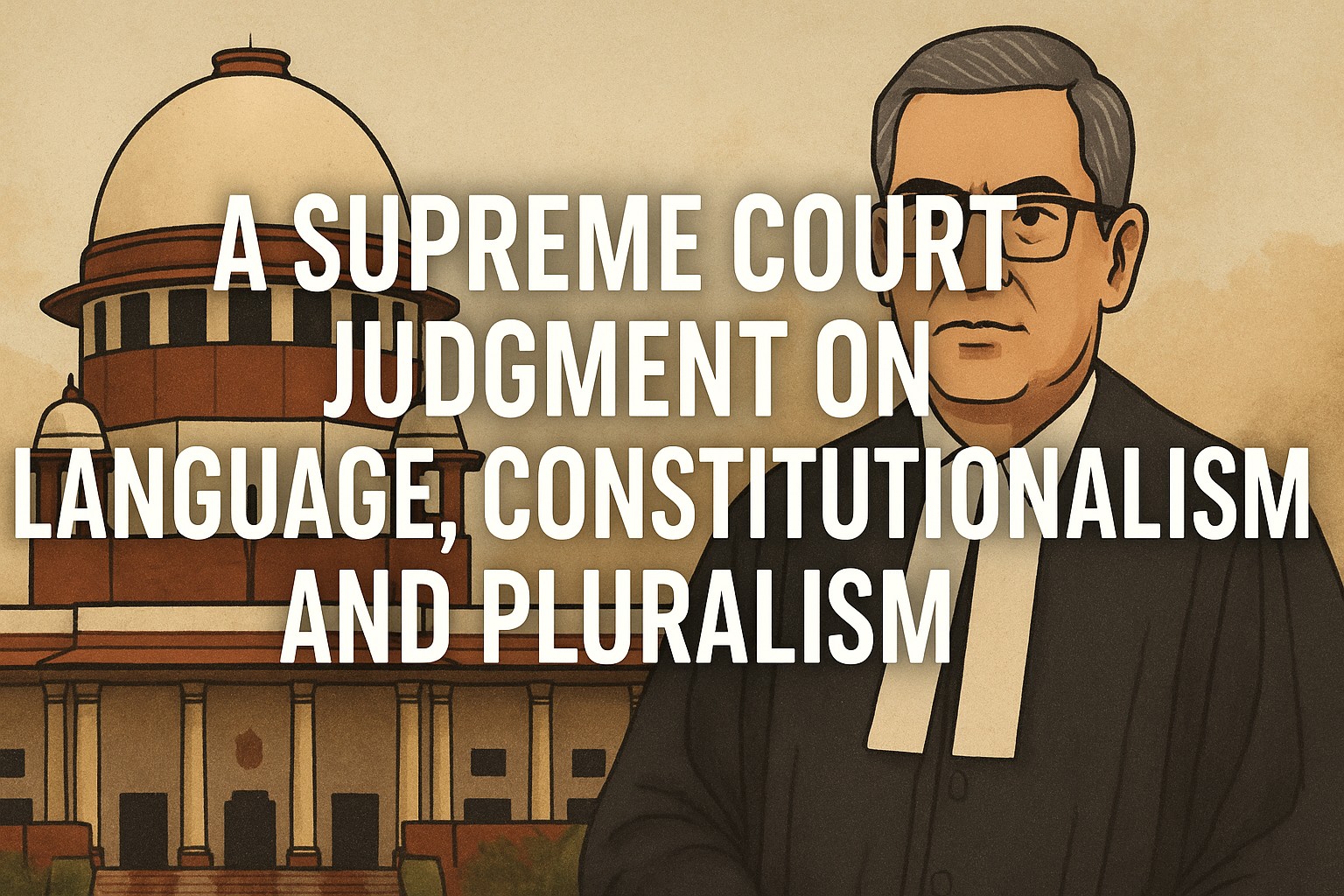
Varshatai v. State of Maharashtra: A Supreme Court Judgment on Language, Constitutionalism, and Pluralism
The Supreme Court of India’s landmark judgment in Varshatai v. State of Maharashtra, delivered on April 15, 2025, by Justices Sudhanshu Dhulia and K. Vinod Chandran, represents a significant affirmation of India’s constitutional commitment to linguistic pluralism and cultural diversity. This case, which centered on the seemingly simple question of whether Urdu could appear on a municipal signboard alongside Marathi in Maharashtra, evolved into a profound exploration of language rights, constitutional interpretation, and the nation’s commitment to tolerance and inclusivity. The Supreme Court’s dismissal of the appeals and its categorical finding that the Maharashtra Local Authorities (Official Languages) Act, 2022 does not prohibit the use of Urdu as an additional language has far-reaching implications for municipal administration and language policy across India.[1][2]
The Factual Matrix and Legal Journey
The case originated from a straightforward administrative matter that spiraled into a prolonged legal battle spanning five years. The Municipal Council of Patur, a town in Akola district of Maharashtra, had displayed the name of the municipal body on its signboard in Marathi at the top, with its translation in Urdu script appearing below. This practice was not new; according to the Court, Urdu had appeared on the signboard since the Council’s establishment in 1956, reflecting the significant Urdu-speaking population within the municipal area. However, Mrs. Varshatai, a former member of the Municipal Council, objected to this practice, contending that only Marathi should be used since it is the official language of Maharashtra.[1]
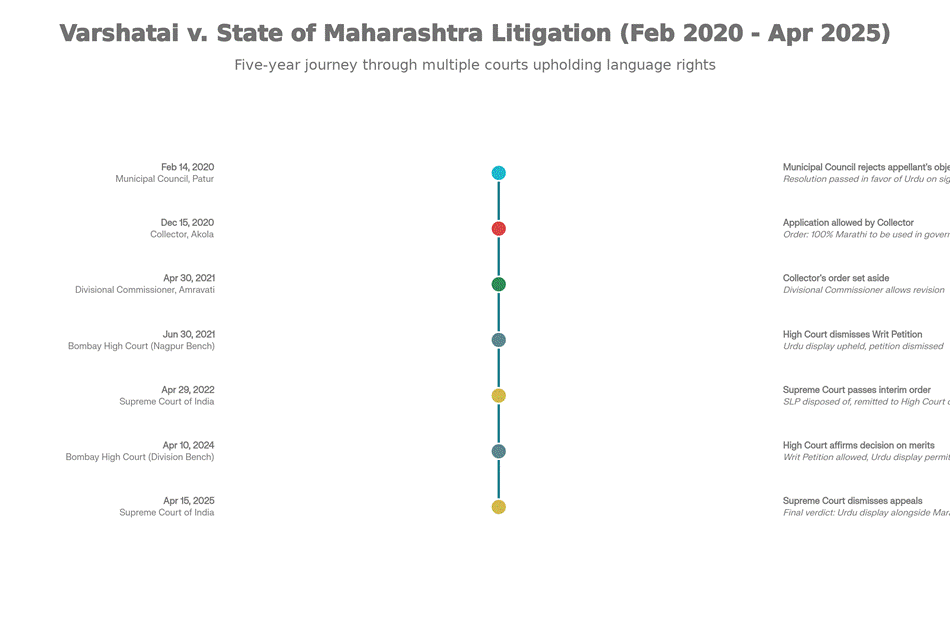
Litigation Timeline: Varshatai v. State of Maharashtra (2020-2025)
When the Municipal Council rejected her objection through a resolution dated February 14, 2020, Mrs. Varshatai pursued the matter by filing an application before the Collector of Akola under Section 308 of the Maharashtra Municipal Council, Nagar Panchayats and Industrial Township Act, 1965. The Collector, interpreting the law narrowly, allowed her application on December 15, 2020, ordering that Rajbhasha (official language) Marathi be used 100% in government proceedings. This order prompted members of the Municipal Council to challenge it before the Divisional Commissioner, Amravati, who set aside the Collector’s order on April 30, 2021. Subsequently, the appellant filed Writ Petition No. 2219 of 2021 before the Bombay High Court (Nagpur Bench), which dismissed the petition on June 30, 2021.[1][2]
The case’s complexity intensified when, during the pendency of the Special Leave Petition before the Supreme Court, Maharashtra enacted the Maharashtra Local Authorities (Official Languages) Act, 2022. The appellant argued that this new legislation definitively prohibited the use of Urdu on municipal signboards. The Supreme Court, recognizing this significant legislative development, disposed of the SLP on April 29, 2022, directing the matter back to the High Court for reconsideration in light of the 2022 Act. The High Court, on April 10, 2024, reaffirmed its earlier decision, holding that even under the new statutory framework, the use of Urdu as an additional language did not violate the 2022 Act.[3][1]
Procedural Issues and the Amendment to Section 308
One of the foundational issues addressed by the Court was whether the appellant’s original application before the Collector was even maintainable. The Court examined Section 308(1) of the 1965 Act, which underwent a crucial amendment in 2018. Prior to this amendment, the Collector possessed broad discretionary powers to suspend the execution of any municipal resolution if he believed it was likely to cause injury or annoyance to the public or might lead to a breach of peace. The Collector could exercise this power sua motu or on the basis of any representation.[1][2]
However, the 2018 amendment fundamentally altered this landscape. Post-amendment, the Collector’s power can be exercised only when the Chief Officer of the Municipal Council formally brings to the Collector’s notice that the Council has passed a resolution contrary to the provisions of the Act, any other law, rules, or bye-laws, or government directions. The Chief Officer has three days from receiving the resolution to file such a report, and the Collector has thirty days to decide on the matter. In the present case, the application was filed by Mrs. Varshatai, a former member of the Council, not by the Chief Officer. The Court observed that the Collector should not have entertained the application in the first place, as it violated the plain language of the amended Section 308.[1]
The High Court had accepted this procedural argument but nevertheless proceeded to examine the matter on merits. The Supreme Court, while affirming this approach, noted that the procedural infirmity compounded the fundamental error in the Collector’s substantive reasoning.[1]
The 2022 Act and Its Interpretation
The core substantive issue concerned the proper interpretation of the Maharashtra Local Authorities (Official Languages) Act, 2022. The appellant’s argument was straightforward: Section 3(1) of the 2022 Act declares Marathi to be the official language of all local authorities in Maharashtra, and save for the exceptions specified in sub-section (2), Marathi must be used for all official purposes and purposes related to public interface and public interest. The appellant contended that the only exception provided in sub-section (2) relates to the use of English in situations where communications cannot be properly conveyed in Marathi or where the intended recipients cannot understand Marathi.[3]
The Supreme Court rejected this interpretation, holding that the 2022 Act, despite its emphasis on Marathi as the official language, does not contain an express prohibition against using additional languages. The Court reasoned that making Marathi the official language is fundamentally different from prohibiting the use of other languages, particularly those recognized in the Eighth Schedule of the Constitution. The judgment states: “There is no prohibition on using any other language, especially one included in the VIIIth Schedule of the Constitution of India”. Sub-section (2) of Section 3 was characterized not as a provision limiting the use of other languages but as an enabling provision that allows the use of English in specific circumstances where Marathi is inadequate for communication purposes.[1]
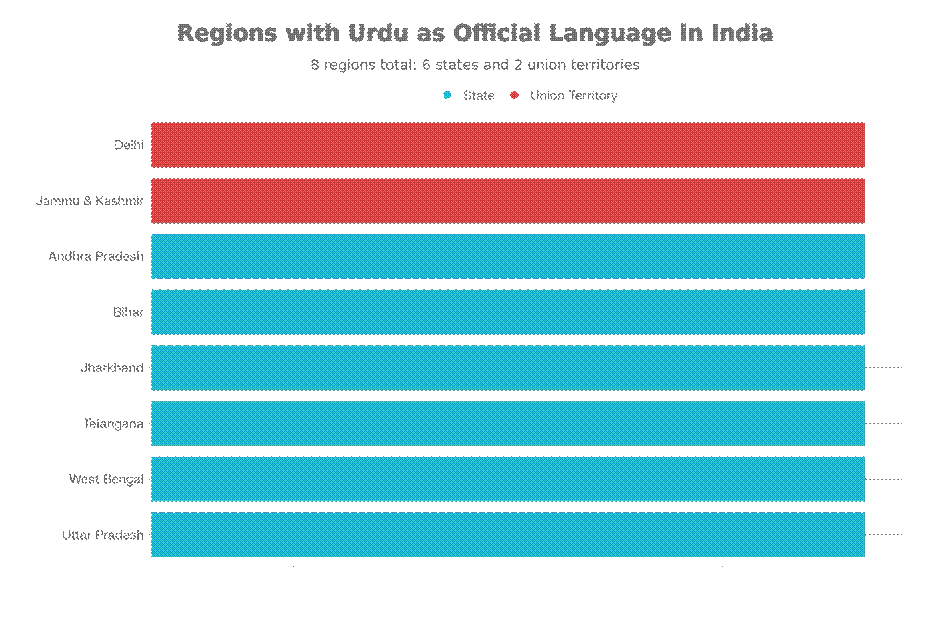
Indian States and Union Territories with Urdu as Official or Secondary Language
Constitutional Foundations: Language as a Right and a Tool
The judgment moved beyond the narrow statutory interpretation to engage with broader constitutional principles. The Court emphasized that both Marathi and Urdu occupy the same constitutional position under Schedule VIII of the Constitution, and neither is subordinate to the other. This foundational equality is significant because it establishes that even when a state designates one language as its official language, it does not thereby acquire the authority to exclude other constitutionally recognized languages from all uses.[1]
The Court drew heavily from the Uttar Pradesh Hindi Sahitya Sammelan v. State of Uttar Pradesh (2014) 9 SCC 716, a five-judge Constitution Bench decision in which the Supreme Court had upheld the validity of Urdu’s designation as the second official language in Uttar Pradesh. In that case, the Court held that Article 345 of the Constitution, which empowers state legislatures to adopt one or more languages in use in the state as official languages, permits the adoption of multiple official languages at different times. The mere adoption of Hindi as the official language does not exhaust the state’s power to adopt other languages for specified purposes.[2][1]
More broadly, the Court articulated a philosophy of language that transcends instrumentalism. The judgment emphasizes that language is fundamentally a tool of communication: “Language is culture. Language is the yardstick to measure the civilizational march of a community and its people.” The Court noted that Urdu is a quintessential example of India’s composite cultural heritage, representing the finest manifestation of “ganga-jamuni tahzeeb” or Hindustani culture, which emerged from the cultural synthesis of northern and central India’s diverse communities. In this context, using Urdu on a municipal signboard serves the primary purpose of communication, ensuring that residents familiar with that language can engage effectively with their local government.[1]
The Historical Tragedy of Hindustani: Partition and Language Politics
Perhaps the most poignant section of the judgment addresses the historical trajectory of Hindustani and the role of Partition in shaping contemporary language politics. The Court noted that before independence, Hindustani—a composite language drawing equally from Hindi and Urdu vocabularies—was widely accepted as the language most likely to serve as India’s national or all-India language. The Constituent Assembly’s Rules of Procedure stipulated that its business would be conducted in Hindustani or English, with provisions for members unable to express themselves in these languages to speak in their mother tongue.[1]
The judgment extensively quotes the work of Granville Austin, a renowned historian of India’s Constitution, to explain how Partition fundamentally altered this trajectory. Austin documents how, prior to 1947, there was considerable optimism in the Constituent Assembly that Hindustani would become the national language. However, the Partition of India and the adoption of Urdu by Pakistan as its national language triggered a visceral reaction among many members of the Assembly. As Austin explains, the anger directed at Muslims for their perceived role in causing Partition translated into hostility toward Urdu and Hindustani. The Hindi extremists in the Assembly became more firmly committed to promoting a Sanskritized Hindi and to displacing both Urdu and English from India’s linguistic landscape.[1]
This historical account is crucial because it establishes that the contemporary prejudice against Urdu is not grounded in linguistic or constitutional logic but rather in post-Partition communal tensions. The Court observed: “The ultimate victim was Hindustani”. The judgment quotes Jawaharlal Nehru’s contemporary writings asserting that Hindustani (which he used interchangeably to refer to both Hindi and Urdu in their common spoken form) was bound to become India’s all-India medium of communication, not by displacing provincial languages but as a compulsory second language to be learned by all Indians.[1]
The Linguistic Reality: Hindi and Urdu as One Language
One of the judgment’s most intellectually rigorous sections addresses the linguistic relationship between Hindi and Urdu. Drawing from the work of renowned scholars including Gyan Chand Jain, Amrit Rai, and Ram Vilas Sharma, the Court established that Hindi and Urdu are not, in linguistic terms, two separate languages but rather two standardized registers of the same underlying language system. Jain writes that “Urdu and Hindi are not two separate languages” and that “their recognition as two separate languages under the Constitution is political expediency, not a linguistic reality”.[1]
The differences between Hindi and Urdu lie primarily in their scripts—Urdu uses the Perso-Arabic script while Hindi uses Devanagari—and in their vocabulary registers, with Hindi borrowing more heavily from Sanskrit and Urdu from Persian. However, their pronouns, verbs, and basic grammatical structures are virtually identical. Ram Vilas Sharma, a prominent Hindi scholar and supporter of Hindi as the national language, observes that there are no two other languages in the world whose pronouns and verbs are 100% identical, as are those of Hindi and Urdu.[1]
The Court emphasized that this linguistic equivalence is not merely an academic matter. In everyday usage across India, the boundaries between Hindi and Urdu are porous and often imperceptible. The word “Hindi” itself derives from the Persian word “Hindavi,” and contemporary Hindi vocabulary is replete with words of Urdu origin, while Urdu similarly incorporates words from Sanskrit and other Indian languages. Moreover, the Court noted that Urdu maintains a significant presence in Indian legal discourse; words such as “adalat” (court), “halafnama” (affidavit), and “peshi” (appearance) are routine terms in Indian courtrooms, even in the Supreme Court, where English is the official language.[1]
India’s Linguistic Diversity and Constitutional Accommodation
The judgment places the Urdu question within the broader context of India’s extraordinary linguistic diversity. The Court noted that India is home to more than 100 major languages and hundreds of mother tongues and dialects. According to the 2001 Census, India had 122 major languages, including the 22 scheduled languages in the Eighth Schedule, and 234 mother tongues. The 2011 Census recorded 270 mother tongues, though this count only included languages with more than 10,000 speakers.[1]
This diversity is foundational to India’s constitutional design. The Eighth Schedule of the Constitution recognizes 22 languages, including both Marathi and Urdu, reflecting the framers’ commitment to preserving linguistic pluralism. The Court observed that Urdu is the sixth most spoken scheduled language in India and is spoken in all states and union territories except perhaps some northeastern states.[1]
The judgment documents that many Indian states and union territories have recognized Urdu either as an official language or as a language permitted for specific official purposes. Andhra Pradesh, Bihar, Jharkhand, Telangana, Uttar Pradesh, and West Bengal have Urdu as a recognized official or secondary language, while the Union Territories of Delhi and Jammu and Kashmir also provide for Urdu in their official language frameworks. This widespread adoption demonstrates that Urdu is not a newcomer to India’s constitutional architecture but rather an integral part of its multilingual federal structure.[1]
The Philosophical Foundations: Language and Tolerance
The judgment opens with a quotation that sets its philosophical tone: “When you learn a language, you don’t just learn to speak and write a new language. You also learn to be open-minded, liberal, tolerant, kind and considerate towards all mankind.” This epigraph encapsulates the Court’s conviction that language rights are intimately connected to constitutional values of tolerance and pluralism.[1]
Justice Sudhanshu Dhulia emphasizes that the distinction between the linguistic politics of language and the linguistic science of language is critical. While the Constitution recognizes Hindi and Urdu as two languages for political and constitutional purposes, linguists and scholars acknowledge their fundamental sameness. This acknowledgment should not undermine the constitutional right to use either language; rather, it should reinforce the understanding that both are Indian languages with equally legitimate claims to constitutional recognition and protection.[1]
The Court quotes the former Chief Justice of India, M. N. Venkatachaliah, who characterized Urdu as possessing “a special place in India” and as “a culture and civilization in itself,” possessing “a rich literature and lore” that constitute “a treasure house of the noblest thoughts on life’s mysteries.” Venkatachaliah’s plea was for urgent measures to ensure Urdu’s survival and the restoration of its “pristine glory”.[1]
The judgment further emphasizes that language is intrinsically a medium of communication and that this fundamental purpose cannot be subordinated to abstract political assertions about linguistic identity. A municipal council exists to serve its community and to facilitate effective communication with residents. If a significant portion of those residents are familiar with Urdu, there is no constitutional, legal, or moral justification for excluding that language from municipal communications, particularly on a signboard designed to inform and welcome the public.[1]
Implications and Broader Significance
The judgment carries implications that extend far beyond the specific facts of the Patur Municipal Council. It establishes several important principles that will shape future language disputes and local administration across India. First, the Court has made clear that the designation of an official language does not create an absolute monopoly; additional languages may be used for supplementary purposes, particularly for facilitating communication with communities that utilize those languages. This principle is especially important for local bodies, which must serve diverse populations.[1]
Second, the judgment provides strong constitutional protection to India’s scheduled languages, particularly those that have been subject to historical marginalization or contemporary prejudice. By firmly rejecting the notion that Urdu is alien to India and by grounding Urdu’s legitimacy in linguistic, historical, and constitutional grounds, the Court has created a constitutional bulwark against attempts to exclude Urdu from India’s linguistic landscape.[1]
Third, the judgment reaffirms that India’s strength lies in its diversity and that constitutional values of tolerance and pluralism are not negotiable sacrifices on the altar of linguistic nationalism. This message is particularly important in a contemporary context where language is increasingly being weaponized as a tool for communal division and exclusion.[1]
Conclusion
Mrs. Varshatai v. State of Maharashtra represents a watershed moment in India’s jurisprudence on language rights and constitutional pluralism. The Supreme Court’s judgment comprehensively addresses the question of whether Urdu can appear on a municipal signboard in Maharashtra and answers unequivocally in the affirmative. However, the judgment’s significance transcends this narrow question. By tracing the historical trajectory of Hindustani, documenting the linguistic equivalence of Hindi and Urdu, and situating both languages within India’s constitutional and cultural framework, Justice Sudhanshu Dhulia has written an opinion that will resonate for generations.
The judgment exemplifies the philosophical commitment embedded in the Indian Constitution to accommodate linguistic and cultural diversity. It acknowledges that Partition created a historical rupture that resulted in the marginalization of Hindustani and contributed to contemporary prejudices against Urdu. Yet, it asserts that these prejudices must be confronted and overcome through a return to constitutional first principles: respect for linguistic rights, recognition of India’s multilingual heritage, and commitment to tolerance and pluralism.
The Court’s affirmation of Urdu’s place in India’s constitutional order does not diminish the position of Marathi or any other language. Rather, it affirms that in a diverse nation, multiple languages can coexist and flourish without threatening each other. As the judgment poignantly states through a verse attributed to poet Iqbal Ashhar, Urdu must no longer feel like an outsider in her own homeland. The Supreme Court’s judgment ensures that languages, like the communities that speak them, can find dignified and acknowledged space within India’s constitutional republic.[1][2][3]
- 248122024_2025-04-15.pdf
- https://www.drishtijudiciary.com/landmark-judgement/constitution-of-india/varshatai-v-the-state-of-maharashtra-2025
- https://www.legitquest.com/act/maharashtra-local-authorities-official-languages-act-2022/BBAC
- https://www.mha.gov.in/sites/default/files/EighthSchedule_19052017.pdf
- https://www.sci.gov.in/landmark-judgment-summaries/
- https://indianexpress.com/article/research/the-eighth-schedule-of-the-indian-constitution-how-language-inclusion-creates-exclusion-9952740/
- https://api.sci.gov.in/supremecourt/2024/24812/24812_2024_12_1501_60900_Judgement_15-Apr-2025.pdf
- https://prsindia.org/files/bills_acts/acts_states/maharashtra/2022/Act No. 31 of 2022 MH.pdf
- https://www.pib.gov.in/newsite/erelcontent.aspx?relid=5928
- https://sabrangindia.in/?p=41219
- https://cdnbbsr.s3waas.gov.in/s36a4cbdaedcbda0fa8ddc7ea32073c475/uploads/2025/02/20250207929853312.pdf