Bail v. Flight Risk: Delhi High Court Balances Personal Liberty Against Flight Risk in Robbery Case
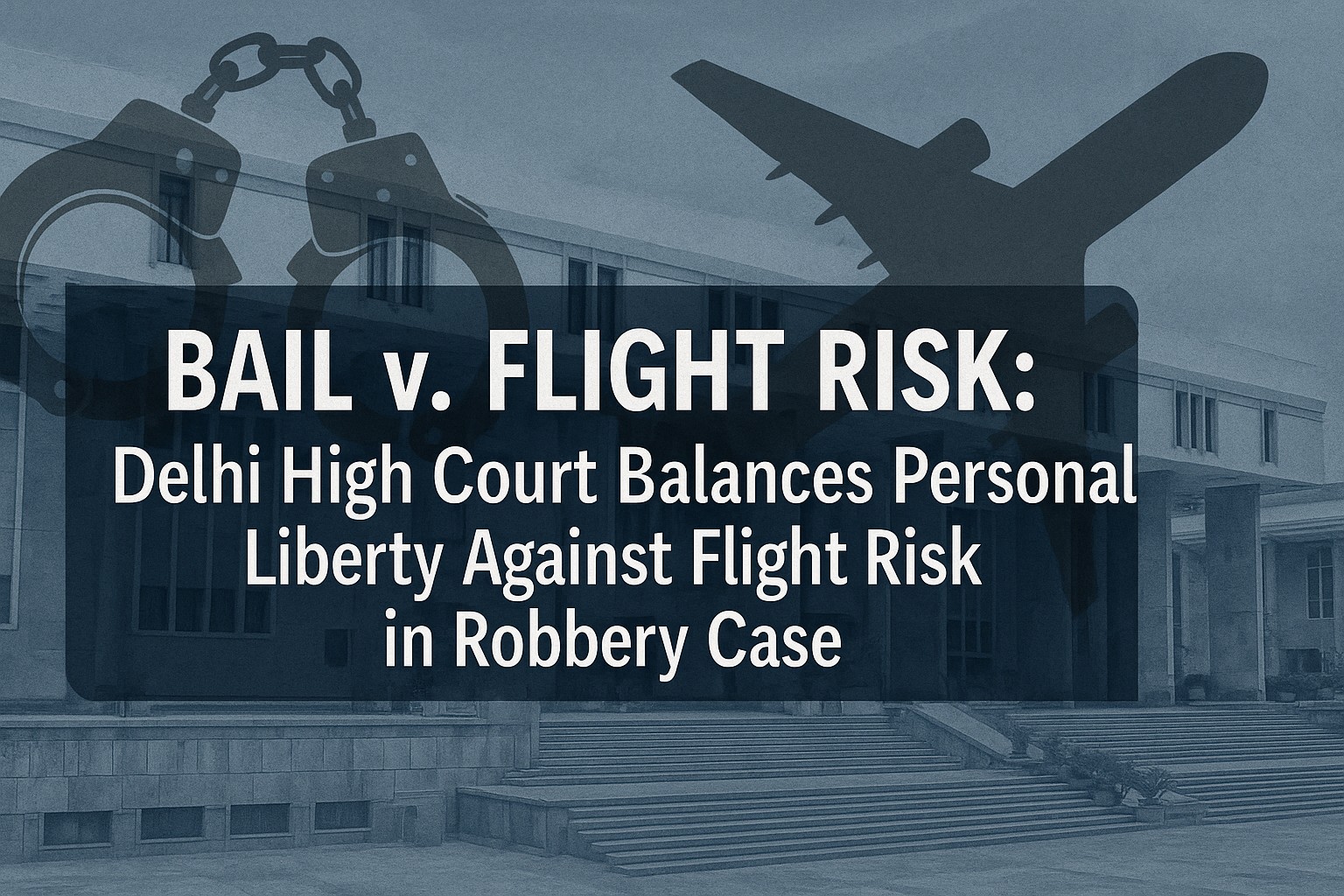
A recent judgment by Justice Amit Mahajan of the Delhi High Court in Arif v. State NCT of Delhi (Bail Application 4829/2025, decided December 12, 2025) presents a nuanced examination of when bail can be granted despite prior proclamation proceedings, a development that reinforces the long-established principle that “bail is the rule, jail is the exception” while also reflecting courts’ concern with flight risk.[1]
The Facts and Procedural Background
The case involves an incident that occurred on November 25, 2023, near the Ghiyasuddin Tomb in Delhi, where a complainant and his friend were allegedly cornered and threatened by a group of persons who demanded their mobile phones and money. According to the prosecution’s case, the accused persons forcibly snatched the complainant’s mobile phone by attacking with some sharp object. This incident led to the registration of FIR No. 394/2023 under Sections 394, 397, and 34 of the Indian Penal Code (IPC), which deal with dacoity and dacoity with attempt to cause death or grievous hurt.[1]
The applicant, Arif, who was 22 years old at the time, was arrested on November 26, 2023, on the basis of secret information and the purported disclosures made by co-accused persons. The trial court, recognizing that the applicant had already spent considerable time in custody and considering that he was a young person with no previous criminal involvements, released him on bail on June 1, 2024. The trial court also noted that all public witnesses had been examined and there was no reasonable apprehension of the applicant influencing the remaining formal witnesses.[1]
However, the applicant’s liberty proved to be temporary. When he failed to appear before the trial court on May 19, 2025, the court issued Non-Bailable Warrants (NBWs) against him for July 15, 2025. When these warrants came back unserved, the court initiated proclamation proceedings under Section 84 of the Bharatiya Nagarik Suraksha Sanhita, 2023 (BNSS), which replaced Section 82 of the former Code of Criminal Procedure, 1973. Following these proceedings, the applicant was taken into custody on August 30, 2025, after his application for recalling the proclamation proceedings was dismissed.[1]
The Applicant’s Case: Alleged Police Harassment
In his bail application before the High Court, the applicant presented a narrative starkly different from that of the prosecution. He contended that his non-appearance before the trial court was not a deliberate attempt to evade trial but rather a consequence of alleged harassment by a Beat Constable on April 17, 2025. According to the applicant, he had left Delhi solely on account of torture and harassment by the concerned constable, and not with any intention of absconding. The applicant stressed that given the young age of 22 years, he should not be subjected to incarceration for the entire duration of the trial merely because proclamation proceedings had been initiated against him.[1]
The State’s Opposition
The State’s Additional Public Prosecutor opposed the grant of bail by highlighting a critical procedural deficiency in the applicant’s case. The prosecutor pointed out that when the applicant had moved an application for recalling the proclamation proceedings on August 30, 2025, the application was dismissed precisely because the applicant had provided no documentary evidence to substantiate his allegations of torture by the Beat Constable. Without such corroborating evidence, the State argued, the applicant’s explanation for his non-appearance could not be credited.[1]
The High Court’s Analysis
Justice Amit Mahajan began his analysis by noting that there was no change in the compelling circumstances that had led the trial court to grant bail to the applicant initially. These circumstances—his youth, the considerable time already spent in custody, the absence of previous criminal involvements, and the completion of examination of public witnesses—remained equally valid at the time of the High Court’s consideration.[1]
The most significant aspect of the Court’s reasoning lies in its treatment of the flight risk issue raised by the initiation of proclamation proceedings. Justice Mahajan acknowledged that such proceedings do raise certain doubts about whether the accused is a flight risk. However, the Court firmly stated that there is no absolute bar against the grant of bail relief to an accused merely because proclamation proceedings have been initiated. [1]
In articulating this principle, the Court observed that the applicant had already spent considerable time in custody, and the initiation of the proclamation proceedings occurred approximately one year after the applicant had been initially released on bail. The Court also noted a significant fact: the applicant himself had appeared before the trial court on August 30, 2025, when arrested in connection with the proclamation proceedings. This appearance suggested that the applicant was not entirely beyond the reach of law enforcement and had not completely absconded. [1]
The Court explicitly refrained from making a final determination on the viability of the applicant’s explanation regarding police harassment at that juncture, stating that it did not consider it “apposite to delve into the viability” of such explanation. However, the Court recognized the significance of the timing—the proclamation proceedings were only warranted after approximately one year of the applicant’s initial release, a substantial gap that suggested the non-appearance was not part of a pre-meditated plan to evade trial. [1]
Bail Granted with Stringent Conditions
Recognizing the legitimate concerns of the State regarding flight risk, Justice Mahajan granted bail to the applicant but imposed a comprehensive set of conditions designed to allay any apprehension that the applicant might evade trial. The conditions included: [1]
- Personal Bond Requirement: The applicant was directed to furnish a personal bond for ₹25,000 with two sureties of the like amount, subject to the satisfaction of the trial court.[1]
- Non-Interference Undertaking: The applicant was prohibited from directly or indirectly making any inducement, threat, or promise to any person acquainted with the facts of the case or tampering with evidence in any manner whatsoever.[1]
- Travel Restriction: The applicant was prohibited from leaving the country without the permission of the trial court.[1]
- Court Appearance: The applicant was directed to appear before the trial court as and when directed.[1]
- Reporting to Investigation Officer: Following his release, the applicant was required to mark his presence before the concerned Investigating Officer once every 15 days.[1]
- Address Disclosure: The applicant was required to provide the address where he would be residing after his release to the Investigating Officer and Station House Officer, with the additional restriction that he could not change this address without informing the concerned officials.[1]
- Mobile Connectivity: The applicant was directed to provide his mobile number to the concerned Investigating Officer and keep his mobile phone switched on at all times.[1]
The Court also made it clear that in the event of any new FIR, DD entry, or complaint being lodged against the applicant, it would be open to the State to seek cancellation of bail.[1]
Legal Principles Affirmed
This judgment reaffirms several well-established principles in Indian criminal jurisprudence. First, it reinforces the cardinal principle that bail is the rule and incarceration is the exception. Courts are mandated to balance the personal liberty of the individual, a fundamental right guaranteed under Article 21 of the Constitution, against the legitimate interests of the State in securing the presence of the accused during trial.[1]
Second, the judgment demonstrates the judicial approach to flight risk assessments. While initiation of proclamation proceedings under Section 84 of the BNSS undoubtedly raises concerns about whether an accused is a flight risk, the absence of corroborating evidence about flight risk cannot serve as the sole ground for indefinite incarceration. The Court properly distinguished between the procedural reality of proclamation proceedings and the substantive question of whether bail should be refused.[1]
Third, the judgment illustrates the flexibility available to courts in imposing bail conditions. Rather than choosing between binary options—either grant bail without restrictions or deny bail entirely—courts can craft a middle path by imposing stringent conditions that address specific concerns of flight risk while respecting the individual’s fundamental right to liberty.[1]
The Triple Test for Bail
The decision implicitly relies on what is known as the “triple test” for bail, which has been recognized in Indian jurisprudence. This test requires courts to assess:[1]
- Whether the accused is a flight risk
- Whether there is apprehension of the accused tampering with evidence
- Whether there is apprehension of the accused influencing witnesses
In the applicant’s case, the Court found that regarding the completed public witnesses, there was no reasonable apprehension of witness tampering. The various conditions imposed—particularly the regular reporting to the Investigating Officer, the residential address disclosure, and the mobile phone connectivity requirement—were designed to effectively address any flight risk.[1]
Significance for Bail Jurisprudence
This judgment carries important implications for bail jurisprudence in the post-BNSS era. With the replacement of the Code of Criminal Procedure, 1973, by the Bharatiya Nagarik Suraksha Sanhita, 2023, courts have had to interpret analogous provisions while maintaining continuity with well-established principles. Section 84 of the BNSS, dealing with proclamation for absconding persons, is substantially similar to the former Section 82 of the CrPC. This judgment clarifies that the mere fact of proclamation proceedings does not create an absolute bar to bail grant.[1]
The judgment also addresses the practical reality faced by many accused persons: the burden of balancing continued legal proceedings against the economic and social cost of prolonged custody. For a 22-year-old individual with limited resources, the prospect of spending the entire duration of a lengthy trial in custody can be economically and psychologically devastating. The Court’s approach recognizes this human dimension while maintaining procedural safeguards.
Conclusion
Justice Amit Mahajan’s judgment in Arif v. State NCT of Delhi exemplifies judicial wisdom in balancing fundamental rights with legitimate state interests. It confirms that while flight risk is a legitimate concern for courts, the initiation of proclamation proceedings does not automatically preclude bail grant. Instead, courts must conduct a holistic assessment of the circumstances, including the time spent in custody, the nature of the offense, the applicant’s roots in the community, and the availability of less restrictive alternatives to incarceration.[1]
The comprehensive conditions imposed in this case demonstrate that courts can craft nuanced bail orders that satisfy both the need to ensure the accused’s presence during trial and the constitutional imperative to protect personal liberty. The judgment reinforces the enduring principle that in criminal justice systems built on the rule of law, the protection of personal liberty remains paramount, provided that adequate safeguards are in place to secure the proper administration of justice.[1]
- 59512122025BA48292025_200912.pdf
- https://delhicourts.nic.in/viewdocuments/QTdPc0VsdjNtNDhWaUV3Z0x3VGVwYTU4NXVNL0hGUUVDYkVydEJFcEZJTWtCNzY4N3Y5RVE0c3VJNkVEZGZiMFJzNU5BTHNCaVBha2RXM3ZCM01Mamc9PQ_EQUALS__EQUALS_
- https://thelaw.institute/criminal-justice-processes/bail-non-bailable-offences-judicial-discretion/
- https://restthecase.com/knowledge-bank/what-to-do-if-bail-is-rejected-in-sessions-court-in-india
- https://kanoongpt.in/bare-acts/the-bharatiya-nagarik-suraksha-sanhita-2023/arrangement-of-sections-chapter-vi-c-proclamation-and-attachment-section-84-87c0661247d00581
- https://api.sci.gov.in/supremecourt/2024/51306/51306_2024_4_1502_59838_Judgement_28-Feb-2025.pdf
- https://criminallawstudiesnluj.wordpress.com/2021/09/13/bail-under-crpc-v-bail-under-uapa-a-critical-analysis/
- https://www.drishtijudiciary.com/to-the-point/bharatiya-nagarik-suraksha-sanhita-&-code-of-criminal-procedure/proclamation-and-attachment
- https://delhihighcourt.nic.in/app/showFileJudgment/AJB07112025CRLA10452025_162601.txt
- https://www.scconline.com/blog/post/2024/02/13/supreme-court-illuminates-bail-under-section-43d-5-of-uapa-against-crpc/
- https://www.mha.gov.in/sites/default/files/2024-04/250884_2_english_01042024.pdf