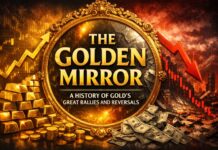
Major Gold Price Rallies in History and What Happened When They Stopped
Gold has gone through powerful multi‑year rallies followed by sharp reversals many times in the past 50 years. These rallies are never random; they are closely tied to inflation, real interest rates, the strength of the US dollar, financial crises, and investor fear or greed. When the big drivers reverse, the gold rally usually ends and prices can stagnate or fall for years.[1][2][3][4]
Below is an analytical article, in simple language, structured around questions:
- When in the past did gold prices surge and how long did those rallies last?
- What happened in the economy during and after those rallies?
- Why do gold prices rise, then suddenly stop rising and fall?
- Roughly how much did gold rise and then fall in each episode?
1. How Gold Behaves in the Economy
Gold is not just a metal; it is treated as:
- Inflation hedge – Protection when people fear rising prices and currency devaluation.[5][3][4][1]
- Safe‑haven asset – A place to park wealth in crises, when stocks or currencies look risky.[6][7][8][9][10]
- Interest‑rate sensitive asset – It pays no interest, so its price moves inversely with real interest rates.[2][3][4][1]
1.1 Real Interest Rates: The Core Driver
Research consistently shows a strong negative correlation between gold prices and real interest rates (nominal interest rate minus inflation).[3][4][1][2]
- When real interest rates are negative or very low, holding money in bank deposits or bonds becomes unattractive because inflation eats away the real value. In such times, investors move money to non‑yielding but “real” assets like gold, pushing its price up.[4][1][5][2][3]
- When real interest rates rise, especially after a central bank like the US Federal Reserve hikes rates to fight inflation, gold becomes less attractive relative to bonds and deposits, and its price tends to fall or stagnate.[9][1][2][3][4]
One study finds that a 1 percentage‑point rise in long‑term real interest rates can reduce the real price of gold by about 13%, while a 1 percentage‑point rise in expected inflation can raise real gold prices by around 37%.[4]
1.2 Safe‑Haven Demand in Crises
During big shocks (financial crises, pandemics, wars), investors often run to gold as a safe haven.[7][8][10][6][9]
- Studies show that gold acts as a safe haven particularly in large negative stock market shocks, especially under extreme conditions.[8][10][6][7]
- However, this safe‑haven behavior is often short‑lived and strongest in the initial crisis phase; as policy support arrives and markets stabilize, the pure safe‑haven role of gold tends to weaken.[10][8]
1.3 Inflation, Dollar and Central Bank Policy
- Inflation fears push gold higher because people expect paper money to lose value.[1][5][3][4]
- Because gold is priced in US dollars, a weaker dollar usually means higher gold prices, and a stronger dollar pressures gold.[5][2][3][9]
- Central bank policies (rate cuts, QE, liquidity injections) often spark or extend gold rallies by lowering real rates and raising inflation expectations.[2][3][9][1][5]
2. Major Historical Gold Rallies and Their End
Below are the main gold bull markets since the 1970s, what triggered them, what stopped them, and how long they lasted.
2.1 The 1970s Super‑Rally (Inflation & Negative Real Rates)
Period of big rise: roughly 1971–January 1980
- Gold was about 35 USD/oz in 1971 (end of Bretton Woods) and surged to about 850 USD/oz by January 1980.
- This is roughly a 24‑fold increase over less than a decade.
What was happening in the economy?
- The US came off the gold standard in 1971, making currencies fiat and increasing uncertainty.[1][4]
- The 1970s saw very high inflation, oil shocks, and low or negative real interest rates for long stretches.[5][2][4][1]
- Real interest rates were negative because inflation was above nominal interest rates, making cash and bonds unattractive.[4][1]
- Investors rushed into gold as an inflation hedge and store of value.[1][5][4]
What stopped the rally?
- The US Federal Reserve under Paul Volcker dramatically raised nominal interest rates in late 1979–early 1980 to crush inflation.[2][4][1]
- Real interest rates turned sharply positive, ending the negative‑real‑rate environment that had fueled gold.[2][4][1]
- A stronger dollar and credible anti‑inflation policy reduced the need for gold as a hedge.[4][1][2]
How much did gold fall and for how long?
- After hitting about 850 USD/oz in 1980, gold entered a long bear market.
- Across the 1980s and 1990s, adjusted for inflation, real gold prices fell heavily; nominally, gold drifted down towards the 300–400 USD/oz range by the late 1990s.
- Econometric work confirms that this long decline was consistent with higher real interest rates and lower inflation expectations.[1][2][4]
Economic reflection:
- The end of the rally coincided with the end of high inflation and the beginning of the “Great Moderation” (stable inflation, relatively stable growth).
- Gold’s fall reflected confidence in central banks and fiat currencies, and the relative attractiveness of stocks and bonds in a high‑real‑rate world.[2][4][1]
2.2 The 2000–2011 Bull Market (Tech Bust, 9/11, GFC, QE)
Period of big rise: roughly 2001–September 2011
- Around 2001, gold was near 250–300 USD/oz.
- By September 2011, it had reached about 1900–1920 USD/oz.
- That is about a 6–7x increase over roughly 10 years.
What triggered the rally?
- Early 2000s: Dot‑com crash, 9/11 attacks, and recession led the Fed to cut rates sharply; real rates fell.[4][1][2]
- Mid‑2000s: Worries about US deficits, dollar weakness and rising commodity prices supported gold.[5][1][2][4]
- 2007–2009: Global Financial Crisis (GFC) – severe stock market crashes and banking panic. Gold demand surged as a safe haven and inflation hedge against massive stimulus and QE.[6][7][8][10][4]
- Central banks (especially emerging markets) added gold to reserves, reinforcing demand.[3][9][4]
What stopped the rally?
- After 2011, although QE continued, inflation stayed subdued and the crisis panic faded.[4]
- The US dollar began to strengthen, and expectations grew that the Fed would eventually raise rates.[3][5][1][2][4]
- As real rates stopped falling and started to rise, the environment for gold worsened.[1][2][4]
How much did gold fall and for how long?
- From its 2011 peak around 1900–1920 USD/oz, gold fell to about 1050–1100 USD/oz by late 2015 – roughly a 45% nominal decline.
- This 4–5‑year bear phase correlated with expectations of Fed rate hikes, stronger dollar, and subdued inflation.[3][5][2][1][4]
Economic reflection:
- The decline reflected shifting investor focus from crisis survival toward growth assets (equities), as well as confidence that central banks could support economies without runaway inflation.[7][8][10][4]
2.3 The 2018–2020/21 Rally (Trade Wars, Covid‑19, Ultra‑Low Rates)
Period of big rise: roughly mid‑2018–August 2020 (continued strength into 2021)
- Around mid‑2018, gold traded near 1200–1250 USD/oz.
- By August 2020, during the Covid‑19 crisis, it hit new nominal highs above 2000 USD/oz.
- That is roughly a 60–70% increase in about 2 years.
What triggered the rally?
- 2018–2019: US–China trade war, geopolitical tensions, and signs of slowing global growth supported safe‑haven demand.[8][9][6][7][5]
- The Fed pivoted from hiking to cutting rates in 2019; real yields on US Treasuries declined, strengthening gold.[9][5][3][2][1][4]
- 2020: Covid‑19 pandemic triggered a massive global shock. Early in the crisis, studies show gold acted as a safe haven for equity markets.[10][8]
- Central banks unleashed unprecedented monetary and fiscal stimulus, driving real interest rates sharply negative and creating strong expectations of future inflation.[9][10][5][3][4]
How did the rally end or pause?
- After August 2020, as vaccines appeared and economies started to reopen, risk appetite improved and the extreme safe‑haven demand cooled somewhat.[8][10]
- Markets started to price in the idea that central banks would eventually normalize policy (even if slowly).
- Gold prices pulled back from above 2000 USD/oz to the 1700–1800 USD/oz zone during 2021, a decline of around 10–15% from the peak.
Economic reflection:
- Gold’s surge mirrored maximum fear about the pandemic and expectations of sustained ultra‑low real rates.[10][8][5][4]
- The subsequent consolidation reflected reduced panic and some belief that stimulus might not produce immediate hyper‑inflation.[5][3][4]
2.4 The Post‑2022/23 Rally (Inflation Re‑Awakening, Geopolitics, Central Bank Buying)
Period: 2022–2025 (ongoing as of late 2025)
- In 2022, gold traded around 1700–1800 USD/oz, then revisited and broke above 2000 USD/oz and, by late 2024/2025, set new highs (for example, above 2700 USD/oz in October in some reports).[9][3]
- This represents a rough 50%+ rise from the lower end of its 2022 range to the recent records.
What is driving this surge?
- High and sticky inflation after massive post‑Covid stimulus and supply shocks.[3][9][5]
- Although central banks raised nominal rates aggressively in 2022–23, markets started to price in “higher for longer” inflation and expectations that real rates may not stay very high, supporting gold.[9][5][3][4]
- Geopolitical tensions (Russia–Ukraine, Middle East, other conflicts) and shifts in global alliances have increased safe‑haven demand.[6][7][8][3][9]
- Central bank gold buying, including by emerging economies seeking to diversify away from the US dollar, has added structural demand.[3][9]
How and when can this rally end?
Historical patterns suggest it is likely to end when one or more of the following occur:
- Markets become convinced that inflation is durably back under control.[5][1][3][4]
- Real interest rates rise and stay high as central banks keep policy tight.[2][1][3][4]
- Major geopolitical risks cool down and risk assets (equities, credit) become more attractive again.[7][6][8][10][9]
As of late 2025, analysts still expect further momentum, but that depends heavily on upcoming inflation and growth data and central bank decisions.[9][5][3]
3. Why Gold Rallies Stop and Prices Fall
From these episodes, we can see a common pattern:
3.1 Shift in Real Interest Rates
- Gold prices rise strongly when real interest rates are negative or falling, because the opportunity cost of holding non‑yielding gold is low.[1][5][2][3][4]
- Rallies tend to stop when central banks hike nominal rates faster than inflation, pushing real rates positive.
3.2 Changing Inflation Expectations
- When investors expect higher future inflation, gold rallies as an inflation hedge.[3][4][1][5]
- If data start showing inflation peaking or moderating, or policymakers gaining credibility in controlling it, then inflation expectations fall, and gold’s role as an inflation hedge becomes less urgent.[4][5][3]
- Econometric analysis shows that, controlling for real rates, a 1 percentage‑point increase in expected inflation can boost real gold prices by roughly 37%, illustrating how powerful expectations are.[4]
3.3 Easing of Crisis and Risk Sentiment
- During intense crises, investors exhibit “flight to safety” and buy gold along with government bonds.[6][7][8][10][9]
- Studies of the Covid‑19 crisis show that gold indeed served as a safe haven in the early phase, but its safe‑haven status weakened later as policy responses stabilized markets and investors shifted back to risk assets.[8][10]
- As stock markets recover and credit spreads tighten, some investors take profits in gold and rotate to equities and other assets, slowing or reversing the rally.[7][10][6][8][9]
3.4 Stronger US Dollar
Because gold is priced in USD, a strong dollar usually pressures gold prices:
- Higher US rates and better US growth attract capital, strengthening the dollar and making gold more expensive for non‑US buyers.[9][1][5][2][3][4]
- A weaker dollar, often associated with easier Fed policy and current‑account worries, acts as a tailwind for gold.[1][5][2][3][9][4]
When dollar strength returns (for example, during the early 1980s and in phases after 2011), gold rallies typically stall.[5][2][3][1][4]
4. How Gold’s Moves Reflect the Wider Economy
4.1 Indicator of Inflation Fears and Monetary Policy Credibility
- Persistent gold price increases often signal that markets are worried about inflation or currency debasement.[3][1][5][4]
- When gold is making new highs despite rate hikes, it can mean investors think central banks are behind the curve, i.e., not tightening enough to tame inflation.[9][5][3][4]
- Conversely, long periods of weak or falling gold prices usually match times when inflation is low and central banks are seen as credible inflation fighters (e.g., 1980s–1990s).[2][1][4]
4.2 Safe‑Haven Barometer for Crisis Intensity
- Spikes in gold prices often align with peak uncertainty – wars, recessions, pandemics, banking crises.[10][6][7][8][9]
- Research on safe‑haven assets finds gold becomes more sensitive to large negative stock market shocks, especially during crises, making it a good barometer for systemic fear.[6][7][8][10]
- As crises fade and policy support stabilizes conditions, the correlation between gold and risk assets changes, and gold may lose some of its safe‑haven premium.[7][8][10]
4.3 Reflection of Currency and Reserve Dynamics
- Central bank buying of gold – especially by countries wanting to diversify away from the US dollar – signals long‑term concerns about currency concentration and geopolitical risk.[8][3][9]
- Rising gold prices, along with sustained official buying, may therefore hint at a slow shift in the global monetary system, with more weight on gold as a neutral reserve asset.[8][3][9]
5. Summary of Rallies: Duration, Magnitude, and Reversal
Below is a simplified summary in words (approximate figures, focusing on big picture):
5.1 1970s Rally
- Start–Peak: ~1971 (≈35 USD/oz) to Jan 1980 (≈850 USD/oz).
- Duration: ~9 years.
- Rise: around +2300% (24×).
- Main Drivers:
- High, volatile inflation; negative real rates.
- Oil shocks; end of gold‑dollar convertibility.
- Weak confidence in fiat money.
- End & Fall:
- Aggressive Fed hikes; real rates turned strongly positive.
5.2 2001–2011 Rally
- Start–Peak: ~2001 (≈250–300 USD/oz) to Sept 2011 (≈1900–1920 USD/oz).
- Duration: ~10 years.
- Rise: roughly +550–650% (6–7×).
- Main Drivers:
- Low/negative real rates after tech bust and 9/11.
- US dollar weakness and fiscal/deficit worries.
- Global Financial Crisis, QE, and systemic fear.
- End & Fall:
- Stabilization after GFC; inflation remained moderate.
- Expectations of Fed normalization and stronger dollar.
5.3 2018–2020/21 Rally
- Start–Peak: mid‑2018 (≈1200–1250 USD/oz) to Aug 2020 (>2000 USD/oz).
- Duration: ~2 years for the sharp phase; strong prices into 2021.
- Rise: about +60–70%.
- Main Drivers:
- Trade‑war tensions and slowing growth fears.
- Fed pivot to lower rates; falling real yields.
- Covid‑19 shock, QE, and record stimulus; safe‑haven rush.
- End & Pullback:
- Risk appetite improved as vaccines rolled out.
- Inflation initially seen as manageable; some profit‑taking.
5.4 2022–2025 Rally (Ongoing)
- Start–Current Highs: From ≈1700–1800 USD/oz (2022) to new records above ≈2700 USD/oz in late 2024/25 (exact levels vary by source and day).[3][9]
- Duration so far: ~3 years and continuing.
- Rise so far: roughly +50%+ from lower 2022 levels to recent highs.
- Main Drivers:
- Persistent post‑pandemic inflation; energy and supply shocks.
- Geopolitical tensions and war.
- Central bank gold buying and worries about long‑term dollar dominance.
- Future reversal risk:
- Sustained high real rates and clear, durable disinflation.
6. Putting It Together for Investors and Observers
From an analytical perspective, gold rallies and corrections are macro stories, not just commodity stories. They reflect:
- Monetary regime shifts (e.g., end of gold standard, advent of QE).
- Inflation cycles and interest‑rate policy (negative vs. positive real rates).[2][1][5][3][4]
- Risk sentiment (crises vs. calm, risk‑on vs. risk‑off).[6][7][10][8][9]
- Currency and geopolitical dynamics (dollar strength, sanctions, reserve diversification).[8][5][3][9]
Prices rise when:
- Real interest rates are falling or negative.
- Inflation fears and policy uncertainty are high.
- Crises drive safe‑haven demand.
Rallies tend to end or reverse when:
- Real interest rates rise and stay positive.
- Confidence in monetary policy returns and inflation expectations decline.
- Crises ease and investors rotate back to higher‑yielding or growth assets.
In other words, gold is a mirror. When you see a big, sustained rally in gold, it is usually reflecting deep anxiety about money, inflation, or stability; when a gold rally breaks and prices fall, it usually signals a regime change – tighter policy, stronger currencies, or reduced fear.
- https://www.goldpriceforecast.com/explanations/gold-real-interest-rates/
- https://www.bullionbypost.co.uk/index/gold/gold-price-interest-rate-relationship/
- https://www.cbsnews.com/news/how-gold-prices-reflect-inflation-expectations/
- https://www.chicagofed.org/-/media/publications/chicago-fed-letter/2021/cfl464-pdf.pdf?sc_lang=en
- https://discoveryalert.com.au/news/gold-inflation-relationship-2025-price-movements/
- https://papers.ssrn.com/sol3/papers.cfm?abstract_id=5338848
- https://www.lse.ac.uk/granthaminstitute/publication/safe-haven-assets-and-investor-behaviour-under-uncertainty/
- https://www.iima.ac.in/sites/default/files/2023-06/Sruthy Madhavan.pdf
- https://timesofindia.indiatimes.com/business/india-business/gold-rate-outlook-gold-silver-hit-lifetime-highs-on-fed-signals-will-inflation-data-fuel-further-gains/articleshow/125962445.cms
- https://www.sciencedirect.com/science/article/pii/S0264999321001772
- https://www.perplexity.ai/finance/GCUSD
- https://www.perplexity.ai/finance/PII