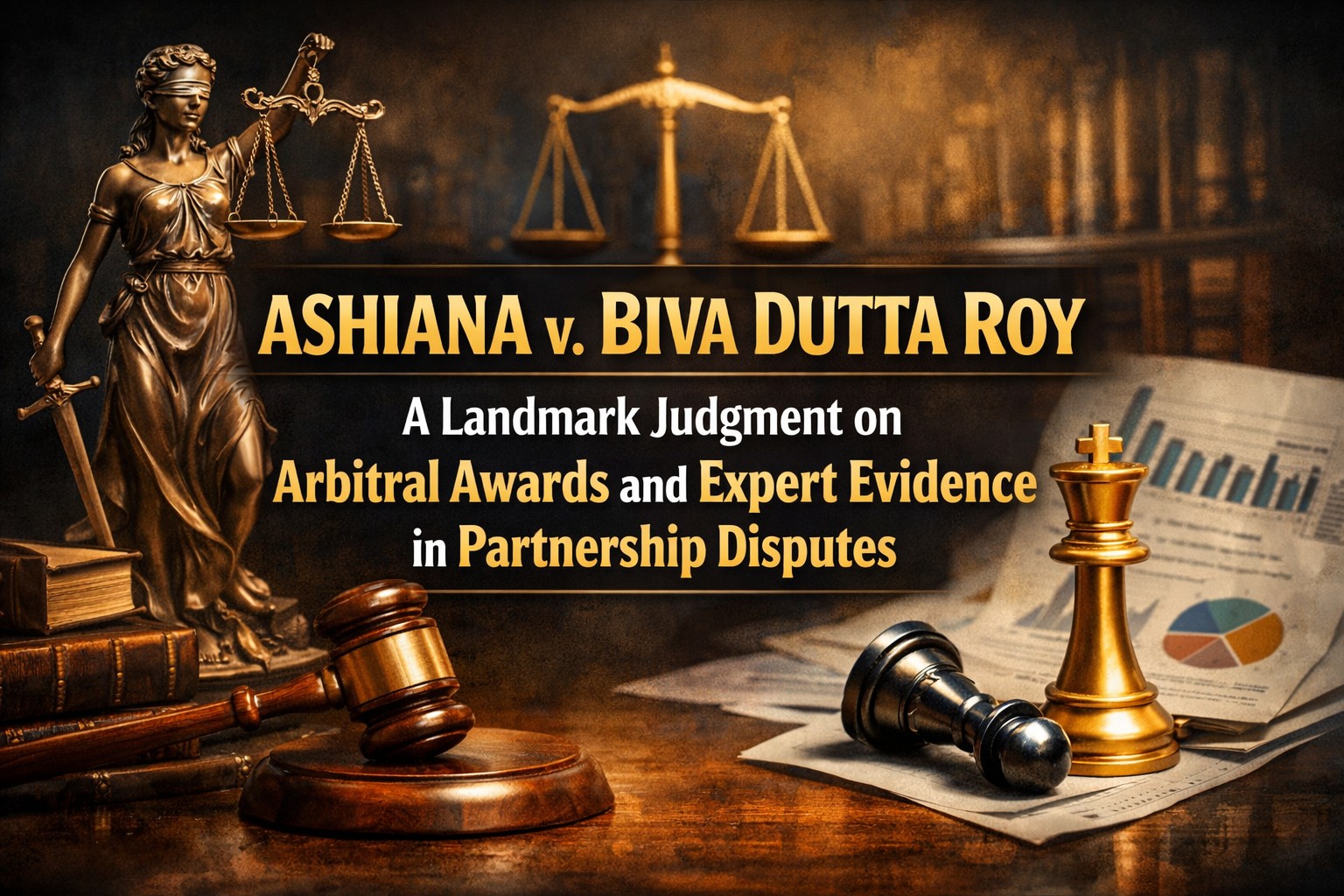
Ashiana v. Biva Dutta Roy: A Landmark Judgment on Arbitral Awards and Expert Evidence in Partnership Disputes
In this significant ruling delivered on December 24, 2025, the Calcutta High Court upheld the dismissal of an application seeking to set aside an arbitral award in a partnership dispute involving real estate development projects. The judgment in Ashiana v. Biva Dutta Roy (FMA 1390 of 2022) provides crucial guidance on the limited scope of judicial intervention under Section 34 of the Arbitration and Conciliation Act, 1996, the admissibility of expert evidence in arbitration proceedings, and the consequences of deliberate non-cooperation in producing documentary evidence. This case exemplifies the judiciary’s commitment to preserving the finality and efficacy of arbitration as an alternative dispute resolution mechanism while maintaining the enforcement of fundamental principles of natural justice.
Factual Background and Procedural History
The dispute in this case originated from three distinct partnership agreements executed between the parties for real estate development. Biva Dutta Roy (the respondent) partnered with Ashiana (represented by Ashoke Kumar Shaw) to develop three residential apartment complexes. The first partnership deed, dated January 25, 2002, governed the construction of Subhankar Apartment, while two other deeds dated July 19, 2003, pertained to Shyamkunj Apartment and Bhagawati Apartment respectively. The partnerships were ostensibly designed as collaborative ventures with clearly defined profit-sharing arrangements, with Biva’s shareholding varying across the three projects—25% in Subhankar and Shyamkunj, and 17.5% in Bhagawati.[1]
Following the completion of all three projects, Biva alleged that she had not received her rightful share of profits. She initially pursued her claims through the civil court system, filing three separate civil suits (Title Suit Nos. 516, 517, and 523 of 2008) before the Civil Judge (Senior Division), 1st Court at Barasat. However, these suits were dismissed, though not on their merits, which suggested procedural or jurisdictional deficiencies rather than a substantive rejection of the claims.[1]
Subsequently, Biva invoked the arbitration clauses contained in each partnership deed and served notices of arbitration on the other partners. When no arbitrator could be appointed by mutual consent, she filed three applications under Section 11 of the Arbitration and Conciliation Act, 1996, seeking judicial appointment of an arbitrator. By an order dated December 4, 2012, the Calcutta High Court appointed a senior advocate as sole arbitrator to handle all three disputes. This composite reference—wherein disputes under multiple partnership agreements were consolidated into a single arbitration—proceeded despite the appellant’s later contestation of this procedural approach.[1]
The Arbitration Process and the Appointment of the Chartered Accountant
The central factual issue in the arbitration was the determination of Biva’s entitlement to profits from the three partnership firms. Both parties filed pleadings and adduced evidence. The arbitrator, recognizing that the dispute fundamentally centered on the accounts of the three partnership firms and that the parties could not produce complete books of accounts, balance sheets, audited accounts, or income-tax returns, deemed it appropriate to appoint a professional Chartered Accountant to provide expert assistance.[1]
Significantly, both parties initially consented to this appointment. However, this consensus proved short-lived. In a letter dated August 1, 2016, Ashiana’s advocate refused to share the remuneration of the Chartered Accountant and withdrew the earlier consent. Despite this withdrawal, the arbitrator exercised his statutory authority under Section 26 of the 1996 Act to appoint S.N. Guha & Co., Chartered Accountants, to scrutinize the accounts of the three partnership firms.[1]
The Chartered Accountant subsequently filed its report dated November 7, 2016. Notably, the report itself contained a significant caveat: the Chartered Accountant noted that it was not in a position to certify the net profits of the three firms due to the non-production of complete books of accounts, bank statements, and other records. Despite these limitations, the Chartered Accountant proceeded to prepare its findings based on the available materials and submitted detailed calculations regarding the profit entitlements of each party.[1]
The Arbitrator’s Award and Its Quantification
After careful consideration of the evidence and the Chartered Accountant’s report, the arbitrator made specific findings regarding Biva’s entitlements in each project. For Subhankar Apartments, where Biva held a 25% share, the arbitrator awarded Rs. 1,03,526/-. For Shyamkunj Apartments, also with a 25% shareholding, Biva’s total profit share was calculated as Rs. 10,72,303/-, of which she had already received Rs. 6,50,000/-, leaving a balance of Rs. 4,47,303/- payable to her. For Bhagawati Apartment, with a 17.5% share, her profit entitlement was determined at Rs. 4,92,010/-, against which she had received Rs. 8,22,500/-, resulting in what the arbitrator assessed as a net balance of Rs. 1,59,510/-.[1]
The total award granted to Biva amounted to Rs. 10,10,339/-, along with interest at 6% per annum from July 15, 2008 (the date of the arbitration reference request) until November 6, 2013, and thereafter at 10% until final payment. Additionally, Ashiana was directed to reimburse Biva with 50% of the Chartered Accountant’s remuneration, amounting to Rs. 17,250/-.[1]
The Application for Setting Aside the Award
Dissatisfied with the award, Ashiana filed an application under Section 34 of the Arbitration and Conciliation Act, 1996, seeking to set it aside. The Additional District Judge, 3rd Court, North-24 Parganas, dismissed this application on February 8, 2022, upholding the award and its enforceability. This dismissal prompted Ashiana to appeal to the Calcutta High Court, raising an array of contentions that necessitated the court’s careful examination of the law governing arbitral awards in India.[1]
Grounds of Challenge: A Multi-Pronged Attack on the Award
Ashiana’s counsel advanced ten distinct grounds for challenging the award, each targeting different perceived deficiencies. First, it was contended that the award was unreasoned in violation of Section 31(3) of the 1996 Act. Second, the arbitrator’s conclusions were characterized as “unfathomable and impossible.” Third, Ashiana alleged that the arbitrator had exceeded his jurisdiction by dealing with matters not referred to him, thereby committing an error that rendered the award patently illegal. Fourth, the appellant asserted that the arbitrator’s conclusions were based on no evidence and were perverse. Fifth, it was argued that the trial judge had failed to examine whether the award was vitiated by patent illegality appearing on its face, contrary to Section 34(2A) of the 1996 Act.[1]
Sixth, a significant line of attack focused on the expert evidence. Ashiana’s counsel contended that the award was based entirely on an expert report prepared by a Chartered Accountant unilaterally appointed by Biva at her instance, and that such a report constituted merely an opinion that was biased in her favor. Relying on the Supreme Court’s decision in Chennadi Jalapathy Reddy v. Baddam Pratapa Reddy, the appellant argued that expert evidence is inherently weak and not substantive in nature, and that adjudicating authorities must be cautious in evaluating such evidence, never relying solely upon it.[1]
Seventh, Ashiana argued that the Chartered Accountant had not recorded reasons in support of his conclusions and had actually admitted that the data and material provided were incomplete. The report’s statement that the accountants “were not in a position to certify the net profit of the three firms” was cited as rendering the award itself perverse and based on no evidence.[1]
Eighth, a jurisdictional challenge was mounted on the ground that the three partnership agreements contained three separate arbitration clauses with different parties. Ashiana contended that all three agreements could not be combined into a single arbitration or composite reference, and that the arbitration proceeding was therefore non est in the eye of law, making the award a nullity. Even if composite reference was permissible, Ashiana argued, the parties to the three deeds were not identical, and therefore separate arbitration references should have been constituted.[1]
Ninth, Ashiana asserted that the award was liable to be set aside as being in conflict with the public policy of India, contending that the arbitrator had not sought to evaluate the Chartered Accountant’s report or obtained independent corroboration thereof, thereby breaching the fundamental principles of natural justice.[1]
Finally, Ashiana’s counsel argued that the appellant had deliberately withheld relevant documents in his custody and control, and that consequently, an adverse inference should not be drawn against the appellant for the non-production of evidence.[1]
The Respondent’s Defense and the Principle of Estoppel
In response, Biva Dutta Roy’s senior counsel argued that Ashiana, who maintained effective control and possession of all the books of accounts and financial records of the three partnership firms, had deliberately failed to cooperate with the Chartered Accountant and subsequently with the arbitrator. After initially consenting to the appointment of the Chartered Accountant, Ashiana withdrew this consent and ceased appearing before the Chartered Accountant and the arbitrator, thereby adopting a strategy of obstruction and non-cooperation.[1]
Additionally, it was argued that Ashiana had not raised the contention that separate arbitration references should have been made for the three projects before the arbitrator. By participating in the composite arbitration proceedings without raising this objection, Ashiana was estopped from asserting this ground for the first time in the Section 34 application. The respondent also emphasized that under the restricted scope of Section 34 of the 1996 Act, as amended, courts cannot re-appreciate evidence as if sitting in appeal over an arbitral award. The grounds for setting aside an award are exhaustively enumerated in the statute, and Ashiana had failed to establish any of these grounds.[1]
The High Court’s Analysis and Application of Law
The Calcutta High Court, in a well-reasoned judgment by Justice Arijit Banerjee (concurred with by Justice Om Narayan Rai), undertook a detailed examination of the legal framework governing arbitral awards and the limited scope of judicial intervention. The court emphasized that the legislature’s intention in enacting the 1996 Act was to minimize judicial interference with arbitral awards and to promote arbitration as an efficient and expeditious mechanism for dispute resolution.[1]
The Limited Scope of Section 34
The court began by reiterating the foundational principle established in numerous Supreme Court decisions: when exercising jurisdiction under Section 34 of the 1996 Act, a court does not function as an appellate court and does not sit in appeal over an arbitral award. The section lists exhaustive grounds for challenging an award, and a petitioner must establish at least one of these grounds to succeed. The proviso to Section 34(2A) explicitly clarifies that an award cannot be set aside merely because the arbitrator has erred in applying the law or because evidence has been reappreciated.[1]
The court cited with approval the Division Bench decision in Laxmi Pat Surana v. Voltas Ltd., which synthesized the key legal principles emerging from extensive case law:
“If the conclusion or the final decision of the Arbitrator is based on a possible view of the matter, a Court should not interfere with an award. Generally, the conclusion of the Arbitrator with regard to the construction of a contract is not to be interfered with, if there is a plausible view of the matter, and even an error relatable to interpretation of the contract by an Arbitrator is regarded as an error within its jurisdiction and as such it is an error which is not amenable to correction by Courts.”[1]
The court further noted that a perverse finding is one based on no evidence or one that no reasonable person would have arrived at. Unless relevant evidence has not been considered or inadmissible material has been taken into consideration, a finding cannot be deemed perverse.[1]
The Doctrine of Patent Illegality Under Section 34(2A)
The court carefully examined the doctrine of patent illegality introduced by the 2015 Amendment to the 1996 Act. Patent illegality, as a ground for setting aside a domestic award, applies when the award is vitiated by illegality appearing on its face—such as when the arbitrator provides no reasoning in violation of Section 31(3) of the Act, or when the decision is so irrational that no reasonable person would have arrived at it, or when the view taken by the arbitrator is not even a plausible view.[2]
The Supreme Court’s judgment in Associate Builders v. Delhi Development Authority was cited to establish that when applying the public policy test to an arbitration award, a court does not act as a court of appeal. Errors of fact cannot be corrected; the arbitrator is the ultimate master of the quantity and quality of evidence. An award based on little evidence or evidence of poor quality would not be held invalid on this score. Once it is found that the arbitrator’s approach is not arbitrary or capricious, he is the last word on facts.[1]
The Tribunal-Appointed Expert Under Section 26
Significantly, the High Court addressed the critical question of whether an arbitrator may appoint an expert to assist in resolving technical or specialized issues, even without the unanimous consent of both parties. The court held that Section 26 of the 1996 Act statutorily empowers an arbitral tribunal to appoint experts to report on specific issues, and this power is not contingent on the continued consent of both parties after the appointment decision has been made.[1]
The court observed:
“In spite of the Chartered Accountant calling for the relevant documents, the parties supplied incomplete documents to him. It is the consistent stand of the respondent no. 1 that all relevant accounting documents pertaining to the business activities of the three partnership firms were in the custody and under the control of the appellant. The appellant supplied incomplete balance sheet of one particular financial year, to the Chartered Accountant. His stand that he did not have any further documents, does not appear to be bona fide since from the evidence on record it appears that all such documents were under his control.”[1]
The court found that Ashiana, which had been instrumental in getting the accounts of the three firms audited and balance sheets prepared, possessed all the relevant documents. By adopting a policy of deliberate non-cooperation and withholding documents from the Chartered Accountant, Ashiana sought to frustrate the expert’s work and the arbitrator’s ability to arrive at a proper determination. The court noted that “the appellant having kept away the best evidence from the Chartered Accountant and the Arbitrator, cannot be heard to complain of the Chartered Accountant’s report or the arbitral award being based on insufficient material or inadequate evidence.”[1]
Expert Evidence and Judicial Scrutiny
Addressing the contention that the award was based solely on expert evidence of poor quality, the court held that adequacy or otherwise of evidence is for the arbitrator to decide. The arbitrator is the sole adjudicator of the quantity and quality of evidence. Unless his decision in this regard is perverse, courts will not interfere. The present case was not one where there was no evidence at all before the arbitrator; rather, there were pleadings, witness evidence, and the expert report based on available documentary materials.[1]
The court rejected the argument that expert evidence is inherently weak or unreliable. While recognizing that parties may present their own experts and that arbitrators must carefully weigh conflicting expert opinions, the court held that the appointment of a neutral, tribunal-appointed expert, especially when dealing with specialized matters like accounting and financial analysis, serves a legitimate and necessary function in arbitration proceedings. The fact that the Chartered Accountant had to work with incomplete materials due to deliberate non-cooperation by the appellant did not render the report inherently unreliable or the award perverse.[1]
The Doctrine of Adverse Inference
The court invoked the doctrine of adverse inference, citing the Supreme Court’s decision in K.M. Patel v. Firm, Mohamadhussain Rahimbux, to hold that when a party deliberately withholds documents or evidence within its exclusive control, an adverse inference may be drawn that such evidence, had it been produced, would have gone against that party. The court found that Ashiana had failed to disclose the complete set of accounting records and balance sheets, thereby depriving both the Chartered Accountant and the arbitrator of full information necessary for a comprehensive determination.[1]
The Issue of Composite Reference
Regarding Ashiana’s contention that the three partnership agreements could not be consolidated into a single composite arbitration, the court did not render an explicit pronouncement on this question but treated it as effectively resolved by the parties’ implicit acceptance of the composite reference through their participation in the consolidated proceedings. Notably, the appellant had not raised this objection before the arbitrator, and by participating in the proceedings without protest, it was deemed to have waived any right to subsequently assert this ground.[1]
The contemporary jurisprudence on composite references emphasizes that when disputes arising from multiple interconnected contracts are sufficiently linked by a common underlying relationship and the parties’ conduct demonstrates an implicit agreement to unified adjudication, courts may permit—and tribunals may conduct—composite arbitrations without violating fundamental principles. The court’s silence on this matter thus implicitly endorsed the consolidation.[3][4][5]
Critical Legal Principles Established by the Judgment
The Balance Between Finality and Justice
This judgment encapsulates a fundamental tension in modern arbitration law: the need to finalize disputes expeditiously while ensuring that arbitral awards are not arbitrary or irrational. The court deftly navigated this tension by emphasizing that judicial intervention under Section 34 is limited to ensuring that the arbitrator has remained within jurisdiction, followed fair procedures, and not acted in a manner that is demonstrably perverse or contrary to public policy. The court did not sit in judgment over the arbitrator’s factual findings or his appraisal of evidence, thereby respecting the autonomy of the parties in choosing arbitration as their dispute resolution mechanism.[2][1]
The Legitimacy of Expert-Assisted Arbitration
The judgment significantly endorses the use of tribunal-appointed experts in arbitration, particularly where parties lack the technical expertise to evaluate specialized matters such as accounting and financial analysis. By holding that an arbitrator’s decision to appoint an expert is statutorily authorized and not contingent on continued party consent, the judgment recognizes that expert assistance enhances the quality and fairness of arbitral proceedings, especially in complex commercial disputes involving accounting, engineering, valuation, or other technical domains.[6][1]
This principle is of immense significance in India’s evolving arbitration jurisprudence. It signals that the appointment of experts is not merely a convenience but a substantive tool for achieving justice in technical disputes. When parties attempt to frustrate such appointments through withdrawal of consent or non-cooperation, arbitrators and courts are empowered to proceed despite such obstruction, and parties cannot subsequently attack awards relying on expert evidence on the ground that such reliance was inappropriate.[1]
The Doctrine of Non-Cooperation and Adverse Inference
The judgment firmly establishes that a party that deliberately withholds documentary evidence within its exclusive control cannot subsequently complain that the arbitral award is based on inadequate evidence. This principle serves a vital protective function in arbitration by ensuring that parties cannot benefit from their own misconduct or obstructionist tactics. By clearly articulating this doctrine, the court has sent a strong signal that transparency and cooperation are essential to the integrity of arbitral proceedings, and deliberate non-cooperation will invite adverse consequences.[6][1]
The Rigorous Application of Section 34(2A)
The judgment demonstrates that while Section 34(2A) of the 1996 Act—introduced by the 2015 Amendment—provides an additional ground for challenging domestic awards on the basis of patent illegality, this ground is applied with considerable rigor. Patent illegality is not invoked merely because the award rests on limited evidence, involves reliance on expert opinion, or represents a view other than what the challenging party would have preferred. Rather, it is confined to situations where the award is so irrational, arbitrary, or contradictory of fundamental legal principles that no reasonable decision-maker could have reached such a conclusion.[2][1]
Implications for Partnership Disputes and Commercial Arbitration in India
Partnership Disputes and the Arbitration Clause
This case reaffirms the principle that partnership disputes, including those concerning profit-sharing and accounts settlement, are eminently arbitrable. The arbitration clause in a partnership deed survives even the dissolution of the partnership firm and can be invoked to resolve disputes regarding profit distribution, accounts, and claims for breach of fiduciary duties.[7][8]
The use of arbitration for partnership disputes offers several advantages over litigation: disputes can be resolved more expeditiously, the proceedings remain confidential, and experienced arbitrators familiar with commercial and partnership law can adjudicate complex factual and legal questions. The judgment’s strong endorsement of arbitration in this context is likely to encourage more partnerships to include arbitration clauses in their deeds.[9]
The Role of Accounting and Financial Expertise
For partnership disputes involving profit-sharing, the judgment establishes that arbitrators may and should appoint Chartered Accountants or other financial experts to analyze accounts and determine profit entitlements. This approach is particularly valuable in cases where partners maintain separate accounting records or where accounting practices may be disputed. Rather than leaving such technical determinations to the arbitrator’s lay judgment, the appointment of an expert ensures that the award is grounded in sound financial analysis.[9]
However, the judgment also highlights the importance of full cooperation and transparency in providing documents to such experts. Partners cannot strategically withhold accounting records and then claim that the expert’s analysis is unreliable. This has significant implications for the governance of partnerships: partners are implicitly required to maintain transparent accounting records and to make such records available when disputes arise.[9]
The Limits of Appellate-Style Review
For practitioners and litigants, this judgment serves as a stern reminder that Section 34 is not an appellate forum. Even if a party believes the arbitrator has reached an incorrect conclusion on the facts or misapplied the law, such grounds cannot support a Section 34 application. Courts will interfere only in cases of gross irrationality, manifest illegality, or procedural unfairness. This principle has profound implications for strategy in arbitration: parties must do their best before the arbitrator, as the opportunity for correction by courts is extremely limited.[2][1]
Conclusion
The judgment in Ashiana v. Biva Dutta Roy represents a mature and principled application of the law governing arbitral awards in India. By firmly upholding the limited scope of judicial intervention under Section 34 of the 1996 Act, endorsing the use of tribunal-appointed experts in technical disputes, recognizing the doctrine of adverse inference against parties that withhold evidence, and refusing to permit parties to benefit from their own obstructionist conduct, the court has reaffirmed the integrity and finality of arbitration as a dispute resolution mechanism.
The judgment’s significance extends beyond the specific context of partnership disputes. It provides crucial guidance for arbitrators, parties, and counsel in understanding the extent to which arbitral awards are protected from judicial challenge and the standards that courts will apply in deciding applications for setting aside awards. By maintaining a firm distinction between permissible grounds for challenge and impermissible appeals based on re-appreciation of evidence or disagreement with the arbitrator’s application of law, the judgment advances the cause of arbitration finality while ensuring that the most egregious violations of law or procedure do not escape judicial oversight.[2][1]
For practitioners engaged in partnership disputes, real estate development transactions, and other commercial matters, the judgment underscores the importance of including well-drafted arbitration clauses that contemplate the appointment of experts, providing clear procedures for the production of documents, and establishing mechanisms for resolving disputes expeditiously. The judgment also sends a sobering message to parties inclined toward non-cooperation or evidence suppression: such tactics will not succeed in vitiating an arbitral award but will instead result in adverse inferences and enforcement of awards against the obstructing party.[1]
Citations:
Ashiana v. Biva Dutta Roy, FMA 1390 of 2022, Calcutta High Court (December 24, 2025)[1]
Section 34 of the Arbitration and Conciliation Act, 1996; Associate Builders v. Delhi Development Authority, (2015) 3 SCC 49[2]
R&D Law Chambers, “Composite Reference for Arbitration of Disputes from Multiple Interconnected Contracts” (2024)[3]
SCCOnline, “Composite Adjudication and Analogous (Or Consolidated) Adjudication by Arbitral Tribunals” (2022)[4]
Aceris Law, “Initiating Arbitrations Under Multiple Arbitration Agreements” (2020)[5]
Maheshwari & Co., “Navigating Profit Sharing and Partnership Disputes in India” (2024)[9]
Law Curb, “Arbitration Clause In Partnership Deed Legal Validity” (2025)[7]
Bar and Bench, “Documentary Proof: The Backbone of Arbitration Awards” (2025)[6]
SCCOnline, “Arbitration Proceedings by Unregistered Partnership Firms” (2022)[8]
- ca6ae9248eef48cc03831146a147a792f86f1c877303006610adc2365743aa421766684144.pdf
- https://corporate.cyrilamarchandblogs.com/2020/05/supreme-court-reaffirms-the-scope-of-patent-illegality/
- https://wiidare.com/expert-evidence-in-arbitration-a-short-guide/
- https://rdlawchambers.com/composite-reference-for-arbitration-of-disputes-from-multiple-interconnected-contracts/
- https://conventuslaw.com/report/india-dmrc-v-damepl-and-the-2024-amendment-bill-where-patent-illegality-stands-in-arbitration/
- https://www.barandbench.com/view-point/documentary-proof-the-backbone-of-arbitration-awards
- https://sheokandlegal.com/articles/partnership-disputes-through-arbitration/
- https://viamediationcentre.org/readnews/MTUxNw==/Navigating-Evidence-and-Discovery-in-Indian-Arbitration-A-Comprehensive-Guide
- https://www.maheshwariandco.com/blog/partnership-disputes-in-india/
- https://www.acerislaw.com/expert-evidence-in-international-arbitration/
- https://www.scconline.com/blog/post/2022/06/07/composite-adjudication-and-analogous-or-consolidated-adjudication-by-arbitral-tribunals-in-multi-contract-and-multi-party-disputes-a-comparative-analysis/
- https://thearbitrationdigest.com/critical-analysis-of-the-ground-of-patent-illegality-in-setting-aside-an-arbitral-award/
- https://www.pslchambers.com/article/expert-tease-me-the-importance-of-experts-in-arbitrations/
- https://www.acerislaw.com/initiating-arbitrations-under-multiple-arbitration-agreements/
- https://www.mcolegals.in/kb/Determining_Patent_Illegality_for_setting_aside_an_Arbitral_Award.pdf
- https://www.scconline.com/blog/post/2022/08/08/pre-joinder-discovery-and-document-production-requests-against-non-signatories-in-arbitration/
- https://www.linkedin.com/posts/azeez-sabri-37647423_arbitration-expertevidence-bhartiyasakshyaadhiniyam-activity-7372056527970430976-F78c
- https://blog.ipleaders.in/section-26-of-arbitration-and-conciliation-act-1966/
- https://www.scconline.com/blog/post/2022/10/26/arbitration-proceedings-by-unregistered-partnership-firms/
- https://www.lawcurb.in/post/arbitration-clause-in-partnership-deed-legal-validity