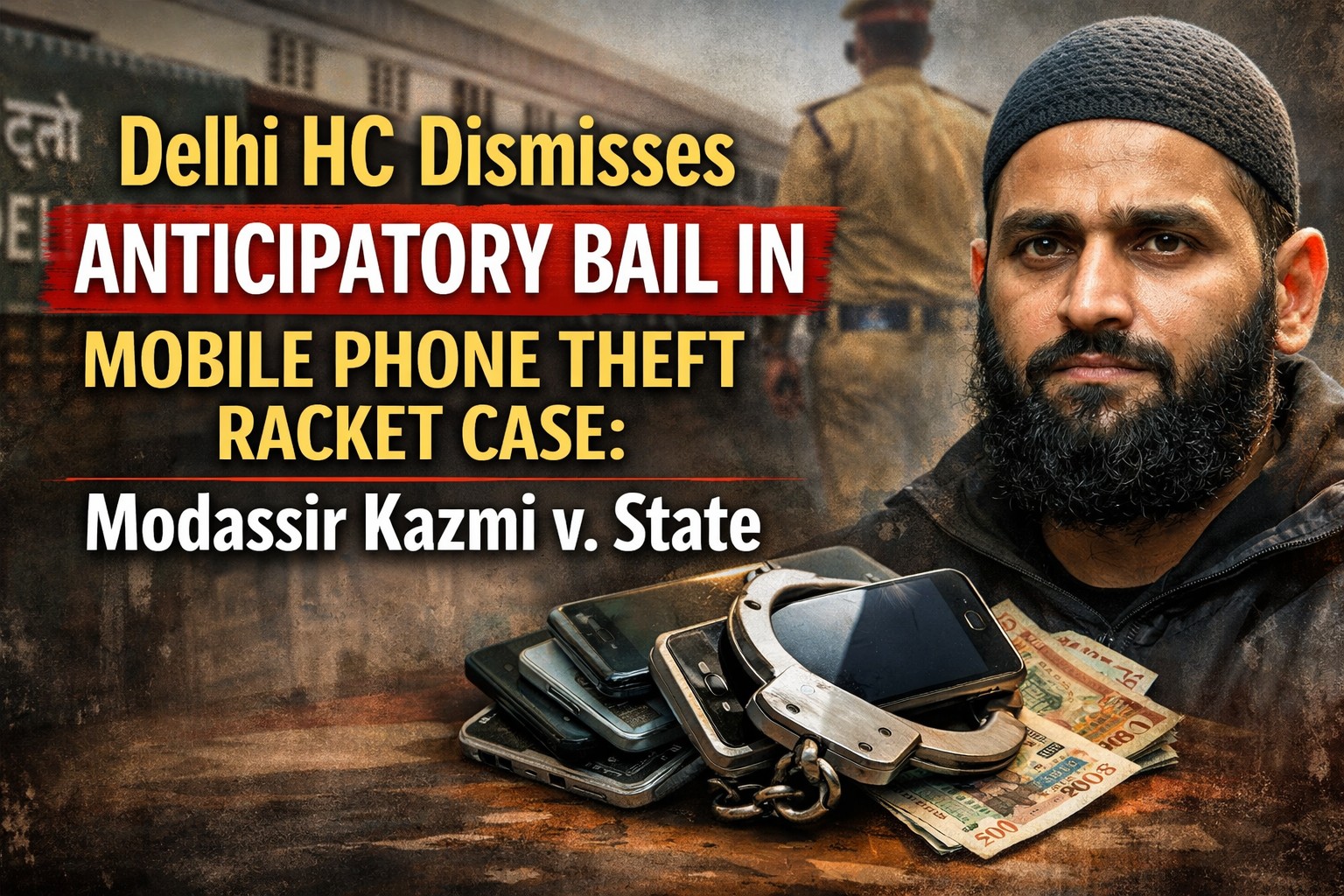
Delhi HC Dismisses Anticipatory Bail in Mobile Phone Theft Racket Case: Modassir Kazmi v. State
Introduction
In a significant judgment dated January 22, 2026, Justice Girish Kathpalia of the High Court of Delhi dismissed an anticipatory bail application filed by Modassir Kazmi, accused of operating a sophisticated stolen mobile phone racket involving IMEI number manipulation and resale. The case, registered as Bail Application 278/2026 under e-FIR No. 80078446/2025 at PS South Campus, brings to light the gravity of organized device trafficking and the evidentiary framework that courts employ while deciding bail matters in such offenses[1].
Background and Case Facts
The Allegation and Investigation
The prosecution alleged that Modassir Kazmi, operating in coordination with his brother Muzammil and other associates, was engaged in a criminal enterprise involving the purchase of stolen mobile phones, alteration of their International Mobile Equipment Identity (IMEI) numbers, and subsequent resale in the market[1].
During the investigation, the Anti-Snatching Cell of Delhi Police’s South-West Division, led by SI Kamal Kant, conducted a raid at the applicant’s shop where multiple stolen mobile phones were recovered[1]. This operation formed the foundation of the criminal allegations against Kazmi and his associates.
Charges Under the Bharatiya Nyaya Sanhita (BNS)
The accused was charged under Section 303(2), 318(4), and 3(5) of the Bharatiya Nyaya Sanhita (BNS), 2023—the newly adopted criminal procedure code that replaced the Indian Penal Code[1]. These sections pertain to organized crime, trafficking in stolen property, and conspiracy, making this a serious criminal matter requiring stringent bail conditions.
Arguments of the Petitioner (Accused)
Defense Contentions
The learned counsel for Modassir Kazmi, Advocates Rajan Chaudhary and Pratyaksh Kumar, presented several arguments in support of the anticipatory bail application:
- Innocence and False Implication: The defense contended that the applicant was innocent and had been falsely implicated solely on account of being the shop owner. According to counsel, Modassir Kazmi had no involvement in the mobile phone business operated by his brother Muzammil[1].
- Absence of Criminal Antecedents: It was argued that the absence of prior criminal records should weigh in favor of granting anticipatory bail[1].
- Investigation Already Concluded: The defense emphasized that since the recovery of mobile phones had already been completed, there remained no necessity for the arrest and custodial interrogation of the applicant[1].
- Challenge to Stolen Status: The defense also challenged the allegation regarding the stolen nature of the recovered phones, claiming that no such allegation had been made in the status report filed before the Court of Sessions[1].
Arguments of the State (Prosecution)
Prosecution’s Strong Opposition
The Additional Public Prosecutor (APP) for the State, Mr. Raghuinder Varma, strongly opposed the bail application and presented compelling evidence to establish the applicant’s involvement in the criminal enterprise:
Bank Records Evidence
The prosecution produced bank records from Axis Bank demonstrating that the mobile phone business operated by the accused had conducted transactions exceeding Rs. 4 crores (Rs. 4,00,00,000)[1]. This substantial financial turnover was indicative of a organized and large-scale operation, raising serious concerns about the nature and scope of the business activities.
Digital Evidence: WhatsApp Communications
Most damaging to the defense was the production of WhatsApp chat screenshots between the accused and co-accused persons. These digital communications explicitly reflected discussions regarding the alteration and manipulation of IMEI numbers of mobile phones[1]. This direct evidence corroborated the core allegation that the accused was knowingly participating in the criminal scheme of changing device identities to facilitate the sale of stolen products.
Need for Custodial Interrogation
The IO submitted that custodial interrogation of the accused was essential to:
- Understand the modus operandi employed by the accused to change IMEI numbers of stolen mobile phones
- Ascertain whether more stolen devices were stored or kept elsewhere by the accused persons[1]
The Court’s Analysis and Reasoning
Judicial Assessment of Defense Arguments
Justice Kathpalia systematically addressed the arguments raised by the defense:
Refutation of “Stolen Phone” Contention: The Court held that the defense’s claim that no allegation of stolen phones existed in the status report was “totally contrary to the last paragraph of the said status report”[1]. The court further observed that the attempt to change IMEI numbers itself logically demonstrates that the phones must have been stolen or illegally obtained, as legitimate business owners would have no reason to alter device identities[1].
The Critical Legal Logic
The judgment contains a significant logical reasoning: if the mobile phones were legitimate goods purchased through legal channels, why would anyone attempt to manipulate their IMEI numbers? The court’s observation that “if the subject mobile phones are not the stolen ones, one wonders as to why somebody would try to change IMEI numbers” represents a fundamental principle in criminal law—reductio ad absurdum—where an implausible assertion is rejected through its own logical inconsistency[1].
Evidentiary Strength
The convergence of three critical forms of evidence presented by the prosecution carried substantial weight:
- Financial Evidence: Large-scale transactions indicating organized commercial operation
- Digital Evidence: Direct communications discussing IMEI manipulation
- Physical Evidence: Recovery of phones from the applicant’s premises
This multifaceted evidentiary framework persuasively established prima facie involvement in the criminal enterprise, far beyond mere ownership of premises.
The Court’s Decision
Dismissal of Anticipatory Bail Application
Justice Kathpalia held that “in view of above circumstances, especially the pendency of investigation and need for custodial interrogation, I do not find it a fit case to grant anticipatory bail”[1]. The anticipatory bail application was therefore dismissed.
Judicial Reasoning for Dismissal
The court identified two critical factors in declining to grant bail:
- Ongoing Investigation: The investigation into the matter had not been concluded, and substantial aspects remained to be examined[1].
- Necessity of Custodial Interrogation: The court found that custodial interrogation was necessary to uncover the complete operational framework of the criminal enterprise and identify whether additional stolen devices remained hidden[1].
Legal Significance and Implications
Anticipatory Bail in Organized Crime
This judgment reaffirms important principles governing the grant of anticipatory bail in organized crime cases:
- Gravity of Charges: Allegations of organized theft and trafficking in stolen property weigh heavily against granting bail in the anticipatory stage[1].
- Evidentiary Threshold: Strong circumstantial and documentary evidence creates a substantial presumption of guilt, justifying custodial investigation even before formal arrest.
- Modus Operandi Investigation: Courts recognize that understanding the operational methods of organized crime networks often requires intensive custodial interrogation[1].
Digital Evidence in Criminal Procedure
The reliance on WhatsApp communications as decisive evidence reflects the modern criminal justice system’s incorporation of digital platforms. Courts now recognize that contemporaneous digital communications provide authentic insights into criminal intent and participation[1].
IMEI Manipulation as Criminal Indicator
The judgment implicitly establishes that attempts to alter IMEI numbers—a critical security identifier for mobile devices—constitute per se evidence of illegal activity. This is particularly significant given the scale of mobile phone theft in urban India.
Broader Context: Mobile Phone Trafficking in India
The Crime Pattern
Mobile phone theft and trafficking constitute one of the most pervasive organized crimes in major Indian cities. Criminal networks typically operate through:
- Stage 1: Theft of high-end mobile devices from commuters and retail locations
- Stage 2: IMEI manipulation to erase original ownership records
- Stage 3: Resale through retail channels, often to unsuspecting buyers
The recovery of such devices often leaves them permanently unusable or traceable to theft, perpetuating victimization.
Role of Anti-Snatching Cells
This case highlights the critical role of specialized Anti-Snatching Cells in Delhi Police’s South-West Division in dismantling such networks through intelligence-led operations and digital forensics[1].
Conclusion
The High Court’s dismissal of Modassir Kazmi’s anticipatory bail application represents a balanced judicial approach that recognizes:
- The Strength of Evidence: Convergent financial, digital, and physical evidence establishing probable involvement
- The Nature of Offense: Organized criminal enterprise requiring thorough investigation
- The Necessity of Investigation: Genuine investigative requirements that justify custodial interrogation
The judgment serves as an important precedent affirming that anticipatory bail cannot be granted as a matter of course, particularly when substantial evidence of serious organized crime exists and investigative needs remain unmet[1].
For legal practitioners and stakeholders in criminal law, this decision underscores the importance of:
- Conducting comprehensive pre-arrest investigations
- Preserving digital evidence in proper chain of custody
- Presenting multifaceted evidence frameworks to courts
- Understanding judicial attitudes toward organized crime cases in bail matters
The case also demonstrates the evolving sophistication of both criminal enterprises and law enforcement responses, with digital communications serving as pivotal evidence in establishing criminal conspiracy in the modern era.
References
[1] Modassir Kazmi v. Government of NCT Delhi through PS South Campus & Anr., Bail Application 278/2026, High Court of Delhi, Judgment delivered by Justice Girish Kathpalia on January 22, 2026.