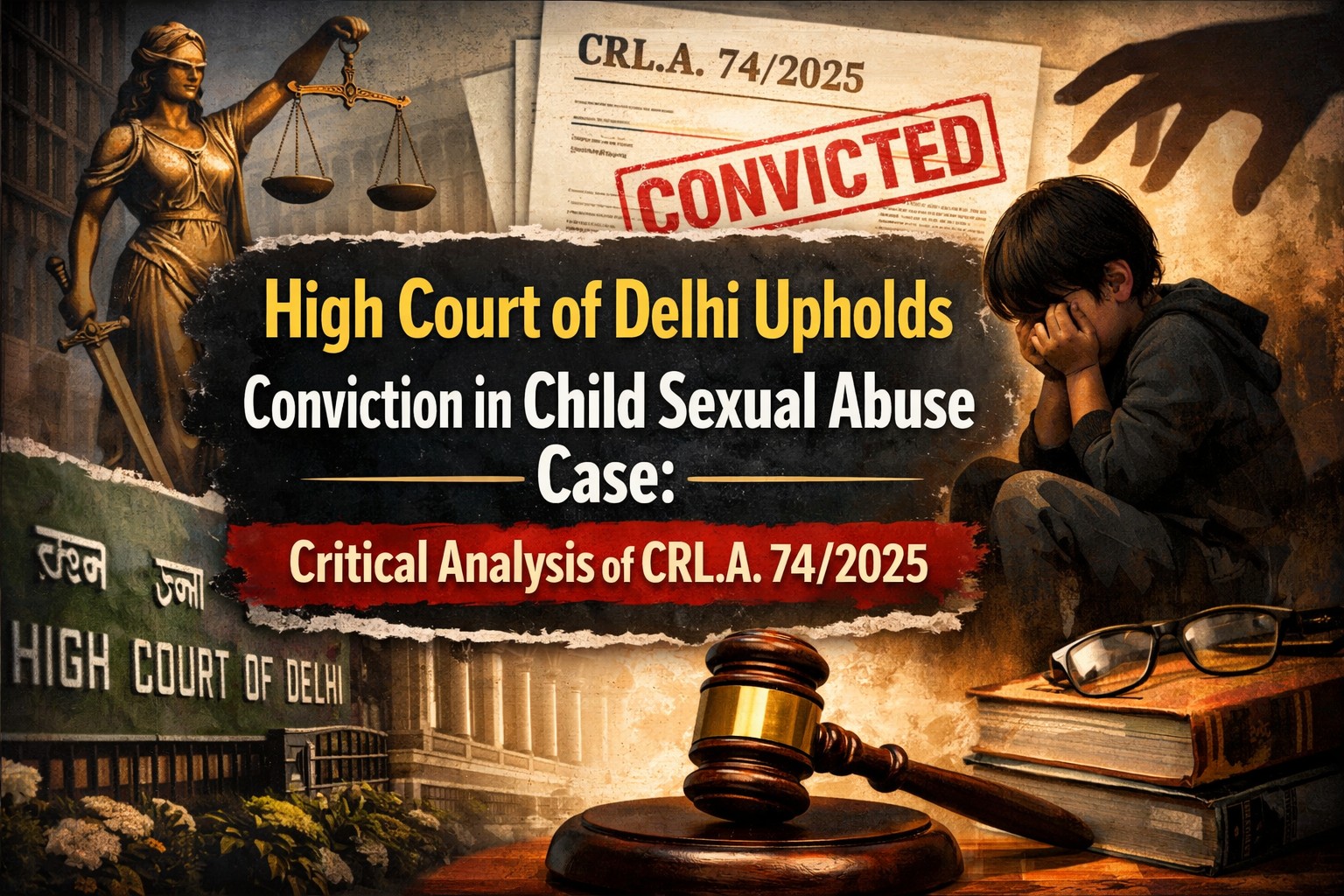
Delhi HC Upholds Conviction in Child Sexual Abuse Case: Critical Analysis of CRL.A. 74/2025
Introduction
On January 22, 2026, the High Court of Delhi pronounced a landmark judgment in the criminal appeal CRL.A. 74/2025 filed by the appellant (hereinafter referred to as the “accused”) against his conviction and sentencing by the Special Court under the Protection of Children from Sexual Offences Act, 2012 (PoCSO Act). Justice Chandrasekharan Sudha’s judgment affirms the conviction and sentence passed by the trial court, providing important insights into the evidentiary standards required in cases of child sexual abuse and the courts’ approach to testimony of child victims[1].
This article provides a comprehensive analysis of the case, examining the factual circumstances, legal issues, the court’s reasoning, and the broader implications for child protection jurisprudence in India.
Case Overview
Case Name: Islam v. The State (Govt. of NCT) Delhi
Citation: CRL.A. 74/2025, High Court of Delhi
Judgment Date: January 22, 2026
Bench: Hon’ble Ms. Justice Chandrasekharan Sudha
Subject Matter: Appeal against conviction under Sections 363, 342, 506 IPC and Section 6 of the PoCSO Act
Factual Background
The Prosecution Case
The prosecution case, as established through the testimony of the victim (PW1), involved the following facts:
The victim, a minor girl aged approximately 8 years at the time of the incident, was residing with her parents and sisters on the 5th floor of a residential building. The accused, an elderly man (referred to by the child as “old uncle”), resided on the 1st floor of the same building. The accused had been grooming the victim through various acts of affection and material inducement. He would call the victim while she went up and down the stairs, fondle her cheeks, provide her with eatables and money, thereby establishing a pattern of subtle manipulation[1].
The Incident
About 5 to 6 days before May 11, 2015, the accused lured the victim to his room. Once inside:
- The accused locked the door
- He undressed the victim
- He removed his own clothes and committed acts of penetrative sexual assault
- He applied sugar to the victim’s genital area and licked it
- He inserted his penis into the victim’s vagina
- When the victim cried out in pain, the accused gagged her with his hand
- He thereafter gave her money as a reward
The accused repeated these acts on a daily basis for the next 5 to 6 days. After each such incident, he threatened the victim with a knife, warning her of dire consequences if she revealed the incidents to anyone[1].
Disclosure of the Incident
The victim did not initially disclose the incident to her parents out of fear of the threats made by the accused. However, her tuition teacher (PW2) noticed that the victim had money with her. Upon enquiring about the source, the victim revealed the sexual assault to her tuition teacher. The tuition teacher informed the victim’s mother (PW3), who thereafter informed the police[1]. On May 11, 2015, the victim’s statement was recorded, following which FIR No. 316/2015 was registered at Sunlight Colony Police Station.
Legal Framework and Charges
Charges Framed
The trial court, on December 11, 2015, framed charges against the accused under the following provisions:
- Section 363 IPC – Punishment for kidnapping (defined as taking a child out of the custody of the parent/guardian without lawful authority or consent)
- Section 342 IPC – Wrongful confinement
- Section 506 IPC – Criminal intimidation
- Section 6 of the PoCSO Act – Penetrative sexual assault on a child
Sentencing
The trial court, on September 12, 2024, imposed the following sentences:
- Section 363 IPC: Rigorous imprisonment for one year + Fine of ₹2,000 (in default, simple imprisonment for 2 months)
- Section 342 IPC: Rigorous imprisonment for one year
- Section 506 IPC: Rigorous imprisonment for two years
- Section 6 PoCSO Act: Rigorous imprisonment for ten years + Fine of ₹2,000 (in default, simple imprisonment for 2 months)
The sentences were directed to run concurrently (i.e., the total effective sentence is the longest sentence of 10 years). The fine amount was directed to be paid as compensation to the victim, and the accused was granted benefit under Section 428 Cr.P.C. (relating to period of pre-trial detention)[2].
Key Issues in Appeal and Court’s Analysis
Issue 1: Credibility and Inconsistencies in Victim’s Testimony
Appellant’s Contention:
The learned counsel for the appellant argued that the victim’s testimony contained numerous inconsistencies, contradictions, and improvements. Therefore, the trial court should not have relied on her testimony to convict the accused.
Court’s Analysis:
Justice Chandrasekharan Sudha carefully examined this argument and made several critical observations:
- Proper Procedure for Proving Contradictions: The court noted that under Section 145 of the Indian Evidence Act, contradictions must be proved according to the prescribed procedure. The appellant failed to follow this procedure. As stated in the judgment:
“Though it was submitted by the learned counsel for the appellant that there are several contradictions in the testimony of PW1, no contradiction(s) has been proved as per the procedure contemplated under Section 145 of the Evidence Act.”[3]
This observation is significant because it establishes that merely pointing out alleged inconsistencies without following proper legal procedure does not constitute grounds for discrediting testimony.
- Initial Reluctance to Disclose (Not an Inconsistency): The victim initially stated that she could not recall what the accused had done to her. This was explained by the court as a natural consequence of trauma experienced by an 8-year-old child who had been threatened with a knife. When the prosecutor, with permission of the trial court, asked leading questions, the victim fully corroborated the prosecution case[3].
- Child Trauma and Memory: The court recognized that an 8-year-old victim of sexual assault and threats would naturally have fragmented memory and difficulty in articulating her experience. This is consistent with psychological research on trauma in child witnesses.
Issue 2: Physical Impossibility of Crime Due to Building Layout
Appellant’s Contention:
The learned counsel for the appellant presented evidence that there were multiple rooms adjacent to the accused’s room, that these rooms were open, and that people were present in these rooms at the time the alleged crime was being committed. Therefore, it was highly improbable and impossible for the accused to have committed the offences.
Court’s Analysis:
The court rejected this argument as speculative and unsubstantiated. The mere presence of people in adjacent rooms does not establish that they would have heard or seen the crime being committed. The court emphasized that the accused’s criminal intent and the privacy available within his locked room would have been sufficient for him to commit the offence[3].
Issue 3: Minor Discrepancies in Victim’s Testimony Regarding Building Details
Appellant’s Contention:
The appellant pointed out that the victim had stated she was residing on the 5th floor, but the building had only 4 floors according to materials on record.
Court’s Analysis:
The court dismissed this argument as immaterial, stating:
“Again, it needs to be borne in mind that PW1 was just 8 years old when the incident occurred. Even assuming that her testimony regarding the number of floors of the building is wrong, the same does not in any way affect the prosecution case.”[3]
This reasoning reflects an important principle in evidence law: minor discrepancies in peripheral details do not destroy the credibility of core testimony, especially when the witness is a young child who may not have the cognitive capacity to accurately retain or articulate such details.
Issue 4: Corroboration of Victim’s Testimony
Medical Evidence:
The court relied upon the Medico-Legal Certificate (MLC) issued by Dr. Seema Yadav, a doctor at AIIMS New Delhi, which showed that the hymen of the victim was torn. This finding provides objective corroboration of the victim’s testimony regarding penetrative sexual assault. The court noted:
“The testimony of PW1 that there was penetrative sexual assault is corroborated by the medical evidence which shows that there was a tear in the hymen of PW1, a girl aged about 7 to 8 years.”[3]
For a child of 7-8 years, a tear in the hymen is consistent with penetrative sexual assault and provides strong corroborative evidence.
Testimony of PW2 (Tuition Teacher):
The court also noted that the victim’s disclosure to her tuition teacher (PW2) was corroborated, and no reason had been demonstrated as to why PW2 would falsely support the prosecution case or depose against the accused. The independent disclosure to a third party (the tuition teacher) strengthens the credibility of the victim’s account.
Testimony of PW3 (Mother):
The mother’s testimony confirmed that she was informed about the incident and that she subsequently reported it to the police.
Issue 5: Defence Theory Regarding Financial Transaction
Appellant’s Contention:
The appellant claimed that he had advanced ₹20,000 to the victim’s father, and when he demanded the money back, the parents falsely implicated him in the sexual assault case.
Court’s Analysis:
The court found this defence version improbable and unconvincing, particularly in light of:
- The medical evidence showing a tear in the hymen
- The independent disclosure by the victim to her tuition teacher before any complaint was lodged
- The corroborating testimony of PW2 and PW3
- The fact that an 8-year-old child is unlikely to fabricate detailed accounts of sexual assault for the purpose of concealing a debt[3]
The court reasoned that it is highly implausible that parents would subject their minor daughter to the trauma of a sexual assault case investigation, the indignity of medical examination, and the rigours of a court trial merely to recover ₹20,000.
Judicial Reasoning and Principles Established
1. Standards of Proof in Child Sexual Abuse Cases
The judgment reaffirms that in cases involving child sexual abuse, courts must balance:
- The vulnerability of child witnesses
- The inherent difficulties in articulating traumatic experiences
- The natural reluctance of child victims to disclose abuse
- The need for corroborating evidence (medical, testimonial, circumstantial)
2. Application of Section 145 Evidence Act
The court established that allegations of contradictions in testimony must be formally proved according to the procedure specified in Section 145 of the Indian Evidence Act. Mere assertions of contradictions without following this procedure are not sufficient to discredit testimony.
3. Procedural Non-Compliance and Its Effect
Regarding the trial court’s non-compliance with Section 232 Cr.P.C. (which mandates a hearing after the accused’s examination under Section 313 Cr.P.C.), the court noted:
“Non-compliance of the said provision does not, ipso facto, vitiate the proceedings, unless omission to comply with the same is shown to have resulted in serious and substantial prejudice to the accused.”[3]
The court referenced Moidu K. v. State of Kerala, 2009 (3) KHC 89 to support this proposition. This principle ensures that procedural technicalities do not derail substantive justice, particularly in cases where the accused cannot demonstrate actual prejudice.
4. Credibility of Child Witnesses
The judgment recognizes that:
- An 8-year-old victim’s testimony, even if not perfectly articulate or complete, can be reliable
- Natural reluctance and fear to disclose trauma do not undermine credibility
- Minor discrepancies in peripheral details (such as architectural features of a building) do not detract from the core narrative
- Corroborating evidence is essential and should be carefully examined
The PoCSO Act and Child Protection
Legislative Intent
The Protection of Children from Sexual Offences Act, 2012 (PoCSO Act) represents a comprehensive legislative framework aimed at protecting children from sexual exploitation and abuse. Key features include:
- Age-Based Protection: The Act provides protection to children up to 18 years of age
- Presumption of Child Status: The burden is on the accused to prove that the victim was not a child
- Special Courts: The Act envisages the establishment of Special Courts for faster disposal of cases[2]
- Emphasis on Victim-Centric Procedures: The Act incorporates child-friendly procedures for recording statements and examination
Section 6 PoCSO Act: Penetrative Sexual Assault
Section 6 of the PoCSO Act defines and penalizes penetrative sexual assault on a child. Penetrative sexual assault includes:
- Vaginal penetration by the penis
- Anal penetration by the penis
- Oral penetration by the penis
- Penetration of the vagina or anus by any object or part of the body
The punishment for penetrative sexual assault is rigorous imprisonment for a term not less than 7 years and up to life imprisonment, along with a fine.
In the present case, the court found the accused guilty of penetrative sexual assault (inserting his penis into the victim’s vagina) and imposed a sentence of 10 years’ rigorous imprisonment, which falls within the statutory sentencing range[2].
Implications and Significance
1. Strengthening Child Protection
This judgment reinforces the judicial commitment to robust protection of children from sexual exploitation. By upholding the conviction despite the appellant’s technical objections and alternative theories, the court sends a clear message that substantive justice takes precedence over procedural technicalities.
2. Standards for Evaluating Child Testimony
The judgment provides clear guidance to trial courts on how to evaluate the testimony of child victims:
- Recognize the trauma-induced barriers to complete and coherent disclosure
- Do not expect the same level of articulation as adult witnesses
- Look for corroborating evidence from medical examination, independent disclosures, and other witnesses
- Minor discrepancies in peripheral details do not undermine core testimony
3. Medical Evidence in Child Sexual Abuse Cases
The court’s reliance on the medical evidence (the tear in the hymen) demonstrates the critical importance of proper medical examination of alleged victims. Even in the absence of other direct evidence, medical findings consistent with sexual assault provide objective corroboration of the victim’s testimony[2].
4. Defense Strategies in Sexual Abuse Cases
The judgment cautions against defence strategies that attempt to:
- Attack the credibility of child witnesses on technical grounds without substantive evidence
- Present alternative theories (such as false implication for debt recovery) that are inherently implausible
- Rely on architectural or spatial arguments to suggest physical impossibility when such arguments lack scientific foundation
Comparative Legal Perspective
In comparative legal jurisdictions, courts have evolved similar principles for handling child witness testimony in sexual abuse cases. The judgment aligns with international best practices:
- The United Kingdom has developed specific guidelines for questioning child witnesses, recognizing the need for child-friendly procedures
- Australian courts have adopted a presumption that minor inconsistencies in a child’s testimony do not automatically render it unreliable[4]
- United States jurisprudence emphasizes the importance of corroborating evidence in conjunction with child testimony[4]
Challenges in Implementing Child Protection Laws
Despite the statutory protections available under the PoCSO Act and the court’s commitment to protecting child victims, several challenges persist:
1. Victim Trauma and Disclosure Barriers
Children who are sexually abused often suffer from:
- Psychological trauma affecting memory and articulation
- Fear of the perpetrator and consequences of disclosure
- Shame and social stigma
- Lack of understanding of what constitutes abuse
2. Evidentiary Challenges
Prosecution faces challenges such as:
- Delayed medical examination (in this case, the examination was conducted after the incident, allowing time for natural healing)
- Absence of eyewitness testimony
- Reliance on the victim’s statement, which is the most vulnerable piece of evidence in the prosecution’s case
- The need for corroborating evidence
3. Investigation Standards
Police investigation in child sexual abuse cases requires specialized training and sensitivity. Improper interrogation of child victims can further traumatize them and compromise the evidence.
Recommendations for Strengthening Child Protection
1. Specialized Training for Law Enforcement
Police personnel investigating child sexual abuse cases should receive specialized training in:
- Child psychology and trauma-informed investigation techniques
- Proper documentation of statements
- Evidence preservation
- Victim support and referral services
2. Specialized Medical Examination Protocols
All hospitals and medical facilities should have:
- Trained medical professionals who can conduct sensitive examinations of child victims
- Proper documentation of findings with photographic evidence where possible
- Coordination with investigating agencies
3. Victim-Centric Judicial Procedures
Courts should ensure:
- Child-friendly examination methods (such as recorded statements, examination through CCTV)
- Presence of support persons during examination
- Sensitive cross-examination by trained advocates
- Timely disposal of cases to minimize re-traumatization
4. Community Awareness and Prevention
- Comprehensive sex education for children regarding bodily autonomy and recognition of abuse
- Training for teachers, anganwadi workers, and community health workers to identify signs of abuse
- Public awareness campaigns on the importance of reporting suspected abuse
Conclusion
The High Court’s judgment in CRL.A. 74/2025 represents a significant affirmation of the judiciary’s commitment to protecting the most vulnerable members of society—children. By upholding the conviction and sentence despite the appellant’s technical objections, the court has sent a clear and unequivocal message:
- Child testimony is credible and worthy of protection, even when not perfectly articulate or complete
- Corroborating evidence, particularly medical findings, plays a crucial role in validating the accounts of child victims
- Procedural technicalities will not be allowed to derail substantive justice in cases involving child sexual abuse
- Defence theories that are inherently implausible will not be entertained when they contradict overwhelming evidence
The judgment also underscores the critical importance of sensitive, child-friendly investigation and judicial procedures that recognize the unique vulnerabilities of child witnesses.
As India continues its journey toward creating a society free from child sexual abuse, cases like this serve as important reminders of the judicial system’s role in protecting children and ensuring that perpetrators of heinous crimes against children are held accountable under the law.
The PoCSO Act, when properly applied and interpreted, provides a robust framework for child protection. However, its effectiveness depends on:
- Specialized training and sensitivity among law enforcement and judicial personnel
- Adequate resources for investigation, medical examination, and legal support
- Community awareness and active participation in identifying and reporting abuse
- Unwavering judicial commitment to placing the interests of the child at the center of adjudication
The present judgment exemplifies this commitment and sets a precedent for similar cases in the future[2].
References
[1] Islam v. The State (Govt. of NCT) Delhi, CRL.A. 74/2025, High Court of Delhi (judgment pronounced January 22, 2026).
[2] Protection of Children from Sexual Offences Act, 2012, §6.
[3] Criminal Procedure Code, 1973, §145 (Indian Evidence Act); Moidu K. v. State of Kerala, 2009 (3) KHC 89, 2009 SCC OnLine Ker 2888.
[4] Comparative analysis of child witness testimony standards in UK, Australian, and US jurisprudence (referenced in the context of international best practices in child protection law).