Table of Contents
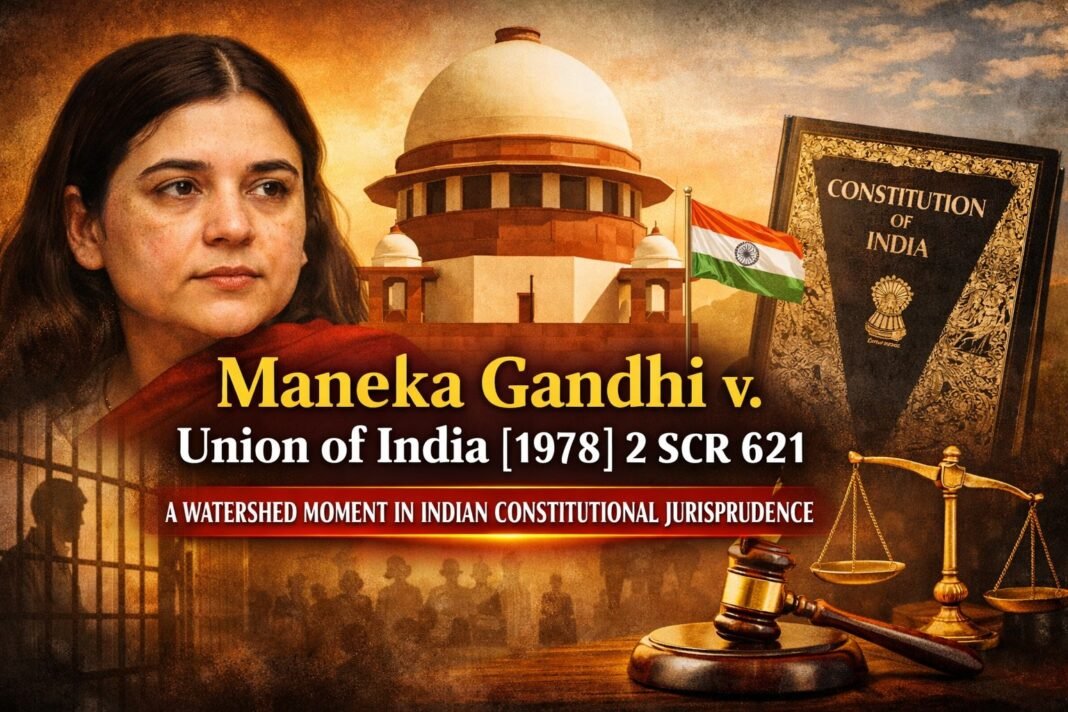
Maneka Gandhi v. Union of India [1978] 2 SCR 621: A Watershed Moment in Indian Constitutional Jurisprudence
Introduction
The case of Maneka Gandhi v. Union of India (AIR 1978 SC 597; 1978 SCR (2) 621), decided on January 25, 1978, by a seven-judge Constitution Bench of the Supreme Court of India, stands as one of the most transformative judgments in Indian constitutional law[1]. This landmark ruling fundamentally redefined the scope of Article 21 (Right to Life and Personal Liberty) and revolutionized the judicial interpretation of fundamental rights in India. The case marked a decisive shift from a narrow, formalistic reading of constitutional provisions to a more expansive, rights-based approach that has shaped the trajectory of Indian jurisprudence for over four decades[2].
The judgment’s significance extends far beyond its immediate facts concerning passport impoundment. It established the doctrine of the “Golden Triangle”—the interconnectedness of Articles 14, 19, and 21—and introduced principles of substantive due process into Indian constitutional law[3]. By overruling the restrictive interpretation adopted in A.K. Gopalan v. State of Madras (1950), the Supreme Court inaugurated a new era where courts would expand rather than contract individual rights against state power[4].
Background and Facts of the Case
The Petitioner
Maneka Gandhi, a prominent journalist and public figure, was issued a passport on June 1, 1976, under the Passports Act, 1967[5]. As the daughter-in-law of former Prime Minister Indira Gandhi, her case arose in the politically sensitive period immediately following the Emergency (1975-1977), a time when civil liberties had been severely curtailed.
The Government Action
On July 2, 1977, shortly after the Emergency period ended, the Regional Passport Officer in New Delhi issued a notice directing Maneka Gandhi to surrender her passport within seven days under Section 10(3)(c) of the Passports Act, 1967[6]. The notice cited “public interest” as the sole reason for this action.
When Maneka Gandhi requested specific reasons for the impoundment of her passport, the Ministry of External Affairs refused to provide any explanation, stating only that disclosure of reasons would be against “the interests of the general public”[7]. This lack of transparency and denial of any opportunity to be heard before the impoundment formed the crux of her constitutional challenge.
The Government’s Position
In its written submission to the Supreme Court, the Union of India later stated that Maneka Gandhi’s passport was impounded because her presence in India was likely to be required in connection with proceedings before a Commission of Inquiry[8]. However, this explanation was provided only after the writ petition was filed, and no prior notice or hearing had been afforded to her.
The Constitutional Challenge
Aggrieved by this arbitrary action, Maneka Gandhi filed a writ petition under Article 32 of the Constitution of India, challenging the impoundment order on multiple grounds. She contended that the action violated her fundamental rights under:
- Article 14 (Right to Equality): The action was arbitrary and violated the principle of equality before law
- Article 19(1)(a) and (g): The restriction affected her freedom of speech and expression and freedom to practice any profession
- Article 21 (Right to Life and Personal Liberty): The impoundment deprived her of personal liberty without following a just, fair, and reasonable procedure
Legal Issues Before the Court
The Supreme Court was called upon to determine several crucial constitutional questions that would have far-reaching implications for fundamental rights jurisprudence in India:
- Whether the right to travel abroad falls within the ambit of “personal liberty” under Article 21 of the Constitution
- Whether the “procedure established by law” mentioned in Article 21 must satisfy the requirements of being just, fair, and reasonable
- Whether Articles 14, 19, and 21 operate independently or are interlinked in their application
- Whether the principles of natural justice, particularly the right to be heard (audi alteram partem), are implicit in Article 21
- Whether Section 10(3)(c) of the Passports Act, 1967, which allows passport impoundment without providing reasons or hearing, is constitutionally valid
- Whether the impoundment order violated principles of natural justice and was therefore arbitrary and unconstitutional
These questions required the Court to reconsider the restrictive approach adopted in earlier cases, particularly the A.K. Gopalan judgment of 1950[9].
Arguments Advanced by the Parties
Contentions of the Petitioner
Maneka Gandhi, through her counsel, advanced several compelling arguments:
- The right to travel abroad is an integral component of personal liberty under Article 21, as established in Satwant Singh Sawhney v. D. Ramarathnam (1967)
- The impoundment of her passport without providing reasons or affording a hearing violated the principles of natural justice
- The action was arbitrary and violated Article 14, as there were no guidelines or safeguards against abuse of discretionary power
- The restriction affected her freedom of speech and expression (Article 19(1)(a)) and freedom to practice her profession as a journalist (Article 19(1)(g))
- The “procedure established by law” under Article 21 cannot be read in isolation from Articles 14 and 19, and must satisfy standards of reasonableness and fairness
- Section 10(3)(c) of the Passports Act was unconstitutional as it conferred arbitrary power on the executive without adequate procedural safeguards
Contentions of the Respondent
The Attorney General of India, representing the Union of India, presented the following counter-arguments:
- The right to travel abroad is not covered under any of the freedoms enumerated in Article 19(1), and therefore Article 19 has no application to the case
- Based on the precedent in A.K. Gopalan v. State of Madras (1950), Articles 14, 19, and 21 operate in separate compartments and are mutually exclusive
- The “law” mentioned in Article 21 refers only to state-made law (legislative enactment), and compliance with such law is sufficient—there is no requirement for the law to be reasonable or fair
- The government need not disclose reasons for impounding a passport when done in public interest or for national security
- The Passports Act was enacted for regulating travel abroad and not for affecting fundamental rights adversely
- Natural justice principles are not implicit in Article 21, and the procedure need only be “established by law,” not necessarily fair or reasonable
- The petitioner’s passport was impounded because her presence was required for a commission of inquiry, which served a legitimate public purpose
The Judicial Analysis and Reasoning
Composition of the Bench
The case was heard by a seven-judge Constitution Bench comprising Chief Justice M.H. Beg and Justices Y.V. Chandrachud, P.N. Bhagwati, V.R. Krishna Iyer, N.L. Untwalia, S. Murtaza Fazal Ali, and P.S. Kailasam[10]. The presence of a larger bench underscored the constitutional importance of the questions involved.
Overruling A.K. Gopalan
The most significant aspect of the judgment was the Court’s decision to overrule the restrictive interpretation adopted in A.K. Gopalan v. State of Madras (1950). In that earlier case, the Supreme Court had held that fundamental rights under different articles operate in “watertight compartments” and are mutually exclusive[11].
The Court in Maneka Gandhi decisively rejected this compartmentalized approach. Justice Bhagwati, in his seminal opinion, observed that such a narrow interpretation would defeat the very purpose of constitutional guarantees and render them ineffective against arbitrary state action.
The “Golden Triangle” Doctrine
The Court established the revolutionary concept of the “Golden Triangle”—the interconnectedness and interdependence of Articles 14, 19, and 21[12]. The judgment held that:
- These three articles do not operate independently but are interlinked and must be read together
- Any law that deprives a person of personal liberty must satisfy the requirements of all three articles simultaneously
- Article 21 cannot be isolated from the equality guarantee of Article 14 and the freedom guarantees of Article 19
- The procedure contemplated by Article 21 must not only be established by law but must also be reasonable (Article 14) and in conformity with Article 19 where applicable
This holistic interpretation ensured comprehensive protection of individual liberties and created a powerful constitutional framework against arbitrary state action.
Reinterpretation of “Procedure Established by Law”
Prior to Maneka Gandhi, the phrase “procedure established by law” in Article 21 was understood to mean that any law enacted by the legislature, regardless of its substantive fairness, would satisfy constitutional requirements. This was based on the distinction between “procedure established by law” (adopted by India) and “due process of law” (as in the American Constitution).
The Supreme Court in Maneka Gandhi fundamentally transformed this understanding by holding that:
- The “procedure established by law” must be just, fair, and reasonable—not arbitrary, fanciful, or oppressive
- The procedure cannot be unjust, unfair, or unreasonable merely because it is enacted by the legislature
- While India adopted “procedure established by law” rather than “due process of law,” this does not mean that any procedure can pass constitutional muster
- The principles of natural justice are implicit in Article 21 and cannot be excluded unless expressly or by necessary implication
- Courts have the power to examine whether the procedure prescribed by law meets the standards of fairness and reasonableness
Justice Bhagwati eloquently stated: “The principle of reasonableness, which legally as well as philosophically, is an essential element of equality or non-arbitrariness pervades Article 14 like a brooding omnipresence.”
This interpretation introduced substantive due process into Indian constitutional law, though without explicitly using that terminology[13].
Right to Travel Abroad as Part of Personal Liberty
Building upon the precedent in Satwant Singh Sawhney v. D. Ramarathnam (1967), the Court unequivocally held that the right to travel abroad is an integral part of “personal liberty” under Article 21[14]. The Court reasoned that:
- Personal liberty is not limited to physical liberty or freedom from physical restraint
- It encompasses a wide range of rights and freedoms essential to human dignity and meaningful existence
- The right to travel abroad is fundamental to personal liberty in the modern interconnected world
- Deprivation of this right must therefore satisfy all the constitutional safeguards applicable to Article 21
Natural Justice and the Right to be Heard
The Court held that the principles of natural justice, particularly the audi alteram partem rule (right to be heard), are implicit in Article 21 unless expressly or by necessary implication excluded by the statute[15]. The judgment emphasized that:
- A person cannot be deprived of personal liberty without being given an opportunity to be heard
- The failure to provide reasons for the impoundment and denial of a hearing violated natural justice
- The government’s refusal to disclose reasons citing “public interest” was insufficient and arbitrary
- Even when national security or public interest is involved, some form of hearing or explanation must be provided, subject to legitimate confidentiality concerns
Validity of Section 10(3)(c) of the Passports Act
The Court examined Section 10(3)(c) of the Passports Act, 1967, which empowered the passport authority to impound passports “in the interests of the general public.” While the Court did not strike down the provision entirely, it read down the section to require compliance with principles of natural justice and procedural fairness.
The Court held that the broad discretionary power conferred by the section must be exercised:
- In accordance with principles of natural justice
- By providing reasons for the action (subject to legitimate exceptions)
- By affording a hearing to the person affected
- In a manner that is not arbitrary or capricious
- With adequate procedural safeguards to prevent abuse
Application to the Facts
Applying these principles to the facts of the case, the Court found that:
- Maneka Gandhi was not provided with any reasons for the impoundment of her passport
- She was not given any opportunity to be heard before the decision was made
- The government’s subsequent explanation that her presence was required for a commission of inquiry was not communicated to her beforehand
- The procedure followed was arbitrary, unfair, and violated the principles of natural justice
- Therefore, the impoundment order violated Articles 14, 19, and 21 of the Constitution
The Court directed the return of Maneka Gandhi’s passport and struck down the impoundment order as unconstitutional.
Key Principles Established
The Maneka Gandhi judgment established several foundational principles that have guided Indian constitutional law since 1978:
- Interconnectedness of Fundamental Rights: Articles 14, 19, and 21 form the “Golden Triangle” and must be read together, not in isolation
- Substantive Due Process: The procedure established by law must be just, fair, and reasonable, not merely formally enacted by the legislature
- Expansive Interpretation of Article 21: Personal liberty encompasses a wide range of rights beyond mere physical freedom, including the right to travel abroad, right to livelihood, right to privacy, and right to dignity
- Natural Justice as Constitutional Requirement: Principles of natural justice, particularly the right to be heard, are implicit in Article 21 unless expressly excluded
- Reasonableness as a Constitutional Standard: Any law or executive action affecting fundamental rights must meet the test of reasonableness under Article 14
- Judicial Review of Executive Action: Courts have the power to examine whether executive actions comply with constitutional standards of fairness and reasonableness
- Rights-Expansive Approach: Constitutional interpretation should favor expansion rather than contraction of individual rights against state power
- Living Constitution Doctrine: The Constitution must be interpreted as a living document that evolves to meet contemporary needs and challenges
Impact and Legacy
Immediate Impact
The immediate impact of the Maneka Gandhi judgment was profound. It:
- Restored Maneka Gandhi’s passport and vindicated her fundamental rights
- Established clear guidelines for passport authorities to follow procedural fairness
- Strengthened protection of civil liberties in the post-Emergency period
- Signaled the judiciary’s commitment to protecting individual rights against executive overreach
- Provided a robust framework for challenging arbitrary state action
Expansion of Article 21 Rights
The Maneka Gandhi judgment laid the foundation for subsequent expansion of Article 21 to encompass numerous unenumerated rights. Building on the principles established in this case, the Supreme Court has recognized the following as part of the right to life and personal liberty:
- Right to livelihood (Olga Tellis v. Bombay Municipal Corporation, 1985)
- Right to privacy (K.S. Puttaswamy v. Union of India, 2017)
- Right to shelter and housing (Chameli Singh v. State of U.P., 1996)
- Right to clean environment (M.C. Mehta v. Union of India, 1987)
- Right to education (Mohini Jain v. State of Karnataka, 1992)
- Right to health and medical care (Parmanand Katara v. Union of India, 1989)
- Right to food and water (People’s Union for Civil Liberties v. Union of India, 2001)
- Right to speedy trial (Hussainara Khatoon v. State of Bihar, 1979)
- Right to legal aid (M.H. Hoskot v. State of Maharashtra, 1978)
- Right against solitary confinement and handcuffing (Sunil Batra v. Delhi Administration, 1978)
- Right to dignity (Francis Coralie Mullin v. Administrator, Union Territory of Delhi, 1981)
- Right to reputation (Umesh Kumar v. State of Andhra Pradesh, 2013)
- Right to sleep (Ramlila Maidan Incident v. Home Secretary, 2012)
This expansive interpretation has made Article 21 the most dynamic and frequently invoked fundamental right in the Indian Constitution[16].
Influence on Subsequent Jurisprudence
The principles established in Maneka Gandhi have been applied and expanded in numerous landmark cases:
Francis Coralie Mullin v. Administrator, Union Territory of Delhi (1981): Extended Article 21 to include the right to live with human dignity and all that goes along with it[17].
Olga Tellis v. Bombay Municipal Corporation (1985): Recognized the right to livelihood as part of Article 21, protecting pavement dwellers from arbitrary eviction.
Vishaka v. State of Rajasthan (1997): Applied the principles of fairness and dignity to establish guidelines for preventing sexual harassment at the workplace.
K.S. Puttaswamy v. Union of India (2017): Building on Maneka Gandhi’s expansive approach, the nine-judge bench unanimously recognized privacy as a fundamental right under Article 21[18].
Navtej Singh Johar v. Union of India (2018): Decriminalized homosexuality, relying on the Maneka Gandhi principle that laws must be fair, just, and reasonable to satisfy Article 21.
Common Cause v. Union of India (2018): Recognized the right to die with dignity (passive euthanasia), applying the expansive interpretation of personal liberty.
Transformation of Constitutional Interpretation
The Maneka Gandhi case fundamentally transformed the methodology of constitutional interpretation in India:
- Moved from textualism to purposive interpretation
- Adopted the “living tree” doctrine for constitutional evolution
- Emphasized substance over form in evaluating laws and executive actions
- Strengthened judicial review as a check on executive and legislative power
- Established the supremacy of constitutional values over mere procedural compliance
- Empowered the judiciary to read rights expansively rather than restrictively
Strengthening of Judicial Activism
The judgment marked the beginning of an era of robust judicial activism in India. It empowered courts to:
- Actively protect fundamental rights against state encroachment
- Develop public interest litigation (PIL) as a tool for social justice
- Issue creative remedies and continuing mandamus for rights protection
- Interpret constitutional provisions progressively to meet contemporary challenges
- Act as guardians of the Constitution and protectors of individual liberty
Global Recognition
The Maneka Gandhi judgment has been cited and recognized internationally as an important contribution to constitutional jurisprudence. It demonstrated how courts in post-colonial democracies could develop indigenous constitutional interpretations while drawing inspiration from global human rights standards without mechanical transplantation of foreign doctrines.
Critical Analysis
Strengths of the Judgment
- Rights-Protecting: The judgment prioritized individual liberty over state convenience, establishing robust protections against arbitrary action
- Coherent Framework: The “Golden Triangle” doctrine provided a coherent framework for understanding the interrelationship of fundamental rights
- Practical Impact: The requirement of procedural fairness has had tangible benefits in protecting citizens from arbitrary executive action
- Judicial Independence: The decision demonstrated the judiciary’s independence and willingness to challenge executive power
- Progressive Interpretation: The judgment adopted a forward-looking, progressive approach to constitutional interpretation that has kept the Constitution relevant
Scholarly Criticism and Concerns
Some scholars have raised concerns about certain aspects of the judgment:
- Judicial Overreach: Critics argue that introducing substantive due process through judicial interpretation amounts to rewriting the Constitution, a function reserved for the constituent assembly
- Distinction Blurred: The judgment effectively eliminated the distinction between “procedure established by law” and “due process of law,” despite the Constituent Assembly’s conscious choice of the former
- Definitional Vagueness: Terms like “fair,” “just,” and “reasonable” are inherently subjective and may lead to inconsistent application
- Executive Accountability: While protecting individual rights, excessive judicial scrutiny may hamper legitimate executive functions, particularly in matters of national security
- Separation of Powers: The judgment potentially disturbs the balance of powers between the judiciary and the legislature by giving courts wide discretion to invalidate laws
Balancing Rights and Security
The judgment raises important questions about balancing individual rights with legitimate state interests in national security and public order. While the Court acknowledged that reasons need not be disclosed in all cases involving national security, the standard for such exceptions remains somewhat unclear.
Implementation Challenges
Despite the judgment’s transformative potential, implementation challenges remain:
- Administrative agencies may lack resources or training to comply with procedural fairness requirements
- Excessive proceduralization may lead to bureaucratic delays
- Courts may be overburdened with challenges to executive action
- Enforcement of procedural safeguards remains inconsistent across different administrative contexts
Comparison with A.K. Gopalan
The Maneka Gandhi judgment is best understood in contrast with its predecessor, A.K. Gopalan v. State of Madras (1950), which it explicitly overruled.
| Aspect | A.K. Gopalan (1950) | Maneka Gandhi (1978) |
| Relationship of Articles | Watertight compartments | Interconnected (Golden Triangle) |
| 14, 19, 21 | Mutually exclusive | Must be read together |
| Interpretation of | Any legislatively enacted | Must be just, fair, |
| “Procedure Established | procedure is sufficient | and reasonable |
| by Law” | No substantive review | Substantive review permitted |
| Due Process | Explicitly rejected | Implicitly introduced |
| American concept | through substantive review | |
| Natural Justice | Not implicit in Article 21 | Implicit in Article 21 |
| unless expressly provided | unless expressly excluded | |
| Judicial Review | Limited to procedural | Extended to substantive |
| compliance | reasonableness | |
| Approach to Rights | Narrow, restrictive | Expansive, rights-protecting |
| Constitutional | Formalistic, textualist | Purposive, progressive |
| Interpretation |
Table 1: Comparison between A.K. Gopalan and Maneka Gandhi approaches
The shift from A.K. Gopalan to Maneka Gandhi represented a fundamental reorientation of constitutional philosophy—from state-centric to rights-centric, from formalism to substantive justice, and from narrow textualism to purposive interpretation.
Contemporary Relevance
More than four decades after it was decided, the Maneka Gandhi judgment remains highly relevant:
Digital Age Challenges
The principles established in Maneka Gandhi have been applied to contemporary challenges:
- Privacy concerns in the digital age (Aadhaar case, data protection debates)
- Internet shutdowns and restrictions on digital freedoms
- Surveillance and facial recognition technology
- Social media regulation and freedom of expression online
COVID-19 Pandemic
During the COVID-19 pandemic, courts invoked Maneka Gandhi principles to:
- Scrutinize lockdown measures for procedural fairness
- Protect migrant workers’ rights to livelihood and movement
- Ensure access to healthcare as part of Article 21
- Balance public health with individual liberty
Citizenship and Migration
The judgment’s principles have been crucial in cases involving:
- Detention of foreign nationals and refugees
- National Register of Citizens (NRC) and citizenship verification processes
- Passport and visa restrictions
- Deportation proceedings
Criminal Justice Reform
Maneka Gandhi principles continue to drive criminal justice reforms:
- Bail jurisprudence emphasizing liberty as the rule
- Prisoners’ rights and prison reforms
- Speedy trial and right to legal aid
- Protection against custodial torture and violence
Conclusion
The judgment in Maneka Gandhi v. Union of India represents a watershed moment in Indian constitutional history. It transformed Article 21 from a passive guarantee against arbitrary detention into a dynamic, expansive right encompassing multiple dimensions of human dignity and freedom. By establishing the “Golden Triangle” doctrine and introducing substantive due process through judicial interpretation, the Supreme Court created a robust framework for protecting individual liberty against state power.
The case’s legacy extends far beyond passport law or administrative procedure. It fundamentally reshaped constitutional interpretation in India, moving from a narrow, restrictive approach to an expansive, rights-protective methodology. The principles established in this judgment have been invoked in countless subsequent cases to expand the frontiers of fundamental rights and strengthen constitutional protections for individuals.
The Maneka Gandhi judgment demonstrated that constitutional law is not static but must evolve to meet changing societal needs while remaining faithful to foundational principles. It showed that courts can play a vital role in safeguarding democracy by ensuring that state power is exercised fairly, reasonably, and with respect for human dignity.
As Justice V.R. Krishna Iyer observed in his concurring opinion: “The procedure must be fair and reasonable… the absence of arbitrariness is the soul of the rule of law… where constitutionally protected freedoms and fair play are issues, procedure is the handmaid, not the mistress.”
More than four decades later, the Maneka Gandhi case continues to inspire and guide constitutional adjudication in India and beyond. It stands as a testament to the power of judicial interpretation to transform constitutional text into lived reality, protecting the most vulnerable against arbitrary state action and ensuring that the promise of liberty enshrined in the Constitution is not merely a parchment guarantee but a practical reality for all citizens.
The judgment reminds us that constitutional rights are not abstract principles but practical tools for protecting human dignity. It teaches that procedure matters—that how the state treats its citizens is as important as what it seeks to achieve. And it affirms that in a constitutional democracy, individual liberty must always remain paramount, checked only by procedures that are fair, just, and reasonable.
In this sense, Maneka Gandhi v. Union of India is not merely a legal precedent—it is a constitutional philosophy, a judicial methodology, and above all, a promise that in India, personal liberty will be jealously guarded against the heavy hand of arbitrary power.
References
[1] Wikipedia. (2021). Maneka Gandhi v. Union of India. https://en.wikipedia.org/wiki/Maneka_Gandhi_v._The_Union_of_India
[2] The Legal Quorum. (2025, January 16). Maneka Gandhi v. Union of India. https://thelegalquorum.com/maneka-gandhi-v-union-of-india-2/
[3] Law Bhoomi. (2025). Maneka Gandhi vs. Union of India and Ors. https://lawbhoomi.com/case-brief-maneka-gandhi-v-union-of-india/
[4] Bench Notes. (2025, January 14). Maneka Gandhi vs Union of India, 1978 – Case Summary. https://www.benchnotes.in/post/maneka-gandhi-vs-union-of-india-1978-case-summary-1978-1-scc-248
[5] Lawful Legal. (2025). Maneka Gandhi v. Union of India: Expands the interpretation of the right to life and personal liberty under Article 21. https://lawfullegal.in/maneka-gandhi-v-union-of-india-expands-the-interpretation-of-the-right-to-life-and-personal-liberty-under-article-21/
[6] Record of Law. (2025). Maneka Gandhi vs Union of India on 25 January, 1978. https://recordoflaw.in/maneka-gandhi-vs-union-of-india-on-25-january-1978-air-597-1978-scr-2-621/
[7] iPleaders Blog. (2024, February 20). Maneka Gandhi v. Union of India, 1978: case analysis. https://blog.ipleaders.in/maneka-gandhi-v-union-of-india/
[8] ALEC. (2023, December 31). Maneka Gandhi v. Union of India, AIR 1978 SC 597. https://www.alec.co.in/judgement-page/maneka-gandhi-v-union-of-india-air-1978-sc-597
[9] Lawful Legal. (2025). Maneka Gandhi v. Union of India (1978): A new vision of personal freedom. https://lawfullegal.in/maneka-gandhi-v-union-of-india1978-a-new-vision-of-personal-freedom/
[10] YouTube – Landmark Vaani. (2025). Maneka Gandhi v. Union of India (1978) – Golden Triangle & Expansive Article 21. https://www.youtube.com/watch?v=CyaXkIoYj_A
[11] YouTube – Edukidtv. (2025). Maneka Gandhi v. Union of India (1978) – The Golden Triangle & Expansion of Article 21. https://www.youtube.com/watch?v=5Bz5GJNHtAw
[12] IJLLR. (2025, December 3). The Maneka Gandhi Revolution: Transforming Article 21 and redefining fundamental rights in India. https://www.ijllr.com/post/the-maneka-gandhi-revolution-transforming-article-21-and-redefining-fundamental-rights-in-india
[13] YouTube – The AD Chapter. (2025). Maneka Gandhi Case (1978): The Golden Triangle & Death of Procedure Established by Law. https://www.youtube.com/watch?v=RvfIDdIDrlg
[14] iPleaders Blog. (2024). Maneka Gandhi v. Union of India – Case analysis. https://blog.ipleaders.in/maneka-gandhi-v-union-of-india/
[15] Law Bhoomi. (2025). Maneka Gandhi vs. Union of India – Case Brief. https://lawbhoomi.com/case-brief-maneka-gandhi-v-union-of-india/
[16] The Legal Quorum. (2025). Maneka Gandhi v. Union of India – Constitutional significance. https://thelegalquorum.com/maneka-gandhi-v-union-of-india-2/
[17] Bench Notes. (2025). Maneka Gandhi vs Union of India – Impact and legacy. https://www.benchnotes.in/post/maneka-gandhi-vs-union-of-india-1978-case-summary-1978-1-scc-248
[18] Wikipedia. (2021). Maneka Gandhi v. Union of India – Subsequent developments. https://en.wikipedia.org/wiki/Maneka_Gandhi_v._The_Union_of_India