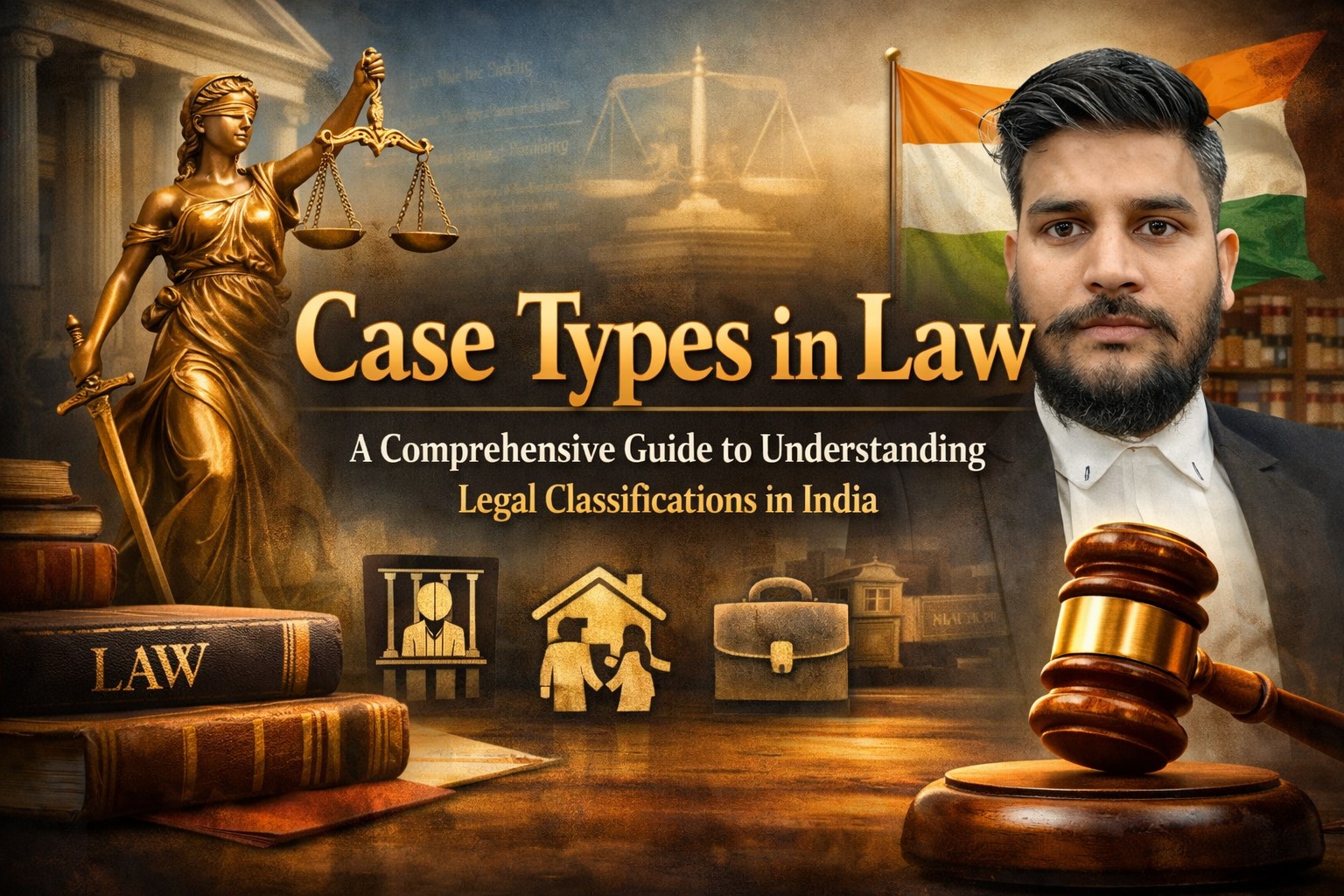
Case Types in Law: A Comprehensive Guide to Understanding Legal Classifications in India
Introduction
When a person approaches a court of law in India, the very first question that arises is: what kind of case is this? The answer to this question determines everything — which court has jurisdiction, what procedural law applies, what relief can be granted, and how long the process may take. This classification is formally known as the “case type” in legal parlance.
Every case registered before a court — from a village-level civil dispute to a constitutional challenge before the Supreme Court of India — is assigned a specific case type code. These codes are not mere administrative labels; they are the backbone of judicial record management and court procedure. Understanding case types is essential for litigants, law students, paralegals, and advocates alike.
What Is a “Case Type” in Law?
A case type is the formal classification or category assigned to a legal proceeding based on its nature, subject matter, the parties involved, and the legal provision under which it is filed. Each case type has a unique abbreviation — such as WP (Writ Petition), SLP (Special Leave Petition), CS (Civil Suit), or SC (Sessions Case) — that is used in cause lists, court records, and case tracking systems.[1]
The case type determines:
- The court or tribunal before which it must be filed
- The procedural law that governs it (CPC, CrPC, BNSS, etc.)
- The court fees payable at the time of filing
- The standard of proof required (beyond reasonable doubt in criminal cases; balance of probabilities in civil cases)[2]
- The nature of relief available (imprisonment, fine, damages, injunction, declaration, etc.)
Broad Categories of Case Types
At the highest level, all cases in the Indian judicial system are classified into three broad categories:[3][4]
- Civil Cases — Disputes between private parties over rights, property, money, or contractual obligations
- Criminal Cases — Offences against society or the State, prosecuted by the government
- Constitutional/Writ Cases — Matters involving the interpretation of the Constitution or enforcement of fundamental rights
Beyond these, India’s legal system also recognizes several specialised categories: family law cases, taxation cases, consumer cases, labour cases, revenue cases, cyber cases, and environmental cases.
1. Civil Case Types
Civil law governs disputes between individuals, companies, or organisations. The primary procedural law for civil matters is the Code of Civil Procedure, 1908 (CPC). Civil cases do not involve the State as a prosecutor; instead, the aggrieved party (the plaintiff) files a suit against the other party (the defendant).[5]
Original Suit (OS / CS)
The foundation of civil litigation. An Original Suit is the primary case filed for the first time before a court. It covers:[1]
- Property disputes — partition, illegal possession, encroachment, ancestral property[5]
- Breach of contract — failure to perform contractual obligations, non-payment[6]
- Recovery of money — unpaid loans, dues, or damages
- Specific performance — compelling a party to perform a contract, especially in land transactions
- Injunction — seeking a court order to restrain a party from doing something[6]
- Declaration — seeking a court’s declaration of legal status or rights
First Appeal (FA)
Filed under Section 96 of CPC against a decree passed by a subordinate civil court. A First Appeal allows the appellate court (usually the High Court or District Court depending on the original forum) to re-examine both facts and law.[1]
Second Appeal (SA)
Filed under Section 100 of CPC before the High Court against the decree passed in a First Appeal. A Second Appeal can only be entertained if it involves a substantial question of law, and the appellate court cannot re-examine questions of fact.[1]
Civil Revision
Filed under Section 115 of CPC where no right of appeal exists but an error of jurisdiction is alleged. Revision is a supervisory remedy, not a continuation of the original case.[1]
Execution Petition / Case
Filed to enforce a decree already passed by a court. Even after winning a case, a successful party may need to file an Execution Petition if the losing party does not comply voluntarily.[1]
Testamentary Case
Filed under Section 273 of the Indian Succession Act, 1925 for probate of a will or for obtaining letters of administration over the estate of a deceased person. These cases are typically filed before the District Judge or High Court.[1]
Election Petition
Filed under Section 81 of the Representation of the People Act, 1951 before the High Court to challenge the outcome of an election to Parliament or a State Legislature.[1]
2. Criminal Case Types
Criminal cases involve acts that are considered offences against society or the State. The State acts as the prosecutor, and the accused faces potential punishment in the form of imprisonment, fine, or in the gravest cases, the death penalty. The procedural law governing criminal cases is now the Bharatiya Nagarik Suraksha Sanhita, 2023 (BNSS) (which replaced the CrPC), and substantive offences are covered by the Bharatiya Nyaya Sanhita, 2023 (BNS) (replacing the IPC).[3]
Sessions Case (SC)
The most serious category of criminal cases. Sessions Cases are tried by a Court of Sessions (District & Sessions Judge). They cover grave offences such as:[7]
- Murder (BNS Section 103)
- Rape (BNS Section 64)
- Dacoity, robbery, and kidnapping
- POCSO offences (Protection of Children from Sexual Offences Act)
These cases are committed (transferred) to the Sessions Court by a Judicial Magistrate after committal proceedings.
Criminal Appeal
Filed under Section 374 BNSS against a conviction by a Magistrate or Sessions Court. The aggrieved convicted person can challenge the conviction, sentence, or both. The State can also appeal against an acquittal under Section 378 BNSS.[1]
Criminal Revision
Filed under Sections 397 and 401 BNSS before the High Court or Sessions Court to correct jurisdictional errors or procedural irregularities in criminal orders. Revision is not a re-trial; it is a supervisory check.[1]
Bail Application (Regular / Anticipatory)
- Regular Bail is filed under Section 483 BNSS (formerly Section 439 CrPC) before the Sessions Court or High Court for a person already arrested and in custody.[1]
- Anticipatory Bail is filed under Section 482 BNSS (formerly Section 438 CrPC) before arrest, to seek protection from future arrest in a specific case.[1]
Application Under Section 528 BNSS (Quashing of FIR)
Filed before the High Court using its inherent powers to quash an FIR, chargesheet, or criminal proceedings when they are found to be an abuse of the process of law. This is one of the most powerful remedies in criminal law, allowing the High Court to prevent injustice even outside formal appellate jurisdiction.[1]
Referred Case / Capital Case
When a Sessions Court passes a death sentence, it cannot execute that sentence on its own. The case must be referred to the High Court under Section 366 BNSS for confirmation. The High Court may confirm, reduce, or set aside the death sentence. If a death sentence is confirmed, the case is tracked separately as a Capital Case at the High Court level.[1]
Cheque Bounce Case (NI Act 138)
Filed under Section 138 of the Negotiable Instruments Act, 1881 before a Judicial Magistrate First Class (JMFC). It is a criminal complaint for dishonour of a cheque due to insufficient funds or a stopped payment. Though criminal in nature, it is quasi-civil in character as it also serves to recover money.[7]
3. Constitutional and Writ Case Types
These cases arise under Articles 32 and 226 of the Constitution of India. Article 32 empowers citizens to approach the Supreme Court directly for enforcement of fundamental rights. Article 226 gives similar (but wider) power to High Courts, extending beyond fundamental rights to any legal right.[3][1]
Writ petitions are sub-classified by the type of writ or the subject matter involved:
| Case Type | Full Form | Purpose |
| WP(C) | Writ Petition (Civil) | Service matters, land acquisition, regulatory disputes |
| WP(Crl.) | Writ Petition (Criminal) | Challenging criminal orders, illegal detention |
| Habeas Corpus | “You shall have the body” | Releasing a person from illegal custody or detention |
| Mandamus | “We command” | Directing a public authority to perform a statutory duty |
| Certiorari | “To be made certain” | Quashing orders passed without jurisdiction or in excess of it |
| Prohibition | — | Preventing a lower court from exceeding its jurisdiction |
| Quo Warranto | “By what authority” | Challenging the legal right of a person to hold a public office |
| PIL | Public Interest Litigation | Filed in public interest by any citizen, not just an aggrieved party |
4. Family Law Case Types
Family cases are primarily handled by Family Courts constituted under the Family Courts Act, 1984. These include:[8][3]
- Matrimonial Petition — Divorce, judicial separation, nullity of marriage under the Hindu Marriage Act, 1955, Special Marriage Act, 1954, or Muslim Personal Law
- Maintenance Application — Filed under Section 144 BNSS (Section 125 CrPC) for maintenance of wife, children, and parents
- Child Custody / Guardianship — Under the Guardians and Wards Act, 1890 or the Hindu Minority and Guardianship Act, 1956
- Domestic Violence Case — Under the Protection of Women from Domestic Violence Act, 2005; has both civil remedies (protection order, residence order) and criminal consequences
- Adoption Petition — Under the Hindu Adoptions and Maintenance Act, 1956 or the Juvenile Justice Act, 2015
- Restitution of Conjugal Rights — Under Section 9 of the Hindu Marriage Act, compelling a spouse to return to cohabitation
5. Consumer Case Types
Consumer cases are filed before Consumer Commissions established under the Consumer Protection Act, 2019. Three tiers of commissions exist based on the value of the claim:[7]
- District Consumer Commission — Claims up to ₹50 lakh
- State Consumer Commission — Claims from ₹50 lakh to ₹2 crore
- National Consumer Commission (NCDRC) — Claims above ₹2 crore
Common consumer cases cover deficiency in services, real estate fraud by builders, insurance claim rejection, defective products, and online purchase complaints.[7]
6. Taxation Case Types
Taxation disputes form a major category of cases before High Courts and specialised appellate tribunals. Key case types include:[3][1]
- Income Tax Appeal — Filed under Section 260A of the Income Tax Act, 1961 before the High Court
- GST/VAT/Sales Tax Revision or Appeal — Filed under respective State and Central GST statutes
- Custom/Excise Appeal — Filed under the Customs Act or Central Excise Act before the High Court
- FEMA Appeal — Filed under Section 35 of the Foreign Exchange Management Act, 1999[1]
These matters are often first heard by the Income Tax Appellate Tribunal (ITAT), Customs Excise & Service Tax Appellate Tribunal (CESTAT), or GST Appellate Authority before reaching the High Court.
7. Labour and Industrial Case Types
Labour cases govern the relationship between employers and employees. Key forums include:[8]
- Labour Courts — Under the Industrial Disputes Act, 1947
- Industrial Tribunals — For larger disputes affecting multiple workmen
- High Court (Writ Jurisdiction) — Challenging awards of Labour Courts
Common disputes include: illegal termination, non-payment of wages, gratuity, bonus, denial of provident fund benefits, and trade union matters.[7]
8. Special Tribunal and Other Case Types
India has a wide network of specialised tribunals, each handling specific subject areas:[7][1]
- Company Petition / Application — Filed before the National Company Law Tribunal (NCLT) under the Companies Act, 2013 for winding up, insolvency (IBC), oppression, mismanagement, etc.
- Arbitration Application — Filed under Section 11(4) of the Arbitration and Conciliation Act, 1996 before the High Court for appointment of an arbitrator[1]
- Contempt Application (Civil/Criminal) — Filed under Sections 10–12 or Section 15 of the Contempt of Courts Act, 1971[1]
- Environmental Case — Filed before the National Green Tribunal (NGT) for pollution, illegal construction, or environmental clearance matters[7]
- Cyber Crime Case — Filed under the Information Technology Act, 2000 for offences such as online fraud, cyberstalking, digital defamation, and identity theft[7]
- Revenue Case / Land Record Dispute — Filed before revenue courts and boards (Revenue Board/Board of Revenue) under State land revenue codes
9. Appellate Case Types at the Supreme Court of India
The Supreme Court of India has its own specific case types, with special sub-markers for urgency:[9]
| Case Type | Meaning |
| SLP (C) | Special Leave Petition (Civil) — under Article 136 |
| SLP (Crl.) | Special Leave Petition (Criminal) |
| W.P.(C) | Writ Petition (Civil) — under Article 32 |
| W.P.(Crl.) | Writ Petition (Criminal) |
| CA | Civil Appeal — after leave granted on SLP (C) |
| Crl. A. | Criminal Appeal — after leave granted on SLP (Crl.) |
| TP | Transfer Petition — to transfer a case between courts |
| Review Petition | To seek a review of the Supreme Court’s own judgment |
| Curative Petition | Last resort after a Review Petition is dismissed |
| SLP-D | SLP in death sentence cases — listed urgently |
| SLP-AB | Anticipatory bail matters before the Supreme Court |
Why Correct Identification of Case Type Matters
Correctly identifying and classifying the case type at the time of filing is not a mere formality — it has serious practical consequences:[1]
- Jurisdiction — Filing under the wrong case type before a court that lacks jurisdiction can result in dismissal of the case
- Court Fees — Different case types attract different court fees under State Court Fees Acts; incorrect classification can lead to deficiency in fees
- Limitation Period — Different case types have different limitation periods under the Limitation Act, 1963; wrong classification can cause valuable time to be lost
- Nature of Relief — Certain reliefs are only available in specific case types; for example, anticipatory bail cannot be sought in a civil writ petition
- Defective Filing — Courts register incorrectly categorised cases as “Defective” cases, causing delays in their listing and hearing[1]
Conclusion
The Indian legal system is structured, layered, and vast — and the concept of case types is the fundamental organising principle that keeps this system functioning. Whether you are an advocate preparing a petition, a litigant seeking justice, or a law student studying procedure, understanding case types gives you a precise roadmap of the legal journey ahead.
From a simple civil suit in a Munsiff Court to a constitutional challenge before the Constitution Bench of the Supreme Court, every legal matter in India has a defined case type that shapes its entire lifecycle — from filing to final judgment. A thorough understanding of these classifications empowers every participant in the justice system to navigate it with clarity, confidence, and precision.
- https://nja.gov.in/CJ-CM_Resolution/Allahabad_HC/INFORMATION ABOUT CASE TYPE NOMENCLATURE AND THEIR NATURE.pdf
- https://www.samwell.ai/blog/types-of-case-guide
- https://shiviforensics.blogspot.com/2025/12/types-of-cases-in-court-indian-legal.html
- https://www.studocu.com/in/document/gauhati-university/bachelor-of-law-llb/types-of-cases-in-india-civil-criminal-and-constitutional-overview/153227007
- https://www.karunasrilaw.com/understanding-common-types-of-civil-cases-in-india
- https://www.civillawselfhelpcenter.org/self-help/getting-started/court-basics/56-types-of-cases
- https://www.advocateshivakumar.com/2025/11/types-of-court-cases-in-india-complete.html
- https://www.linkedin.com/posts/dranupamkumarmishra_lexcliq-activity-7330789436626034688-M27w
- https://www.sci.gov.in/case-category/
- https://highcourtchd.gov.in/sub_pages/top_menu/case_information/CASE_TYPE.pdf
- https://ujs.sd.gov/self-help/understanding-the-courts/case-type-definitions/
- https://www.peoples-law.org/evaluate-my-situation
- https://selfhelp.courts.ca.gov/types-cases
- https://www.court.co.lancaster.pa.us/250/Criminal-and-Civil-Cases-Explained
- https://cdnbbsr.s3waas.gov.in/s3ec05b5b0db7f3a77ca4fcf9eca57aa71/uploads/2024/01/2024010234.pdf
- https://www.lawyered.in/legal-disrupt/articles/10-most-interesting-indian-cases-everyone-should-know-about/
- https://www.civillawselfhelpcenter.org/self-help/getting-started/court-basics/56-types-