Rights of Surety in Contract of Guarantee: A Comprehensive Legal Analysis
Introduction
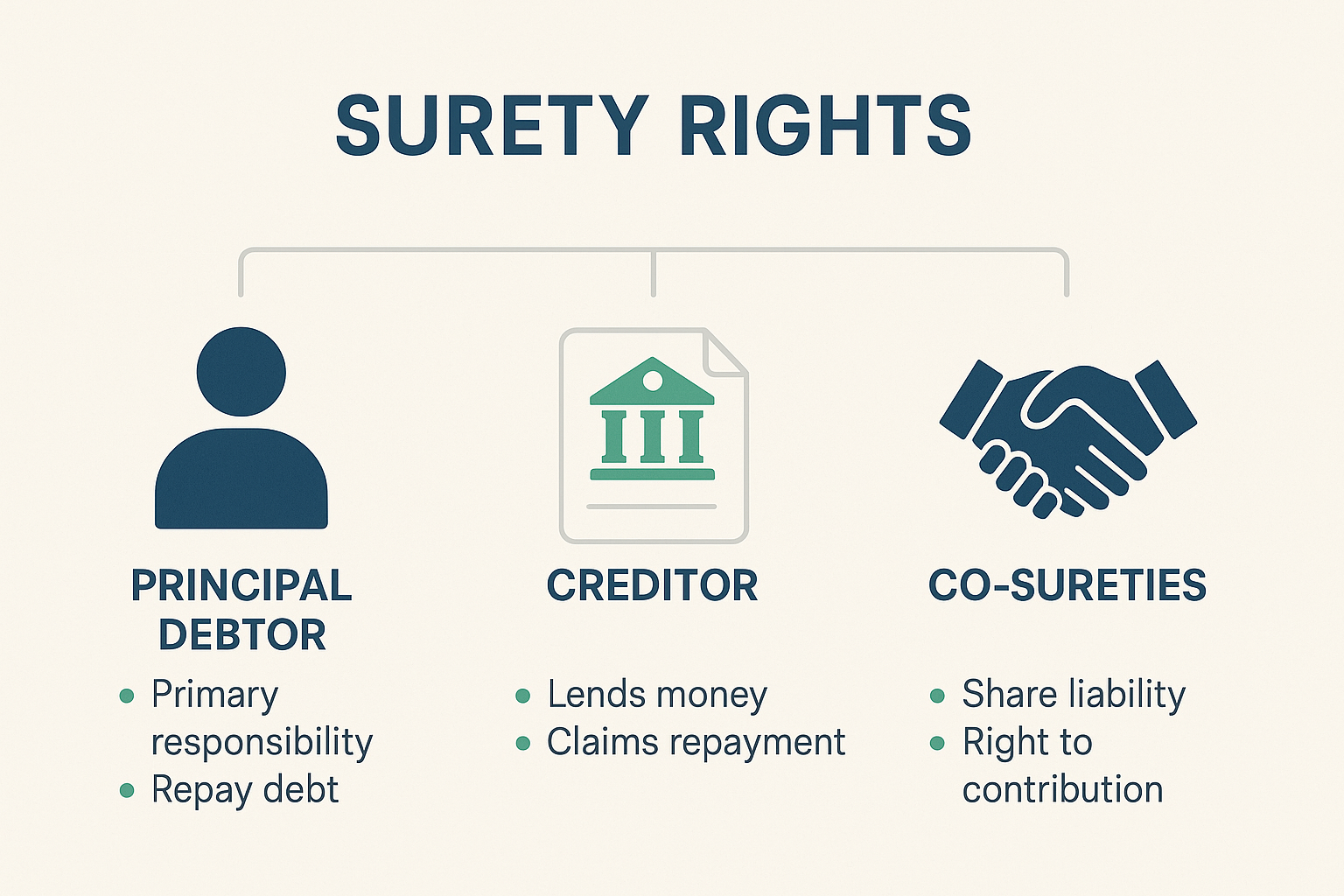
A surety occupies a unique position in contract law, serving as a secondary obligor who guarantees the performance of another’s obligations. The Indian Contract Act, 1872, through Sections 124-147, provides a comprehensive framework governing the rights and liabilities of sureties. This article examines the three categories of rights available to a surety: rights against the principal debtor, rights against the creditor, and rights against co-sureties, along with relevant case law and practical implications for legal practitioners.[1][2]
Rights Against the Principal Debtor
Right of Subrogation (Section 140)
Section 140 of the Indian Contract Act establishes the fundamental right of subrogation, which allows a surety who has discharged the guaranteed obligation to step into the shoes of the creditor. The section states that “where a guaranteed debt has become due, or default of the principal debtor to perform a guaranteed duty has taken place, the surety upon payment or performance of all that he is liable for, is invested with all the rights which the creditor had against the principal debtor”.[2][3][4][5]
This principle ensures that once the surety satisfies the creditor’s claim, they acquire all remedial rights that the creditor possessed, including the right to sue for recovery, claim securities, and pursue legal remedies. In Citibank, New Delhi v. J.K. Jute Mills Co., Ltd., Kanpur (AIR 1982 Del. 487), the Delhi High Court emphasized that a surety who pays the guaranteed amount is entitled to the benefit of securities in their original conditions unimpaired. However, it’s crucial to note that if a surety pays less than the full guaranteed amount, they can claim only the amount actually paid, not the entire guarantee sum.[3][6][1][2]
The Supreme Court has clarified in recent judgments that the equitable right under Section 140 is confined to the debt actually cleared by the surety. If the surety pays only part of the guaranteed amount, their subrogation rights are limited to that specific payment. This principle maintains proportionality between payment and recovery rights.[7]
Right to Indemnity (Section 145)
Section 145 establishes the surety’s fundamental right to indemnification from the principal debtor. This section embodies three critical principles: first, every contract of guarantee contains an implied promise by the principal debtor to indemnify the surety; second, the surety can recover whatever sum they have rightfully paid under the guarantee; and third, the surety cannot recover sums paid wrongfully.[8][1][3]
The United Commercial Bank Ltd. v. Okara Grain Buyers Syndicate Ltd. (AIR 1968 SC 1115) established that when a person stands surety for another, there exists an implied warranty that the principal debtor will indemnify the surety in case of default. This right extends beyond the principal amount to include legal costs and expenses incurred in defending suits brought by creditors, provided the defense was reasonable.[1][3][8]
Practical Illustration: If B is indebted to C for ₹1,00,000, and A stands surety for this debt, when C demands payment and A refuses, leading to litigation where A defends on reasonable grounds but is compelled to pay the debt with costs, A can recover from B both the principal debt and the legal costs incurred.[1]
Rights Against the Creditor
Right to Benefit of Securities (Section 141)
Section 141 grants sureties the right to benefit from every security that the creditor holds against the principal debtor at the time of entering the suretyship contract. This right exists regardless of whether the surety was aware of such securities at the time of guarantee. The section further provides that if the creditor loses or parts with such security without the surety’s consent, the surety is discharged to the extent of the security’s value.[9][10][1]
In Goverdhandas v. Bank of Bengal (1891) 15 Born., the court established that the equity between creditor and surety requires that the creditor should not do anything to deprive the surety of their rights to securities. However, the landmark case Krishna Talvar v. Hindustan Commercial Bank Ltd. (AIR 1957 Punjab 310) clarified that if securities are lost or destroyed due to acts of God, acts of enemies of the State, or unavoidable accidents, the surety is not discharged.[11][12][13][14]
Important Limitation: The right to securities arises only after the creditor is paid in full. If the surety has guaranteed only part of the debt, they cannot claim a proportional part of the securities after paying their portion. This principle was established in Goverdhan Das v. Bank of Bengal (1891).[12][15]
Right Against Creditor’s Conduct
Sureties are protected against prejudicial conduct by creditors through various statutory provisions. Section 139 protects sureties from creditor acts or omissions that impair the surety’s eventual remedy against the principal debtor. This includes situations where creditors fail to preserve securities or act in ways that prejudice the surety’s recovery prospects.[16]
The State of M.P. v. Kaluram (AIR 1967) case illustrates this protection. The state sold felled trees with guaranteed payments, retaining the right to prevent timber removal upon default and resell for price realization. When the buyer defaulted but the state continued allowing timber removal, the surety was not held liable as the creditor’s conduct impaired the surety’s remedy.[15]
Rights Against Co-Sureties
Right to Equal Contribution (Sections 146 & 147)
Section 146 establishes the principle of equal contribution among co-sureties. When two or more persons are co-sureties for the same debt, whether jointly or severally, under the same or different contracts, and whether with or without knowledge of each other, they are liable inter se to contribute equally to the unpaid portion of the debt.[17][3][8][1]
Section 147 addresses situations where co-sureties are bound in different sums, providing that their liability is limited to their respective maximum obligations while maintaining the principle of proportional sharing.[3][17][1]
Practical Examples:
- Equal Liability Scenario: A, B, and C are sureties to D for ₹1,00,000 lent to E. If E defaults, A, B, and C are each liable to contribute ₹33,333 (equal shares of the debt).[1]
- Different Penalty Amounts: A, B, and C enter separate guarantee bonds with penalties of ₹10,000, ₹20,000, and ₹40,000 respectively for D’s obligations to E. If D defaults to the extent of ₹30,000, each surety is liable to pay ₹10,000, limited by A’s maximum obligation.[1]
Right Against Release of Co-Surety (Section 138)
Section 138 provides that the release of one co-surety by the creditor does not discharge other co-sureties, nor does it free the released surety from responsibility to other co-sureties. This ensures that the burden of contribution remains equitably distributed among all original co-sureties despite creditor actions affecting individual sureties.[3][1]
Judicial Developments and Landmark Cases
Recent Supreme Court Jurisprudence
Recent Supreme Court decisions have significantly shaped surety rights interpretation. In State Bank of India v. M/S Indexport Registered and Others (1992), the Court held that surety liability is co-extensive with that of the principal debtor unless otherwise provided by contract, and creditors can proceed against sureties without first exhausting remedies against principal debtors.[18]
The Punjab National Bank v. Vikram Fibres (2020) case clarified the extent of discharge when creditors grant time extensions to principal debtors. Similarly, ICICI Bank v. Dynaspede Systems (2021) addressed how corporate restructuring affects guarantee obligations.[19]
Contemporary Challenges
Modern surety law faces several enforcement challenges. The ICICI Bank v. Vista Steel (2018) case emphasized the burden of proof requirements, stating that while initial burden rests on sureties to establish valid guarantee relationships and payments made, the burden may shift to principal debtors or creditors once basic facts are established.[19]
Insolvency and Bankruptcy Code Impact: The relationship between surety rights and the Insolvency and Bankruptcy Code, 2016, has been examined in several cases. In K.V. Jayaprakash, the NCLAT held that personal guarantors are entitled to recover amounts under Section 140 of the Contract Act as creditors but are not “secured creditors” under the IBC unless security interests were created.[7]
Practical Guidance for Legal Practitioners
Drafting Considerations
When drafting guarantee agreements, practitioners should include specific clauses protecting surety rights:
- Information Rights Clauses: Ensuring sureties receive regular updates about principal debtors’ financial conditions
- Consent Requirements: Explicit provisions requiring surety consent for material contract modifications
- Securities Preservation Obligations: Requirements for creditors to maintain securities and consult sureties before releases
- Contribution Mechanisms: Clear procedures for determining contribution shares among co-sureties[19]
Documentation Requirements
Successful enforcement of surety rights requires comprehensive documentation including original guarantee agreements, evidence of principal debtor default, proof of surety payments, documentation of creditor-held securities, and relevant correspondence.[19]
Conclusion
The rights of sureties under Indian contract law represent a carefully balanced framework protecting secondary obligors while maintaining commercial efficacy. The tripartite structure of rights against principal debtors, creditors, and co-sureties ensures that sureties are not left unfairly burdened while guaranteeing contractual performance. Recent judicial developments continue to refine these principles, adapting traditional guarantee concepts to contemporary commercial realities including corporate restructuring and insolvency proceedings.
For legal practitioners, understanding these rights is essential for effective client counseling, contract drafting, and litigation strategy. The interplay between statutory provisions, judicial interpretations, and practical enforcement challenges requires careful consideration of each guarantee relationship’s specific circumstances. As commercial transactions become increasingly complex, the fundamental principles governing surety rights remain crucial for maintaining commercial confidence and protecting the interests of all parties in guarantee arrangements.
The evolution of surety law through landmark cases like Citibank v. J.K. Jute Mills, Krishna Talvar v. Hindustan Commercial Bank, and Goverdhandas v. Bank of Bengal continues to provide guidance for modern applications, ensuring that the rights of sureties remain robust and enforceable in India’s evolving legal landscape.
- https://blog.ipleaders.in/rights-of-a-surety/
- https://sgm.org.in/teaching/Contract2/e1.pdf
- https://notes.collegehive.in/books/business-law/page/rights-of-surety
- https://lawgist.in/indian-contract-act/140
- https://lawbhoomi.com/rights-of-surety-in-a-contract-of-guarantee/
- https://www.casemine.com/commentary/in/enforcement-of-surety’s-liability-and-validity-of-power-of-attorney:-delhi-high-court-in-citibank-v.-juggilal-kamlapat-jute-mills-co.-ltd./view
- https://www.reedlaw.in/articles/surety’s-right-of-subrogation-under-the-insolvency-and-bankruptcy-code
- http://student.manupatra.com/Academic/Abk/Law-of-Contract-and-Specific-Relief/Chapter9.htm
- https://www.jiwaji.edu/pdf/ecourse/law/8 – Rights of Surety against Creditor.pdf
- https://thelegalschool.in/blog/right-of-surety-against-creditor
- https://highcourtchd.gov.in/landmark_judgments/HC/English/RFA_84_1951.pdf
- https://law.uok.edu.in/Files/5ce6c765-c013-446c-b6ac-b9de496f8751/Custom/Contract of indemnity and Guarantee (2) (3 files merged).pdf
- https://ibclaw.in/guarantor-cannot-but-be-stated-to-be-a-strict-liability-even-if-the-principal-debtor-is-discharged-from-his-liability-unless-such-discharge-is-through-the-act-of-the-creditor-without-consent-of-the/?print=pdf
- https://www.advocatekhoj.com/library/lawreports/indiancontractact/49.php?Title=Indian+Contract+Act%2C+1872&STitle=Section+141
- https://www.lkouniv.ac.in/site/writereaddata/siteContent/202004061919580137anurag_sriv_law_Contract_of_Guarantee.pdf
- https://blog.ipleaders.in/a-guide-to-contract-of-guarantee/
- https://thelegalschool.in/blog/rights-of-surety-in-contract-of-guarantee
- https://thelegalschool.in/blog/section-126-indian-contract-act
- https://legalheights.in/blog-single.php?b_id=118
- http://bdlaws.minlaw.gov.bd/act-26/chapter-details-86.html
- https://blog.finology.in/Legal-news/contract-law-notes-indemnity
- https://corporate.cyrilamarchandblogs.com/2022/04/replacement-of-bank-guarantees-with-surety-bonds-in-government-procurement-a-welcome-relief/
- https://ibbi.gov.in/uploads/legalframwork/c13fc9da20ee23e8709b8b249d0ac345.pdf
- https://thelegallock.com/comprehensive-guide-to-sections-124-147-of-the-indian-contract-act-indemnity-guarantee-and-suretyship-explained/