





A Landmark Judgment on Disability Inclusion: The Mission Accessibility Case and the Future of Equal Opportunity in Civil Services Examinations
Introduction
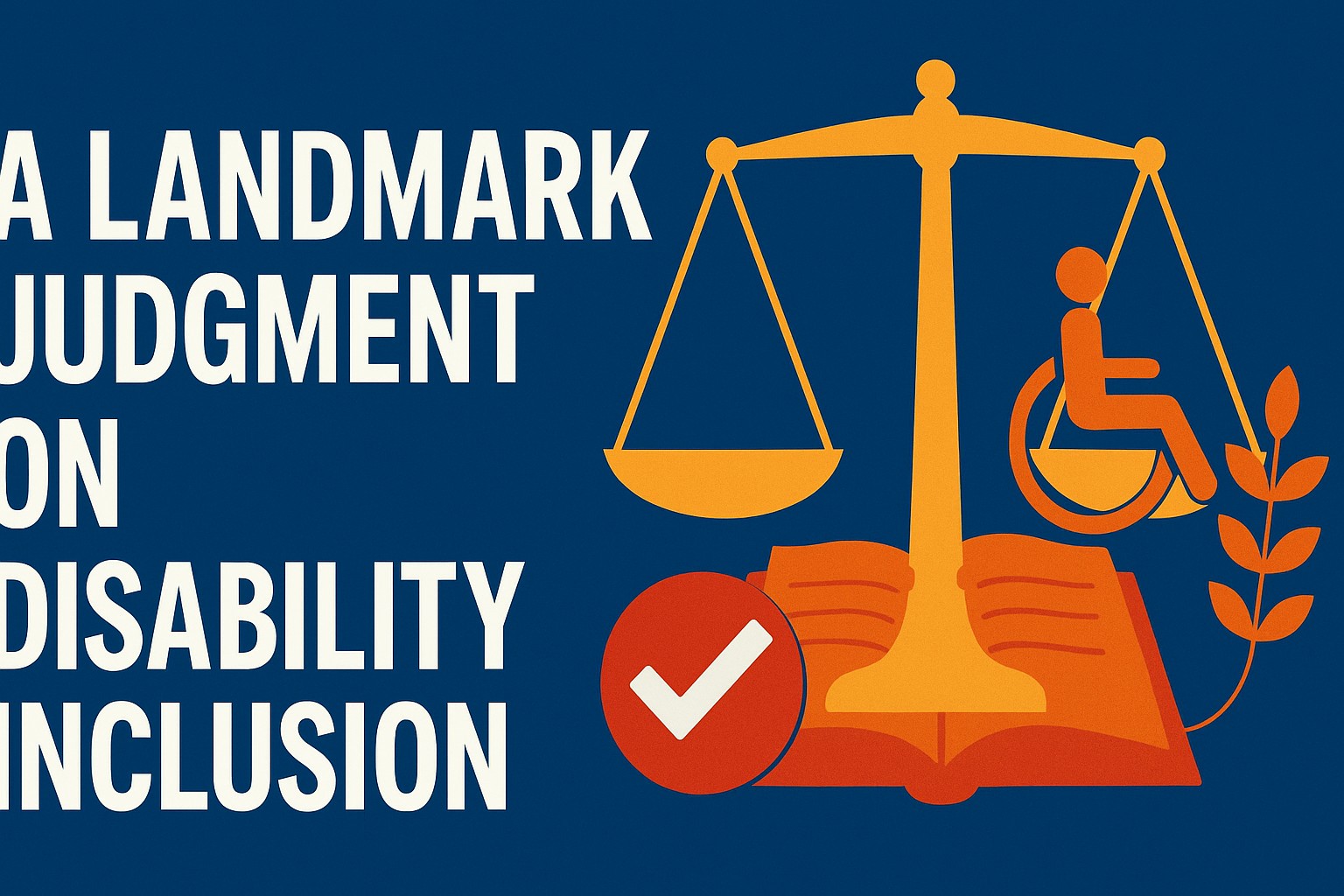
The Supreme Court of India has delivered a landmark judgment in Writ Petition (C) No. 206 of 2025, decided on December 3, 2025, addressing one of the most critical issues concerning the rights of persons with disabilities in competitive public examinations. The petition, filed by Mission Accessibility, an organization dedicated to advancing the rights of persons with disabilities, represents a watershed moment in India’s journey toward genuine substantive equality. This judgment, delivered by Justices Vikram Nath and Sandeep Mehta, redefines what it truly means to ensure equal opportunity in public recruitment processes, moving beyond the facade of formal equality to embrace the more challenging terrain of substantive inclusion.
The Constitutional Vision and the Case’s Opening Statement
The judgment opens with a profound philosophical reflection that captures the essence of the case. Justice Mehta articulates that equality, in its truest sense, demands not uniformity but the removal of barriers that prevent individuals from standing on equal footing. The Court emphasizes that the Constitution of India envisions a Republic where every person, regardless of physical or sensory limitation, can participate with dignity in the nation’s collective journey. The law, as an instrument of justice, must therefore transcend mere formal equality and ensure substantive inclusion, transforming rights from written promises into lived realities.
This preamble sets the tone for the entire judgment, establishing that the case is not merely about accommodations or special provisions, but about fulfilling the constitutional promise of equal opportunity that lies at the heart of the Indian constitutional design.
Background: What Mission Accessibility Sought
Mission Accessibility, through this writ petition, sought to enforce the constitutional rights of persons with disabilities (PwD) to equal opportunity. The organization challenged the Union Public Service Commission’s (UPSC) Civil Services Examination (CSE) procedures on multiple grounds, seeking several critical reliefs:
- Scribe Registration Timeline: Removal of the mandatory requirement to furnish scribe details at the time of application submission, with permission to provide such details at a reasonable time closer to the examination date.
- Modification of Application Process: A directive allowing candidates with disabilities to modify their scribe details at any time before any given stage of the Civil Services Examination.
- Use of Screen Reader Technology: Permission for visually impaired candidates to use laptops equipped with Screen Reader Software at all stages of the CSE.
- Accessible Digital Question Papers: Provision of question papers in accessible digital formats for candidates with disabilities.
- Declaratory Relief: A declaration that the impugned requirements were arbitrary, unreasonable, and violative of Articles 14, 16, and 21 of the Constitution of India, as well as the Rights of Persons with Disabilities Act, 2016.
The petitioner specifically highlighted the unreasonable restrictions imposed on visually impaired and other disabled candidates, arguing that these restrictions created unnecessary barriers and violated their fundamental right to equal opportunity in access to public office.
The Court’s Journey: From May to December 2025
The judgment reflects the Court’s careful, deliberative approach to a complex issue that required balance between accessibility rights and examination integrity. The case progressed through several stages:
May 2025: When the matter first came before the Court, Justice Mehta directed the UPSC to engage in dialogue with the Department of Personnel and Training (DoPT). The Court also directed the UPSC to file affidavits clarifying its position on critical issues, particularly regarding the change of scribe and the provision of screen reader facilities.
September 2025: The UPSC filed an additional affidavit dated September 12, 2025, which marked a significant turning point. The Commission disclosed that it had comprehensively reviewed the issue and, in principle, resolved to introduce the facility of Screen Reader Software for visually impaired candidates. However, the affidavit acknowledged that the necessary infrastructure for implementation was not yet in place, as the UPSC depends entirely on the infrastructure, logistical support, and manpower of State Governments, District Authorities, Schools, and Colleges.
October 2025: The matter was again heard on October 31, 2025, where the petitioner expressed satisfaction with the in-principle decision but raised concerns about the absence of a concrete implementation plan. The petitioner argued that while the UPSC’s intention was commendable, the lack of a defined roadmap, operational framework, or timeline for equipping examination centres left the matter in a state of uncertainty.
Key Findings and Observations
1. The Validity of the In-Principle Decision
The Court acknowledged and validated the UPSC’s in-principle decision to introduce Screen Reader Software as a substantial alleviation of the grievances raised in the petition. This decision was recognized as marking a conscious progressive step toward extending the facility to visually impaired candidates, thereby recognizing and advancing their rights to equal opportunity and accessibility in public examinations.
2. The Implementation Gap
However, the Court was equally clear that while the policy decision had been taken, the mechanism and modalities for its effective implementation remained to be streamlined and operationalized. The Court observed that the UPSC’s dependence on external infrastructure, coupled with the absence of a clearly delineated roadmap or timeline, underscored the need for:
- Institutional coordination
- Phased execution
- Concrete planning
- Inter-agency collaboration
- Establishment of uniform standards
3. The Constitutional Mandate
The judgment emphasizes that accessibility rights are not acts of benevolence but expressions of the constitutional promise of equality, dignity, and non-discrimination enshrined in Articles 14, 19, and 21 of the Constitution. The Court stressed that the UPSC, being a premier constitutional body entrusted with upholding merit and fairness in public recruitment, must ensure that its processes are accessible, transparent, and sensitive to the needs of every segment of society.
The Court’s Directions: A Blueprint for Implementation
The judgment issues comprehensive directions to ensure that the promise of accessibility is translated into practical reality. These directions provide a clear roadmap for the UPSC and other stakeholders:
Direction A: Scribe Change Provisions
The UPSC must ensure that in every notification for its examinations, a clear provision is incorporated permitting candidates eligible for a scribe to request a change of scribe up to at least seven days prior to the date of the examination. Such requests shall be:
- Objectively considered
- Disposed of by a reasoned order
- Decided within three working days of receipt
This addresses one of the key concerns raised by the petitioner regarding the inflexible requirement to furnish scribe details at the time of application submission.
Direction B: Comprehensive Compliance Affidavit
The UPSC has been directed to file a comprehensive compliance affidavit within two months from the date of the order. This affidavit must clearly delineate:
- Plan of Action: The proposed steps for deploying Screen Reader Software
- Timeline: Specific deadlines for implementation
- Modalities: Operational procedures and protocols
- Testing and Standardization: Steps for validating the software and related infrastructure across examination centres
- Feasibility Assessment: Whether the facility can be made operational from the next cycle of examinations
Direction C: Formulation of Uniform Guidelines
In coordination with the Department of Empowerment of Persons with Disabilities (DEPwD) and the National Institute for the Empowerment of Persons with Visual Disabilities (NIEPVD), the UPSC shall formulate uniform guidelines and protocols for:
- Use of Screen Reader Software
- Other assistive technologies
- Standardization and accessibility protocols
- Security of the examination process
- Application across all or identified examination centres
Direction D: Government Support
The Union of India, through the Department of Personnel and Training (DoPT) and the Ministry of Social Justice and Empowerment, shall extend all necessary administrative and technical support to the UPSC for expeditious implementation. This includes:
- Facilitating coordination with State Governments
- Providing technical expertise
- Ensuring resource allocation for infrastructure development
Direction E: Balanced Implementation
The implementation of these measures shall ensure full accessibility while maintaining the sanctity, confidentiality, and fairness of the examination process. This direction reflects the Court’s nuanced approach, recognizing that accessibility and examination integrity are not mutually exclusive but can be harmoniously balanced through proper planning and execution.
The Broader Significance: What This Judgment Means
For Persons with Disabilities
This judgment represents a historic step forward for persons with disabilities seeking access to positions of public service. It recognizes that the right to equal opportunity is not merely theoretical but must be operationalized through concrete measures and accessible infrastructure. By mandating screen reader technology and ensuring the flexibility to change scribes, the Court has acknowledged the specific needs of visually impaired candidates and other persons with disabilities.
For Constitutional Jurisprudence
The judgment reinforces the evolving interpretation of Articles 14, 16, and 21 of the Constitution. It articulates that formal equality—treating everyone alike—is insufficient when individuals start from positions of disadvantage. The Court’s emphasis on substantive equality represents a mature and nuanced understanding of constitutional equality, aligned with international disability rights standards and the Convention on the Rights of Persons with Disabilities.
For Public Recruitment Institutions
The judgment sends a clear message to all public recruitment bodies that accessibility is not an afterthought or a burden but a constitutional imperative. The UPSC, despite its longstanding tradition and critical role in recruitment, must adapt its procedures to ensure that merit and fairness are extended to all, including persons with disabilities.
For Administrative Law
The judgment demonstrates the Court’s willingness to provide specific, actionable directions rather than abstract pronouncements. By requiring the UPSC to file a compliance affidavit with a clear timeline, mandating the formulation of uniform guidelines, and specifying the timeline for disposition of scribe change requests, the Court has moved beyond traditional declaratory relief to ensure practical implementation of rights.
Addressing the Security and Integrity Concerns
One of the concerns that the UPSC had raised was regarding the security and integrity of examinations with the use of screen reader technology. The judgment thoughtfully addresses this concern by:
- Acknowledging the UPSC’s responsibility to maintain examination integrity
- Permitting the UPSC to conduct comprehensive testing and standardization before implementation
- Requiring coordination with specialized institutions like NIEPVD for technical expertise
- Allowing a phased implementation approach
This balance reflects the Court’s understanding that accessibility measures and examination security need not be at odds; rather, with proper planning and inter-agency coordination, both can be achieved.
The Follow-Up: March 2026 and Beyond
The judgment orders the matter to be listed again on February 16, 2026, for receiving the compliance affidavit of the UPSC. This follow-up mechanism ensures that the directions are not merely aspirational but are subject to judicial oversight and accountability. The Court’s ongoing engagement signals that the realization of accessibility rights will not be left to administrative discretion alone but will be monitored by the judiciary.
Conclusion: From Aspiration to Reality
The Mission Accessibility judgment represents a transformative moment in India’s approach to disability inclusion in public services. The Court’s opening observation is particularly apt: the true measure of inclusivity in governance lies not in the formulation of progressive policies but in their faithful and effective implementation.
By moving beyond the UPSC’s in-principle decision to mandate concrete implementation plans, timelines, and inter-agency coordination, the judgment ensures that the constitutional vision of equal opportunity does not remain a distant aspiration but becomes a living, enforceable, and enduring reality.
The judgment stands as a testament to the principle that in a constitutional democracy rooted in the values of liberty, equality, and justice, accommodating persons with disabilities is not a concession but a fulfillment of the constitutional promise itself. As the UPSC and other institutions work to implement these directions, they will not merely be making procedural changes but advancing the fundamental constitutional commitment to ensure that India’s public service remains open to all its citizens, regardless of disability, and that merit and fairness are extended in their fullest sense.
The next chapter of this journey—marked by the February 2026 hearing—will determine whether the promise made in this judgment translates into tangible, accessible examinations where every candidate, irrespective of disability, has a genuine and equal opportunity to serve the nation.