




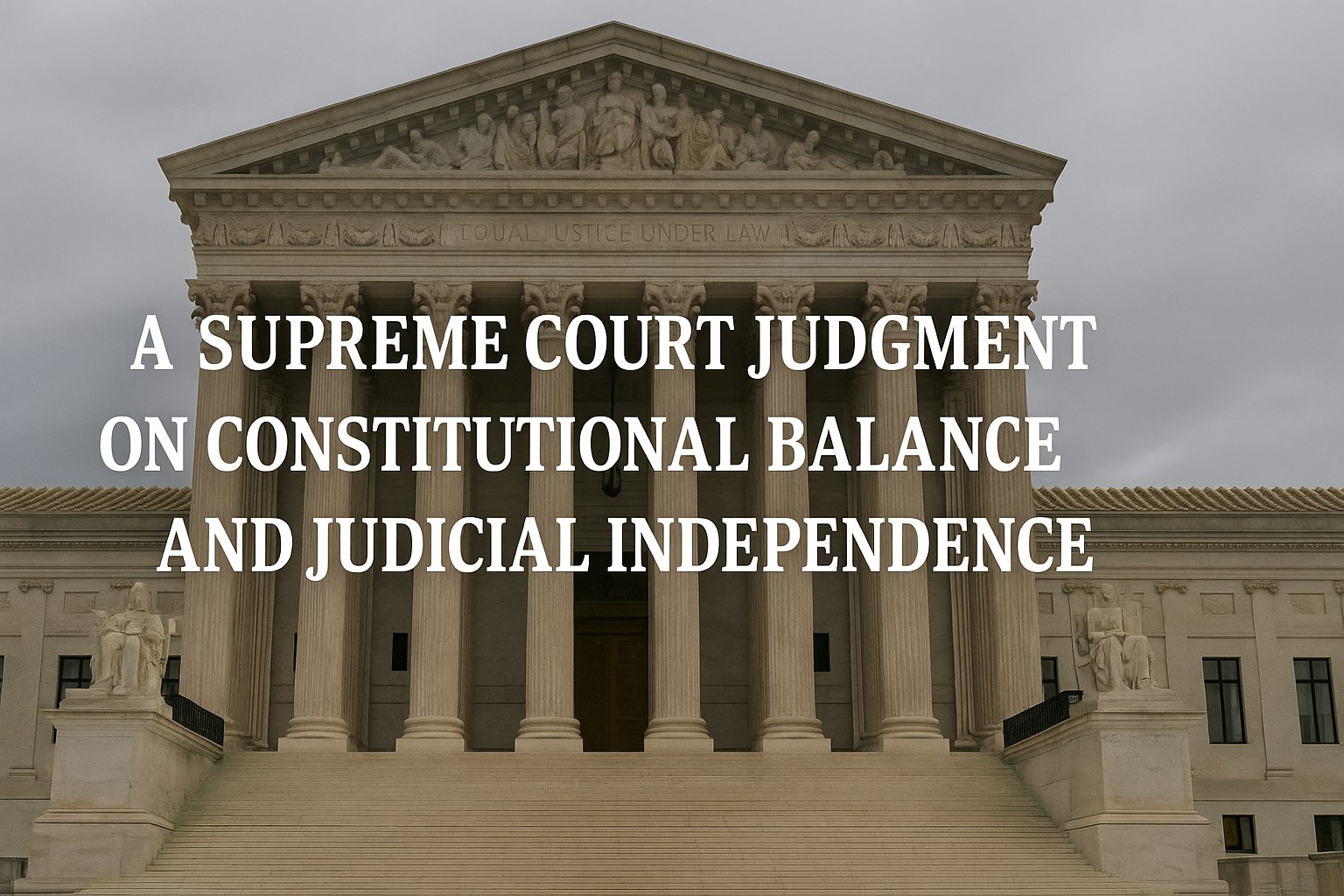
A Supreme Court Judgment on Constitutional Balance and Judicial Independence
In November 2025, India’s Supreme Court delivered a landmark judgment in Madras Bar Association v. Union of India and Another (2025 INSC 1330) that addresses one of the most significant constitutional tensions in independent India—the power of Parliament to reform judicial institutions without undermining the separation of powers and judicial independence that are foundational to the Constitution. Through a comprehensive examination of a decade-long constitutional dialogue, the Court held that while Parliament possesses broad legislative authority, this power is not absolute when it comes to matters that strike at the heart of India’s constitutional architecture.
The judgment deals with the constitutional validity of the Tribunals Reforms Act, 2021, which consolidated and standardized the appointment, tenure, qualifications, and service conditions of tribunal members across multiple specialized adjudicatory bodies in India. At its core, this case represents a critical juncture where the judiciary examined whether Parliament can circumvent binding judicial directions through fresh legislation, and whether the legislature’s policy choices can override constitutional principles enshrined by the judiciary’s interpretation of the Constitution.
The Constitutional Framework and Historical Context
The Evolution of Tribunal Jurisprudence in India
The judgment cannot be understood in isolation. It forms the culmination of a three-decade constitutional evolution concerning the status, independence, and functioning of tribunals in India. The Supreme Court’s engagement with tribunal governance began in earnest with the enactment of the Administrative Tribunals Act, 1985, pursuant to Article 323-A of the Constitution, which empowered Parliament to establish administrative tribunals to adjudicate service disputes of public servants.
In S.P. Sampath Kumar v. Union of India and Others (1987), a Constitution Bench held that tribunals must function as real substitutes for High Courts—not merely in form but in substance. Justice Ranganath Misra emphasized that the Chairperson of a Tribunal’s “office should for all practical purposes be equated with the office of Chief Justice of a High Court,” necessitating the appointment of retiring or retired Chief Justices of High Courts or senior judges of proven ability. The Court prescribed a selection process involving a high-powered committee with a sitting Supreme Court Judge nominated by the Chief Justice of India as Chairperson. Furthermore, the Court warned against short tenures, observing that a five-year tenure served as a deterrent to attracting competent candidates, particularly younger professionals who would retire long before the usual age of superannuation.
This principle was reinforced in L. Chandra Kumar v. Union of India and Others (1997), where a seven-judge Bench acknowledged that while tribunals exercise judicial functions and cannot simply be treated as bureaucratic arms of the executive, they need not comprise exclusively judicial members. Where specialized expertise is essential to the tribunal’s function, technical members may be appointed. However, the Court cautioned that technical members cannot be used to dilute judicial standards. Importantly, the Court suggested establishing a single umbrella organization (later termed the National Tribunals Commission) to supervise and ensure the independence of all tribunals.
The doctrine of judicial independence in tribunal appointments was crystallized in Union of India v. R. Gandhi, President, Madras Bar Association (2010). The Court emphasized that without institutional independence in appointments, funding, and administration, Indian tribunals will remain quasi-executive rather than truly judicial bodies. It held that when judicial functions are transferred from courts to tribunals, such bodies must comprise members of comparable rank, status, and independence as the judges they replace. The Court observed that allowing tribunal members to retain their lien with parent ministries undermines independence, as such members would continue thinking and acting as civil servants. The presence of the sponsoring department’s Secretary in the selection committee was identified as particularly problematic, especially where the government itself is a litigant before the tribunal.
Subsequently, in Madras Bar Association v. Union of India and Another (2014), the Court invalidated the National Tax Tribunal Act, 2005, holding that allowing the Central Government to determine jurisdiction, composition, and the transfer of tribunal benches compromised judicial independence. The Court established that for tribunals replacing High Court jurisdiction, the appointment procedure must be similar to that for High Court judges, the composition of selection committees must ensure judicial primacy, and the possibility of reappointment could compromise independence by encouraging members to decide cases with an eye toward securing another term.
The Finance Act, 2017 and Subsequent Reforms
Following these judgments, Parliament enacted the Finance Act, 2017, which subsumed provisions relating to appointments, tenure, and service conditions of tribunal members under a single legislative framework. Section 184 of the Finance Act authorized the Union Government to frame rules on these matters through subordinate legislation, a move that fundamentally shifted the balance from judicially-prescribed standards to executive discretion exercised through delegated authority.
The 2017 approach gave rise to the Tribunal, Appellate Tribunal and Other Authorities (Qualifications, Experience and Other Conditions of Service of Members) Rules, 2017, which the Supreme Court subsequently found wanting in Rojer Mathew v. South Indian Bank Limited (2020). The Court struck down these rules for weakening tribunal independence through excessive executive control. It held that while the power to prescribe qualifications need not remain exclusively with the legislature, any delegation must be accompanied by clear legislative guidelines. The Court emphasized that the independence of tribunals depends on their isolation from the executive, and allowing the executive unfettered discretion threatened this independence.
Following interim directions in Rojer Mathew, the government framed the Tribunal, Appellate Tribunal and other Authorities [Qualification, Experience and Other Conditions of Service of Members] Rules, 2020, which again came under judicial scrutiny in Madras Bar Association v. Union of India and Another (2021). This judgment represented a three-judge Bench’s assessment of whether the 2020 Rules brought the system into compliance with earlier constitutional directions.
The Challenge to the Tribunals Reforms Act, 2021
Provisions of the Impugned Act
The Tribunals Reforms Act, 2021 (hereinafter “Impugned Act”) consolidated and standardized tribunal governance across approximately nineteen different tribunals. Its key provisions include:
Appointments and Qualifications (Section 3): The Central Government is empowered to frame rules regarding qualifications, appointments, salaries, allowances, and service conditions of tribunal members, “notwithstanding anything in prior judgments or existing laws.” Appointments must be made on the recommendation of a Search-cum-Selection Committee. A minimum age of fifty years is prescribed for appointment.
Tenure (Section 5): Chairpersons serve for four years or until age seventy, whichever is earlier. Members serve for four years or until age sixty-seven, whichever is earlier. A transitional safeguard applies to those appointed between May 26, 2017, and the notified date, allowing them to continue under their original terms, subject to a maximum tenure of five years.
Removal (Section 4): Members may be removed for insolvency, conviction involving moral turpitude, incapacity, conflict of interest, or abuse of position. For grounds relating to incapacity, conflict of interest, or abuse (clauses c-e), the affected member must be given notice and an opportunity to be heard.
Salaries and Allowances (Section 7): The Government is empowered to prescribe salaries and benefits equivalent to Central Government officers at equivalent pay levels. Higher house rent allowances may be granted for those in rented accommodation. Crucially, service conditions cannot be altered to the disadvantage of members after appointment.
Abolition of Several Tribunals: The Act abolishes numerous specialized tribunals and appellate authorities, transferring their functions to High Courts, Commercial Courts, or designated authorities.
Premature Termination (Section 33): All persons serving in various tribunal positions cease to hold office from the notified date, with compensation of up to three months’ pay for premature termination. Pending proceedings are transferred to relevant courts.
Arguments of the Petitioners
The petitioners, represented by eminent Senior Counsel, advanced multifaceted constitutional arguments:
Violation of Separation of Powers and Judicial Independence: Sections 3(1), 3(7), 5, and 7(1) were challenged as infringing Articles 14, 21, and 50 of the Constitution, and as contradicting binding judicial decisions. The petitioners argued that by diluting the judiciary’s role in appointments, tenure, and service conditions, these provisions undermine the basic structure doctrine.
Impermissible Legislative Overruling of Judicial Directions: The Act was characterized as an attempt to undo safeguards prescribed by the Supreme Court through delegated rule-making powers vested in the executive. The petitioners contended that reintroducing provisions previously struck down—such as minimum age requirements, truncated four-year tenures, and the process of recommending multiple names—frustrated the Court’s earlier directions.
Violation of Legitimate Expectations and Vested Rights: Sitting tribunal members had legitimate expectations regarding tenure, reappointment, and allowances based on earlier judicial pronouncements. The Act’s retrospective application threatened these vested rights.
Arbitrary Age and Tenure Restrictions: The minimum age of fifty years and four-year tenure were assailed as discouraging meritorious younger candidates. The phrase “preferably within three months” for government action on recommendations was criticized as leaving the door open to executive delay.
Continued Executive Control: The petitioners contended that despite judicial directions, the Government retained control over allowances and house rent entitlements, and the much-anticipated National Tribunals Commission had not been established, leaving tribunals under executive control.
Arguments of the Union of India
The Union of India, represented by the Attorney General and Additional Solicitor General, presented a robust defense of legislative authority:
Parliamentary Competence in Law-Making: The Union contended that courts cannot compel the legislature to enact laws in a particular manner. Law-making is a domain reserved for Parliament, and judicial review cannot prescribe the contents of legislation.
Limited Scope of Mandamus: The Union argued that mandamus arises only when a clear public duty is imposed by law. If a statute does not create an obligation to frame rules or make appointments in a particular form, courts cannot direct the executive. Non-compliance with judicial directions that intrude into legislative policy-making cannot attract contempt charges.
Parliamentary Authority to Redefine Frameworks: Parliament is fully competent to redefine qualifications, eligibility, or selection processes for tribunals. Even if judicial guidelines were earlier issued, Parliament can modify the underlying legal framework through valid legislation, which would not amount to overriding judicial authority but merely exercising its constitutional role.
Tribunals as Creatures of Legislation: The Union submitted that tribunals are creatures of legislation and the independence of the judiciary is not compromised by prescribing tenure or service conditions for tribunal members by statute.
Constitutional Validity Cannot Be Tested Against Judicial Directions: A statute can only be invalidated for lack of legislative competence or violation of explicit constitutional provisions. It cannot be struck down for not conforming to earlier judicial directions or because courts prefer an alternative structure.
The Court’s Analysis and Holdings
Constitutional Supremacy and the Role of the Judiciary
The judgment begins with a profound invocation of Dr. B.R. Ambedkar’s observations in the Constituent Assembly, emphasizing that the Constitution provides for a supremacy of the Constitution over all State organs, including Parliament. The Court established that while Parliament possesses vast legislative powers, these powers are constrained by constitutional limitations. The Constitution is the supreme law; all organs derive authority from it and remain bound by its prescriptions.
The Court rejected the notion of parliamentary sovereignty in the English sense. Citing Special Reference No. 1 of 1964, the Court noted that in India, it is the Constitution that is supreme and sovereign. Parliament itself can only amend the Constitution by following the procedure prescribed in Article 368. The judgment further invoked Kesavananda Bharati, which recognized the supremacy of the Constitution as part of the basic structure, and State of Rajasthan v. Union of India, which asserted that the Constitution is “Suprema lex” and every organ, including Parliament, derives authority from it and must act within limits defined by the Constitution.
The Court held that judicial review is a basic feature of the Constitution. Once the Court has struck down a provision or issued binding directions identifying a constitutional defect, Parliament cannot simply override that judgment by reenacting the same measure in a different form. What Parliament may legitimately do is cure the defect identified by the Court, but it cannot restate or repackage the invalidated provision.
The Distinction Between Directing Legislation and Reviewing Legislation
The Court drew a crucial distinction that defines the limits of both judicial and legislative authority. The judiciary cannot direct Parliament to legislate in a specific manner because that would mean the Court functioning as a law-maker. However, the judiciary must review the validity of any law Parliament enacts because judicial review is essential to preserving constitutional supremacy.
The Court stated: “A clear distinction must be maintained between directing legislation and reviewing legislation. The former is forbidden, because the Court cannot function as a law-maker. The latter is indispensable to preserving the supremacy of the Constitution.” Where the Court identifies constitutional infirmities and issues mandatory directions ensuring compliance with constitutional principles—such as those concerning the independence, composition, or tenure of adjudicatory bodies—those directions are binding. Parliament may respond by removing the basis of the judgment through curative legislation, but it cannot enact a statute reproducing the very defects the Court has critiqued.
The Impermissibility of Nullifying Constitutional Judgments
The Court examined the doctrine that Parliament cannot nullify a constitutional judgment without curing the underlying defect. The judgment drew from NHPC LTD. v. State of Himachal Pradesh, where a State legislature had attempted to circumvent a High Court judgment by enacting a fresh law containing similar provisions to those struck down. The Supreme Court held that such legislative responses violate constitutional supremacy because they fail to engage with and remedy the constitutional violation.
Applying this principle, the Court examined whether the Impugned Act merely restated the defects identified in earlier judgments or genuinely cured them. The Court noted that provisions such as the minimum age requirement and the four-year tenure—which had been previously critiqued—reappear in the Impugned Act. Additionally, the Act contains a clause explicitly stating that provisions shall apply “notwithstanding anything in prior judgments or existing laws,” which the Court found deeply troubling as it appeared to be an attempt to legislatively override judicial determinations.
Separation of Powers and Judicial Independence as Justiciable Principles
The Union had contended that constitutionality cannot be tested against “abstract principles” such as separation of powers or judicial independence. The Court firmly rejected this argument, holding that these are not vague, free-floating ideals but structural pillars of India’s constitutional order, integral to constitutionalism worldwide.
The Court observed that judicial independence is inseparable from the guarantee of judicial review, and judicial review is the mechanism ensuring all State action conforms to the Constitution. The separation of powers is not merely philosophical; it underwrites the distribution of authority among the three branches. It is reflected in Articles 32, 136, 141, 226, and 227, which vest the judiciary with power to interpret law, enforce fundamental rights, and supervise subordinate courts and tribunals. It is also embedded in provisions concerning appointment, tenure, and removal of judges—all designed to insulate courts from executive dominance.
Legislative measures concerning tribunal structure, composition, and functioning necessarily intersect with these structural principles. A law that compromises tribunal independence, the Court held, strikes at the constitutional design itself and remains subject to judicial review.
Application to Tribunal-Specific Issues
Search-cum-Selection Committees and Judicial Dominance
The Court examined the composition of the Search-cum-Selection Committees prescribed by the Impugned Act. Under Section 3(3), the Committee comprises:
- The Chief Justice of India or a Supreme Court Judge nominated by him (Chairperson)
- Two Secretaries to the Government of India
- One additional Member (with various possibilities depending on whether it’s a Chairperson or Member appointment, and specific tribunal types)
- The Secretary of the sponsoring Ministry/Department as Member-Secretary (without voting rights)
The Court held that while the presence of the Chief Justice of India as Chairperson with a casting vote provides some judicial representation, the overall composition leans toward executive dominance. The inclusion of two Government Secretaries, whose ministries may themselves appear as litigants before the tribunal, creates conflicts of interest and undermines the impartiality essential to judicial independence.
The Court referenced its earlier judgment in Madras Bar Association v. Union of India (2021), which established that while the Secretary of the sponsoring department may serve as a Member-Secretary or Convener, they cannot have voting rights. The Court directed amendments ensuring that the Committee’s composition better reflects judicial primacy, consistent with the principle that bodies exercising judicial functions must be insulated from executive pressure.
Tenure and Age Restrictions
The Impugned Act prescribes a four-year tenure for Chairpersons (until age seventy) and four years for Members (until age sixty-seven). The Court found this problematic for multiple reasons:
Inadequacy for Expertise: Tribunal members require time to develop expertise in their specialized subject matter. By the time members achieve proficiency, their term ends, negating their accumulated knowledge. The Court had previously emphasized in the 2010 MBA (I) judgment that a longer term—seven or five years—was necessary to attract meritorious candidates and allow them to function effectively.
Discouragement of Younger Talent: The minimum age of fifty years, combined with a short tenure, discourages younger, meritorious professionals from accepting tribunal positions. The Court noted that younger advocates, around age 45, bring fresh perspectives and vitality essential for an independent and vibrant tribunal system. A 25-year practice requirement for advocates would mean minimum appointment age around 48, and with a four-year tenure, such individuals would have minimal service. Ensuring reappointment eligibility becomes necessary to make tribunal positions viable for younger talent.
Risk of Executive Interference: Short tenures increase the risk that members might decide cases with an eye toward securing reappointment, compromising independence. Longer tenures and security of service insulate members from such pressures.
Allowances and House Rent Entitlements
The Court addressed Section 7’s provisions on allowances and house rent entitlements. While the Act provides that allowances shall be equivalent to those of Central Government officers at equivalent pay levels, and that service conditions cannot be altered to disadvantage after appointment, the Court found these provisions insufficient.
The judgment referenced earlier judicial observations that lack of suitable housing in Delhi has deterred retired judges from accepting tribunal appointments. Merely providing house rent allowance at standard rates does not adequately address this problem. The Court directed the Government to make earnest efforts to provide suitable housing or, in the alternative, to enhance house rent allowance to Rs. 1,25,000 for members and Rs. 1,50,000 for Chairpersons/Presidents.
Appointment Procedure and the Panel of Two Names
The Impugned Act, through Section 3(7), requires the Search-cum-Selection Committee to recommend a panel of two names for each vacancy, upon which the Central Government is expected to act “preferably within three months.” The Court found both elements problematic.
The recommendation of a panel of two names, the Court held, gives the Government discretion in selecting from the panel. This discretion undermines the binding nature of the Committee’s recommendations and creates opportunities for executive influence. Earlier judgments had established that the Committee’s recommendations should be final, with the executive having no discretion in appointments. To accommodate practical considerations (such as adverse Intelligence Bureau reports on the first choice), the Court permitted an additional candidate to be placed on a waiting list, but the primary recommendation should be binding.
The phrase “preferably within three months” was found inadequate. “Preferably” does not create a binding obligation and leaves room for indefinite delay. The Court directed that the Government should complete appointments within three months of receiving the Committee’s recommendation. Delays in appointments contribute significantly to tribunal vacancies and pendency of cases, which impair access to justice for citizens.
Legislative Overruling Through Explicit Clauses
The Court was particularly troubled by Section 3(7), which states that the Search-cum-Selection Committee shall recommend a panel of two names “notwithstanding anything contained in any judgment, order or decree of any court, or in any law for the time being in force.” Similar language appears in other sections, most notably Section 5 on tenure.
The Court observed that this language appears designed to legislatively override the judicial directions embodied in earlier judgments. While Parliament can enact new laws and amend existing frameworks, it cannot do so in a manner that explicitly attempts to negate the effect of constitutional judgments without curing the underlying constitutional defect. Such language suggests an intent to perpetuate the very defects the judiciary had identified and directed be remedied, which violates the principle of constitutional supremacy.
The National Tribunals Commission
A significant lacuna the Court identified is the non-establishment of a National Tribunals Commission, which had been recommended in L. Chandra Kumar (1997) and endorsed by subsequent benches, including in the concurring opinion of Justice Chandrachud in Rojer Mathew (2020).
The Court noted that tribunals continue to be dependent on their sponsoring ministries for funding, infrastructure, and administrative support. This structural dependence compromises independence, as tribunal members remain under the executive’s control through administrative means even if they are not directly answerable to the executive on judicial matters.
The Court directed the Government to establish a National Tribunals Commission at the earliest. Until such establishment, a separate “Tribunals Wing” within the Ministry of Law and Justice should be created to handle administrative and financial matters relating to all tribunals, thus removing them from direct control of sponsoring departments.
Constitutional Implications and Future Directions
The Limits of Delegation and Rule-Making Powers
The judgment addresses a fundamental issue in constitutional law: the extent to which Parliament can delegate powers to the executive concerning matters of constitutional importance. While the Court acknowledged that Parliament need not regulate every detail in primary legislation and may delegate implementation to the executive, there are limits.
When matters go to the heart of constitutional principles—such as the independence of adjudicatory bodies—broad delegation without sufficient legislative guidance is impermissible. The qualifications, eligibility criteria, and selection procedures for tribunal members cannot be left entirely to executive discretion. While details of salaries, allowances, and administrative procedures may be delegated, the fundamental framework protecting independence must be legislatively specified.
Binding Nature of Constitutional Judgments
The judgment reinforces the principle that constitutional judgments of the Supreme Court bind all organs of government, including Parliament. When the Court identifies a constitutional defect and issues directions to remedy it, Parliament cannot respond by enacting a law that perpetuates the defect without addressing the Court’s reasoning. This does not mean Parliament has no legislative options; it means those options must be genuinely curative and responsive to the constitutional infirmity identified.
The Balance Between Democratic Majorities and Constitutional Constraints
The judgment navigates the tension between the democratic will expressed through parliamentary majorities and the constitutional constraints that bind all democratic institutions. The Court acknowledged that the judiciary cannot direct Parliament to legislate in a specific manner, as that would constitute judicial overreach. However, the Court emphasized that democratic governance in India is constitutional democracy, not merely majoritarian democracy. Constitutional principles limit what even overwhelming majorities can do. The separation of powers and judicial independence are not negotiable features that can be diluted by legislative majorities; they are foundational to the constitutional structure.
Conclusion
The judgment in Madras Bar Association v. Union of India (2025 INSC 1330) represents a watershed moment in India’s constitutional jurisprudence concerning the balance among the three branches of government. It establishes that while Parliament possesses broad legislative authority, this authority is not absolute when it strikes at constitutional principles embedded in the Constitution’s text, scheme, and spirit.
The Court’s holding that Parliament cannot legislatively override constitutional judgments without curing the underlying constitutional defects reaffirms the supremacy of the Constitution over all institutions, including Parliament. It clarifies that judicial review, far from being an encroachment on legislative authority, is essential to ensuring that all State action remains within constitutional bounds.
For the tribunal system specifically, the judgment mandates significant reforms: enhanced judicial involvement in appointment processes, longer tenures for members, greater institutional autonomy through a National Tribunals Commission, and removal of provisions that explicitly attempt to nullify earlier judicial directions. These reforms aim to ensure that tribunals function as genuine adjudicatory bodies independent from executive control, capable of dispensing speedy and efficient justice to citizens whose disputes fall within their jurisdiction.
The judgment also carries broader implications for administrative law and the doctrine of separation of powers in India. It signals that attempts to dilute or circumvent constitutional protections through legislative means, even by Parliament itself, remain subject to judicial review. In this sense, it reinforces the model of constitutional supremacy that has been central to Indian constitutionalism since 1950, ensuring that the Constitution’s foundational principles remain inviolable regardless of the winds of political change or electoral outcomes.
As India’s tribunal system undergoes restructuring in accordance with this judgment, the coming years will reveal whether these constitutional directions translate into practical independence and efficiency for thousands of citizens seeking justice through specialized adjudicatory forums across the country.