





B.N. Rao: A Government Employee, Not the Architect – Why All Constitutional Credit Belongs to Bharat Ratna Dr. Bhimrao Ramji Ambedkar
In recent years, a dangerous historical distortion has emerged that seeks to diminish Bharat Ratna Dr. Bhimrao Ramji Ambedkar’s role as the principal architect of the Indian Constitution by elevating Benegal Narsing Rau to equal or even superior status. This revisionist narrative is not only factually, morally, and ethically incorrect but represents a calculated attempt to undermine the contributions of one of India’s greatest constitutional minds. The truth must be stated clearly: B.N. Rao was merely a government employee who performed his assigned duties, while Bharat Ratna Dr. Bhimrao Ramji Ambedkar was the elected representative who led the constitutional revolution that gave India its democratic foundation. [1]
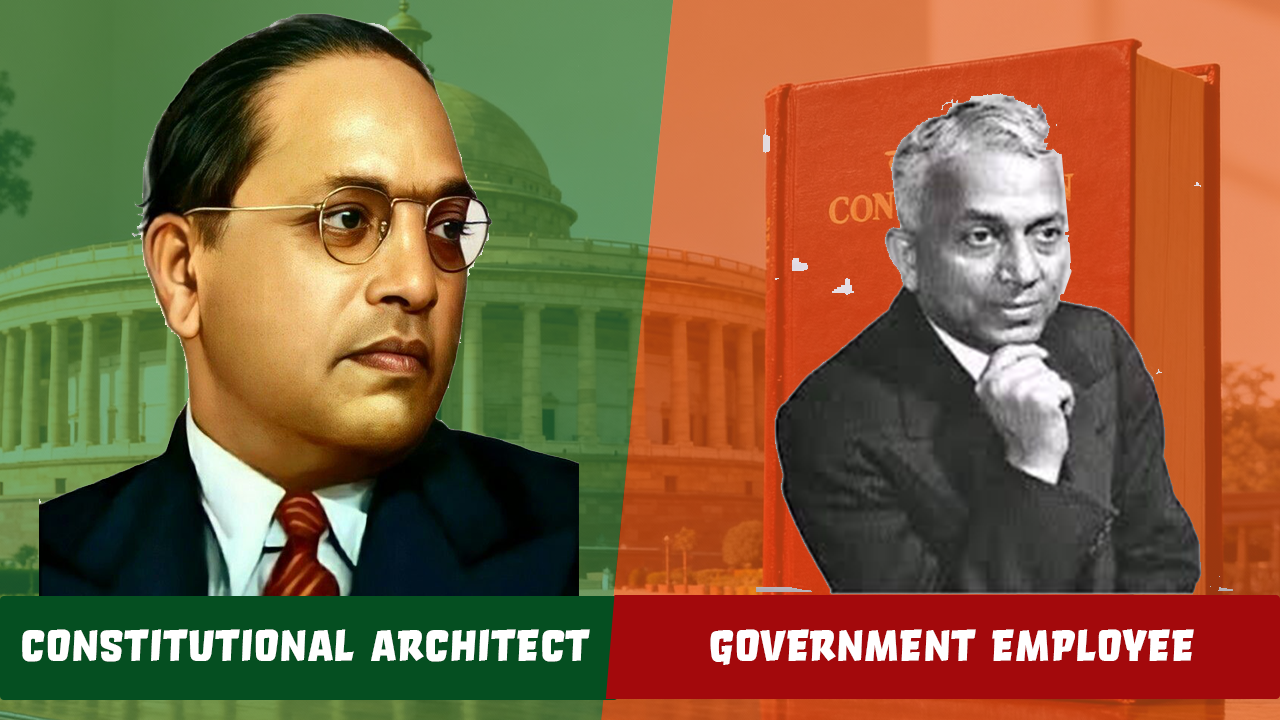
Comparison infographic showing the distinct roles of B.N. Rao and Dr. B.R. Ambedkar in Constitution making
The Fundamental Distinction: Employee vs. Elected Representative
The most critical distinction between B.N. Rao and Bharat Ratna Dr. B.R. Ambedkar lies in their fundamental roles and how they came to be involved in the Constitution-making process. B.N. Rao was appointed as the Constitutional Adviser to the Constituent Assembly in 1946. He was a civil servant, a government employee who was given a specific task by his superiors. As one source clearly states, “he was not a formal member of the Drafting Committee“ and “never debated or defended a single clause on the Assembly floor”. [2][3][1]
In stark contrast, Bharat Ratna Dr. B.R. Ambedkar was elected to the Constituent Assembly and subsequently appointed Chairman of the Drafting Committee on 29 August 1947. He was not merely fulfilling a bureaucratic duty – he was representing the people and leading the most crucial committee in the constitutional process. The distinction is clear: one was an employee doing his job, the other was a democratic leader shaping the nation’s future. [4][5]
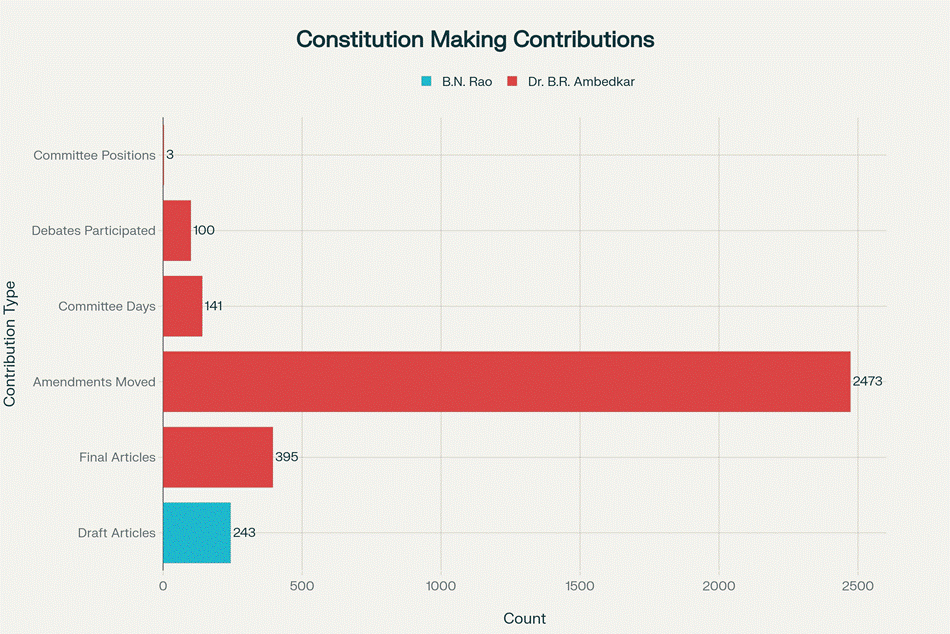
Quantitative comparison showing the stark difference in contributions between B.N. Rao (government employee/advisor) and Dr. B.R. Ambedkar (elected representative/Chairman)
The Statistical Reality of Their Contributions
The quantitative evidence overwhelmingly demonstrates the vast difference in their contributions to the Constitution-making process. B.N. Rao prepared an initial draft consisting of 243 articles and 13 Schedules. This was his primary contribution – a preliminary compilation based on existing constitutional documents from other countries.[6][7]
Bharat Ratna Dr. B. R. Ambedkar, leading the Drafting Committee, transformed this initial draft through an intensive process that lasted 141 days. The Committee expanded the Constitution to 315 articles in its first submission, and the final Constitution contained 395 articles and 8 Schedules. The Assembly considered approximately 7,635 amendments, with 2,473 actually moved and debated. [8][9][6]
Bharat Ratna Dr. B. R. Ambedkar personally defended the Constitution clause by clause on the Assembly floor, participating in debates across 114 days dedicated to constitutional discussion. As T.T. Krishnamachari, a contemporary witness, testified: “it happened ultimately that the burden of drafting this Constitution fell on Dr. Ambedkar, and I have no doubt that we are grateful to him for having achieved this task in a manner which is undoubtedly commendable”. [1][6]
Ambedkar’s Acknowledgment: Courtesy, Not Equivalence
Revisionists often misinterpret Dr. Ambedkar’s gracious acknowledgment of B.N. Rao’s contribution as evidence of equal credit. In his concluding speech on 25 November 1949, Ambedkar stated:
“The credit that is given to me does not really belong to me. It belongs partly to B.N. Rau the Constitutional Adviser to the Constituent Assembly who prepared a rough draft of the Constitution for the consideration of the Drafting Committee”. [2][4][10]
However, this statement must be understood in context. Ambedkar was demonstrating the humility and magnanimity of a true leader, acknowledging all contributors to the process. The key word here is “partly” – he was not transferring his credit to Rao, but acknowledging Rao’s preliminary work as a starting point.[1]
As one analysis correctly notes: “gratitude doesn’t rewrite authorship. Acknowledging Rau’s input as a starting point doesn’t make him the architect. Rau gave the raw stone, and Ambedkar sculpted it into India’s constitutional identity”.[1]
The Substance of Constitutional Vision
The fundamental difference between their contributions becomes even clearer when we examine the substance of what each brought to the Constitution. B.N. Rao’s draft was essentially a compilation exercise – he studied foreign constitutions and prepared a technical document based on existing models. While this work was useful, it lacked the transformative vision that would make the Indian Constitution unique.[2][11]
Dr. B.R. Ambedkar brought far more than technical expertise. He infused the Constitution with principles of social justice, equality, and protection for marginalized communities. The provisions for Scheduled Castes and Scheduled Tribes, the abolition of untouchability, the system of reservations, and the fundamental rights framework – these transformative elements came from Ambedkar’s vision, not from Rao’s preliminary draft.[4][12]
As the Parliament of India’s Eminent Parliamentarians Monograph Series notes, “Ambedkar exerted his influence to evolve a parliamentary form of Constitution for Republican India” and he “wasn’t just writing a legal document— he was drafting a social revolution”.[13][1]
The Historical Pattern of Erasure
The attempt to diminish Ambedkar’s role in favor of B.N. Rao follows a disturbing historical pattern. As one insightful analysis observes, this represents “modern expressions of the same Dominant Oppressive-caste anxieties that once resisted his inclusion in the process”.[1]
The same forces that initially opposed the Constitution when it was first adopted – because it lacked “Hinduness” and was too Western in their view – are now trying a different strategy. Unable to destroy the document, they seek to erase its author.
“From Buddha to Ravidas, from Kabir to Ambedkar—the Brahminical system has always used three steps: Discredit. Vilify. Assimilate”.[1]
Contemporary Testimony
The contemporaries who witnessed the Constitution-making process were unanimous in their recognition of Ambedkar’s central role. Dr. Rajendra Prasad, President of the Constituent Assembly, stated: “We could never make a decision which was or could ever be so right as when we put him on the Drafting Committee and made him its Chairman. He has not only justified his selection but has added lustre to the work he has done“.[1]
Pattabhi Sitaramayya praised Dr. Ambedkar’s intellectual power: “What a steam-roller intellect he brought to bear upon this magnificent and tremendous task; irresistible, indomitable, unconquerable”.[1]
These were not posthumous tributes or political statements – they were real-time acknowledgments from respected leaders who observed the process firsthand.
The Role of Government Employees vs. Constitutional Leaders
It is important to understand that government employees, by definition, perform duties assigned to them by higher authorities. They do not make independent political decisions or represent popular will. B.N. Rao performed his assigned task competently – he compiled existing constitutional provisions and prepared a working document. This was his job, and he did it well.[14][15]
However, constitutional leadership requires far more than technical competence. It requires vision, political courage, the ability to build consensus, and the moral authority to champion transformative principles. These qualities cannot be found in a government employee doing his assigned duty – they are found in elected leaders who represent the people’s aspirations.
Conclusion: Setting the Record Straight
The attempt to equate B.N. Rao’s technical contribution with Dr. B.R. Ambedkar’s constitutional leadership is both historically inaccurate and intellectually dishonest. Rao was a competent civil servant who performed his assigned task of compilation. Ambedkar was the architect who transformed raw material into a living Constitution that has guided the world’s largest democracy for over seven decades.
The Constitution of India bears Ambedkar’s intellectual fingerprints in every article that protects the marginalized, guarantees fundamental rights, and establishes the framework for social justice. No government employee, however competent, could have conceived and championed the transformative vision that Ambedkar brought to the Constitution-making process.[4][12]
All credit for writing the Constitution rightfully belongs to Dr. B.R. Ambedkar first and foremost. After him, recognition may go to the committees and fellow members who supported his vision. But to a government employee who was simply doing his job? That is not just historically wrong – it is an insult to the democratic process and the transformative leadership that gave India its constitutional identity.
The truth is simple: B.N. Rao was an employee who compiled; Bharat Ratna Dr. B.R. Ambedkar was the architect who created. Comparing them is indeed nothing but the foolishness of those who either don’t understand history or are deliberately trying to distort it.
- https://www.reddit.com/r/OutCasteRebels/comments/1lhmyat/historical_distortion_alert_the_myth_that_bn_rao/
- https://en.wikipedia.org/wiki/B._N._Rau
- https://testbook.com/question-answer/which-of-the-following-individuals-was-appointed-a–610533945b1e2e5e6a0cf067
- https://en.wikipedia.org/wiki/Bhimrao_Ambedkar
- https://vajiramandravi.com/current-affairs/drafting-committee/
- https://csja.gov.in/images/p1195/s_1_constitution_vision_of_Justice/Dr_Ambedkars speech.pdf
- https://www.rarebooksocietyofindia.org/postDetail.php?id=196174216674_10152187172601675
- https://testbook.com/question-answer/how-many-days-did-the-drafting-committee-take-to-c–5e1daefcf60d5d146afdb45f
- https://en.wikipedia.org/wiki/Twelfth_Schedule_to_the_Constitution_of_India
- https://en.wikipedia.org/wiki/B._R._Ambedkar
- https://www.calj.in/post/bn-rau-the-unsung-architect-of-the-constitution
- https://brcmlawcollege.edu.in/about-us/an-architect-of-indian-constitution/
- https://www.youtube.com/watch?v=rCVgsKQRTTg
- https://www.constitutionofindia.net/committee-report/draft-constitution-prepared-by-the-constitutional-adviser/
- https://www.referencer.in/CS_Regulations/CCS(Conduct)Rules1964/GOI_Decisions_05.aspx
- https://theiashub.com/upsc/drafting-committee/
- https://x.com/nethrapal/status/1978002550700786000
- https://testbook.com/question-answer/who-was-the-chairman-of-the-drafting-committee-of–5facecd0d6e51907fd94ee7f
- https://hi.wikipedia.org/wiki/बी॰_एन॰_राव
- https://www.studyiq.com/articles/drafting-committee/
- https://bahujansahitya.com/real-constitution-maker-ambedkar-vs-bn-rau/
- https://testbook.com/question-answer/how-many-members-were-there-in-the-drafting-commit–5e08a2f7ee8be60d06c31644
- https://www.scribd.com/document/907646652/Ambedkar-or-Bn-Rao
- https://www.hindustantimes.com/india-news/bn-rau-an-idealist-and-a-staunch-constitutionalist/story-lG9tBvsvmm2TTfTs5L9I0N.html
- https://www.doubtnut.com/pcmb-questions/71464
- https://castefreeindia.com/indian-constitution-dr-ambedkar-authored-or-bn-rao/
- https://www.youtube.com/watch?v=XFfF5-oKlyM
- https://www.youtube.com/watch?v=qOdn9xt054M
- https://www.constitutionofindia.net/members/b-r-ambedkar/
- https://www.worldwidejournals.com/indian-journal-of-applied-research-(IJAR)/article/dr-ambedkar-an-architect-of-the-indian-constitution/ODU2OA==/?is=1
- https://www.studocu.com/in/document/dyal-singh-college/political-science-honours/2025-constitution-making-contributions-of-dr-br-ambedkar-and-bn-rau/137493052
- https://www.studyiq.com/articles/drafting-committee/?srsltid=AfmBOooeJ01DIoB4d5V7MzwEY_Ig7r0KkgcajxMKRnCbUGOEX89Ncriy
- https://magazines.odisha.gov.in/orissareview/2018/Jan/engpdf/42-44.pdf
- https://www.youtube.com/watch?v=A-YT14dsTpM
- https://byjus.com/free-ias-prep/major-committees-in-indian-constituent-assembly/
- https://www.reddit.com/r/UPSC/comments/1np9exr/did_the_drafting_committee_overshadowed_the_role/
- https://www.shaalaa.com/question-bank-solutions/discuss-dr-babasaheb-ambedkar-is-called-the-architect-of-the-indian-constitution_175797
- https://factly.in/dr-b-r-ambedkar-is-the-chairman-of-the-drafting-committee-whereas-b-n-rau-is-the-constitutional-advisor-of-the-constituent-assembly/
- https://en.wikipedia.org/wiki/Constituent_Assembly_of_India
- https://study.com/academy/lesson/elected-vs-appointed-us-leaders-definition-examples.html
- https://en.themooknayak.com/bahujan-nayak/du-professor-condemns-deafening-silence-of-bahujan-leaders-as-brahmanical-forces-install-bn-rau-as-real-constitution-maker
- https://www.constitutionofindia.net/blog/this-month-in-constitution-making-august-1947-constituent-assembly-appoints-drafting-committee/
- https://www.humanrightsinitiative.org/programs/ai/rti/india/national/2008/chri_cic_pubrep_submission_aug08.pdf
- https://www.constitutionofindia.net/articles/article-54-election-of-president/
- https://en.wikipedia.org/wiki/Republican_government
- https://www.youtube.com/watch?v=KRy9IrJ9-2w
- https://www.thequint.com/opinion/bn-rau-constitutions-co-architect-along-with-br-ambedkar
- https://www.youtube.com/watch?v=mz3AvvtvTTM
- https://ceodelhinet.nic.in/eLearningv2/admin/EnglishPDF/Chapter 3 Election and Representation.pdf
- https://indianexpress.com/article/explained/constitution-day-ambedkar-fundamental-rights-minorities-protection-8290465/
- https://jithendtkliterature.blogspot.com/2025/10/constitution-difference-draft.html
- https://drambedkarbooks.com/wp-content/uploads/2009/03/draft-discussions.pdf
- https://www.constitutionofindia.net/stages-of-constitution-making/
- https://www.scobserver.in/journal/did-dr-ambedkar-want-to-burn-the-constitution/
- https://www.doubtnut.com/qna/544441448
- https://en.wikipedia.org/wiki/Forty-second_Amendment_of_the_Constitution_of_India
- https://x.com/nethrapal/status/1803249032237552122?lang=en
- https://indianexpress.com/article/opinion/columns/constitution-day-br-ambedkar-anniversary-constitution-drafting-committee-9043543/
- https://en.wikipedia.org/wiki/Amendment_of_the_Constitution_of_India
- https://testbook.com/question-answer/when-was-the-drafting-committee-formed–5ffd936a98f00a3a44d27e92
- https://en.wikipedia.org/wiki/List_of_amendments_of_the_Constitution_of_India