






Balancing Bail Rights with Victim Protection: Analyzing the Sanjeev Kumar Judgment on Child Sexual Abuse and Witness Harassment
The Delhi High Court’s December 17, 2025 judgment in Bail Application 4475/2025 presents a critical case study in balancing accused’s constitutional rights to bail with victim protection in child sexual abuse cases. Despite granting bail to the accused after he violated previous bail conditions and harassed the victim, Justice Amit Mahajan imposed stringent protective conditions, including residential restrictions within 5 km of the victim, mandatory weekly police check-ins, and directed continuous victim monitoring by investigating officers—establishing an important precedent for victim-centered bail conditions in sexual assault and POCSO Act cases.
Overview of the Case and Charges
The judgment concerns Sanjeev Kumar, accused of heinous crimes against a minor victim that began with inappropriate touching during home tuitions and escalated into a coerced child marriage, domestic abuse, forced sexual intercourse, and subsequent harassment. The case was registered as FIR No. 645/2023 at Police Station Bindapur on September 25, 2023, under Sections 376 (rape), 506 (criminal intimidation), and 323 (voluntarily causing hurt) of the Indian Penal Code, along with Section 6 of the Protection of Children from Sexual Offences Act, 2012 (POCSO Act). The charges represent a pattern of systematic victimization spanning from the victim’s adolescence into her early adulthood, demonstrating how child sexual abuse often extends beyond a single traumatic incident into prolonged exploitation.[1]
The allegations reveal a troubling progression of abuse. The accused initially developed an inappropriate relationship with the victim during his visits for home tuitions, touching her inappropriately. When the victim was just 15 years old, the accused threatened her and forced her into marriage on April 15, 2019, after coercing her to convince her mother for consent. This forced child marriage exemplifies the intersection of child protection laws and matrimonial coercion—an area where Indian law has undergone significant evolution following landmark Supreme Court decisions striking down exceptions to rape provisions within child marriages.[1]
The Escalation of Abuse Within Marriage and Pregnancy Termination
Following the marriage, the pattern of abuse intensified dramatically. The accused subjected the victim to regular domestic violence, including beating and forced sexual intercourse. In November 2020, when the victim became pregnant, the accused exercised control over her reproductive autonomy by taking her to his native village in Bihar and forcibly terminating the pregnancy. This aspect of the case demonstrates how sexual abuse of minors frequently encompasses reproductive coercion—a form of gender-based violence increasingly recognized in jurisprudence but still inadequately addressed in many criminal proceedings.[1]
The victim’s attempts at escaping the abusive relationship began in 2021 when she resisted the accused’s attempt to register a second marriage with her. However, escape proved difficult, as the accused escalated his harassment through telephonic threats, including threats to falsely implicate her in criminal cases and to commit suicide. The accused also threatened to make obscene photographs of the victim viral—demonstrating how digital harassment and threats to reputation have become integral tools of control in contemporary sexual abuse cases. These threats reflect the evolving nature of sexual violence in the digital age, where intimate image-based abuse serves as a mechanism for ongoing victimization and control.[1]
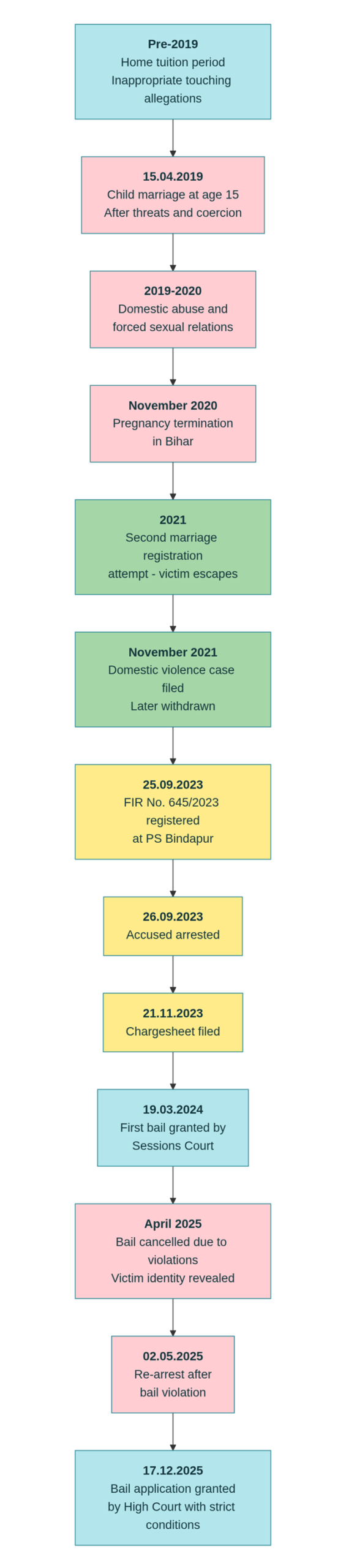
Timeline of Events in Sanjeev Kumar Bail Application Case (Bail APPLN. 4475/2025)
The Legal Journey: From Registration to Initial Bail and Violation
The victim filed a domestic violence complaint in November 2021 under the Domestic Violence Act, but due to family intervention, she was forced to withdraw it. This withdrawal, occurring without allegations under POCSO Act, later became a point of judicial scrutiny. The chargesheet was filed on November 21, 2023, under Sections 376, 506, 323 of the IPC and Section 6 of POCSO Act. The accused was arrested on March 26, 2023, and remained in custody until the Sessions Court granted him bail on March 19, 2024.[1]
The Sessions Court’s bail order is particularly notable for its problematic reasoning, which questioned the credibility of abuse allegations by noting that the victim did not file complaints immediately upon leaving the accused. The Sessions Judge observed that the marriage occurred “in the presence of the parents” and therefore could not be considered as occurring under threat, and criticized the victim for the temporal gap between her escape (October 21, 2020) and the POCSO allegations (filed December 17, 2022). This reasoning reflects a persistent judicial bias that fails to account for the psychological dynamics of abuse, trauma bonding, family pressure, and the stigma surrounding sexual assault disclosures in Indian society—factors that extensively documented in psychological and sociological research explain delayed reporting in sexual abuse cases.[1]
The bail granted on March 19, 2024, was subsequently cancelled when the accused violated its conditions in serious ways. He granted an interview revealing the victim’s identity, directly violating Section 228A of the Indian Penal Code, which criminalizes disclosure of victim identity in sexual offense cases. Additionally, the accused made contact with the victim through various means and continued harassing her. This bail violation demonstrated the real and ongoing danger the victim faced, forcing her to change her residential address. The accused was re-arrested on May 2, 2025, after spending seven months in custody prior to this bail application hearing.[2][1]
Understanding Section 228A and Victim Identity Protection
The revelation of the victim’s identity represents a serious separate offense under Section 228A of the Indian Penal Code, which was inserted in 1983 following the Mathura rape case to prevent social victimization of sexual assault victims. Section 228A prescribes imprisonment up to two years and/or fine for anyone who prints, publishes, or discloses any matter that identifies victims of sexual offenses. The legislative intent behind this provision is to protect victim privacy and dignity while encouraging victims to come forward without fear of social stigma or retribution.[2]
The section recognizes certain exceptions: disclosure authorized by the police officer investigating in good faith, disclosure by the victim herself, or in cases of deceased, minor, or unsound mind victims, authorization from next-of-kin of recognized welfare institutions. In Sanjeev Kumar’s case, no such authorization existed, making his revelation of victim identity a distinct criminal violation layered atop the primary sexual abuse charges.[2]
The High Court’s Bail Decision: Balancing Liberty and Protection
Justice Amit Mahajan’s December 17, 2025 decision represents a sophisticated balancing of the accused’s right to bail against the imperative to protect the victim from further harassment. The court acknowledged that the chargesheet had been filed months earlier (November 21, 2023) and all public witnesses, including the victim, had been examined. The court recognized that the accused had been in custody for over seven months since re-arrest on May 2, 2025, a substantial period that addressed concerns about the maximum two-year punishment for revealing victim identity.[1]
However, Justice Mahajan was clearly troubled by the pattern of abuse and the accused’s demonstrated willingness to violate bail conditions and continue harassing the victim despite previous restrictions. The court explicitly noted that “on the earlier occasion also the applicant was found to have harassed and threatened the victim” and that victim’s counsel raised “every apprehension that the applicant if released on bail will further harass the victim.” This acknowledgment placed victim protection concerns at the forefront of the bail decision.[1]
The Protective Framework: Stringent Bail Conditions
Rather than denying bail outright, which might have been affirmed by higher courts given the extended custody period and case advancement, Justice Mahajan imposed a comprehensive framework of protective conditions representing best practices in sexual assault cases. The bail conditions included:[1]
Substantive Restrictions: The accused cannot directly or indirectly make inducements, threats, or promises to any person acquainted with case facts, nor tamper with evidence. He cannot leave the country without trial court permission and must appear as directed.
Territorial Restrictions: Most significantly, the accused cannot reside within 5 kilometers of the locality where the victim resides—a condition that physically separates the perpetrator from the victim’s community and dramatically reduces opportunities for contact or intimidation.
Accountability Mechanisms: The accused must provide his residential address post-release and inform authorities of any changes. He must submit his mobile number to the investigating officer and keep it switched on at all times. Critically, he must appear before the investigating officer once weekly—a condition that creates regular accountability checkpoints.
Victim Protection Protocol: The judgment directs the investigating officer to remain in daily contact with the victim via mobile phone and to take prompt action upon receiving any complaint. This provision represents an important judicial recognition that victim safety requires proactive police engagement rather than passive complaint-reception.[1]
These conditions reflect evolved judicial thinking about bail in sexual offense cases, influenced by the Supreme Court’s landmark decision in Aparna Bhat v. State of Madhya Pradesh (2021), which established that bail conditions in sexual assault cases should: (i) not mandate or permit contact between accused and victim; (ii) actively protect the victim from harassment; (iii) involve the victim in determination of special protective conditions; (iv) ensure prompt victim notification of bail; and (v) be free from stereotypical or patriarchal notions about women.[3]
Judicial Observations and Their Legal Significance
Justice Mahajan emphasized that observations made in the bail order should “not influence the outcome of the trial and also not be taken as an expression of opinion on the merits of the case.” This clarification is crucial, as it signals that the court was not prejudging the case on merits, a particularly important safeguard given the Sessions Court’s controversial reasoning about the victim’s credibility and delayed reporting.[1]
The judgment distinguishes between accepting bail on grounds of custody duration and case advancement (factors favoring release) while simultaneously recognizing the accused’s demonstrated propensity for harassment (factors requiring protective conditions). This nuanced approach reflects judicial maturity in understanding that bail denial is not the only tool for victim protection, and that conditions can effectively mitigate risk while preserving the accused’s constitutional right to liberty pending trial.
The court also made an important procedural direction: in event of any new FIR, DD entry, or complaint against the accused, the State can seek bail cancellation through a separate application. This creates a dynamic accountability mechanism rather than static conditions, allowing courts to respond to demonstrated violations without waiting for trial conclusion.[1]
Broader Jurisprudential Implications for Sexual Assault Bail
This judgment operates within the context of evolving judicial standards for bail in sexual offense cases, particularly those involving minors. In Independent Thought v. Union of India (2017), the Supreme Court struck down Exception 2 to Section 375 IPC, which had provided immunity for sexual intercourse with married girls aged 15-17 years. The Court determined that such an exception created arbitrary distinctions between married and unmarried minor girls and conflicted with POCSO Act provisions that extend absolute protection to all children below 18.[4]
The same legal principles that invalidated Exception 2 underscore why bail conditions in child sexual abuse cases must prioritize victim protection. If a child cannot legally consent to sexual relations within marriage, she equally cannot be deemed culpable for “consenting” to bail conditions that expose her to contact with her abuser. Courts increasingly recognize that protective bail conditions are not punitive restrictions on the accused but necessary safeguards for individuals whose legal status requires special protection.
The judgment also reflects jurisprudence on bail conditions more broadly. The Supreme Court in Frank Vitus v. Narcotics Control Bureau (2024) emphasized that bail conditions cannot be “fanciful, arbitrary or freakish” and must be limited to ensuring accused’s appearance, preventing offense commission, preventing evidence tampering, and preventing obstruction of justice. The conditions here satisfy these criteria: residential restrictions prevent contact that could lead to further offense or witness tampering; weekly reporting ensures appearance; mobile phone requirements facilitate tracking; and victim monitoring addresses potential further harassment.[5]
The Charging and Investigation Framework
The case proceeded under multiple statutory frameworks. Sections 376 (rape), 506 (criminal intimidation), and 323 (voluntarily causing hurt) of the IPC address the physical and psychological abuse aspects. Section 6 of POCSO Act addresses sexual assault on children. The separate charging under Section 228A (identity disclosure) represents a prosecutorial recognition that bail violations themselves constitute independent crimes requiring separate accountability.[1]
The POCSO Act framework is particularly significant here. POCSO shifted from consent-based analysis to recognition that children cannot consent to sexual activity, thereby criminalizing all sexual activity with children below 18. The accused’s argument that his marriage to the victim somehow legitimized subsequent sexual activity would be rejected under POCSO, as the Act makes consent irrelevant for children. Furthermore, courts addressing POCSO cases must consider factors specific to child abuse, including the victim’s age, the age difference between accused and victim, and whether the victim is particularly vulnerable due to psychological or physical circumstances.[6]
Victim Support and Trauma-Informed Justice
A significant innovation in the bail order is the direction for investigating officers to maintain daily contact with the victim. This represents judicial recognition of victim trauma and the ongoing psychological impact of abuse. Victims of prolonged child sexual abuse, particularly within relationships of trust and control, frequently experience complex trauma including anxiety disorders, depression, PTSD, hypervigilance, and difficulty trusting authority figures.
The judicial direction for daily police contact serves multiple functions: it provides the victim with a regular contact point to report harassment, creates documentary evidence of any violation, signals state commitment to victim protection, and may provide psychological reassurance that the victim is not abandoned by the system. This trauma-informed approach recognizes that bail decisions affect victim safety and recovery trajectories, not merely accused constitutional rights.
Conclusion: Victim Protection as a Judicial Imperative
The Sanjeev Kumar judgment demonstrates that granting bail in sexual assault cases need not mean abandoning victim protection. Through comprehensive, purpose-driven conditions calibrated to prevent specific harms (contact, harassment, identity revelation), courts can protect vulnerable witnesses while respecting the accused’s right to liberty pending trial. The court’s detailed victim protection protocol—particularly the daily police-victim contact and 5 km residential restriction—may serve as a model for other Indian courts addressing bail in child sexual abuse cases.
However, the judgment also highlights persistent challenges: the Sessions Court’s initial reasoning about delayed reporting reflects bias that continues to inhibit victim disclosure; the victim’s need to change her address after bail violation demonstrates the real danger even with protective conditions in place; and the possibility of acquittal despite apparent evidence reminds us that bail decisions operate in context of uncertain trial outcomes.
The ultimate test of this judgment’s success will be whether it prevents further harassment while maintaining evidentiary integrity for trial. More broadly, it contributes to a judicial framework where bail decisions in sexual offense cases prioritize victim protection through affirmative police action rather than presuming passive compliance with conditions. As sexual assault jurisprudence continues evolving—particularly in response to digital harassment and reproductive coercion—decisions like this provide important guidance on integrating protective bail conditions with constitutional rights to bail.
Citations:
Sanjeev Kumar v. The State (NCT of Delhi), Bail Application 4475/2025, High Court of Delhi, December 17, 2025[1]
Section 228A, Indian Penal Code, 1860; Lawrato and Legal Services India on IPC Section 228A[2]
Aparna Bhat v. The State of Madhya Pradesh, Madhya Pradesh High Court, March 18, 2021[3]
Supreme Court Bail Jurisprudence on POCSO Act cases, from Supreme Court Child Rights decisions[7]
Protection of Children from Sexual Offences Act (POCSO), 2012 – Provisions and Judicial Interpretation[6]
Independent Thought v. Union of India, Supreme Court of India, 2017[4]
Frank Vitus v. Narcotics Control Bureau, Supreme Court of India, 2024 (SCC 479)[5]
- 59517122025BA44752025_201122.pdf
- https://jgu.edu.in/child-rights-clinic/supreme-court-grants-bail-to-pocso-accused-after-five-months-in-custody/
- https://mpsja.mphc.gov.in/Joti/pdf/LU/Aparna_Bhat_vs_The_State_Of_Madhya_Pradesh_on_18_March_2021.PDF
- https://www.scobserver.in/reports/independent-thought-union-of-india-exception-to-rape-within-child-marriages-judgment-of-the-supreme-court-in-plain-english/
- https://www.legalservicesindia.com/law/article/39777/5/Bail-Condition-Enabling-Police-To-Constantly-Track-Movement-Of-Accused-Can’t-Be-Imposed-SC
- https://www.jetir.org/papers/JETIR2406289.pdf
- https://lawrato.com/indian-kanoon/ipc/section-228a
- https://ipclaws.in/ipc/section-228a/
- https://www.drishtijudiciary.com/current-affairs/cyber-harassment-bail-condition
- https://en.wikipedia.org/wiki/Section_228A_of_the_Indian_Penal_Code
- https://vajiramandravi.com/current-affairs/judicial-discretion-in-pocso-bail-legal-grey-zones-and-recent-trends/
- https://delhihighcourt.nic.in/app/showFileJudgment/SVN20052025BA47642024_203000.pdf
- https://delhihighcourt.nic.in/app/showFileJudgment/59517122025BA44752025_201122.txt
- https://www.hilarispublisher.com/open-access/sexual-abuse-through-child-marriages-the-law-in-india-2167-1222-1000404.pdf
- https://www.crpc.in/know_your_rights.html
- https://www.casemine.com/judgement/in/68f7c0a59a22022a04926810
- https://mphc.gov.in/upload/jabalpur/MPHCJB/2021/MCRC/17991/MCRC_17991_2021_FinalOrder_04-May-2021.pdf
- https://cjp.org.in/police-custody-under-crpc-bnss-a-paradigm-shift-in-balancing-liberty-and-investigation/
- https://lawlens.in/doc/c21973c4-9bac-4cb4-ac5b-30c408e7d967
- https://www.scconline.com/blog/post/2025/09/29/supreme-court-interim-bail-with-rehabilitation-pocso-rehabilitation-support-convict/
- https://www.lcitylscb.org/information-for-practitioners/safeguarding-topics/understanding-bail-conditions/