








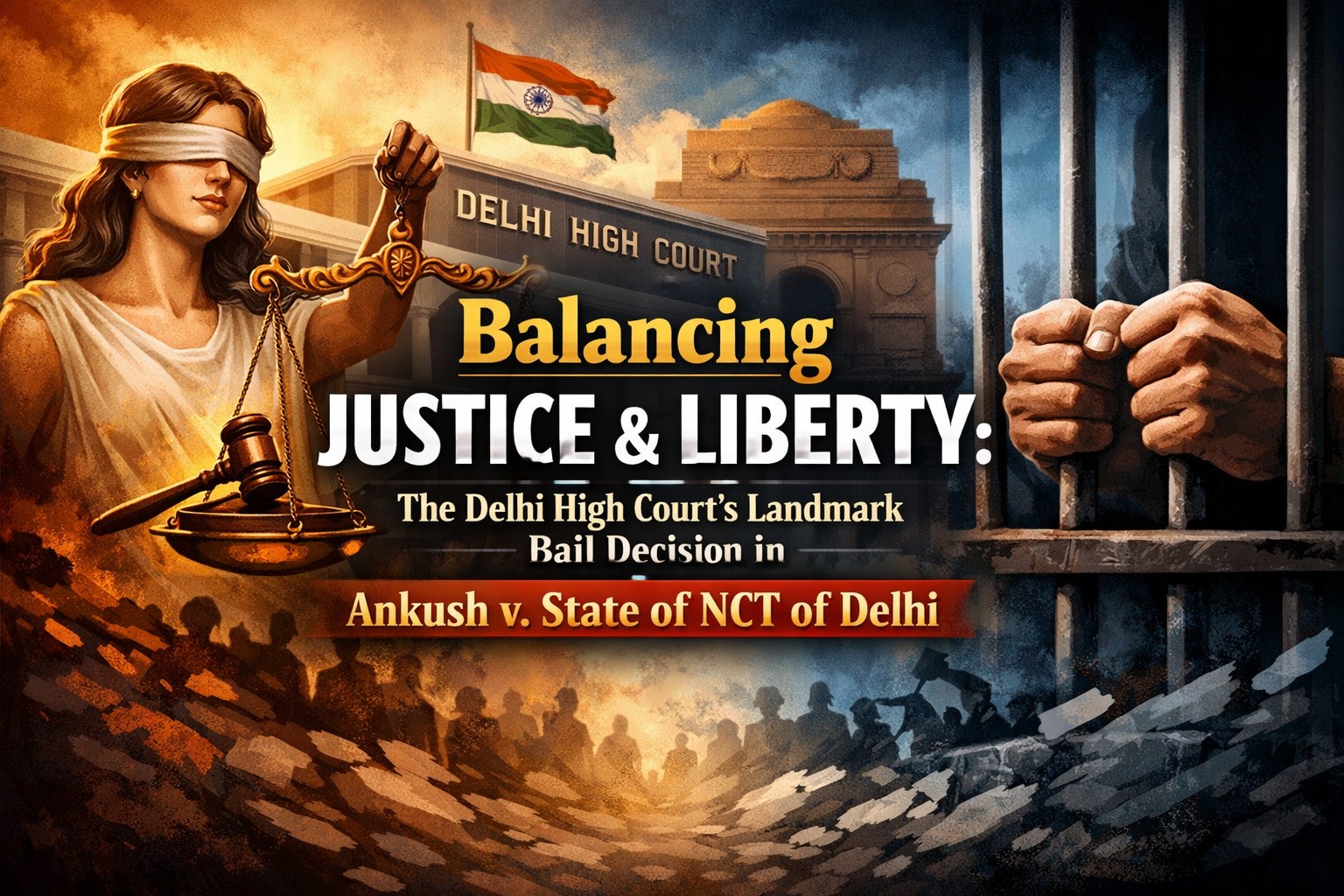
Balancing Justice and Liberty: The Delhi High Court’s Landmark Bail Decision in Ankush v. State of NCT of Delhi
The Delhi High Court’s judgment in Bail Application 3729/2025 (decided December 16, 2025) represents a significant reaffirmation of an accused’s fundamental right to a speedy trial, even in cases involving grave criminal allegations. Justice Amit Mahajan’s decision to grant bail to Ankush @ Dal Chand after 30 months of custody highlights the critical tension between prosecutorial interests and constitutional protections, establishing important precedent on how courts must navigate this balance when trials face protracted delays.
The Facts and Allegations
The case originated from an FIR (No. 850/2021) filed on July 12, 2021, at Police Station Sultanpuri in Delhi. The allegations are exceptionally serious in nature, involving multiple criminal statutes: Section 313 (wrongful restraint), Sections 323 (voluntarily causing hurt) and 376 (rape) of the Indian Penal Code, 1860, Section 498A (cruelty by husband), Section 6 of the Protection of Children from Sexual Offences Act, 2012, and Section 10 of the Prohibition of Child Marriage Act, 2006. According to the prosecution narrative, the accused established a relationship with a minor girl, forcibly sexually assaulted her before their scheduled marriage while threatening to release obscene videos he had recorded without her consent, subsequently married her, subjected her and his family to dowry demands, and finally perpetrated violence against her while she was pregnant.[1]
The prosecution’s chronology presents a pattern of systematic abuse spanning nearly two years. The victim, a minor at the time of initial assault, became pregnant after the marriage in March 2021 and was coerced into consuming medical termination of pregnancy pills in December 2020. The violence that triggered the FIR occurred on July 11, 2021, when the victim was seven months pregnant and seeking respite at Sanjay Gandhi Hospital. The sheer gravity of these allegations underscores why the prosecution vigorously opposed bail, arguing that release would enable witness intimidation and evidence tampering.[1]
The Procedural History and Rights of an Undertrial
What makes this judgment particularly instructive is the procedural complexities surrounding the applicant’s custody status. The Trial Court initially admitted the applicant on bail on November 22, 2021, observing that the parties had solemnized their marriage with parental consent and that the victim had already delivered a child, making further custodial interrogation unnecessary. The applicant was released on November 24, 2021.[1]
However, this first period of freedom ended abruptly. On March 9, 2023, another FIR (No. 230/2023) was registered at Police Station Sultanpuri, alleging that the applicant had assaulted the victim’s brother and her daughter. This led to the applicant’s re-arrest on April 21, 2023, and cancellation of his previous bail. From April 2023 until the December 2025 judgment, the applicant remained in judicial custody—a continuous period of approximately 30 months or 2.5 years of pre-trial incarceration.[1]
The defense counsel presented a starkly different narrative than the prosecution. They argued that the parties were in a consensual relationship and willingly married, and that the charges stemmed from marital discord and adjustment issues. They further contended that the victim’s family, disapproving of her continued contact with the applicant, orchestrated false accusations to destroy their relationship. Crucially, they noted that the applicant had been released on bail in the subsequent FIR (No. 230/2023), yet remained detained in the original case.[1]
The Constitutional Principle: Right to Speedy Trial Under Article 21
Justice Mahajan’s judgment is grounded in the constitutional principle that an accused possesses a fundamental right to a speedy trial under Article 21 of the Indian Constitution, which guarantees the right to life and personal liberty. This principle, while seemingly straightforward, has required the Indian judiciary to grapple with complex jurisprudential questions: Can this right be overridden when crimes are exceptionally serious? Do statutory restrictions on bail negate this constitutional guarantee? These questions have generated evolving jurisprudence that the Delhi High Court carefully navigated.
The judgment cites two landmark Supreme Court decisions that crystallize contemporary bail jurisprudence. In Union of India v. K.A. Najeeb (AIR 2021 SC 712), the Supreme Court held that “once it is obvious that a timely trial would not be possible, and the accused has suffered incarceration for a significant period of time, the courts would ordinarily be obligated to enlarge them on bail.” More directly relevant to the present case, in Javed Gulam Nabi Shaikh v. State of Maharashtra (Crl.A.2787/2024), the Supreme Court observed with unmistakable clarity: “If the State or any prosecuting agency including the court concerned has no wherewithal to provide or protect the fundamental right of an accused to have a speedy trial as enshrined under Article 21 of the Constitution then the State or any other prosecuting agency should not oppose the plea for bail on the ground that the crime committed is serious.”[1]
The Supreme Court further emphasized that the “presumption of innocence” remains fundamental to criminal jurisprudence: “We may hasten to add that the petitioner is still an accused; not a convict. The over-arching postulate of criminal jurisprudence that an accused is presumed to be innocent until proven guilty cannot be brushed aside lightly, howsoever stringent the penal law may be.” This statement directly challenges a dangerous tendency in Indian criminal practice where the seriousness of allegations effectively operates as a substitute for establishing guilt, transforming bail from a procedural safeguard into a mechanism of punishment.[1]
The Trial Timeline: When Delay Becomes Constitutional Violation
The judgment reveals a critical metric for evaluating delay: the extent of trial progress relative to time served. Out of 22 prosecution witnesses, only 8 had been examined by the time of the bail application—approximately 36% of the prosecution’s case. Fourteen witnesses remained unexamined, and the judgment explicitly states that “the trial is likely to take considerable time.” For an applicant who had spent 30 months in custody with more than 64% of the witness examination still pending, Justice Mahajan concluded that “no purpose would be served by keeping the applicant in further custody.”[1]
This proportionality analysis—between period served and likely remaining trial duration—represents a crucial doctrinal development. It shifts focus from the abstract seriousness of allegations to the concrete reality of delayed justice. Justice Mahajan notes that the applicant “cannot be made to spend the entire period of trial in custody, specially when the trial is likely to take considerable time as 14 witnesses are yet to be examined.” This reasoning acknowledges that the Indian criminal justice system, despite its constitutional commitments, operates with significant resource constraints. When trials face protracted delays due to systemic factors rather than accused misconduct, constitutional protections must operate as a counterweight.[1]
Balancing Legitimacy: Protective Conditions as Alternatives to Detention
While the judgment grants bail on speedy trial grounds, it does not treat these grounds as license to ignore legitimate prosecutorial concerns. The victim, present in court, expressed fear that the applicant would “further try to threaten her” if released. The prosecution argued serious risk of witness intimidation given the nature of the allegations and the applicant’s apparent liberty while on previous bail. These concerns, while insufficient to justify continued detention absent trial progress, demanded judicial response.[1]
Justice Mahajan imposed a carefully calibrated set of six conditions designed to protect the victim while respecting the applicant’s liberty:
- Territorial restriction: The applicant must reside at least 5 kilometers away from the victim’s residence, a distance designed to physically discourage harassment while permitting freedom of movement.[1]
- Non-contact order: An absolute prohibition on contacting the victim, her family members, or witnesses “in any manner whatsoever”—a critical safeguard given the domestic violence allegations.[1]
- Mobility tracking: Requirement to provide his mobile number to the investigating officer, maintain it switched on continuously, and mark presence before the investigating officer every two weeks.[1]
- Passport restriction: Prohibition on leaving the country without trial court permission.[1]
- Reporting obligation: Regular court appearances as directed.[1]
- Escalation mechanism: A provision enabling the police to take immediate action upon discovery of any violations, with authority for the respondent to seek bail cancellation through formal application if new FIRs or complaints are lodged.[1]
This framework exemplifies modern bail jurisprudence’s sophistication. Rather than adopting the crude binary of detention versus freedom, Justice Mahajan constructed conditional liberty—a middle pathway that respects both the accused’s constitutional right to remain free pending trial and the victim’s safety interests. The temporal restriction (every two weeks) is more stringent than typical reporting requirements, designed to ensure ongoing state monitoring while maintaining the accused’s ability to work, reside with family, and prepare his defense.
The Presumption of Innocence: Still Binding Despite Seriousness
An important dimension often obscured in serious criminal cases is explicitly addressed in this judgment. The prosecution argued that “the allegations against the accused are serious in nature and he has misused the liberty granted to him,” implying that the seriousness of allegations alone justifies detention. Justice Mahajan implicitly rejected this reasoning by shifting the analytical focus from crime categorization to trial progress.[1]
This reflects a broader doctrinal principle articulated in the judgment’s citation of Supreme Court jurisprudence: the presumption of innocence operates even when the accused stands charged with grave crimes. The victim and her family, though sympathetic parties, are not the tribunal of fact. Their allegations, however credible they may appear and however serious the potential consequences, remain allegations pending proof “beyond a reasonable doubt” at trial. An undertrial prisoner who remains presumed innocent cannot be indefinitely incarcerated as proxy punishment for delaying prosecutions and congested court dockets.
The judgment notes that Justice Mahajan clarified that “the observations made in the present order are only for the purpose of deciding the present bail application and should not influence the outcome of the trial and also not be taken as an expression of opinion on the merits of the case.” This cautionary statement is important: bail determinations operate within different evidentiary and analytical frameworks than ultimate guilt determinations. A bail grant implies nothing about the eventual trial outcome; it reflects only that constitutional protections mandate liberty pending trial when trial is indefinitely delayed.[1]
The Broader Jurisprudential Context: Special Laws and Constitutional Rights
While the present case does not involve special laws (like the UAPA—Unlawful Activities Prevention Act), Justice Mahajan’s reasoning resonates with evolving case law concerning stringent bail provisions. Recent Supreme Court decisions have established that even special laws with restrictive bail provisions cannot override Article 21 protections when trials face indefinite delay. In Union of India v. K.A. Najeeb, the accused spent 5.5 years in custody under UAPA charges with trial completion appearing unlikely. The Supreme Court held that despite UAPA’s restrictive bail provisions, constitutional courts retain power to grant bail when Article 21 rights are violated through prosecutorial or systemic delay.[2][3]
Similarly, in Javed Gulam Nabi Shaikh, decided earlier in 2024, the Supreme Court observed that “howsoever serious a crime may be, an accused has a right to speedy trial as enshrined under the Constitution of India.” The Court further noted that trial courts and High Courts have “forgotten a very well settled principle of law that bail is not to be withheld as a punishment.”[2]
This evolution in bail jurisprudence reflects a sophisticated understanding that true justice requires two components: effective prosecution of crime AND protection of individual liberty. When prosecutors and courts create conditions where accused persons spend years awaiting trial, both components are violated. The accused is punished without conviction; the community’s interest in timely justice is undermined through delay; and public confidence in the criminal justice system erodes.
Victim Safety and Constitutional Rights: Creating Space for Both
One aspect that distinguishes this judgment is its sincere engagement with victim concerns. The prosecution’s opposition to bail was not abstract; it grounded itself in the victim’s expressed fear of continued harassment. Rather than dismissing these concerns as insufficient to override speedy trial protections, Justice Mahajan constructed conditions specifically designed to address them.
The 5-kilometer separation requirement is particularly significant in cases involving intimate partner violence or domestic abuse. Research demonstrates that geographic distance substantially reduces harassment risk in domestic violence contexts. By combining this with technology-enabled monitoring (mobile phone requirement with regular reporting) and non-contact orders, Justice Mahajan created protective scaffolding that would likely satisfy victim safety concerns while respecting the accused’s liberty.
However, this approach also implicitly recognizes a limitation: victim safety concerns, however legitimate, cannot justify indefinite pre-trial detention. The victim is a crucial witness; her testimony is likely critical to the prosecution’s case. Her fear of harassment, while understandable, cannot operate as independent ground for perpetual detention when trial progress has stalled. Rather, protective conditions that reduce (without eliminating) harassment risk represent the appropriate judicial response.
Institutional Implications: Court Capacity and Systemic Delay
Justice Mahajan’s judgment implicitly critiques institutional capacity problems within the Indian criminal justice system. The existence of 22 prosecution witnesses for a single FIR reflects either prosecutorial overreaching or genuine complexity, but either way, the examination of only 8 witnesses after 30 months of custody is indefensible. This pace suggests systemic constraints—inadequate courtroom hours, insufficient judicial resources, or poor case management—that cannot burden the accused through continued detention.
The Supreme Court, in Javed Gulam Nabi Shaikh, made this institutional critique explicit: “If the State or any prosecuting agency including the court concerned has no wherewithal to provide or protect the fundamental right of an accused to have a speedy trial as enshrined under Article 21 of the Constitution then the State or any other prosecuting agency should not oppose the plea for bail on the ground that the crime committed is serious.” This statement contains an important implicit message to institutional actors: resource constraints do not justify bail denial. Rather, they justify systemic reform. Courts cannot use bail as a proxy mechanism for managing caseload pressures.[1]
Justice Mahajan acknowledges, but does not credit, the prosecution’s suggestion that the case would require additional time to examine remaining witnesses. Instead, the judgment shifts responsibility: if the prosecution cannot organize its case efficiently, this reflects prosecutorial or institutional failure, not accused misconduct. The accused cannot be indefinitely detained as consequence of such failure.
Comparative Jurisprudence: International Perspectives
While the judgment does not engage with comparative law, it aligns with global bail jurisprudence. International human rights law, including the International Covenant on Civil and Political Rights (which India has ratified), establishes that speedy trial is a fundamental right and that pre-trial detention must remain exceptional, not routine. Many common law jurisdictions (Australia, Canada, UK) have developed sophisticated bail jurisprudence establishing that trial delay, particularly when not attributable to the accused, justifies bail or bail review.
Justice Mahajan’s approach thus reflects not judicial innovation, but rather the application of long-settled constitutional principles. The innovation lies in courts finally enforcing these principles despite serious criminal allegations.
Conclusion: Rebalancing the Scales of Justice
The Delhi High Court’s judgment in Ankush v. State of NCT of Delhi represents a significant rebalancing of India’s bail jurisprudence. For too long, serious allegations have operated as practical detention without trial, with courts treating bail as privilege to be granted only upon proof of innocence—inverting constitutional protections. This judgment reasserts that bail is constitutional protection, not judicial gift, and that speedy trial remains fundamental even when allegations are grave.
The decision does not minimize the victim’s suffering or the seriousness of the charges. Instead, it establishes that justice requires three elements: prosecution of crime, respect for liberty, and trial completion within reasonable timeframes. When one element fails (trial within reasonable timeframes), courts must restore balance by protecting another element (liberty pending trial). Protective conditions, rather than detention, provide the appropriate mechanism.
For the Indian criminal justice system, struggling with massive case backlogs and undertrial prison populations exceeding 70% of total incarcerated persons, this judgment provides crucial doctrinal permission to grant bail in delayed trials. It permits courts to reject prosecutorial arguments that “seriousness of crime” justifies indefinite detention. Most importantly, it reaffirms that an accused remains presumed innocent not merely as legal fiction, but as operative constitutional principle requiring liberty pending trial—even when the charges are exceptionally grave.
- 59516122025BA37292025_201755.pdf
- https://www.drishtijudiciary.com/current-affairs/right-to-speedy-trial
- https://thelawwaywithlawyers.com/1982-2/
- https://lawfoyer.in/javed-gulam-nabi-shaikh-vs-state-of-maharashtra-and-another/
- https://api.sci.gov.in/supremecourt/2024/10252/10252_2024_16_17_53504_Judgement_03-Jul-2024.pdf
- https://www.lawgratis.com/blog-detail/javed-gulam-nabi-shaikh-vs-state-of-maharashtra-july-03-2024
- https://cjp.org.in/liberty-under-siege-reclaiming-the-right-to-speedy-trial-from-the-grip-of-special-laws/
- https://theamikusqriae.com/union-of-india-v-k-a-najeeb-2/
- https://majestylegal.in/wp-content/uploads/2024/07/06072024-1.pdf
- https://lawhelpline.in/wp-content/uploads/2024/01/BAILSHORT.pdf
- https://www.scobserver.in/journal/bail-under-uapa-can-be-granted-if-the-accuseds-trial-has-been-delayed/