







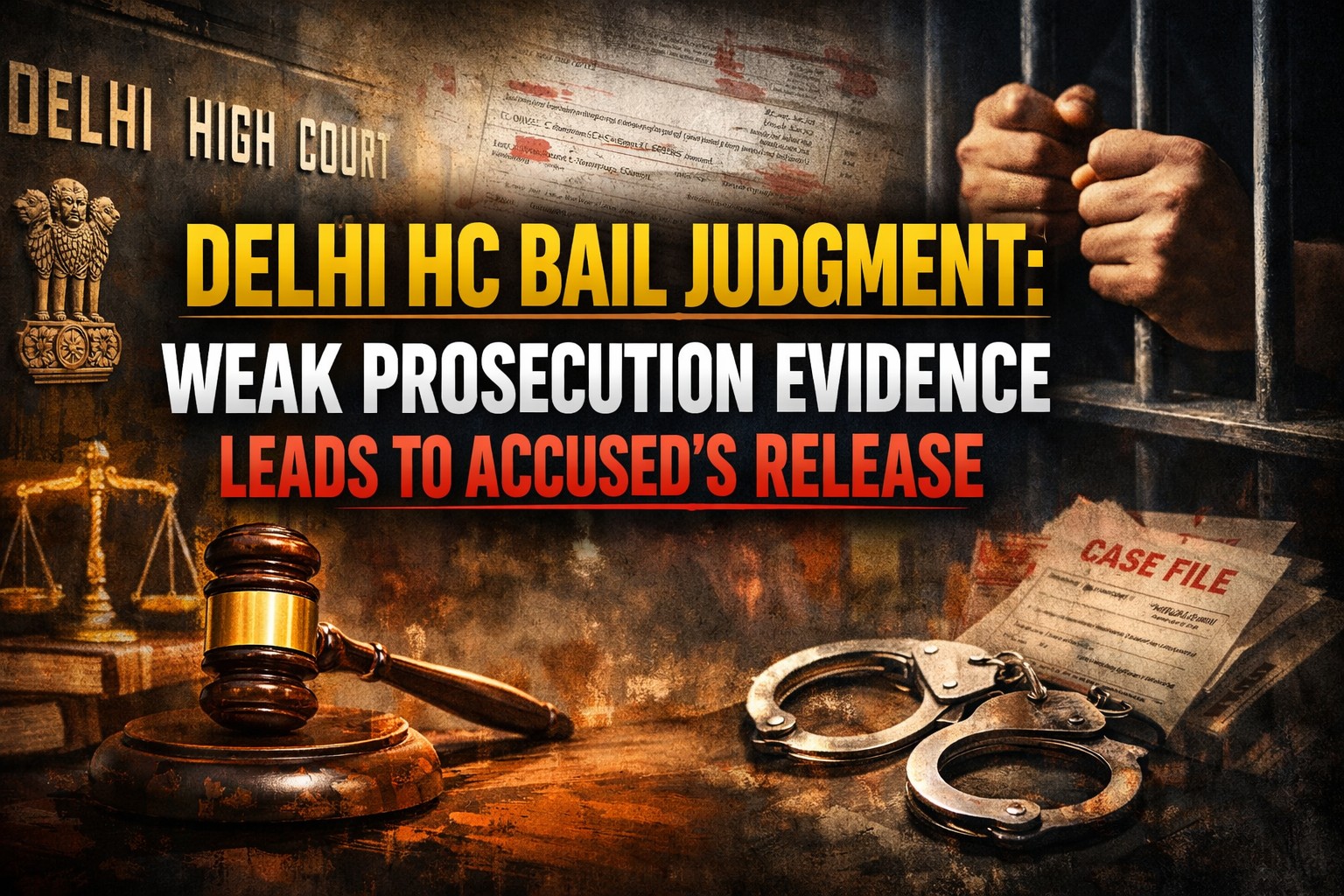
Delhi High Court Bail Judgment: Weak Prosecution Evidence Leads to Accused’s Release
Introduction
In a significant bail application decided on January 7, 2026, Justice Girish Kathpalia of the High Court of Delhi granted regular bail to Rakesh @ Raka @ Pehlwan (Bail Application No. 4322/2025), accused in a firearms case. This judgment underscores the critical importance of concrete evidence in criminal proceedings and highlights how the absence of reliable corroboration can lead to the acquittal of accused persons even in serious cases[1]. The order also illustrates the judicial approach toward examining the strength of the prosecution’s case at the pre-trial stage, particularly when dealing with allegations of attempt to commit murder under Section 307 IPC.
Case Details and Charges
Case Reference: FIR No. 262/2021, Police Station Narela Industrial Area, Delhi
The applicant, Rakesh @ Raka @ Pehlwan, faced charges under the following legal provisions[2]:
- Section 307 IPC (Attempt to Commit Culpable Homicide)
- Section 506 IPC (Criminal Intimidation)
- Section 34 IPC (Acts Done by Several Persons in Furtherance of Common Intention)
- Sections 25, 54, and 59 of the Arms Act (relating to illegal possession and use of firearms)
The case originated from an incident dated May 2, 2021, at approximately 4:45 PM in Narela Industrial Area.
Factual Background
Alleged Incident
According to the First Information Report and the prosecution’s case narrative, the complainant was waiting for his friend on a scooter when the incident occurred. Two individuals arrived on a motorcycle—one riding and one sitting as a pillion passenger. The pillion passenger dismounted and allegedly:
- Threatened to kill the complainant
- Drew a pistol from his possession
- Attempted to cock the weapon
The complainant, sensing imminent danger, abandoned his scooter and fled into the nearby house of one Rajat, from where he contacted the police. Upon returning to the scene, a live cartridge was recovered from the spot[2].
Alleged Perpetrators
The incident involved two individuals:
- The person cocking the pistol – the pillion passenger from the motorcycle
- The person driving the motorcycle – identified later as Rakesh @ Raka @ Pehlwan (the applicant in this case)
The prosecution’s case against Rakesh hinged on his role as the motorcycle driver, allegedly providing active assistance to the co-accused who wielded the firearm.
Court’s Analysis and Key Findings
Weakness in Prosecution’s Case
Justice Kathpalia critically examined the prosecution evidence and identified several fatal gaps in the case[3]:
Lack of Proper Identification
- The motorcycle’s registration number was never recorded by the complainant de facto
- No direct evidence establishing the connection between Rakesh and the motorcycle in question
- The Test Identification Parade (TIP) was conducted approximately 1.5 years after the alleged incident, rendering its reliability highly questionable
Problematic TIP Procedure
The defense argued—and the court implicitly acknowledged—that the 18-month delay in conducting the TIP severely compromised its reliability. Additionally, the accused was in jail in connection with a separate case during most of this period, further weakening the identification procedure’s evidentiary value.
Absence of Corroborating Evidence
- No incriminating material recovered from the accused
- No weapon recovered from either the accused or the co-accused
- The live cartridge recovered from the scene could not be connected to any specific weapon since the alleged pistol was never recovered
- Absence of any forensic or physical evidence linking the applicant to the crime scene
Investigative Admissions
Most significantly, the Additional Public Prosecutor (APP), on instructions from the Investigating Officer (IO), made a crucial concession to the court:
“The accused/applicant is not the person who was cocking the pistol, but he is the person who was driving the motorcycle.”[3]
This admission itself raised serious questions about the investigative conclusions, as the prosecution could not even definitively establish Rakesh’s presence at the incident.
The court noted that the learned trial court had already discharged Rakesh of the charges under Section 307 IPC—the most serious allegation involving attempt to commit culpable homicide[3]. This prior discharge indicated that the trial court also found insufficient evidence to proceed on this grave charge.
Legal Argument on Constructive Guilt
The defense contended that even accepting the prosecution’s narrative at face value, the act of merely cocking a pistol, by itself, does not constitute the offense of “attempt to commit culpable homicide.” This argument, while not directly addressed in elaborate detail in the judgment, reflects the established jurisprudence on attempt liability, where mere preparation or intention is insufficient without a substantial step toward commission of the offense[2].
Judicial Reasoning and Precedent
Bail Jurisprudence
The High Court’s decision reflects the well-established principles governing bail in criminal cases:
- Liberty as Fundamental Right – The court recognized that personal liberty is a fundamental constitutional right, and deprivation of bail requires strong and clear evidence of guilt
- Weakness of Prosecution Case – When the prosecution evidence is weak or circumstantial with significant gaps, courts routinely grant bail
- Presumption of Innocence – The accused retains the presumption of innocence throughout the trial, which is particularly important where the prosecution has failed to establish a prima facie case
This approach is consistent with precedents laid down by the Supreme Court of India and various High Courts, emphasizing that bail is the rule and jail is an exception, particularly when the prosecution evidence is fraught with infirmities[4].
CCTV Footage
While the court acknowledged that the APP had shown CCTV footage of the incident, the clarity and evidentiary value of this footage in definitively identifying the accused was not documented in the judgment. The fact that visual identification could not be reliably made despite such footage further strengthens the argument for bail.
The Court’s Order
Relief Granted
Justice Kathpalia allowed the bail application and directed the release of the accused on the following conditions[3]:
- Bail Quantum: Regular bail granted
- Personal Bond: Rs. 10,000/-
- Surety: One surety in the like amount (Rs. 10,000/-)
- Competent Authority: Conditions to be fulfilled to the satisfaction of the learned trial court
Rationale for Release
The court explicitly stated:
“Admittedly, registration number of the motorcycle allegedly driven by the accused/applicant was not noted by the complainant de facto. There is no clear material on record to connect the accused/applicant with the alleged offence. The live cartridge allegedly recovered from the spot cannot be connected with any weapon since the pistol allegedly cocked by co-accused has not been recovered. Considering the above circumstances, I find no reason to deprive the accused/applicant liberty any further.”[3]
This reasoning demonstrates that the accumulation of evidentiary gaps and the prosecution’s inability to establish crucial links in the chain of evidence necessitated the grant of bail.
Legal Implications and Significance
1. Emphasis on Proper Investigation
This judgment underscores the importance of thorough and meticulous investigation in cases involving firearms and serious offenses. The failure to recover the alleged weapon, the motorcycle, or any physical evidence linking the accused directly to the crime is a grave investigative shortcoming that inevitably weakens the prosecution’s case.
2. Limitations of Eyewitness Identification
The judgment implicitly cautions against over-reliance on eyewitness identification, particularly when:
- The identification is made after an extended period (1.5 years)
- Proper documentation (such as vehicle registration number) was not recorded at the scene
- Formal identification procedures are delayed and conducted under compromised circumstances
3. Bail as a Substantive Right
By granting bail despite serious allegations, the court reaffirms that bail is not merely a procedural matter but a substantive protection of the accused’s fundamental right to liberty. The strength of the prosecution’s case—or lack thereof—is a critical determinant of bail eligibility.
4. The Doctrine of Abetment and Accessory Liability
The case also reflects judicial scrutiny toward establishing accessory liability. Simply being present at the scene or driving a vehicle that the co-accused used is insufficient to establish culpable participation in the offense without additional evidence of shared intention or active participation.
5. Weapon Recovery in Firearms Cases
The judgment demonstrates that in cases involving alleged use of firearms, the recovery of the weapon is often crucial to establish:
- The authenticity of the threat
- The nexus between the cartridge recovered and the firearm
- The reliability of forensic evidence
The absence of the weapon severely undermines the prosecution’s narrative[5].
Comparative Jurisprudence
Similar principles have been articulated in various Supreme Court and High Court decisions:
- In cases involving attempt to commit murder, courts have emphasized that mere preparation or threat without a substantial step constituting “attempt” is insufficient[5]
- The requirement of identification of the specific perpetrator is mandatory in offenses involving identified victims and specific incidents[5]
- Bail applications should be decided on the basis of the material available on record at that stage, not on speculative theories of what the prosecution might prove[6]
Conclusion
The Delhi High Court’s judgment in Rakesh @ Raka @ Pehlwan’s bail application is a significant reminder of the foundational principle that the accused’s guilt must be established through reliable, credible, and legally admissible evidence. The confluence of several evidentiary gaps—the failure to record the motorcycle registration, the unreliable identification procedure after 1.5 years, the absence of physical evidence, and the investigator’s own admission about the accused’s limited role—collectively demonstrated that the prosecution had not established even a prima facie case against the accused.
Justice Kathpalia’s order upholds the constitutional guarantee of liberty and the presumption of innocence, demonstrating judicial vigilance in protecting the fundamental rights of citizens. While the judgment does not preclude further proceedings against the accused, it ensures that he shall not be deprived of his liberty pending trial without substantive evidence of his culpability.
The judgment also serves as an instructive note for investigating agencies emphasizing the importance of:
- Proper documentation at the crime scene
- Timely recording of identification details
- Conducting TIP procedures at the earliest opportunity
- Securing and preserving critical evidence, particularly weapons in firearms cases
- Establishing clear nexus between the accused and the alleged offense
For legal practitioners, this judgment reiterates the principle that in criminal cases, particularly those involving serious offenses like attempt to murder, the burden resting on the prosecution is heavy and uncompromising. Mere allegations, however serious, are insufficient; the prosecution must marshal concrete, reliable evidence to prove its case beyond reasonable doubt[4][6].
References
[1] High Court of Delhi. (2026, January 7). Bail Application No. 4322/2025 & Criminal Miscellaneous Application No. 33460/2025, Rakesh @ Raka @ Pehlwan v. State Government of NCT Delhi. New Delhi: High Court of Delhi.
[2] Indian Penal Code, 1860. Sections 307 (Attempt to Commit Culpable Homicide), 506 (Criminal Intimidation), and 34 (Acts Done by Several Persons in Furtherance of Common Intention). Government of India.
[3] Kathpalia, J. (2026, January 7). Judgment (Oral) in Bail Application 4322/2025. High Court of Delhi, New Delhi. Presided by Justice Girish Kathpalia.
[4] Supreme Court of India. (2000). Bail jurisprudence on presumption of innocence and liberty as fundamental right. Constitutional Law – Criminal Procedure.
[5] Supreme Court of India. Criminal law principles on attempt to commit offense, weapon recovery, and corpus delicti in firearms cases. [General reference to established jurisprudence on criminal law].
[6] Supreme Court of India & High Courts. (Various judgments). Principles governing bail applications and the burden of proof in criminal proceedings under the Indian legal system. [General reference to criminal procedure jurisprudence].