







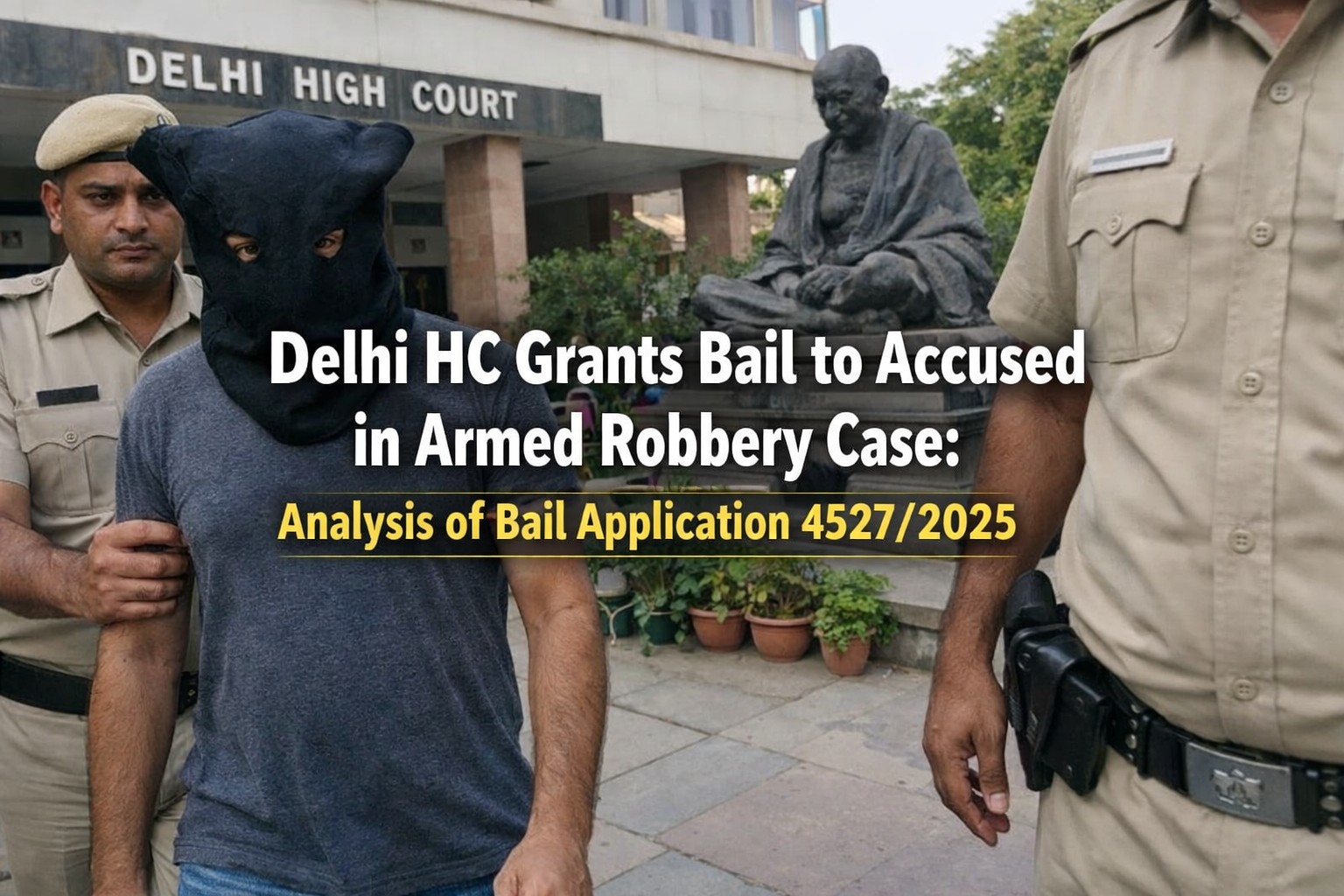
Delhi High Court Grants Bail to Accused in Armed Robbery Case: Analysis of Bail Application 4527/2025
Introduction
On January 6, 2026, Justice Girish Kathpalia of the Delhi High Court delivered a landmark decision in Bail Application 4527/2025, granting regular bail to accused Ghanshyam @ Tippu Pandit in a dacoity case involving the theft of Rs. 52 lakh. The judgment raises important questions about the evidentiary standards required for bail, the significance of partial recovery, and the principles of equality before the law in criminal procedure[1]. This article provides a detailed analysis of the court’s reasoning, the legal principles applied, and the implications of this decision for bail jurisprudence in India.
The Factual Background
The Crime and FIR Registration
The incident occurred on December 21, 2024, near the NKS Hospital traffic signal in the TSR (Traffic Signal Road) area of Delhi. According to the prosecution’s allegations, two individuals—Thakor Maheshji and Krushna Kumar—were transporting cash of Rs. 52,00,000/- on the instructions of their employer, received from one Amit Bhai. At approximately 5:15 PM, three unidentified individuals approached them on a motorcycle. One of the accused brandished a pistol and demanded the money bag, while the other two physically assaulted the complainant by striking his face. The miscreants then snatched the bag and fled on their motorcycle[2].
Following the incident, the Delhi Police registered FIR No. 766/2024 under Police Station Sarai Rohilla. The accused was charged under multiple sections of the Bharatiya Nyaya Sanhita (BNS), 2023, specifically Sections 309(4), 309(6), 311, and 61(2)—provisions dealing with dacoity, criminal intimidation, and abetment respectively.
Legal Provisions Invoked
The charges against the accused fall under the following BNS provisions:
- Section 309(4) and 309(6): Pertaining to dacoity and dacoity with criminal intimidation
- Section 311: Related to dacoity and preparation to commit dacoity
- Section 61(2): Concerning abetment of offenses
These are serious provisions carrying significant punishment, which ordinarily influences bail considerations unfavorably toward the accused.
The Accused’s Defense and Counter-Arguments
Allegations of False Implication
The defense mounted by Ghanshyam’s counsel, Mr. Tribhuvan, centered on the assertion of false implication. The accused argued that:
- He was previously released on bail on February 29, 2024, in an appeal arising from a murder case
- Following his release, the local police allegedly booked him in two additional false cases without proper justification[3]
- The current case represents part of a pattern of harassment and false implication by the police
This allegation, while serious, required substantiation through documentary evidence and cross-examination, which was not fully apparent from the court’s reasoning.
Reliance on Co-Accused’s Bail Grant
The defense further argued that Samay Singh, a co-accused with a similar role in the crime, had already been granted bail by the trial court. This invoked the principle of parity in bail jurisprudence—where similar accused in similar circumstances should not be treated differentially.
The Prosecution’s Case
Role Attribution
The prosecution, represented by APP Mr. Sanjeev Sabharwal with investigation officers SI Sachin Jaswal and SI Avdhesh Dixit, attributed the following role to the accused:
The prosecution claimed that Ghanshyam was not one of the three boys who physically carried out the snatching. Instead, his role was that of an insider informant or facilitator who:
- Had prior knowledge that the complainant would be carrying a money bag
- Conveyed this information to the actual perpetrators
- Facilitated the commission of the crime through information and planning[4]
Recovery and Evidence
The prosecution’s strongest piece of evidence was the partial recovery of Rs. 2,00,000/- from the accused’s possession out of the total looted amount of Rs. 52,13,500/-. This recovery was intended to establish the accused’s involvement and link him to the crime scene proceeds.
The Court’s Reasoning and Key Findings
Finding No. 1: Limited Role of the Accused
Justice Kathpalia made a critical observation: the accused was admittedly not one of those three boys who actually snatched the money bag. This finding was significant because it placed the accused in a secondary role—potentially that of abetment or facilitation rather than principal perpetration. The court acknowledged that:
- The actual perpetrators (the three boys with the pistol) were the primary offenders
- The accused’s alleged role was limited to providing information or facilitating the crime
- No evidence of direct physical participation was presented
This distinction is crucial under Indian criminal law, where the degree of culpability differs between principal actors and abettors, and the severity of punishment varies accordingly.
Finding No. 2: Parity with Co-Accused
A second critical finding concerned the grant of bail to co-accused Samay Singh by the trial court. The court observed that:
- Samay Singh had a similar role to the present accused
- Samay Singh had already been granted bail by the competent trial court
- There was no apparent reason to treat the two accused differently[5]
This invocation of the principle of parity in bail is well-established in Indian criminal jurisprudence. The Supreme Court has repeatedly held that similarly situated accused cannot be arbitrarily denied bail when others in the same circumstances have been granted relief. The underlying rationale is equality before the law—a fundamental principle enshrined in Article 14 of the Indian Constitution.
Finding No. 3: Disproportionate Recovery
Perhaps the most telling observation was regarding the recovery amount. Out of the total looted amount of Rs. 52,13,500/-, only Rs. 2,00,000/- was recovered from the accused’s possession. This represented approximately 3.84% of the total amount stolen. The court noted this discrepancy and implicitly questioned whether this minimal recovery was sufficient to establish the accused’s primary guilt in the matter[6].
The significance of this finding relates to the evidentiary principle that possession of stolen goods raises suspicion, but the degree of recovery matters. A substantial recovery would strengthen the prosecution’s case proportionally. In this instance, the minimal recovery made the case against the accused appear weaker, particularly when considering his alleged secondary role as an informant or facilitator.
Legal Principles Applied
1. Bail Standards Under Indian Criminal Law
Indian criminal jurisprudence recognizes distinct standards for granting bail based on the severity of the offense:
- Bailable Offenses: Where bail is a matter of right, and the accused must meet strict conditions to deny it
- Non-Bailable Offenses: Where bail is discretionary, and the court must balance the nature of the offense, the evidence, and the rights of the accused
Dacoity under Section 309 BNS is a serious non-bailable offense, meaning the threshold for granting bail is higher. However, it is not impossible, and courts regularly grant bail even in dacoity cases based on individual circumstances[7].
2. The Triple Test for Bail
In deciding bail applications for serious crimes, Indian courts apply what is commonly known as the “triple test”:
- Nature and gravity of the charges: More serious offenses favor detention
- Strength of the prosecution’s case: A weak case favors bail
- Character and antecedents of the accused: Prior criminal history disfavors bail, while a clean record favors it
The court’s findings implicitly applied this test:
- Nature of charges: Serious (dacoity), but with a secondary role for the accused
- Strength of case: Weakened by minimal recovery and reliance on the accused’s peripheral role
- Antecedents: Not discussed in detail in the judgment, though the defense raised concerns about false implication
3. Principle of Parity
The court invoked the principle that similarly situated accused must be treated similarly. This principle, derived from Article 14 of the Constitution, requires that:
- Where the role and circumstances are similar
- And bail has been granted to one accused
- Bail cannot be arbitrarily withheld from another in identical circumstances
- Without substantial and articulated reasons for differential treatment[8]
The prosecution offered no explanation for why Samay Singh deserved bail while Ghanshyam did not, making this principle dispositive.
4. The Proportionality Doctrine
The court implicitly applied the proportionality doctrine in observing the minimal recovery. This principle requires that:
- Detention should be proportionate to the severity of involvement
- Evidence should be proportionate to the accusations
- The degree of incrimination should match the nature of the charges
A 3.84% recovery rate, while not exonerating the accused, certainly diminishes the strength of the case against him.
Critical Analysis of the Judgment
Strengths of the Judgment
- Emphasis on Secondary Role: The court correctly identified that the accused was not a principal perpetrator, which affects the severity of culpability and the necessity of detention.
- Application of Parity Principle: The invocation of parity with a co-accused already granted bail was appropriate and consistent with established precedent.
- Evidentiary Analysis: The court’s observation about the disproportionate recovery demonstrates a rigorous approach to evaluating prosecution evidence.
- Liberty Preservation: The judgment demonstrates the court’s commitment to preserving individual liberty, a cornerstone of constitutional governance, while not compromising on criminal accountability[9].
Potential Weaknesses or Concerns
- Limited Engagement with False Implication Allegation: While the defense raised serious concerns about false implication and a pattern of harassment, the judgment does not directly address these allegations with detailed reasoning.
- Insufficient Analysis of Facilitation Role: The judgment could have been more explicit about the distinction between the information provider/facilitator role and the principal perpetrators, and why this distinction matters legally.
- Lack of Conditions: While bail was granted with nominal sureties (Rs. 10,000/-), the judgment does not impose additional conditions such as:
- Regular police reporting
- Surrendering of passport
- Restrictions on travel outside Delhi
- Prohibition on contacting witnesses
Such conditions, while not preventing bail, strengthen the prosecution’s ability to secure the accused’s presence at trial.
Implications and Broader Significance
1. Strengthening the Presumption of Innocence
This judgment reaffirms the fundamental principle that the presumption of innocence remains with the accused until guilt is proven beyond reasonable doubt. The court’s refusal to detain the accused despite serious charges underscores that:
- Bail is not punishment but a mechanism to ensure appearance at trial
- Detention should not be used as an instrument of coercion or harassment
- The burden remains on the prosecution to prove its case, not on the accused to prove innocence[10]
2. Standards for Partial Recovery Evidence
The judgment sends a clear signal regarding the evidentiary value of partial recovery in organized crime scenarios:
- Incomplete recovery alone may not justify detention
- The proportion of recovery to the total crime amount matters significantly
- Courts will scrutinize whether recovery evidence is proportionate to the allegations
This principle is particularly important in crimes involving multiple perpetrators, where proceeds are distributed among various participants.
3. Restraint on Police Discretion
The defense’s allegation of false implication, while not extensively analyzed, hints at concerns about police overreach. The judgment’s grant of bail despite the seriousness of charges may be seen as:
- A check on arbitrary police action
- A reminder that serious allegations alone do not justify prolonged detention
- A requirement that police present substantive evidence, not mere suspicion
4. Consistency and Parity in Judicial Decision-Making
The reliance on the co-accused’s bail grant establishes that:
- Courts must maintain consistency in their bail decisions
- Differential treatment requires explicit and substantial justification
- Administrative convenience or case pressure cannot override principles of equality
Conclusion
The Delhi High Court’s decision in Bail Application 4527/2025 represents a measured and principled approach to bail adjudication in serious criminal cases. While dacoity is a grave offense that typically results in detention, the court’s refusal to incarcerate the accused highlights the importance of:
- Distinguishing between principal perpetrators and secondary participants
- Evaluating evidence rigorously rather than accepting prosecution assertions at face value
- Maintaining consistency and parity in judicial treatment
- Preserving individual liberty within the framework of criminal justice
Justice Kathpalia’s observation that he found “no reason to further deprive liberty to the accused” encapsulates a philosophy of criminal justice that balances accountability with constitutionalism[11]. The judgment serves as a reminder to courts and law enforcement agencies that serious crimes do not automatically warrant indefinite detention, and that procedural fairness and evidentiary rigor are non-negotiable even in the most heinous cases.
For legal practitioners, law enforcement officials, and students of criminal law, this judgment provides valuable precedent on bail jurisprudence, the application of the parity principle, and the proper evaluation of recovery evidence in crimes involving multiple perpetrators. It stands as a landmark decision in asserting the supremacy of constitutional principles over administrative convenience in criminal procedure.
References
[1] High Court of Delhi, Bail Application 4527/2025 & Crl.M.A. 34996/2025, Ghanshyam @ Tippu Pandit v. State of NCT of Delhi, decided on January 6, 2026, by Justice Girish Kathpalia.
[2] Ibid., Para 2, detailing the factual allegations and the circumstances of the alleged dacoity on December 21, 2024.
[3] Ibid., Para 3, wherein the defense counsel’s contentions regarding false implication are recorded.
[4] Ibid., Para 4, outlining the prosecution’s position regarding the accused’s role and knowledge.
[5] Ibid., Para 5, making the critical observation about the co-accused Samay Singh being granted bail by the trial court with a similar role.
[6] Ibid., Para 5, noting the recovery of Rs. 2,00,000/- out of Rs. 52,13,500/-, representing only a small fraction of the total looted amount.
[7] Bachan Singh v. State of Punjab, (1980) 2 SCC 684, establishing the foundational principles for bail in non-bailable offenses in Indian criminal jurisprudence.
[8] Arnab Goswami v. State of Maharashtra, (2022) 2 SCC 1, reinforcing the principle of parity and equality in bail adjudication.
[9] Constitution of India, Articles 14 (Equality before Law) and 21 (Right to Life and Liberty), forming the constitutional foundation for bail principles.
[10] Woolmington v. DPP, (1935) AC 462 (also applicable in Indian criminal law through common law principles), establishing the presumption of innocence as a cardinal principle.
[11] High Court of Delhi, Bail Application 4527/2025, Para 6, the operative part of the judgment granting bail to the accused.