







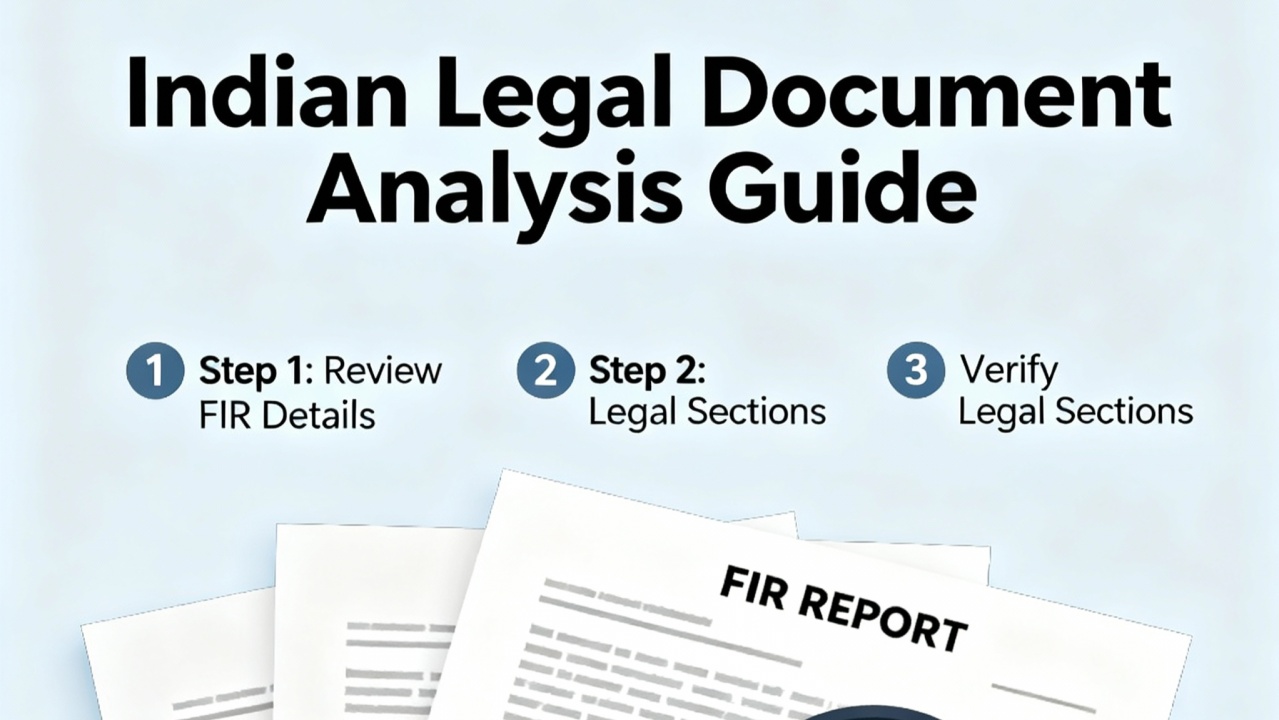
How to Read an FIR and NC Report: A Practical Step-by-Step Guide
Understanding how to properly read and analyze First Information Reports (FIRs) and Non-Cognizable (NC) Reports is crucial for anyone involved in the criminal justice system, whether as a complainant, accused, legal practitioner, or concerned citizen. This comprehensive guide provides practical, step-by-step instructions on how to interpret these critical legal documents, identify potential issues, and understand their implications.
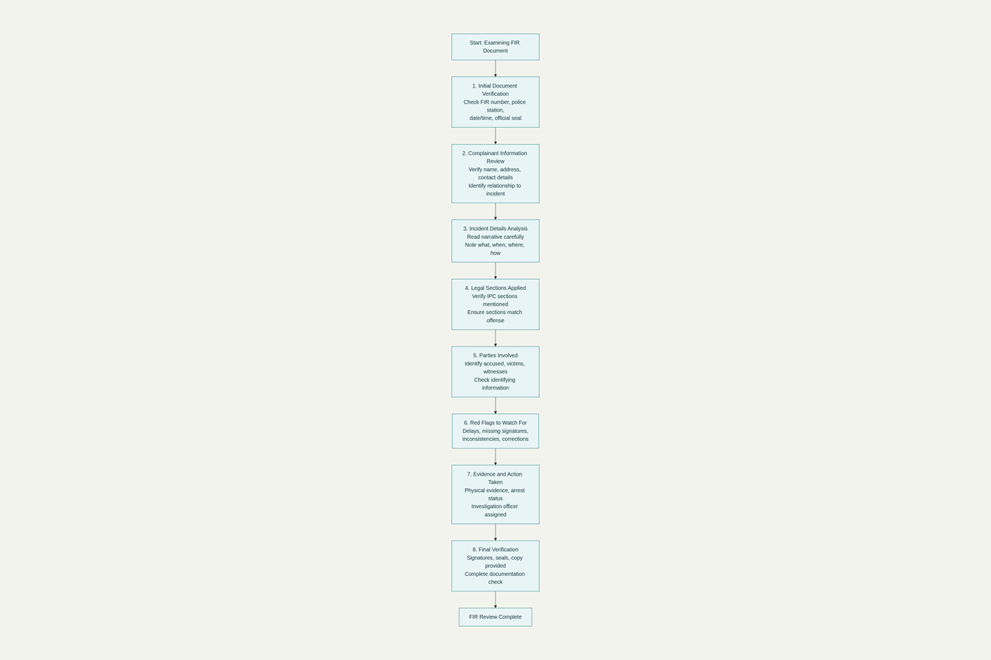
Step-by-step guide for reading and analyzing an FIR document to identify key information and potential issues
Understanding the Fundamentals
What Makes These Documents Important
Both FIR and NC reports serve as foundational documents in India’s criminal justice system, but they operate under different legal frameworks and carry distinct implications. An FIR represents the first official record of a cognizable offense and immediately sets the criminal justice machinery in motion, while an NC report documents non-cognizable offenses that require magistrate’s permission for police action.[1][2][3][4]
The Supreme Court has consistently emphasized that these documents, while not substantive evidence themselves, serve as crucial corroborative tools that can either strengthen or weaken a case depending on their accuracy and timing. Therefore, knowing how to read them correctly becomes essential for protecting one’s legal interests.[2][5]
Step-by-Step Guide to Reading an FIR
Step 1: Initial Document Verification
Begin by examining the document’s authenticity and basic registration details. Check the FIR number, which should be consecutive and unique for that calendar year at the specific police station. Verify the police station name and ensure it has territorial jurisdiction over the place where the offense occurred. The registration date and time are critical – note both when the incident occurred and when the FIR was actually registered, as any significant delay must be explained.[1][2][6]
Look for the official police station seal and the investigating officer’s signature. The document should bear proper police letterhead and formatting. If any of these basic elements are missing or appear suspicious, it could indicate procedural irregularities.[2][1]
Step 2: Complainant Information Analysis
Carefully examine the complainant’s details including full name, complete address, and contact information. Determine the complainant’s relationship to the incident – whether they are the victim, an eyewitness, or someone providing hearsay information. The FIR should clearly indicate the capacity in which the informant is providing information.[1][2][6]
If the information is based on hearsay, the source should be mentioned to distinguish it from firsthand knowledge. This distinction significantly affects the credibility and legal weight of the information provided.[2]
Step 3: Incident Details Examination
Read the narrative portion meticulously, applying the “11 W’s” principle that investigating officers are supposed to follow: What happened, Who was involved (both perpetrators and victims), When did it occur, Where did it take place, Why (motive), Which way (method of commission), Witnesses present, What was stolen or damaged, and What traces were left.[1][2]
Pay particular attention to the description of events, noting whether it flows logically and contains sufficient detail. The time of occurrence should be specific – if complainants don’t have exact times, police often use reference points like “after cock-crow” or “when the train passed”.[2][1]
Step 4: Legal Sections Assessment
Examine the legal provisions cited, typically from the Indian Penal Code (IPC) or other applicable laws. Verify that the sections mentioned actually correspond to the offense described in the narrative. Misapplication of legal sections is a common error that can significantly impact prosecution.[1][7]
Ensure the offense is properly classified as cognizable, justifying the registration of an FIR rather than an NC report. If non-cognizable sections are included, there should be at least one cognizable offense to justify FIR registration.[8][9][10]
Step 5: Parties Involved Documentation
Identify all accused persons mentioned, noting whether they are named specifically or described as “unknown persons”. The omission of known accused persons’ names is a significant weakness that courts view unfavorably. For each accused, check for adequate identifying details including physical description, known addresses, and any relationships to the victim.[2]
Similarly, verify that all victims and witnesses are properly identified with complete details. Missing witness information can be characterized by defense as fabrication or afterthought.[1][2]
Step 6: Red Flags and Warning Signs
Several critical red flags warrant careful attention. Unexplained delays in filing the FIR are viewed with suspicion by courts and must be accompanied by reasonable explanations such as physical incapacity, geographical challenges, or other compelling circumstances.[2]
Look for missing or questionable signatures – the complainant must sign or provide thumb impression after the FIR is read back to them. Inconsistent information within the document or contradictions with known facts can severely damage a case’s credibility.[6][2]
Overwriting or unauthorized corrections should be avoided entirely, and if absolutely necessary, must be initialed and dated before the complainant signs. Vague descriptions or lack of specific details about crucial elements like time, place, or sequence of events indicate poor documentation.[2]
Step 7: Evidence and Action Taken Review
Note any physical evidence mentioned in the FIR, including weapons used, property stolen, or traces left at the scene. Check whether immediate police action was taken, such as visiting the crime scene, arresting accused persons, or securing evidence.[1][2]
The FIR should indicate the investigation officer assigned to the case and any immediate steps taken pursuant to registration. The document should reflect prompt police response appropriate to the gravity of the offense described.[5]
Step 8: Final Authentication Verification
Confirm that all required signatures are present and authentic. The complainant’s signature or thumb impression should appear after notation that the FIR was read back to them. The investigating officer’s signature should be clear and identifiable.[1][2]
Verify that the complainant received a free copy of the FIR, as mandated by Section 154(2) of the CrPC. The document should indicate this provision explicitly. Check for proper police station seal and ensure all mandatory fields are completed.[2][6]
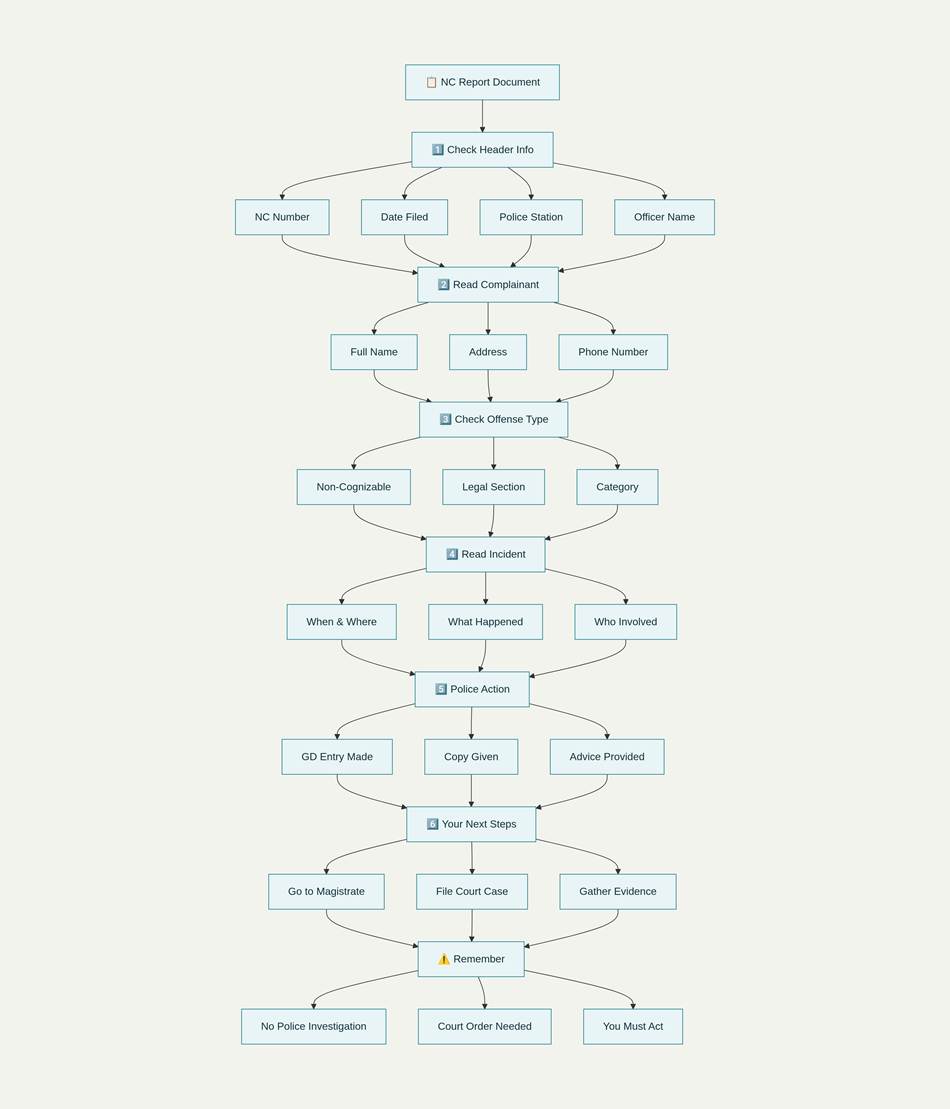
Essential elements to look for when reading an NC (Non-Cognizable) Report
How to Read an NC Report
Document Structure and Purpose
NC reports follow a different format and serve distinct purposes compared to FIRs. These reports are prepared when police receive information about non-cognizable offenses – minor crimes where police cannot arrest without warrant or investigate without magistrate’s permission.[3][4][10]
Key Elements to Examine
Document Identification: Look for the NC report number, date of registration, police station name, and General Diary reference number where the entry was made. Unlike FIRs, NC reports are typically recorded in the General Diary rather than a separate register.[3][10]
Complainant Information: Similar to FIRs, verify the complainant’s complete details and relationship to the reported incident. The nature of the complaint should be clearly described, focusing on why it constitutes a non-cognizable rather than cognizable offense.[11]
Offense Classification: The report should clearly indicate the type of non-cognizable offense being reported. Common categories include defamation under Section 499 IPC, simple assault under Section 323 IPC, verbal threats, minor property disputes, or public nuisance complaints.[12][3]
Police Action and Limitations: The NC report should explicitly state that the matter has been entered in the General Diary and that the complainant has been advised to approach the magistrate for further action. It should clearly indicate that police cannot investigate or arrest without court orders.[4][3]
Understanding NC Report Implications
Unlike FIRs, NC reports do not trigger immediate police investigation. They serve primarily as official acknowledgment that a complaint has been received and recorded. The complainant must independently approach the magistrate under Section 200 of the CrPC to seek permission for police investigation or to file a private complaint.[3][12]
Common Errors and How to Spot Them
FIR-Related Errors
Timing Discrepancies: Watch for inconsistent time stamps between when the incident occurred, when it was reported to police, and when the FIR was actually registered. Significant gaps without explanation suggest potential manipulation or delay tactics. [2]
Jurisdictional Issues: Ensure the FIR was registered at a police station with territorial jurisdiction over the crime location. While “Zero FIRs” can be registered anywhere and later transferred, this should be clearly noted in the document. [2]
Incomplete Information: Missing details about crucial elements like weapon descriptions, injury specifics, property values, or witness information can indicate hasty or inadequate documentation. Such omissions may be exploited by defense counsel as evidence of careless investigation. [1][2]
NC Report Errors
Misclassification: Verify that the reported offense is genuinely non-cognizable. Sometimes serious offenses are deliberately downgraded to avoid investigation responsibilities, which constitutes misconduct. [9][3]
Inadequate Documentation: Even though NC reports are simpler than FIRs, they should still contain sufficient detail to understand the nature of the complaint and the parties involved. [10][11]
Failure to Advise: The report should clearly indicate that the complainant was advised about approaching the magistrate and the limitations of police action in non-cognizable matters. [3][4]
Practical Tips for Document Analysis
For Complainants and Victims
Always read the entire document carefully before signing. Ensure all details are accurately recorded in your own words rather than police interpretations. Verify that your contact information is correct and that the nature of the offense is properly categorized. [1][2][6]
Keep multiple copies of the document and note the names and badge numbers of officers involved. If you spot errors, request corrections immediately before signing, as post-signature amendments are viewed suspiciously by courts. [2][6]
For Accused Persons
Focus particularly on the timeline of events and any claimed identification procedures. Note whether your name was mentioned in the original complaint or added later during investigation. Look for inconsistencies in witness statements or physical evidence descriptions that might support your defense. [2]
Pay attention to whether proper procedures were followed in document preparation and whether your constitutional rights were respected throughout the process. [13][14]
For Legal Practitioners
Develop systematic approaches to document analysis that cover all the elements outlined above. Create checklists to ensure no critical details are overlooked during case preparation. Cross-reference information in FIRs with subsequent investigation findings to identify discrepancies that might benefit your client’s position. [15]
Digital Age Considerations
Online Access and Verification
Many states now provide online access to FIR copies through police websites. When accessing documents digitally, verify their authenticity through official channels and ensure downloaded copies match original police records. [16][17]
Be aware that certain sensitive cases may not be immediately published online, requiring formal applications for access. Understanding these digital procedures can expedite case preparation and ensure timely access to crucial documents. [17][16]
Technology-Assisted Analysis
Modern legal practice increasingly relies on technology for document analysis. Machine learning systems can help identify patterns in FIR data and flag potential inconsistencies or legal section misapplications. However, such tools should supplement rather than replace careful human analysis of these critical documents. [7]
Conclusion
Mastering the skill of reading FIRs and NC reports requires systematic approach, attention to detail, and understanding of both legal requirements and practical implications. These documents serve as the foundation upon which entire criminal cases are built, making their accurate interpretation crucial for all stakeholders in the justice system.
By following the step-by-step guidance provided in this article, readers can develop the analytical skills necessary to identify strengths, weaknesses, and potential issues in these critical legal documents. Whether you are a complainant seeking justice, an accused person defending your rights, or a legal professional representing clients, the ability to properly read and analyze these reports will significantly enhance your effectiveness within India’s criminal justice system.
Remember that while these documents are important, they represent only the beginning of the legal process. Proper analysis of FIRs and NC reports should be combined with comprehensive understanding of subsequent investigation procedures, evidence collection, and trial processes to ensure complete protection of legal rights and interests.
- https://www.linkedin.com/posts/atul-pratap-singh-7282b8243_rules-to-read-an-fir-activity-7357293162203111424-EMZs
- https://police.py.gov.in/PTS New 2018/Study Materials/Hand Book on FIR by PTS on 20.02.10.pdf
- https://restthecase.com/knowledge-bank/what-is-ncr-in-police-station
- https://bprd.nic.in/page/citizen_corner
- https://www.barowalia.in/post/what-happens-after-an-fir-is-filed-step-by-step-guide
- https://kamalandcoadvocates.com/guide/how-to-file-fir-for-criminal-cases/
- https://www.ijraset.com/research-paper/fir-analysis-using-ml-for-proper-acts-and-sections
- https://blog.ipleaders.in/first-information-report-everything-important-you-should-know-about/
- https://www.drishtiias.com/daily-news-analysis/first-information-report-fir
- https://police.py.gov.in/Police manual/Forms pdf/Form 95. REPORT IN NON-COGNIZABLE OFFENCES.pdf
- https://lawrato.com/criminal-legal-advice/what-is-the-procedure-to-file-a-non-cognizable-complaint-244671
- https://blog.ipleaders.in/non-cognizable-offences/
- https://www.mondaq.com/india/crime/1255970/rights-of-the-accused-before-or-after-arrest-in-india
- https://cjp.org.in/law-on-arrest-and-detention-know-your-rights/
- https://www.scribd.com/document/877740708/SKILL-2-Checklist-of-Questionnaire-When-an-Accused-Approaches-You
- https://orissajudicialacademy.nic.in/monthly_case_review/aprr.pdf
- https://gyansanchay.csjmu.ac.in/wp-content/uploads/2022/09/pre-trial-procedure-FIR.pdf
- https://www.nctwcs.org/downloads/NCTWC_Interpretation_And_Action_Workbook_final.pdf
- https://instrumental.com/resources/automate-failure-analysis/failure-analysis-methods-for-product-design-engineers-finding-sources-of-error-pt-1/
- https://www.studyguidezone.com/north-carolina-foundations-of-reading-test/
- https://www.academia.edu/72187400/Evaluation_of_Stuck_at_Faults_in_a_FIR_Filter_Design
- https://www.mometrix.com/academy/north-carolina-foundations-of-reading-exam/
- https://dashthis.com/blog/mistakes-in-data-analysis/
- https://study.com/academy/course/north-carolina-foundations-of-reading-190-study-guide-prep.html
- https://www.dpi.nc.gov/documents/accountability/testing/eog/eog-reading-grades-3-8-test-specifications
- https://www.lloydlawcollege.edu.in/blog/what-is-fir-detailed-explanations.html
- https://barton.libguides.com/pearson_test/foundations_of_reading
- https://www.humanrightsinitiative.org/publications/police/fir.pdf
- https://practicetestgeeks.com/north-carolina-foundations-of-reading-test/
- https://www.dpi.nc.gov/districts-schools/classroom-resources/office-early-learning/early-literacy/science-reading
- https://www.newsband.in/article_detail/common-mans-guide-to-firs-and-ncs
- https://munley.com/how-do-i-fix-a-police-report-if-it-is-wrong/
- https://www.cognidox.com/blog/a-guide-to-non-conformance-reports
- https://www.police1.com/investigations/articles/how-to-write-organized-and-concise-police-reports-GAb3L0YXolm2fsqu/
- https://www.linkedin.com/posts/advocate-geetika-jain-a02875189_nc-bns-bnss-activity-7360505552805777409-khDB
- https://www.youtube.com/shorts/wM4hbTiYtII
- https://www.khuranaandkhurana.com/2023/09/21/criminal-accountability-delaying-and-non-registration-of-fir/
- https://partnersinvertrouwen.com/en/post/inappropriate-behavior-what-is-the-difference-between-a-report-and-a-complaint/
- https://lawrato.com/civil-legal-advice/nc-registered-against-me-a-yr-ago-can-it-affect-police-verification-258989
- https://advocaterajeyjain.com/fir-and-nc.php
- https://www.lawreform.ie/_fileupload/reports/r98adr.pdf
- https://kishanganj.nic.in/faq/f-i-r-n-c-complaint-cognizance/
- https://pressbooks.bccampus.ca/businesswritingessentials/chapter/chapter-14-routine-report-writing-situations/
- https://citizen.mahapolice.gov.in/Citizen/mh/faq.aspx
- https://blog.ipleaders.in/need-know-police-complaint/