






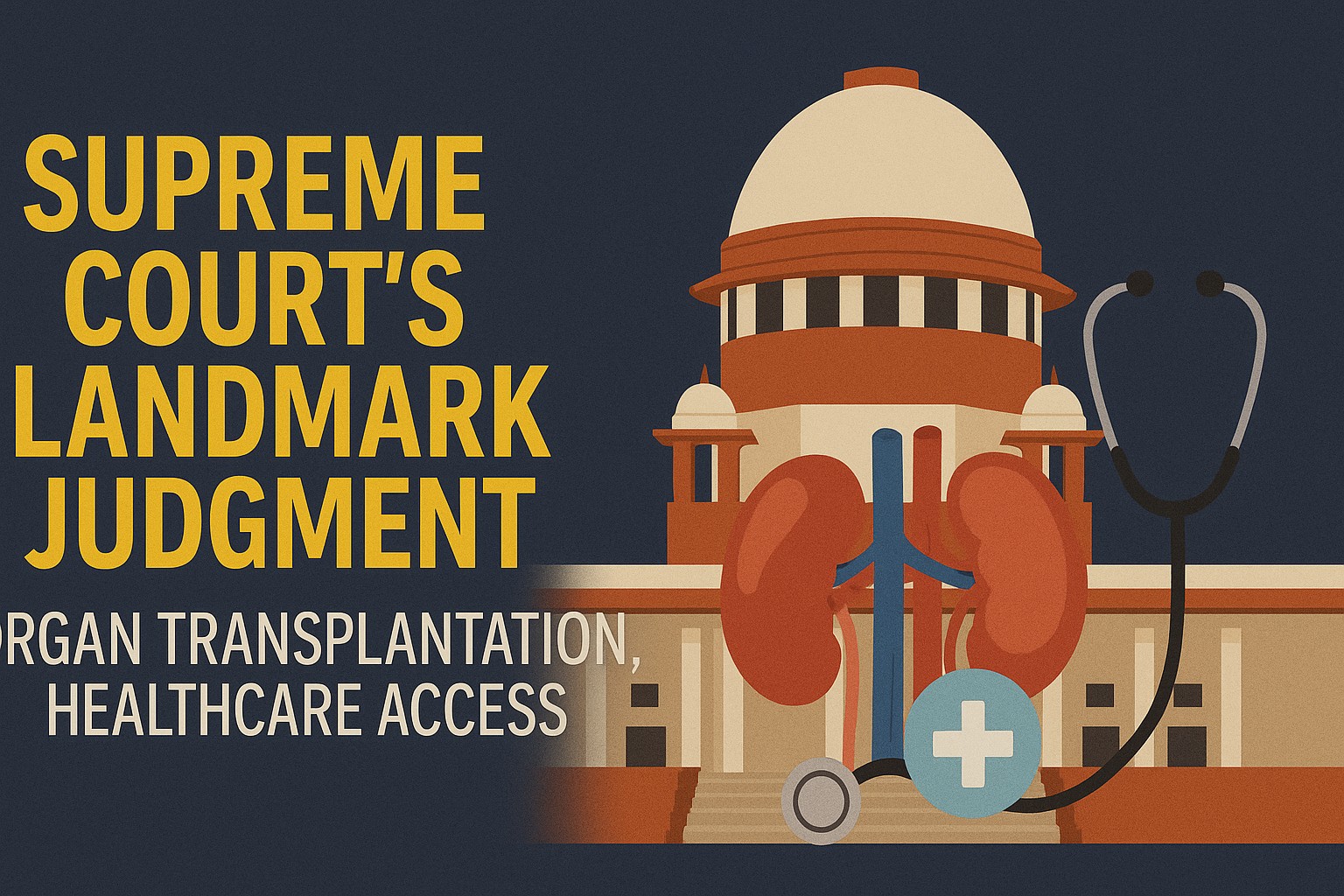
Supreme Court’s Landmark Judgment on Organ Transplantation: A Step Towards Equitable Healthcare Access
The Supreme Court of India delivered a historic judgment on November 19, 2025, addressing critical issues surrounding uniformity, equality, and access to organ donation and transplantation across the country. In the Writ Petition filed by the Indian Society of Organ Transplantation against the Union of India, Chief Justice B.R. Gavai emphasized the need for a comprehensive national framework to streamline organ transplantation processes and ensure equitable access for both donors and recipients.
The Regulatory Framework
The judgment builds upon the foundation established by the Transplantation of Human Organs Act, 1994, which was enacted under Article 252(1) of the Constitution. Notably, significant amendments were introduced in 2011, expanding the scope to include tissue transplants and enabling swap transplantation through Section 9(3A). The Transplantation of Human Organs and Tissue Rules, 2014 were subsequently introduced to implement these changes. However, the Court observed that several states had not yet adopted these amendments and rules, creating a fragmented regulatory landscape that impeded the establishment of a uniform national policy.
Critical Implementation Gaps
The judgment identifies several structural deficiencies in India’s organ transplantation infrastructure. Some states, including Andhra Pradesh, had not adopted the 2011 amendment, while Karnataka, Telangana, Andhra Pradesh, and Manipur had failed to adopt the 2014 Rules. More significantly, the Court found that five jurisdictions—Meghalaya, Nagaland, Andaman and Nicobar Islands, Lakshadweep, and Ladakh—were functioning without a State Organ and Tissue Transplant Organization (SOTTO), making organ transplantation effectively impossible in these regions.
The Court also noted that registered hospitals authorized to conduct organ transplantation were virtually non-existent in several states, including Jharkhand, Meghalaya, Mizoram, Nagaland, Sikkim, and select Union Territories. This geographic disparity severely constrains the capacity for life-saving procedures across the country.
Brain-Stem Death Certification and Awareness
A crucial recommendation made by the petitioner and endorsed by the Supreme Court involves linking brain-stem death certification with the death registration process. The Court requested amendments to Form 4 and Form 4A of the Registration of Births and Deaths Rules, 1999, to include a column documenting brain-stem death certification and providing an option for organ donation to relatives. This measure is intended to dramatically increase public awareness about organ donation possibilities and exponentially boost donation rates, as brain-dead individuals can donate up to eight vital organs, compared to only tissues available from those who suffer natural cardiac death.
Addressing Donor-Recipient Incompatibility Through Swap Transplantation
The judgment highlights a significant underutilization of swap transplantation, a mechanism permitted under Section 9(3A) of the 1994 Act. Despite low deceased organ donation rates and frequent donor-recipient incompatibility issues, swap transplantation was not being actively operationalized due to the absence of a national policy and varying state-level approaches. The Supreme Court recognized that a unified national grid for swap transplantations would connect donors and recipients across different states, substantially increasing successful transplantation outcomes.
Ensuring Equitable Allocation and Preventing Discrimination
The judgment addresses a critical concern regarding allocation criteria under Rule 31(4)(f) of the 2014 Rules, which currently vary from state to state. This fragmented approach allows individuals with resources to exploit the system by registering in multiple states, while lacking mechanisms to address concerns of gender, class, and regional discrimination. The Court specifically referenced the Gujarat High Court’s decision in Vidya Ramesh Chand Shah v. State of Gujarat (2022), which struck down domicile-based registration requirements as discriminatory.
The Supreme Court emphasized that a uniform national policy is imperative for securing the substantial right to health and preventing systemic inequalities in access to transplantation services.
Protection and Welfare of Live Donors
In a significant development, the Court addressed concerns about live donors being abandoned after providing organs. Referencing the World Health Organization’s Guiding Principles for Organ Donation, the judgment emphasizes that live donations are acceptable only when professional medical care of donors is ensured and organized follow-ups are maintained. The Court cited the Kerala High Court judgment in Moideen v. State of Kerala (2017), which recognized that donors undergoing organ extraction face medical risks and potential complications affecting the remaining organ. The judgment emphasized that selling organs out of economic desperation contradicts the principles of a healthy, civilized society.
The Court held that donors who part with vital organs deserve adequate healthcare support and follow-up care after the operation. This recognition represents a paradigm shift in organ transplantation jurisprudence, prioritizing donor welfare alongside recipient needs.
Comprehensive Directions for Implementation
The Supreme Court issued 11 specific directions to establish a cohesive national organ transplantation system:
Regulatory Adoption: The Union of India was requested to persuade remaining states to adopt the 2011 amendment and 2014 Rules, with the Secretary of Health and Family Welfare personally monitoring progress.
Infrastructure Development: The Court directed the establishment of SOTTOs in Meghalaya and Nagaland and mandated a five-year plan to develop transplantation facilities in states and Union Territories with inadequate infrastructure.
National Policy Framework: NOTTO was requested to evolve uniform allocation criteria, model guidelines, and swap transplantation protocols to ensure nationwide consistency and prevent regional disparities.
Digital Infrastructure: The judgment emphasized the need for an accessible web portal to operationalize swap transplantation on a national level, facilitating connections between donors and recipients across state boundaries.
Donor Welfare Guidelines: NOTTO was directed to develop comprehensive guidelines addressing informed consent, mandatory medical follow-ups, portal maintenance, and measures to prevent commercialization and exploitation.
Data Reporting and Accountability: All states and hospitals were directed to report organ donation and transplantation data to the national registry maintained by NOTTO, with strict penalties for non-compliance.
Collaborative Approach and Constitutional Significance
What distinguishes this judgment is the collaborative spirit demonstrated by the Union of India, the Solicitor General, and the Additional Solicitor General, who approached the matter as a public health challenge rather than adversarial litigation. The Chief Justice and judges acknowledged this cooperative approach, recognizing it as essential for implementing practical solutions.
The judgment reflects the constitutional duty to ensure equitable access to healthcare and the fundamental right to life under Article 21 of the Constitution. By mandating a uniform national policy, the Court ensures that a citizen’s access to life-saving organ transplantation is not determined by their state of residence or socio-economic status.
Implications and Path Forward
This judgment represents a watershed moment in India’s approach to organ transplantation. By addressing infrastructure gaps, standardizing allocation criteria, protecting donor welfare, and establishing a digital national grid, the Court has set the stage for a paradigm shift in organ availability and transplantation success rates. The focus on brain-stem death certification through the death registration process could potentially unlock thousands of additional organ donations annually.
The six-month review timeline, with a preference for a bench including Justice K. Vinod Chandran, signals the Court’s commitment to ensuring effective implementation of these directives. As India grapples with an acute shortage of organs and tissue for transplantation, this judgment provides a comprehensive roadmap for creating an equitable, efficient, and donor-protective national transplantation ecosystem.