







Supreme Court’s Landmark Judicial Services Judgment: Restoring Merit, Experience, and Accelerated Advancement
The Supreme Court of India delivered a transformative judgment on May 20, 2025 in All India Judges Association v. Union of India, known as the Sixth AIJA Case (2025 INSC 735). This decision, delivered by Chief Justice B.R. Gavai and Justices Augustine George Masih and K. Vinod Chandran, fundamentally restructures the promotion and recruitment framework for India’s subordinate judiciary. The judgment restores the Limited Departmental Competitive Examination (LDCE) quota from 10% to 25% for promotion to the District Judge cadre, reduces the minimum qualifying experience requirement, introduces merit-based incentives at the Civil Judge (Senior Division) level, and mandates a restoration of the three-year practice requirement for entry into judicial service. These reforms collectively address systemic inefficiencies that have developed over two decades and seek to strengthen the foundation of India’s judicial system through better talent retention, incentive structures, and professional standards.[1][2][3]
The Historical Context and Evolution of LDCE Policy
To fully understand the significance of the 2025 judgment, one must examine the evolution of judicial service policies since the first All India Judges Association judgment in 1992. In 1996, following directions from the Supreme Court in the First AIJA Case, the Government of India constituted the First National Judicial Pay Commission under the chairmanship of Justice K.J. Shetty. The Shetty Commission, after extensive deliberations, submitted its report on November 11, 1999. This commission made far-reaching recommendations about recruitment ratios, pay scales, and working conditions of the subordinate judiciary. One of its key recommendations was that recruitment to the Higher Judicial Service (District Judge cadre) should consist of 25% from direct recruitment among advocates and 75% from promotions among Civil Judges.[1][2]
The Supreme Court accepted the Shetty Commission’s recommendations in its landmark judgment dated March 21, 2002, commonly referred to as the Third AIJA Case. However, in fashioning the implementation of these principles, the Court introduced a nuanced two-tier promotion system within the 75% quota reserved for promotions. The Court directed that 50% of the posts should be filled through merit-cum-seniority with a suitability test, while the remaining 25% should be filled strictly on the basis of merit through the Limited Departmental Competitive Examination (LDCE). This structure was designed to provide incentives for meritorious officers to compete and achieve accelerated promotion, fostering a culture of excellence within the subordinate judiciary. The minimum qualifying service for appearing in LDCE was set at five years as a Civil Judge (Senior Division).[4][5][1]
However, practical experience revealed significant challenges in implementing this 25% LDCE quota. Many High Courts struggled to fill the requisite number of posts through LDCE due to an insufficient pool of eligible candidates and other administrative complexities. Some states reported as many as 50 posts of District Judges remaining vacant under the LDCE quota without alternative mechanisms for filling them. This situation led to what the Supreme Court later recognized as a frustration of the original purpose of the LDCE mechanism. Consequently, in its judgment dated April 20, 2010 (the Fourth AIJA Case), the Supreme Court reduced the LDCE quota from 25% to 10% and correspondingly increased the merit-cum-seniority quota from 50% to 65%. The new recruitment ratio became 65:10:25 (promotion by merit-cum-seniority, LDCE, and direct recruitment respectively).[1][4]
The Critical Issues Addressed in the 2025 Judgment
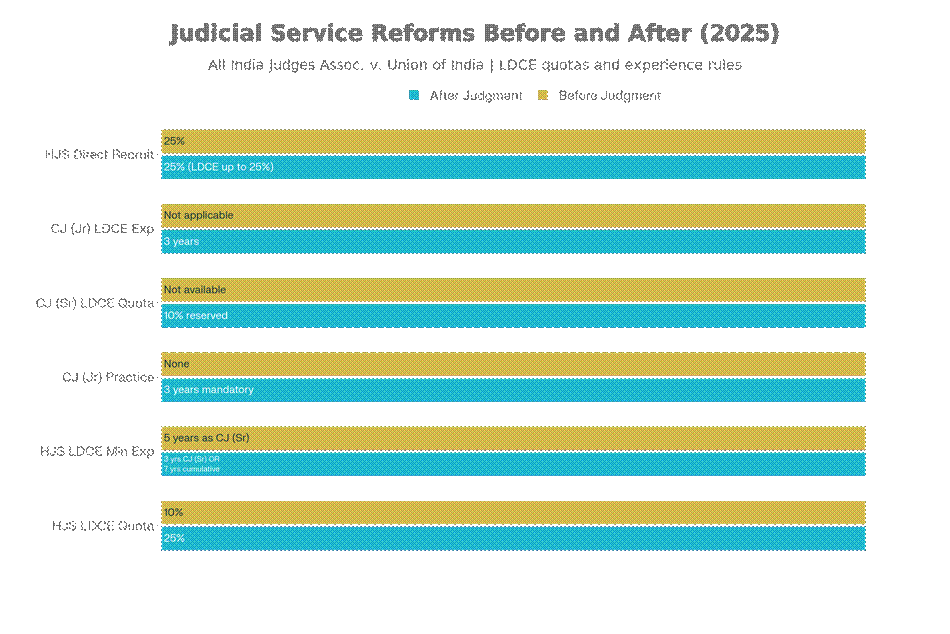
Major Judicial Service Reforms: Before and After the 2025 AIJA Judgment
The 2025 judgment revisits and reverses several key aspects of the 2010 decision, addressing eight substantive issues that were framed during the hearing. The first and most significant issue concerned whether the LDCE quota should be restored to 25% from 10%. The Court’s analysis revealed that with the passage of two decades, a significant change had occurred in the demographic profile and eligibility of Civil Judges (Senior Division). Many more officers were now available in the eligible pool, having acquired the requisite experience as Civil Judges (Senior Division). Moreover, several High Courts—specifically those of Chhattisgarh, Patna, Kerala, Manipur, Madras, and Uttarakhand—had by 2023 recommended restoration of the 25% quota, whereas others maintained the existing position. The Court further observed that even those High Courts recommending restoration of the 25% quota suggested that any unfilled seats should revert to regular promotion within the same fiscal year, thereby preventing any adverse impact on judicial administration.[1][2][4]
The Court’s reasoning for restoring the LDCE quota to 25% was multifaceted. First, it would provide a genuine incentive for meritorious officers in the Civil Judge (Senior Division) cadre to compete and achieve accelerated promotion to the District Judge cadre. Second, by establishing a reversion mechanism for unfilled seats, there would be no disruption to the regular promotion process or judicial administration. The Court emphasized that the purpose of the LDCE mechanism had been substantially frustrated by setting the minimum qualifying service at five years, because in several states, officers who completed five years as Civil Judges (Senior Division) were already eligible for promotion through the regular merit-cum-seniority channel. This meant that the supposed “incentive” for fast-track promotion through LDCE was effectively negated, as officers would naturally progress through regular promotion around the same timeframe.[2][4][1]
Addressing the Qualifying Experience Barrier
The second major issue concerned whether the minimum qualifying experience for appearing in LDCE should be reduced. The Court undertook a comprehensive analysis comparing the average time taken by Civil Judges (Junior Division) to become eligible for LDCE across various states. The data presented was striking: in Bihar and Uttar Pradesh, the average time was 9 to 10 years; in Himachal Pradesh, it was 15 to 16 years; in Maharashtra, 11 years; in Manipur, 10 years and 7 months; in Punjab, 14 to 15 years; in Haryana, 14 years. When compared to the average time required to reach the District Judge cadre through regular promotion—which ranged from 9 to 10 years in some states to 19 to 20 years in others—the analysis revealed a critical inefficiency. In most states, the average time to become eligible for LDCE was nearly identical to or even exceeded the time required to achieve promotion through the regular channel.[1][2]
This analysis led the Court to a crucial conclusion: if the purpose of LDCE was to provide incentive for accelerated promotion, yet officers had to wait five years as Civil Judges (Senior Division) to become eligible, the system was defeated at its inception. In many cases, such officers would by that time have already been promoted through regular channels. The Court therefore decided to reduce the minimum qualifying service as a Civil Judge (Senior Division) from five years to three years. However, recognizing concerns about maintaining minimum standards, the Court also imposed a cumulative service requirement: candidates appearing in LDCE must have a minimum of 7 years of total judicial service, including their time as Civil Judges (Junior Division) and Civil Judges (Senior Division). This balanced approach ensures that candidates possess adequate experience while enabling genuinely faster progression for the most meritorious officers.[2][4][1]
Introducing Merit Incentives at the Civil Judge Level
The third and fourth issues addressed a significant gap in the existing system: the absence of any merit-based incentive mechanism for Civil Judges (Junior Division). The Court observed that just as the Supreme Court had recommended in 2002 that 25% of the promotional posts to District Judge be filled through LDCE to incentivize merit within the Civil Judge (Senior Division) cadre, there should be a similar mechanism to incentivize merit at the Civil Judge (Junior Division) level. Therefore, the Court directed that 10% of the posts in the Civil Judge (Senior Division) cadre be reserved and filled through LDCE from among Civil Judges (Junior Division) who have completed a minimum of three years’ service in that cadre. This innovation creates a two-tier merit-based advancement system that provides incentives at every level of the judicial hierarchy, encouraging officers to continuously improve and compete for advancement.[1][2][4]
Suitability Testing and Cadre-Based Quota Calculation
The Court also addressed the question of whether suitability tests should be formally introduced for the 65% quota of regular promotions to the Higher Judicial Service. While the Third AIJA Case had contemplated such suitability tests in 2002, the Court noted that their implementation had been inconsistent across High Courts. The 2025 judgment clarified that every High Court must frame rules to determine suitability of candidates for promotion, emphasizing factors such as updated knowledge of law, quality of judgments rendered, Annual Confidential Reports of the preceding five years, disposal rates, performance in viva voce, and general communication skills.[1][2][4][5]
Regarding whether quotas should be calculated on the basis of cadre strength or annual vacancies, the Court adopted a uniform approach. Since most states were already calculating quotas on the basis of cadre strength, the Court directed all High Courts to follow this uniform practice. This standardization eliminates divergences in how recruitment processes are conducted across different states, contributing to greater fairness and consistency in the judicial services system.[2][4][1]
The Restoration of Practice Requirements
Perhaps the most contentious issue concerned the restoration of minimum practice requirements for entry into the Civil Judge (Junior Division) cadre. In the Third AIJA Case (2002), the Supreme Court had eliminated the requirement that candidates possess three years of practice as advocates before entering the judicial service. This decision was based on the Shetty Commission’s argument that modern legal education, particularly the five-year law degree course, adequately equipped young law graduates for judicial service, particularly when supplemented by intensive induction training. The Shetty Commission had also expressed concern that the three-year practice requirement was preventing talented young graduates from the National Law School of India University and similar premier institutions from entering the judiciary, thereby frustrating the purpose of establishing such institutions.[1]
However, after two decades of experience with allowing fresh law graduates to enter judicial service without any practice experience, the vast majority of High Courts reported serious problems. The High Court of Andhra Pradesh noted instances of Civil Judges without any bar experience treating lawyers and court staff disrespectfully and struggling with procedural issues. The High Court of Madhya Pradesh reported numerous complaints regarding behavioral and temperament problems among fresh law graduates, as well as instances of ill-treatment toward advocates and litigants. The High Court of Uttar Pradesh observed that such fresh entrants lacked familiarity with court decorum and etiquette. The High Court of Orissa emphasized that inexperienced judges take considerable time to acclimate themselves to the court environment and often remain unaware of proper court procedures.[1]
In light of these consistent reports from virtually all High Courts, the Court concluded that the experiment of appointing fresh law graduates without bar experience had not been successful. The Court emphasized that judges, from their very first day on the bench, must decide questions affecting the life, liberty, property, and reputation of litigants. Neither book knowledge nor pre-service training could adequately substitute for first-hand experience of how courts function and how lawyers and judges interact within the judicial system. The Court therefore directed that all High Courts and State Governments amend their service rules to mandate a minimum of three years’ practice as a lawyer for candidates appearing in examinations for the Civil Judge (Junior Division) post.[1]
Implementation and Safeguards
Recognizing practical concerns about verifying actual practice experience, the Court introduced a certification mechanism. The three-year practice requirement may be satisfied through a certificate issued by either the Principal Judicial Officer of the court where the candidate has practiced or by an advocate with at least ten years’ standing (duly endorsed by the Principal Judicial Officer). For candidates practicing before High Courts or the Supreme Court, certification would be provided by an advocate with at least ten years’ standing, endorsed by an officer designated by that High Court or the Supreme Court.[1][6]
An important innovation in the Court’s approach concerns the calculation of practice experience. The Court decided that the practice period should be calculated from the date of provisional enrolment/registration with the State Bar Council, not from the date of passing the All-India Bar Examination (AIBE). This decision balanced two competing concerns: the need to ensure candidates possess genuine practice experience, while also recognizing that practical considerations (such as universities declaring results at different times) might prevent candidates from appearing for the AIBE immediately after graduation. By commencing the practice clock from provisional registration, candidates gain the opportunity to begin accumulating practice experience as soon as they are eligible, rather than waiting for AIBE results.[1]
Additionally, the Court directed that experience gained while working as Law Clerks with judges or judicial officers throughout the country should be counted toward the practice requirement, recognizing this as valuable exposure to judicial functioning. The judgment further mandates that newly appointed Civil Judges (Junior Division) selected through the examination must undergo at least one year of compulsory training before presiding over a court, ensuring that even with three years of bar practice, they receive essential judicial preparation.[1]
Broader Implications for Judicial Administration
The implications of this judgment extend well beyond mere procedural adjustments. By restoring the LDCE quota to 25% and reducing the minimum qualifying service requirement, the Court is fundamentally reshaping incentive structures within the subordinate judiciary. Merit-based advancement at every level—from Civil Judge (Junior Division) to Civil Judge (Senior Division) to District Judge—is now more explicitly encouraged. This structural reform is intended to foster a culture in which diligent, meritorious officers are not trapped in arbitrary waiting periods but can progress based on demonstrated excellence.[1][2][3]
The restoration of the practice requirement addresses what the Court recognized as a departure from constitutional principles. Articles 233, 217, and 124 of the Constitution prescribe minimum practice periods for appointment to progressively higher judicial positions: three years for District Judges, ten years for High Court judges, and ten years for Supreme Court judges. The Court found it logical that entry into even the most junior rung of the judiciary should not be permit entry without any such safeguard, particularly when institutional experience in lower courts cannot be garnered without actual exposure to court functioning.[1]
Furthermore, the judgment acknowledges the critical role of the subordinate judiciary as the foundation of the entire judicial system. As the Court emphasized, the subordinate judiciary bears the greatest weight of India’s judicial work and is the point of contact between the legal system and ordinary citizens. Ensuring that this foundational level is populated by officers who combine academic merit with practical experience and professional maturity is therefore essential to the integrity and efficiency of the entire system.[1]
Timeline and Implementation Requirements
The Court issued a clear implementation timeline to ensure effective transition to the new framework. All High Courts are directed to amend relevant service rules within three months from the date of judgment, and the concerned State Governments have been given a further three months to consider and approve these amendments. This structured timeline ensures that the reforms can be implemented in a coordinated manner across all states without creating administrative chaos or uncertainty.[1][7]
Importantly, the judgment includes a transitional provision addressing ongoing recruitment processes. Processes that had been kept in abeyance pending the resolution of these proceedings are permitted to proceed in accordance with the recruitment rules applicable on the date of advertisement or notification. However, the new requirements regarding minimum practice, experience reduction, and expanded LDCE quotas apply only from the next recruitment cycle, ensuring fairness to candidates who have already been selected or are in the pipeline under the previous rules.[8][1]
Conclusion
The 2025 All India Judges Association judgment represents a significant recalibration of India’s judicial services system, informed by two decades of practical experience since the 2002 Third AIJA Case. Rather than representing a radical departure, the judgment is more accurately characterized as a course correction based on accumulated evidence of what works and what does not. By restoring the 25% LDCE quota with a reduced qualifying service requirement, introducing merit-based incentives at the Civil Judge (Senior Division) level, mandating proper suitability testing procedures, and restoring the three-year practice requirement, the Supreme Court has sought to achieve multiple objectives simultaneously: providing genuine incentives for meritorious officers, strengthening the professional standards of the judiciary through experienced entry points, ensuring uniform implementation across all High Courts, and maintaining the integrity of the judicial hierarchy.[1][2][3][4]
The judgment reflects a sophisticated understanding that institutional design matters profoundly in shaping behavior and outcomes within the judiciary. By restructuring incentives and entry requirements, the Court is not merely issuing technical directives but is fundamentally reshaping the signals that the judicial system sends to aspiring judges about what qualities are valued and rewarded. The emphasis on demonstrated merit at multiple levels, combined with the requirement of practical experience at entry, creates a framework in which judicial officers are encouraged to continuously improve and seek advancement through excellence rather than mere seniority. For the thousands of judicial officers working in subordinate courts across India and the hundreds of millions of citizens who depend on these courts for justice, these reforms carry profound significance.[2][1]
- 601811989_2025-05-20.pdf
- https://testbook.com/recent-judgements/all-india-judges-association-vs-union-of-india
- https://www.legalbites.in/landmark-judgements/case-summary-all-india-judges-association-ors-v-union-of-india-ors-2025-3-years-bar-practice-mandatory-for-civil-judge-exam-1143992
- https://www.scconline.com/blog/post/2025/05/20/sc-restores-3-year-practice-civil-judge-exams/
- https://www.scobserver.in/supreme-court-observer-law-reports-scolr/three-years-of-practice-must-for-civil-judge-junior-division-eligibility-all-india-judges-association-v-union-of-india-eligibility-judicial-officers/
- https://allindiajudges.org/uploads/namefile/articles_31.pdf
- https://www.toprankers.com/what-is-career-trajectory-of-a-civil-judge
- https://www.livelaw.in/supreme-court/supreme-court-increases-ldce-quota-for-promotion-of-civil-judges-reduces-qualifying-services-292779
- https://www.scconline.com/blog/post/2025/11/19/supreme-court-directions-determining-seniority-in-higher-judicial-services/
- https://www.sci.gov.in/landmark-judgment-summaries/
- https://www.ijllr.com/post/recalibrating-the-bench-a-case-comment-on-all-india-judges-association-v-union-of-india-2025
- https://api.sci.gov.in/supremecourt/2024/508/508_2024_1_11_50357_Judgement_13-Feb-2024.pdf
- https://airjarajasthan.in/wp-content/uploads/2025/08/SHETTY_COMMISSION_REPORT__FULL_TEXT_.pdf
- https://cdnbbsr.s3waas.gov.in/s3ec0232b3ee0272954b956a7d1f86f76a/uploads/2025/01/2025010470.pdf
- https://indianexpress.com/article/explained/explained-law/supreme-court-criteria-seniority-judicial-services-10333514/
- https://api.sci.gov.in/jonew/ropor/or/or/all/4871.pdf
- https://applycareer.co.in/dhc/highcourt2024dhjse/ImportantInstructions.pdf
- https://www.drishtiias.com/daily-updates/daily-news-analysis/reforming-subordinate-judiciary
- https://allindiajudges.org/assets/front/img/Volume_I__Chapter_1___2__222_Pages.pdf
- https://www.scobserver.in/reports/reservation-for-civil-judges-in-principal-district-judge-posts-seniority-judgement-summary/