





The Charge of GST: Understanding Inter-State and Intra-State Supply Mechanisms Under Indian Tax Law
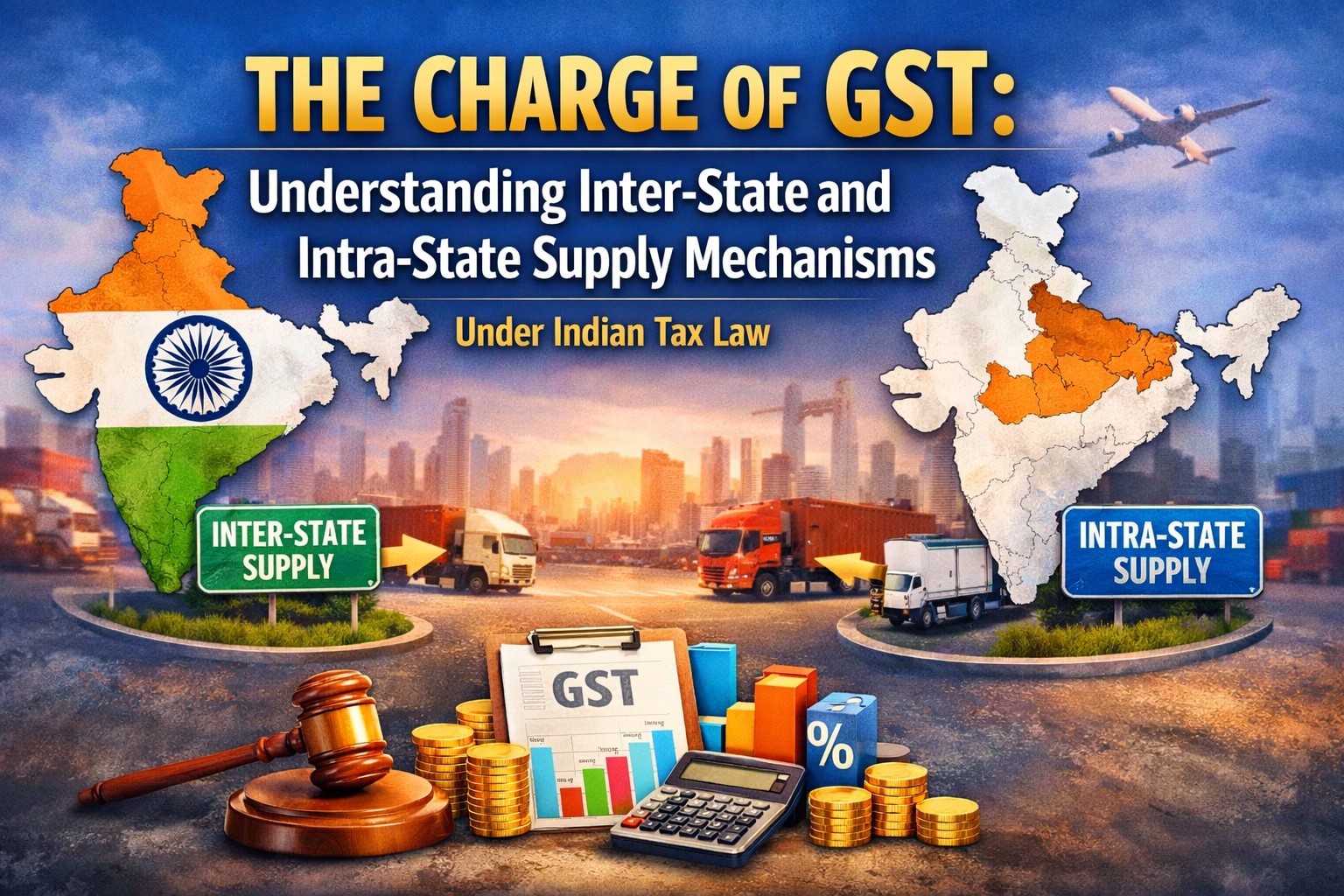
The Charge of GST represents one of the most fundamental and critical components of India’s Goods and Services Tax regime, establishing the constitutional and legal framework through which the government imposes and collects tax on all commercial transactions. This charging mechanism, governed by Sections 5, 7, 8, and 9 of the IGST Act (2017) and Section 9 of the CGST Act (2017), determines not only which type of tax will be levied on a transaction—whether Central GST (CGST), State GST (SGST), or Integrated GST (IGST)—but also crucially identifies the person liable to pay that tax to the government. The charging section is not merely a technical provision but a constitutional requirement derived from Article 265 of the Indian Constitution, which mandates that no tax shall be levied or collected except by the authority of law[1][2]. This article provides a comprehensive examination of how the charge of GST operates across different types of supplies, the determination of supply nature, and the complex mechanisms governing tax liability in both inter-state and intra-state transactions[3].
Constitutional Foundation and Legal Framework
The charging of GST in India is anchored in the constitutional mandate of Article 265, which represents a fundamental safeguard ensuring that all taxation operates within the boundaries of written law[1][2]. This provision reflects the principle of legality in taxation, establishing that taxation is not an inherent or assumed power of government but rather must be explicitly granted through legislative enactment[2]. Under the pre-GST regime, different types of taxes were governed by separate acts, but the introduction of GST through the 101st Constitutional Amendment created a unified framework where both the Union and State governments obtained concurrent powers to legislate on the subject matter[1]. The IGST Act, 2017, and the CGST Act, 2017, collectively establish the charging mechanism by which this power is exercised, with specific sections determining which tax applies to which type of supply[4][5].
The constitutional architecture supporting GST taxation is reinforced through Articles 268-281 of the Indian Constitution, which establish the overall distribution of tax-collecting authority between the central government and states[6]. However, it is Article 265 that provides the overarching constitutional principle requiring that every tax—whether CGST, SGST, or IGST—must have its foundation in duly enacted legislation. This principle ensures that taxpayers cannot be arbitrarily taxed and that all fiscal impositions operate under the rule of law rather than administrative discretion[6][1].
Understanding Inter-State Supply Under Section 7 of the IGST Act
Section 7 of the IGST Act, 2017, establishes the definition and taxation framework for inter-state supply, which forms the foundation of IGST collection[7]. An inter-state supply occurs when the location of the supplier and the place of supply are in different states or union territories[3][7]. The critical distinguishing factor is not where the goods physically move but the legal relationship between the supplier’s location and where the supply is intended to be delivered. For goods, this requires that the location of supplier (LOS) and place of supply (POS) differ across state or UT boundaries, with the movement of goods occurring within India[3].
The statute provides five distinct categories of inter-state supplies[3]. The first comprises ordinary inter-state supplies of goods where the supplier and place of supply are in different states or union territories[7]. The second involves the import of goods, which is treated as an inter-state supply until such goods cross the customs frontiers of India[3][7], reflecting the policy that imported goods are subject to IGST at the point of importation regardless of the importer’s location. Third, inter-state supply of services occurs when both the location of supplier and the place of supply are in different states or union territories[7]. Fourth, import of services into India is classified as an inter-state supply, with IGST payable by the recipient[3]. Fifth, Section 7(5) provides a residual provision covering supplies where the supplier is located in India but the place of supply is outside India—typically export transactions—as well as supplies to or from Special Economic Zone (SEZ) developers or units[3][7].
The application of these provisions reveals the territorial scope of GST. For instance, if a manufacturer in Maharashtra supplies goods to a distributor in Karnataka, the transaction constitutes an inter-state supply subject to IGST, regardless of which party bears the transportation cost[3]. Similarly, when an Indian software company provides services to a client in a different state, the transaction is inter-state even though the service delivery may occur electronically or through remote engagement[3].
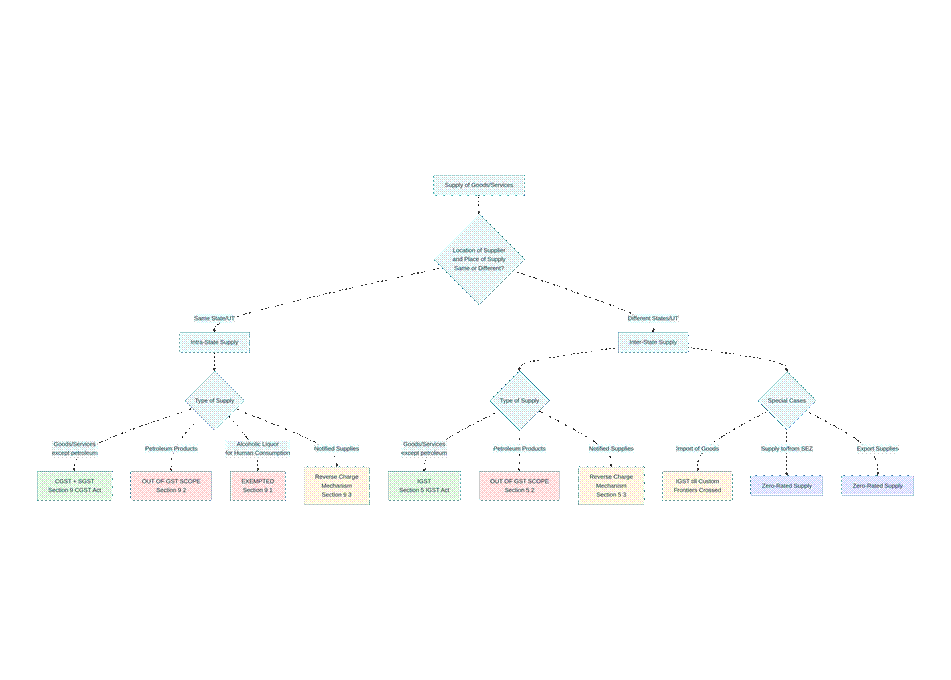
GST Charging Framework: Inter-State vs Intra-State Supply Classification
Special Cases: Special Economic Zones and Exports
Special Economic Zones occupy a distinctive position within the GST charging framework[8][9]. Supplies to SEZ units or developers are classified as zero-rated supplies, meaning GST is not levied on the outward supply to the SEZ[3][8]. However, the critical feature of zero-rating is that it allows the supplier to claim refund of input tax credit (ITC) even though the outward supply is tax-free[8][9]. This mechanism incentivizes domestic suppliers to supply to SEZs by ensuring the entire supply chain remains tax-neutral. Conversely, supplies made by SEZ units into the domestic tariff area (DTA) are treated as import of goods into the DTA and attract IGST[3][9]. This asymmetry reflects the policy objective of facilitating SEZ operations while ensuring tax revenues when SEZ goods re-enter the domestic economy.
Understanding Intra-State Supply Under Section 8 of the IGST Act
Intra-state supply represents the opposite scenario from inter-state supply and is governed by Section 8 of the IGST Act[3]. An intra-state supply occurs when both the location of the supplier and the place of supply of goods or services are in the same state or union territory[3][7]. For goods, the movement of goods must occur within India, making the location of the supplier and the destination identical for tax purposes[3]. For services, the same principle applies: when both the location of supplier and the place of supply are in the same state or union territory, the supply is classified as intra-state[3].
However, Section 8 contains critical exceptions that modify the basic rule[3]. First, supplies to or from a SEZ and the domestic tariff area, even when located in the same state, are treated as inter-state supplies rather than intra-state supplies[3]. This exception ensures that SEZ transactions attract IGST rather than CGST and SGST, maintaining consistency with the SEZ policy. Second, goods imported into the territory of India until they cross the customs frontiers are not treated as intra-state supplies even if the importer is located in a specific state[3]. Third, supplies made to a foreign tourist are not considered intra-state supplies, reflecting the international nature of such transactions[3].
For purposes of determining supply location under the IGST Act, the statute introduces the concept of distinct persons, which has significant implications for the intra-state versus inter-state classification[3]. According to Explanation 1 to the Act, an establishment in India and an establishment outside India, or establishments in different states or union territories, are treated as distinct persons[3]. Furthermore, a person carrying on business through a branch, agency, or representational office in a territory is deemed to have an establishment in that territory for tax purposes[3]. This provision prevents artificial splitting of supplies across state lines to avoid CGST and SGST obligations.
Section 9 of the CGST Act: Charging of Central Goods and Services Tax
Section 9 of the CGST Act functions as the primary charging section for intra-state supplies and establishes the framework for levying Central GST on all intra-state transactions[4][5]. The charging provision contains multiple components, each addressing different aspects of tax liability. Subsection (1) establishes the basic charging rule: CGST shall be levied on all intra-state supplies of goods or services or both, except on the supply of alcoholic liquor for human consumption, extra neutral alcohol, and rectified spirit[4][5]. The tax is levied on the value determined under Section 15 (relating to valuation) at rates not exceeding 20 percent, with the combined CGST and SGST rate not exceeding 40 percent[4][5].
The section identifies taxable persons as the entities liable to pay CGST: these include registered persons and persons liable for registration upon crossing specified turnover thresholds[4]. This definition is crucial because it establishes that not all suppliers are initially liable for GST; rather, liability arises upon obtaining or becoming liable to obtain GST registration[4]. The mechanism ensures that the smallest traders remain outside the GST net, reducing compliance burdens on micro-enterprises[4].
Subsection (2) addresses petroleum products specifically, providing that CGST shall be levied on supplies of petroleum crude, high speed diesel, motor spirit (petrol), natural gas, and aviation turbine fuel from a notified date[3][5]. Currently, these products remain outside the scope of GST, reflecting political and economic sensitivities around fuel taxation[3][5].
Reverse Charge Mechanism and Non-Standard Liability
Subsection (3) introduces the Reverse Charge Mechanism (RCM), a fundamental innovation in GST that inverts the standard tax liability structure[3][5]. Under normal circumstances, the supplier is liable to collect and pay GST on supplies. However, for notified goods and services, RCM provides that GST shall be paid on a reverse charge basis by the recipient of the goods or services[3][5]. This mechanism applies to specific categories of goods and services identified through government notifications, requiring the recipient (rather than supplier) to register, calculate, and pay GST directly to the government[10].
The rationale for RCM lies in targeting informal sectors and ensuring tax compliance from unorganized suppliers who might otherwise evade GST[10][11]. For example, when a business purchases services from an unregistered plumber or carpenter, the RCM mechanism makes the business liable to pay GST on those services, even though the service provider is not registered[3][10]. This shift of liability ensures that GST is collected even from informal supply chains[10].
Subsection (4) establishes a variant of RCM applicable to purchases from unregistered suppliers[4][5]. When a registered person purchases taxable supplies from an unregistered supplier, the registered person is liable to pay GST under RCM[4]. This provision is critical because it prevents registered businesses from claiming unwarranted input tax credit benefits and ensures that the GST burden ultimately rests on registered persons purchasing from informal suppliers[4].
E-Commerce Operator Provisions
Subsection (5) addresses a modern phenomenon: the supply of services through electronic commerce operators (ECOs)[3][4]. The statute provides that the government may notify categories of services where tax shall be paid by the ECO if such services are supplied through the electronic commerce platform[3][4]. This creates a three-party supply relationship: the actual service provider (e.g., a restaurant), the customer, and the intermediary e-commerce platform[12][13].
For e-commerce operators, the statute mandates that registration is compulsory regardless of turnover threshold, as ECOs cannot benefit from the exemption limits applicable to other businesses[12][13]. Section 24(x) of the CGST Act, 2017, specifically overrides the ₹20 lakh exemption threshold for e-commerce operators, making them liable for registration even if their supplies are minimal[12]. Additionally, persons supplying goods or services through ECOs are also mandatory to register if the ECO is required to collect tax at source under Section 52[12].
The mechanism operates distinctly across different service categories. For restaurant services supplied through food delivery platforms like Zomato and Swiggy, the e-commerce operator is liable to collect and pay 5% GST on behalf of the restaurants, without entitlement to input tax credit[3][14]. This represents a fundamental shift from the pre-2022 framework where restaurants themselves collected GST. The policy change, implemented from January 1, 2022, was designed to address widespread tax evasion in the food delivery sector where platforms collected tax from customers but restaurants often failed to remit it to government authorities[14].
For passenger transport services provided through ECOs (such as radio taxis or aggregators), the ECO is liable to pay 5% GST[3]. However, for omnibus services (buses), the liability depends on the supplier’s nature: if the supplier is a body corporate, the supplier pays tax; if the supplier is other than a body corporate (e.g., individual operator), the ECO is liable[3].
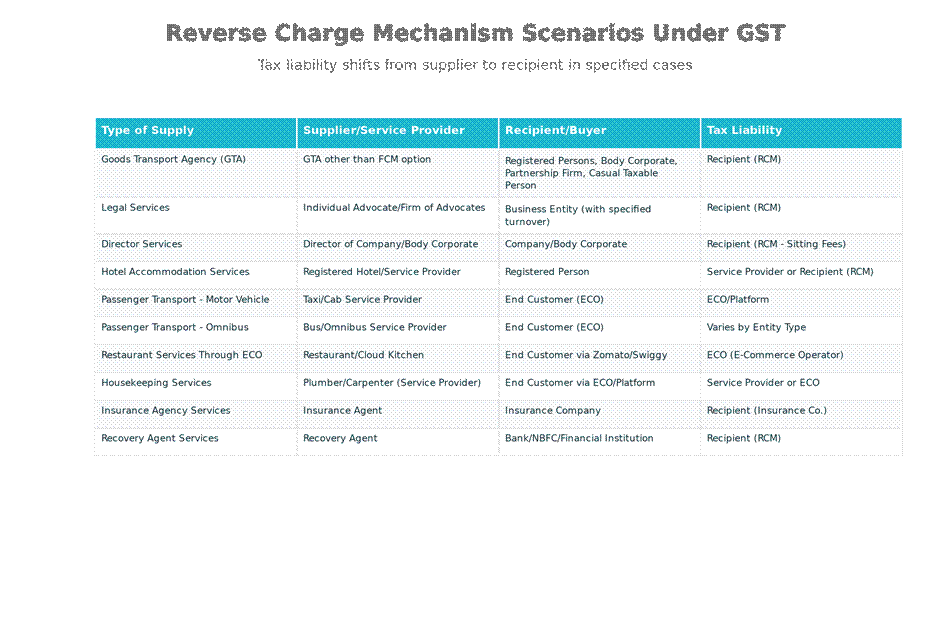
Reverse Charge Mechanism: Specified Goods and Services Under GST – Tax Liability Distribution
Section 5 of the IGST Act: Charging of Integrated Goods and Services Tax
Section 5 of the IGST Act mirrors Section 9 of the CGST Act in structure but applies to inter-state supplies[3]. The fundamental charging provision in Section 5(1) establishes that IGST shall be levied on all inter-state supplies of goods or services or both, except on alcoholic liquor for human consumption, extra neutral alcohol, and rectified spirit[3]. The tax is levied on the determined value at notified rates not exceeding applicable limits, payable by the taxable person[3].
However, a critical distinction from intra-state supplies arises from a specific proviso: IGST on the import of goods is levied as custom duty under Section 3(7) of the Customs Act rather than as an internal tax[3]. This integration of IGST with customs duties reflects India’s position that imported goods should bear IGST equivalent to what similar domestic goods would bear within India.
A significant recent development pertains to the taxation of online money gaming. Through Notification No. 03/2023, the government clarified that the supply of online money gaming is treated as supply of goods under GST (specifically as “specific actionable claims” as defined in Section 2(102A) of the CGST Act)[3]. The import of online money gaming services attracts IGST under Section 5(1), not under customs provisions[3]. This clarification brought digital gaming within the formal GST framework, closing a major tax loophole.
RCM and Specified Services Under Section 5(3)
Section 5(3) of the IGST Act specifies that GST on notified inter-state supplies shall be paid on a reverse charge basis, expanding the RCM framework to inter-state transactions[3]. Additionally, Notification No. 10/2017 identifies specified categories of inter-state services subject to RCM. A particularly important category involves services supplied by any person located in a non-taxable territory (outside India or in special jurisdictions) to any person other than a non-taxable online recipient[3]. This provision captures imports of services, ensuring that Indian businesses receiving foreign services bear the GST liability rather than relying on unregistered foreign suppliers.
Classification of Goods and Determination of GST Rates
A critical practical challenge in applying the charge of GST involves correctly classifying goods and services to determine applicable tax rates[3]. The statute references the Harmonized System of Nomenclature (HSN) for goods and the Services Accounting Code (SAC) for services[3]. GST rates are published in rate notifications with reference to HSN codes for goods and SAC codes for services[3].
The HSN is an 8-digit code system comprising chapter number (2 digits), heading (2 digits), sub-heading (2 digits), and tariff item (2 digits)[3]. For services, the SAC comprises a maximum of 6 digits with similar hierarchical structure[3]. Correct classification is essential because it determines the GST rate applicable, affecting the tax liability of both supplier and recipient[3]. Misclassification can result in penalties, demands, and interest charges imposed by tax authorities.
Place of Supply and GST Determination
The place of supply (POS) functions as the pivotal concept determining inter-state versus intra-state classification[15][16]. GST is fundamentally a destination-based tax, meaning goods and services are taxed where they are consumed, not where they are produced[15][17]. This principle requires determining the geographical point at which supply occurs for tax purposes.
For goods, the place of supply is generally the location where goods are delivered to the recipient[15]. If a supplier in Delhi delivers goods to a buyer in Maharashtra, the place of supply is Maharashtra, making the transaction inter-state and subject to IGST[15]. If the same supplier delivers goods within Delhi, the transaction is intra-state, subject to CGST and SGST[15].
For services, the place of supply determination is more complex and varies based on the type of service and whether parties are registered[16]. For most business-to-business (B2B) services, the place of supply is the location of the service recipient (where registration is obtained)[16]. For business-to-consumer (B2C) services, the place of supply is typically the location of the service supplier[16]. Special rules apply for specific services: for transportation services, place of supply is the recipient’s location in B2B transactions and the delivery location in B2C transactions[18]; for banking and financial services, place of supply is the recipient’s location based on the address in records[18].
Specified Services Under Reverse Charge: Key Categories
The IGST Act and relevant notifications specify multiple categories of services subject to RCM, representing a significant portion of the services sector[3]. Goods Transport Agency (GTA) services constitute one of the most important RCM categories[3]. When a GTA supplies transportation services to specified recipients (factories, societies, cooperative societies, registered persons, body corporates, partnership firms, casual taxable persons, and local authorities), the recipient is liable to pay 5% GST under RCM if the GTA has not paid IGST under the 12% option[3]. However, if the GTA opts for the 12% option under forward charge mechanism, the GTA bears the tax liability and the recipient can claim full ITC[3].
Legal services supplied by individual advocates, senior advocates, or firms of advocates to business entities with specified turnover are subject to RCM[3][10]. The recipient business entity is liable to pay GST under RCM, ensuring that legal service providers (particularly solo practitioners and small firms) are brought within the tax net without requiring registration[3].
Director services present a unique RCM situation[3]. Remuneration paid to directors of companies or body corporates is subject to different treatment depending on the nature of directorship. While-time directors and managing directors providing employment services are not subject to RCM; however, sitting fees paid to independent directors are subject to RCM[3]. This distinction reflects the classification of independent director remuneration as professional services rather than employment services[3].
Services supplied by governments and tribunals to business entities are subject to RCM, with significant exceptions[3]. Services by the Department of Posts, Ministry of Railways, services in relation to aircraft or vessels, and transport of goods or passengers are excluded from RCM[3]. This mechanism extends GST collection to government service providers while recognizing that certain core government functions should remain outside the RCM framework[3].
Sponsorship services present an inverse RCM situation: the sponsor (not the sponsee) is liable to pay GST when a non-body corporate provides sponsorship to a body corporate or partnership firm[3]. This unusual structure reflects the view that sponsorship constitutes a supply from the sponsor to the recipient entity[3].
Additional specified services subject to RCM include recovery agent services (paid by banks and financial institutions), insurance agency services (paid by insurance companies), and services by music composers, photographers, and artists involving transfer or licensing of copyright[3][11].
Special Case: Electronic Commerce and Specified Passenger Services
A specialized application of RCM involves passenger transport services through electronic commerce operators[3]. For motor vehicles other than omnibus (radio-taxis, motorcabs, maxicabs, motorcycles), the ECO is always liable to pay 5% GST[3]. This fixed liability ensures that ride-hailing platforms are within the GST net regardless of whether individual drivers register.
The statute also addresses housekeeping services such as plumbing and carpentry provided through ECOs[3]. When these services are supplied through an electronic commerce platform, the liability depends on the service provider’s registration status: if registered, the service provider pays tax under forward charge; if unregistered, the ECO is liable[3].
A particularly important practical clarification addresses passenger service fees (PSF) and user development fees (UDF) charged by airlines[3]. The Supreme Court and departmental clarifications confirm that while airlines collect these fees from passengers on behalf of airport operators, the collection service itself is taxable but the collected amounts are not[3]. Essentially, the airline’s service of collecting and remitting fees to airport operators is subject to GST at applicable rates, but the fees themselves are not subject to additional GST[3].
Input Tax Credit and Reverse Charge Compliance
A critical operational aspect of RCM involves input tax credit (ITC) treatment[10][19]. Unlike standard forward charge mechanisms where suppliers cannot claim ITC, under RCM, recipients who pay GST under reverse charge are entitled to claim ITC on such payments, subject to conditions[10][19]. However, ITC under RCM must be paid in cash first; the recipient cannot directly use RCM ITC to offset other GST liabilities in the same month[3]. Additionally, ITC claimed for RCM payments must be in respect of similar category inputs and input services, subject to blocked credit limitations under Section 17(5) of the CGST Act[3].
Practical compliance under RCM requires recipients to self-invoice for RCM purchases and maintain detailed records demonstrating the nature of the supply and the GST paid[19]. The supplier is still required to report the transaction in their GSTR-1 return (outward supplies), while the recipient reports purchases in GSTR-3B and claims ITC after confirming the supplier has reported the corresponding transaction[19].
Conclusion: Integration and Practical Application
The charge of GST represents a sophisticated and multi-layered system reflecting India’s federal structure and the government’s dual objectives of revenue collection and tax compliance promotion. The distinction between inter-state and intra-state supplies, the application of normal and reverse charge mechanisms, and the special treatment of e-commerce platforms collectively create a comprehensive framework governing all commercial transactions. While the statutory provisions provide clear guidance through Sections 5, 7, 8, and 9, practical application requires careful analysis of supply nature, determination of place of supply, and proper classification of goods and services[3][4][5].
The reverse charge mechanism represents a particularly innovative feature, enabling tax authorities to reach informal suppliers and prevent evasion through supply chain intermediaries. However, it simultaneously imposes significant compliance obligations on recipients, requiring registration, invoice generation, and timely GST payment even when suppliers are unregistered[3][10]. The e-commerce operator provisions modernize the framework for digital transactions, recognizing that supply chains increasingly involve digital platforms while ensuring these platforms bear appropriate tax responsibility.
Understanding the charge of GST is fundamental for businesses, practitioners, and tax authorities alike. Misclassification of supplies, incorrect determination of place of supply, or failure to recognize RCM applicability can result in significant compliance failures and tax exposures. As the GST regime matures and regulations evolve, particularly regarding digital services and e-commerce, continued attention to charging mechanisms remains essential for all stakeholders in India’s tax system[3][1][4][5][2].
- https://www.gktoday.in/article-265/
- https://testbook.com/constitutional-articles/article-265-of-indian-constitution
- Charge-of-GST-Summary.pdf
- https://taxinformation.cbic.gov.in/content/html/tax_repository/gst/acts/2017_CGST_act/active/chapter3/section9_v1.00.html
- https://carahulgupta.com/post/section9-CGST-Act-Levy-and-Collection-GST-Updated
- https://blog.ipleaders.in/law-taxation-constitution-india/
- https://taxinformation.cbic.gov.in/content/html/tax_repository/gst/acts/2017_IGST_Act/active/chapteriv/section7_v1.00.html
- https://cleartax.in/s/zero-rated-supplies-in-gst
- https://razorpay.com/learn/sez-in-gst/
- https://blog.saginfotech.com/reverse-charge-mechanism-under-gst
- https://cleartax.in/s/list-of-services-under-rcm-in-gst
- https://www.taxtmi.com/article/detailed?id=7601
- https://www.dmifinance.in/gst-for-e-commerce-sellers-in-india/
- https://www.compliancecalendar.in/learn/impact-of-gst-on-food-delivery-startups-swiggy-zomato-and-many-more
- https://cleartax.in/s/place-of-supply-of-goods
- https://cleartax.in/s/place-of-supply-of-service-gst
- https://www.iifl.com/blogs/business-loan/place-of-supply-in-gst
- https://icmai.in/upload/Taxation/IDT/PPT/GST-Place-Supply_R.pdf
- https://razorpay.com/learn/reverse-charge-mechanism-gst/
- https://www.icsi.edu/WebModules/Customs Laws/Chapter12_V.pdf
- https://rmpsco.com/article-265-gst-section-71/
- https://cbic-gst.gov.in/hindi/IGST-bill-e.html
- https://cbic-gst.gov.in/hindi/sectoral-faq.html
- https://busy.in/gst-rates/ecommerce-operator/
- https://gstcouncil.gov.in/sites/default/files/e-version-gst-flyers/Zero ratings of suplies.pdf
- https://tallysolutions.com/gst/reverse-charge-mechanism-in-gst/
- https://razorpay.com/learn/gst-on-hotel-rooms/
- https://tallysolutions.com/gst/gst-rates-services/
- https://www.taxmann.com/post/blog/analysis-gst-on-hotel-accomodation-services
- https://www.linkedin.com/posts/rashiagarwalzypp_gst-zomato-swiggy-activity-7369636887348584450-H71N
- https://cleartax.in/s/impact-of-gst-hospitality-industry