




The Foundation of Progress: Mutual Respect Within the Downtrodden (Dalit) Community
The path to collective empowerment for any marginalized community begins with a fundamental principle often overlooked in the struggle for external recognition: mutual respect among community members themselves. For the Downtrodden (Dalit) community of India, fostering internal dignity, unity, and respect based on education, age, social achievements, and economic progress is not merely a social ideal—it is the cornerstone upon which sustainable empowerment and long-term social justice are built. Historical evidence and contemporary success stories demonstrate that communities united by mutual respect create exponentially greater impact than those fragmented by internal divisions, making this principle essential for Downtrodden (Dalit) advancement in the 21st century.
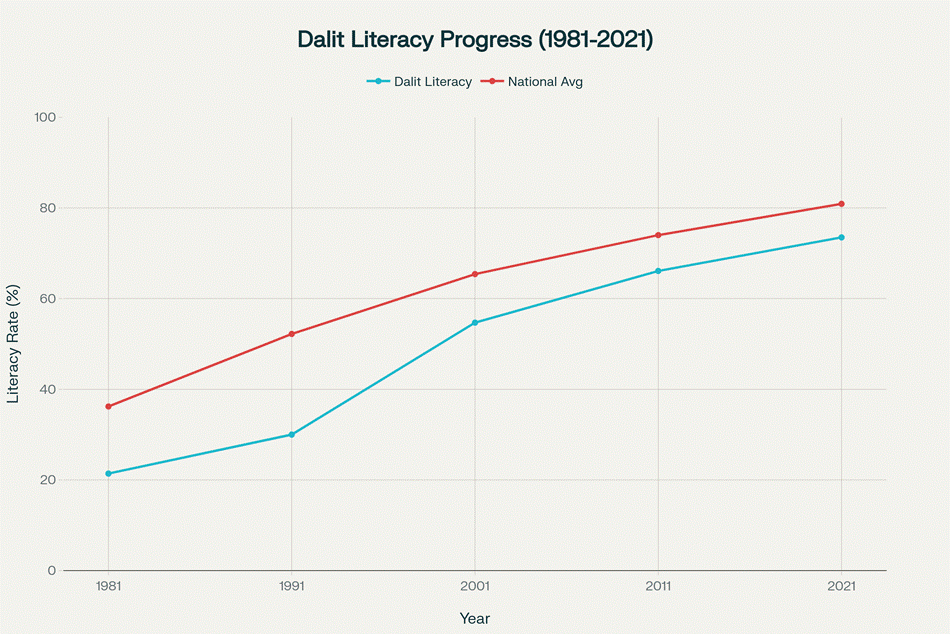
Progress in Downtrodden (Dalit) literacy rates compared to national average over four decades, showing significant educational advancement.
Historical Context: Lessons from Downtrodden (Dalit) Struggles and Leadership
The Downtrodden (Dalit) community’s journey toward empowerment has been marked by both remarkable achievements and internal challenges that underscore the critical importance of mutual respect. Dr. B.R. Ambedkar, the architect of the Indian Constitution and the most prominent Downtrodden (Dalit) leader in modern history, recognized early that internal unity was essential for external progress. His philosophy emphasized three foundational principles borrowed from the French Revolution: liberty, equality, and fraternity—with fraternity representing the mutual respect and solidarity necessary within the community. [1][2]
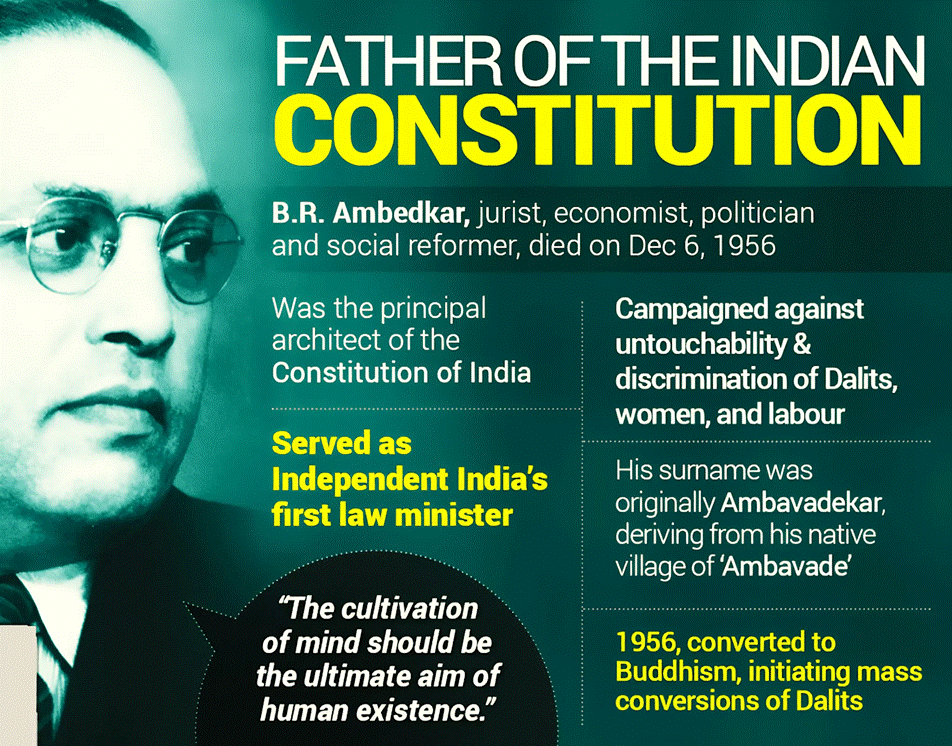
B.R. Ambedkar, renowned as the Father of the Indian Constitution, championed Downtrodden (Dalit) rights and social reforms, inspiring empowerment through education and unity.
Ambedkar’s own experiences revealed the transformative power of education and achievement in breaking caste barriers. Born into a Mahar family, he overcame tremendous obstacles to become one of India’s most respected intellectuals, earning degrees from Columbia University and the London School of Economics. His journey from marginalization to national leadership exemplified how individual achievements, when respected and celebrated by the community, elevate the entire group’s social standing.[2][3]
However, Ambedkar also warned against the dangers of internal division. When organizing Mumbai mill workers in the 1930s, he observed that workers belonging to untouchable castes faced additional discrimination even from other oppressed workers. This led him to argue that “labour unity will not be possible as long as this specific injustice within the broader injustice caused by this casteist Brahminism within the workers is not addressed”. His insight remains profoundly relevant today: external solidarity cannot be achieved without first establishing internal respect and recognition.[4]
The Modern Leadership Legacy: Building on Ambedkar’s Foundation
The decades following Ambedkar’s death have witnessed the emergence of numerous Downtrodden (Dalit) leaders who have demonstrated the power of community support and mutual recognition. Kanshi Ram, founder of the Bahujan Samaj Party, built his political movement on the principle of collective Downtrodden (Dalit) identity while respecting diverse sub-caste experiences. His protégé Mayawati became India’s first Downtrodden (Dalit) Chief Minister, ruling Uttar Pradesh multiple times and demonstrating that political representation could be achieved through community unity.[5][6][7]
Beyond politics, contemporary Downtrodden (Dalit) success stories span every field imaginable. Kalpana Saroj transformed from a child bride living in Mumbai slums to a serial entrepreneur with a business empire worth $112 million. Bhagwan Gawai rose from construction worker to CEO of a Dubai-based energy company with $80 million annual turnover. Minakshee Rode topped the IIT Delhi Ph.D. entrance examination, challenging stereotypes about “merit” and intellectual capability. Shailaja Paik became a MacArthur “genius” fellowship recipient for her groundbreaking research on Downtrodden (Dalit) women’s history.[8][9][10][11]
These achievements represent more than individual success—they demonstrate the collective potential that emerges when communities support and celebrate each other’s accomplishments. As Chandra Bhan Prasad, a Downtrodden (Dalit) researcher, observed: “This is a golden period for Dalits… Because of the new market economy, material markers are replacing social markers. Dalits can buy rank in the market economy”.[8]
Education as the Great Equalizer: Respecting Knowledge and Achievement
The transformative power of education within the Downtrodden (Dalit) community cannot be overstated. Statistical evidence reveals remarkable progress over recent decades, demonstrating how educational achievements deserve community recognition and respect. Downtrodden (Dalit) literacy rates have increased dramatically from 21.4% in 1981 to 73.5% in 2021, though still trailing the national average of 80.9%. This progress represents millions of individuals who have broken through historical barriers to access knowledge and skills.[12][13]
Educational empowerment has proven particularly transformative in challenging traditional hierarchies. Missionary education programs in states like Bihar have shown exceptional results, with 63% of Downtrodden (Dalit) respondents reporting reduced caste discrimination after accessing quality education. These institutions created “inclusive educational atmospheres that cultivated avenues for social integration, diminishing caste-based discrimination, and supporting equality”.[14]
The ripple effects of educational achievement extend far beyond individual advancement. Research shows that Downtrodden (Dalit) students who attended missionary schools could find work in various fields, ending cycles of poverty and creating new opportunities for their families. Educational success also builds social capital within communities, as graduates often become mentors and advocates for others facing similar challenges.[14]
Practical implications for mutual respect include:
- Recognizing academic achievements regardless of the institution or field of study
- Supporting educational aspirations of community members through mentorship and resources
- Valuing diverse forms of knowledge, from traditional skills to modern technical expertise
- Creating networks that connect educated professionals with community development initiatives
Economic Empowerment: Celebrating Entrepreneurship and Success
Economic mobility within the Downtrodden (Dalit) community has accelerated dramatically since India’s 1991 liberalization, creating new opportunities for mutual recognition based on business achievement and professional success. University of Pennsylvania research documented phenomenal entrepreneurship growth: in eastern Uttar Pradesh, Downtrodden (Dalit) business ownership increased from 4.2% to 11% between 1990 and 2010, while western UP saw growth from 9.3% to 36.7%.[8][9]
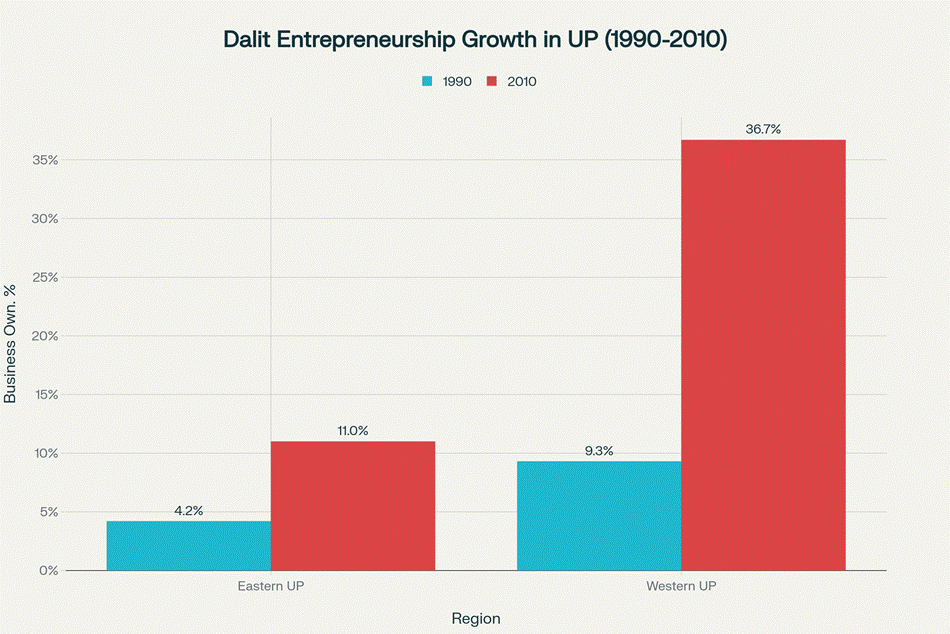
Remarkable growth in Downtrodden (Dalit) entrepreneurship in Uttar Pradesh over two decades, with Western UP showing particularly strong progress.
This economic transformation has produced numerous role models whose success deserves community celebration. Ratibhai Makwana built a ₹380-crore plastic manufacturing company employing 3,500 people, including 2,000 Downtrodden (Dalit)s. Raja Nayak operates businesses worth ₹60 crore across diverse sectors while running educational institutions for underprivileged communities. Saka Shailaja has empowered over 10,000 women through free beauty training programs, demonstrating how individual success can create collective benefit.[8][15]
These entrepreneurs exemplify how economic achievements, when supported by community respect, create multiplier effects. Bhagwan Gawai has identified 30 young Downtrodden (Dalit) achievers to mentor as investors, while Ravi Kumar Narra, National President of the Downtrodden (Dalit) Indian Chamber of Commerce, advocates that “Downtrodden (Dalit) community needs business leadership” to drive sustainable change.[16]
The Telangana government’s Downtrodden (Dalit) Bandhu Scheme, providing ₹10 lakh grants to Downtrodden (Dalit) families for income-generating activities, represents institutional recognition of entrepreneurial potential. Early results show 51% of beneficiaries reporting increased income, 35% changing occupations, and 21% experiencing reduced income volatility.[17][18]
The Challenge of Internal Disunity: Understanding the Costs of Division
Despite remarkable individual achievements, internal conflicts within the Downtrodden (Dalit) community continue to undermine collective progress. Research identifies more than 900 Downtrodden (Dalit) sub-castes throughout India, with internal divisions that sometimes manifest as rivalry and discrimination. These divisions weaken the community’s political voice and dilute resources that could be directed toward collective advancement.[19]
Historical tensions persist between different Downtrodden (Dalit) sub-communities. Balmikis and Pasis boycotted the BSP in the 1990s, claiming it was a Jatav party. In Punjab, converted Downtrodden (Dalit) Sikhs sometimes claim superior status over Hindu Downtrodden (Dalit)s and refuse intermarriage. Such divisions allow external forces to exploit internal weaknesses, as political parties play different sub-castes against each other for electoral advantage.[19]
The psychological costs of internal disunity are severe. As documented in research on marginalized communities, “the oppressed engage in forms of behaviour that foremost hurts them” when they internalize oppression rather than challenging its external sources. This manifests in self-blaming, self-wounding cycles that prevent communities from addressing root causes of discrimination.[20]
Contemporary political conflicts illustrate these dynamics. Recent criticism of Mayawati by leaders like Udit Raj reflects legitimate concerns about representation, but public disputes can undermine broader community solidarity. As one analyst noted, “when exploitation is a reality, unity cannot be forged just by its denial. Unity is possible only by eliminating all forms of exploitation, particularly internal exploitation”.[4][5][21]
Age and Wisdom: Honoring Elder Contributions and Traditional Knowledge
Respect for elders represents a crucial dimension of internal community dignity that deserves renewed emphasis within Downtrodden (Dalit) empowerment movements. Traditional Indian culture has long recognized that “age brings valuable insights simply through the experiences gained from various life events”. For Downtrodden (Dalit)s, elder community members often possess irreplaceable knowledge about historical struggles, survival strategies, and cultural traditions that younger generations need to understand and preserve.[22]
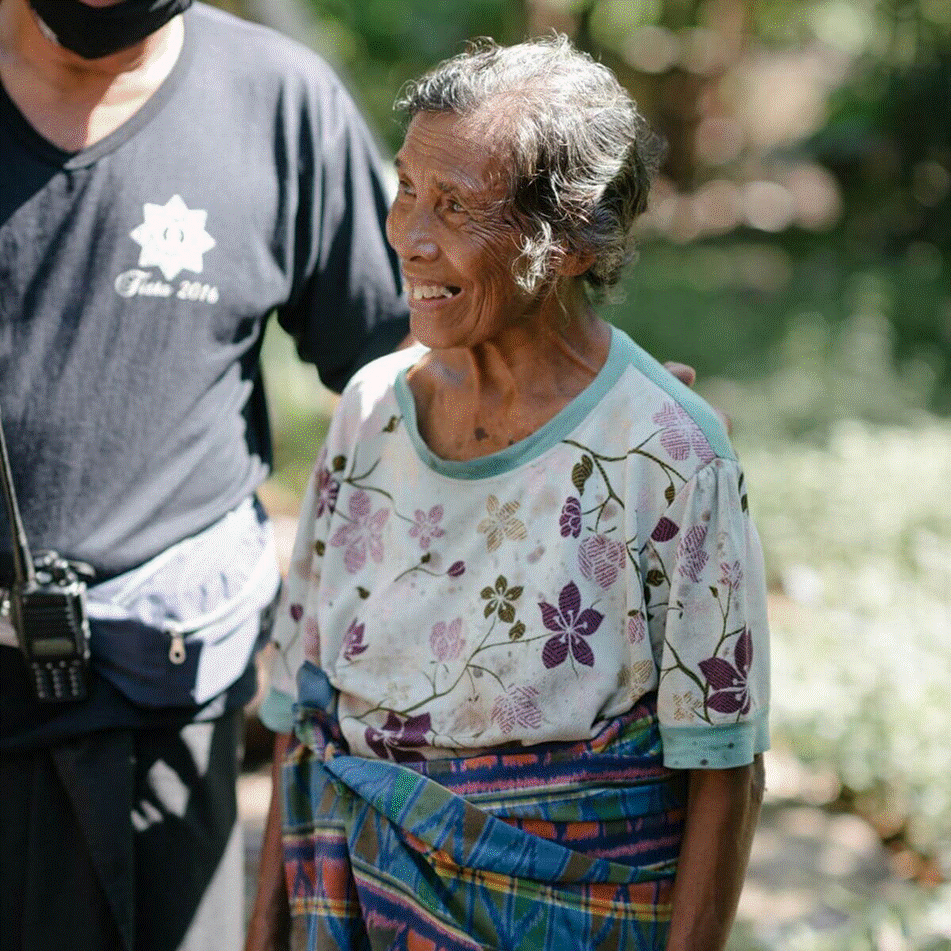
Elderly person receiving respectful support within a community, symbolizing the value of age and wisdom.
Elder Downtrodden (Dalit)s have lived through transformational periods in Indian history—from pre-independence caste restrictions through the early decades of constitutional protections to contemporary economic liberalization. Their experiences provide essential perspective on both the progress achieved and challenges that persist. As one community development expert noted, “Older individuals served as vital sources of community knowledge and wisdom that had been transmitted orally over generations”.[22]
Practical approaches to honoring elder wisdom include:
- Creating formal mentorship programs connecting experienced community leaders with young professionals
- Documenting oral histories to preserve accounts of historical struggles and achievements
- Involving elders in decision-making processes related to community development and political representation
- Recognizing traditional skills and occupational knowledge that elders possess
- Providing platforms for elders to share their insights on navigating discrimination and building resilience
However, respect for age must be balanced with critical thinking about outdated attitudes or practices. As younger generations gain education and exposure to new ideas, communities must navigate tensions between honoring traditional wisdom and embracing progressive change. The goal is mutual respect across generations rather than blind deference to age or uncritical rejection of tradition.
Social Status and Achievement: Building Inclusive Recognition Systems
Creating sustainable mutual respect within the Downtrodden (Dalit) community requires developing inclusive approaches to recognizing social status and achievement that avoid replicating external hierarchies. Traditional caste society denied Downtrodden (Dalit)s recognition based on merit, education, or contribution—a historical injustice that communities must consciously reverse by celebrating diverse forms of excellence and service.
Contemporary Downtrodden (Dalit) achievers demonstrate the breadth of fields where community members can excel and deserve recognition. Beyond the prominent examples already discussed, thousands of Downtrodden (Dalit) professionals work as doctors, engineers, teachers, civil servants, artists, and activists. Dr. Shailaja Paik’s MacArthur fellowship represents global recognition of scholarly achievement, while countless others make daily contributions to community welfare that merit local acknowledgment.[11]
The key is developing recognition systems that are inclusive rather than hierarchical. Instead of creating new forms of internal stratification, communities can celebrate multiple pathways to contribution and achievement. This includes:
- Professional excellence in any field, from traditional occupations enhanced by new skills to cutting-edge technology careers
- Educational achievement at all levels, recognizing that even basic literacy represents victory over historical exclusion
- Community service and activism that advances collective welfare and rights
- Cultural contributions including artistic expression, literary work, and preservation of community heritage
- Economic success that creates opportunities for others, whether through business, employment, or philanthropy
Practical Steps for Fostering Mutual Respect: A Framework for Action
Building sustainable mutual respect within the Downtrodden (Dalit) community requires systematic approaches that address both psychological and structural dimensions of empowerment. Based on successful community development models and Downtrodden (Dalit)-specific experiences, several practical strategies can strengthen internal solidarity:
1. Education and Consciousness-Raising Programs
Community-led educational initiatives can help address internalized prejudices and build appreciation for diverse contributions. These programs should focus on:
- Downtrodden (Dalit) history and achievements to build pride and shared identity beyond victimhood narratives
- Critical thinking skills to analyze external oppression without reproducing it internally
- Conflict resolution techniques for addressing disputes constructively
- Leadership development that emphasizes collaborative rather than hierarchical approaches
2. Economic Cooperation and Resource Sharing
Financial solidarity strengthens communities while demonstrating practical benefits of mutual support:
- Rotating credit associations (similar to traditional “chit funds”) that pool resources for education and business investment
- Mentorship networks connecting successful professionals with aspiring entrepreneurs and students
- Cooperative enterprises that create shared ownership and decision-making opportunities
- Skills exchange programs where community members teach each other diverse capabilities
3. Cultural Celebration and Heritage Preservation
Positive cultural identity formation requires celebrating shared heritage while embracing diversity:
- Community festivals that honor Downtrodden (Dalit) leaders, cultural traditions, and contemporary achievements
- Storytelling initiatives that preserve accounts of struggle and success for younger generations
- Arts and literature programs that provide creative expression opportunities and build cultural pride
- Heritage documentation projects that record traditional knowledge and practices
4. Political Representation and Advocacy Coordination
Unified political voice amplifies community influence while respecting internal diversity:
- Coalition building across sub-caste lines around shared policy priorities
- Candidate development programs that prepare leaders from different backgrounds for political roles
- Issue-based organizing that focuses on concrete policy changes rather than personality conflicts
- Voter education initiatives that emphasize collective benefit over narrow sub-community interests
5. Intergenerational Dialogue and Learning
Bridging age gaps strengthens community cohesion while facilitating knowledge transfer:
- Regular community meetings that provide platforms for different generations to share perspectives
- Joint projects that combine elder wisdom with youth energy and modern skills
- Oral history collection that preserves important community memories and lessons
- Cross-generational mentoring that flows both ways between older and younger community members
The Role of External Alliances: Building Bridges While Maintaining Identity
While internal unity remains paramount, Downtrodden (Dalit) community empowerment also benefits from strategic alliances with other marginalized groups and sympathetic mainstream organizations. The key is engaging externally from a position of internal strength and clear identity rather than fragmented weakness.
Successful alliance-building requires mutual respect principles that Downtrodden (Dalit)s practice internally to be extended to relationships with other communities. This includes recognizing that “our struggles are interconnected” while understanding that different groups face unique challenges. As community development research indicates, “solidarity starts with listening” and requires “genuine allyship” rather than “performative actions”.[23]
Historical examples demonstrate both possibilities and pitfalls of external alliances. Ambedkar’s complex relationship with Gandhi and the Congress party illustrates how mainstream organizations may offer support while maintaining paternalistic attitudes. Contemporary partnerships with other OBC communities, religious minorities, and progressive movements show more promise when based on genuine equality and shared decision-making.[1][2][24][7]
Practical guidelines for external engagement include:
- Maintaining autonomous organizational capacity that prevents co-optation by other groups
- Insisting on equal partnership terms rather than junior or dependent relationships
- Focusing on concrete policy outcomes that benefit Downtrodden (Dalit) communities tangibly
- Building coalitions around specific issues while preserving distinct community identity
- Supporting other marginalized groups reciprocally when their struggles align with broader justice principles
Economic Dimensions: From Survival to Prosperity Through Unity
The economic transformation of Downtrodden (Dalit) communities over recent decades provides compelling evidence for the power of mutual support and recognition. Statistical analysis reveals that Downtrodden (Dalit) entrepreneurship contributes approximately 0.97% to state GDP in regions where supportive policies exist, while individual entrepreneurs average ₹571,500 annual contributions. These figures represent collective wealth creation that benefits entire communities when successful individuals reinvest locally.[25]
The transition from survival-focused economic activity to prosperity-generating enterprises requires community support systems that celebrate and facilitate individual achievement. Traditional Downtrodden (Dalit) occupations in leather work, sanitation, and manual labor are being transformed through new technologies and market opportunities. Rather than abandoning these fields entirely, many entrepreneurs are applying modern techniques to traditional skills, creating “successful entrepreneurship ventures” that honor heritage while generating contemporary income.[26]
Community-level economic empowerment also emerges through job creation initiatives led by successful Downtrodden (Dalit) businesses. Companies like Ratibhai Makwana’s Gujarat Pickers Industries employ nearly 2,000 Downtrodden (Dalit)s out of 3,500 total workers, demonstrating how individual success can create collective opportunity. Similarly, Raja Nayak runs schools and colleges under the Kalaniketan Educational Society for disadvantaged communities, showing how economic achievement can be channeled into social service.[8]
The Downtrodden (Dalit) Indian Chamber of Commerce and Industries (DICCI) represents institutional recognition of this economic potential. With leaders like Ravi Kumar Narra advocating for “business leadership” within the community, DICCI creates networks that connect entrepreneurs, facilitate resource sharing, and advocate for policies supporting Downtrodden (Dalit) business development.[16]
Gender Dimensions: Respecting Women’s Leadership and Contributions
Mutual respect within the Downtrodden (Dalit) community must explicitly address gender dynamics, recognizing that Downtrodden (Dalit) women face multiple layers of discrimination based on caste, gender, and often class. Recent achievements by Downtrodden (Dalit) women leaders demonstrate the transformative potential that emerges when communities support female leadership and recognize women’s diverse contributions.[11]
Shailaja Paik’s MacArthur “genius” fellowship for historical research on Downtrodden (Dalit) women represents global recognition of scholarship that documents previously ignored experiences. Her work “sheds light on the persistent nature of caste-based discrimination and the dynamics that sustain untouchability” while providing historical context for contemporary empowerment efforts. Community celebration of such achievements encourages other women to pursue academic and professional excellence.[11]
Entrepreneurial success stories also demonstrate women’s economic leadership potential. Kalpana Saroj’s $112 million business empire began with overcoming child marriage and domestic violence to become a serial entrepreneur. Saka Shailaja’s training of 10,000 underprivileged women in beauty and makeup skills has created sustainable income opportunities for participants, with many earning ₹10,000-60,000 monthly. These examples show how individual women’s achievements can create collective empowerment opportunities. [8][9][15]
Practical approaches to supporting Downtrodden (Dalit) women’s leadership include:
- Recognizing diverse forms of contribution, from traditional caregiving roles to professional achievements
- Creating safe spaces for women to develop leadership skills and express political views
- Supporting women’s economic initiatives through microfinance, training, and market access
- Addressing gender-based violence within communities as a barrier to full participation
- Promoting women’s representation in community decision-making bodies and political organizations
Conclusion: Unity as the Foundation for Lasting Change
The evidence is overwhelming: mutual respect within the Downtrodden (Dalit) community is not merely a moral imperative but a practical necessity for sustainable empowerment and social justice. Historical examples, contemporary success stories, statistical trends, and community development research all point to the same conclusion—communities that honor each other’s achievements, support collective advancement, and maintain internal solidarity create exponentially greater impact than those fragmented by division and mutual disregard.
The path forward requires conscious effort to transform historical patterns of internalized oppression into new cultures of mutual celebration and support. This means recognizing educational achievement regardless of institutional prestige, celebrating economic success while ensuring it benefits the broader community, honoring elder wisdom while embracing progressive change, and supporting leadership across gender, age, and sub-caste lines.
Dr. B.R. Ambedkar’s vision of liberty, equality, and fraternity remains as relevant today as it was nearly a century ago. The liberty to achieve individual potential, the equality to access opportunities regardless of birth circumstances, and the fraternity to support each other’s advancement—these principles provide the foundation for lasting transformation.[1][2]
The stakes could not be higher. In an increasingly competitive and globalized world, marginalized communities cannot afford the luxury of internal division. The choice is clear: unite around shared values of dignity, respect, and collective advancement, or remain vulnerable to external manipulation and internal stagnation. The success stories documented throughout this analysis demonstrate that when Downtrodden (Dalit) communities choose unity and mutual respect, they create not just individual prosperity but collective power capable of transforming society itself.
As the African proverb states, “Those who respect the elderly pave their own road toward success”. For the Downtrodden (Dalit) community, the parallel truth is equally important: those who respect each other’s contributions, achievements, and dignity create the foundation upon which all future progress will be built. The time has come to make that choice—and to build that foundation together.
- https://politicsforindia.com/dalit-perspective-on-indian-national-movement/
- https://vajiramandravi.com/upsc-exam/dr-br-ambedkar/
- https://www.jhsr.in/archives/articles/dr-b-r-ambedkars-contribution-to-upliftment-of-the-dalit-its-relevance-in-contemporary-india/
- https://m.thewire.in/article/caste/opposition-to-sub-classification-negation-of-reality-equality-and-unity
- https://timesofindia.indiatimes.com/city/lucknow/bsps-political-strength-remained-intact-despite-mayawatis-misbehaviour-corruption-and-greed-udit-raj/articleshow/118346817.cms
- https://www.newindianexpress.com/thesundaystandard/2018/Mar/24/why-bsp-chief-mayawati-is-mistress-of-the-survival-game-1791992.html
- https://indianexpress.com/article/political-pulse/mayawati-october-9-lucknow-rally-alarm-bells-ringing-rival-camps-10281346/
- https://yourstory.com/2018/01/dalit-entrepreneurs
- https://infobank.aroehan.org/stories-of-5-entrepreneurs-from-dalit-community/
- https://velivada.com/2017/05/18/what-brahmin-merit-minakshee-rode-dalit-tops-iit-delhi-ph-d-literature-entrance/
- https://www.bbc.com/news/articles/cn8jz25w7g9o
- https://www.roundtableindia.co.in/socio-economic-overview-of-dalits-in-india/
- https://www.e-ir.info/2010/06/23/the-dalits-of-india-education-and-development/
- https://journals.bilpubgroup.com/index.php/fls/article/download/9147/6480/48839
- https://velivada.com/2021/07/10/meet-saka-shailaja-a-dalit-woman-entrepreneur-who-has-uplifted-10000-underprivileged-women-in-telangana/
- https://twocircles.net/2021mar06/441264.html
- https://www.ijhssi.org/papers/vol9(1)/Series-1/0901019397.pdf
- http://www.isid.ac.in/~acegd/acegd2024/papers/GautamNair.pdf
- https://en.wikipedia.org/wiki/Dalit
- http://www.rgics.org/wp-content/uploads/wpn-49.pdf
- https://www.indiatoday.in/india/story/udit-raj-congress-leader-mayawati-strangle-dalit-muslim-comments-retorts-political-row-2681742-2025-02-18
- https://www.reddit.com/r/AskIndia/comments/1kpb9un/why_is_respecting_elders_so_deeply_valued_in/
- https://www.catharsistherapy.ca/post/building-solidarity-across-marginalized-groups
- https://www.roundtableindia.co.in/the-left-and-the-ambedkarite-movements-need-debate-and-unity/
- https://saudijournals.com/media/articles/SJEF_94_63-72.pdf
- https://www.ijfmr.com/papers/2025/3/46366.pdf
- https://www.allresearchjournal.com/archives/2022/vol8issue12/PartD/9-9-2-891.pdf
- https://polish-sociological-review.eu/pdf-126362-54183?filename=Between+Exclusion+and.pdf
- https://www.bridgespan.org/getmedia/cdf3a0c2-1c96-49c8-a09a-a64a303ccf33/pathways-to-greater-social-mobility-for-indias-dalit-and-adivasi-communities.pdf
- https://core.ac.uk/download/pdf/236165545.pdf
- https://www.ijhssi.org/papers/v4(8)/H0481055058.pdf
- https://wisdompress.co.in/wp-content/uploads/2022/10/Social-Mobility-of-Schedule-Caste-and-Education.pdf
- https://www.journalofpoliticalscience.com/uploads/archives/3-1-19-671.pdf
- https://www.drishtiias.com/mains/model-essays/the-impact-of-education-on-socio-economic-mobility
- https://www.globalministries.org/resource/caste-and-the-dalits-an-introduction/
- https://www.roundtableindia.co.in/the-legacy-of-b-r-ambedkar-and-his-contribution-in-social-justice-and-equality/
- https://aud.delhi.gov.in/education-and-social-mobility
- https://www.dhyeyaias.com/current-affairs/daily-current-affairs/sub-classification-of-scheduled-castes
- https://en.wikipedia.org/wiki/B._R._Ambedkar
- https://www.roundtableindia.co.in/dalit-protest-identity-and-outcry-against-caste-hegemony-apartheid-an-overview/
- https://lotusarise.com/caste-conflicts-in-india-upsc/
- http://www.uniindia.com/udit-raj-warns-bsp-rally-may-help-bjp/north/news/3593288.html
- https://forum4researchers.com/cw_admin/docs/IJIRP-SEP-13-03.pdf
- https://www.taxtmi.com/news?id=34390
- https://banotes.org/state-politics-in-india/understanding-dalit-identity-struggles-india/
- https://academic.oup.com/book/34930/chapter/298530248
- https://www.cdpp.co.in/articles/dalit-entrepreneurs-exploring-what-it-means-to-run-a-business-as-a-dalit
- https://www.idea.int/sites/default/files/publications/successful-strategies-facilitating-the-inclusion-of-marginalized-groups.pdf
- https://www.wisdomlib.org/concept/respect-for-elders
- https://theirworld.org/news/poverty-leaves-india-with-huge-literacy-problem-to-solve/
- https://www.eccar.info/sites/default/files/document/9_Toolkit-en_ImprovingAccess_web.pdf
- https://www.thinkcounterculture.com/post/the-wisdom-of-our-elders
- https://pmc.ncbi.nlm.nih.gov/articles/PMC2474466/
- https://www.duja.co.za/strategies-for-scaling-social-impact-in-marginalised-communities/
- https://pilc.py.gov.in/sites/default/files/art24.pdf
- https://www.rjhssonline.com/HTMLPaper.aspx?Journal=Research+Journal+of+Humanities+and+Social+Sciences%3BPID%3D2013-4-3-9
- https://www.templetonworldcharity.org/ideas/building-social-solidarity-through-tackling-public-social-and
- https://blackstonefm.com/4-cultures-that-could-teach-you-about-embracing-older-age/
- https://ijmds.in/index.php/ijmds/article/download/89/79/79
- https://ieecp.org/2024/03/15/community-conversation-building-a-civil-society-in-solidarity-with-marginalized-groups-for-greater-social-impact/
- https://www.thecitizen.in/index.php/en/NewsDetail/index/9/20196/Celebrate-Our-Elderly
- https://www.ijhssi.org/papers/vol9(9)/Ser-3/O09098488.pdf
- https://ctb.ku.edu/en/table-of-contents/assessment/promotion-strategies/overview/main
- https://www.socialprotectionfloorscoalition.org/wp-content/uploads/2025/02/20250211-CSocD63-Building-Social-Resilience-and-Solidarity_side-event_IPA-et-al_Concept-note.pdf
- https://ecampusontario.pressbooks.pub/communitydevelopmentpractice/chapter/27/
- https://www.un.org/esa/socdev/egms/docs/2009/Ghana/inclusive-society.pdf
- https://mpra.ub.uni-muenchen.de/120639/1/MPRA_paper_120639.pdf
- https://www.linkedin.com/pulse/4-steps-effective-community-development-joel-mcreynolds
- https://www.yesmagazine.org/social-justice/2017/10/26/how-i-confronted-my-own-privilege-as-a-person-of-color
- https://www.authorea.com/users/846220/articles/1235100-caste-and-economic-inequality-in-contemporary-india-analyzing-structural-barriers-to-social-mobility
- https://ebooks.inflibnet.ac.in/aep05/chapter/approaches-to-working-with-communities/
- https://truestoryaward.org/story/135
- https://www.theindiaforum.in/caste/caste-and-careers-limited-mobility-over-three-generations
- https://www.gcu.edu/blog/business-management/9-ways-create-company-culture-dignity-respect
- https://www.ashoka.edu.in/caste-in-higher-education-examining-and-redefining-affirmative-action/
- https://multiarticlesjournal.com/counter/d/3-4-71/IJCRM-2024-3-4-71.pdf
- https://www.cmxhub.com/blog/build-a-thriving-community-from-scratch
- https://ppl-ai-code-interpreter-files.s3.amazonaws.com/web/direct-files/91a4f275bce9971cfaf00bda0262a61a/247e133d-72a1-4ca4-a33e-1466116145ae/f95de05d.csv
- https://ppl-ai-code-interpreter-files.s3.amazonaws.com/web/direct-files/91a4f275bce9971cfaf00bda0262a61a/247e133d-72a1-4ca4-a33e-1466116145ae/000f0c8b.csv
- https://ppl-ai-code-interpreter-files.s3.amazonaws.com/web/direct-files/91a4f275bce9971cfaf00bda0262a61a/247e133d-72a1-4ca4-a33e-1466116145ae/169926d8.csv