







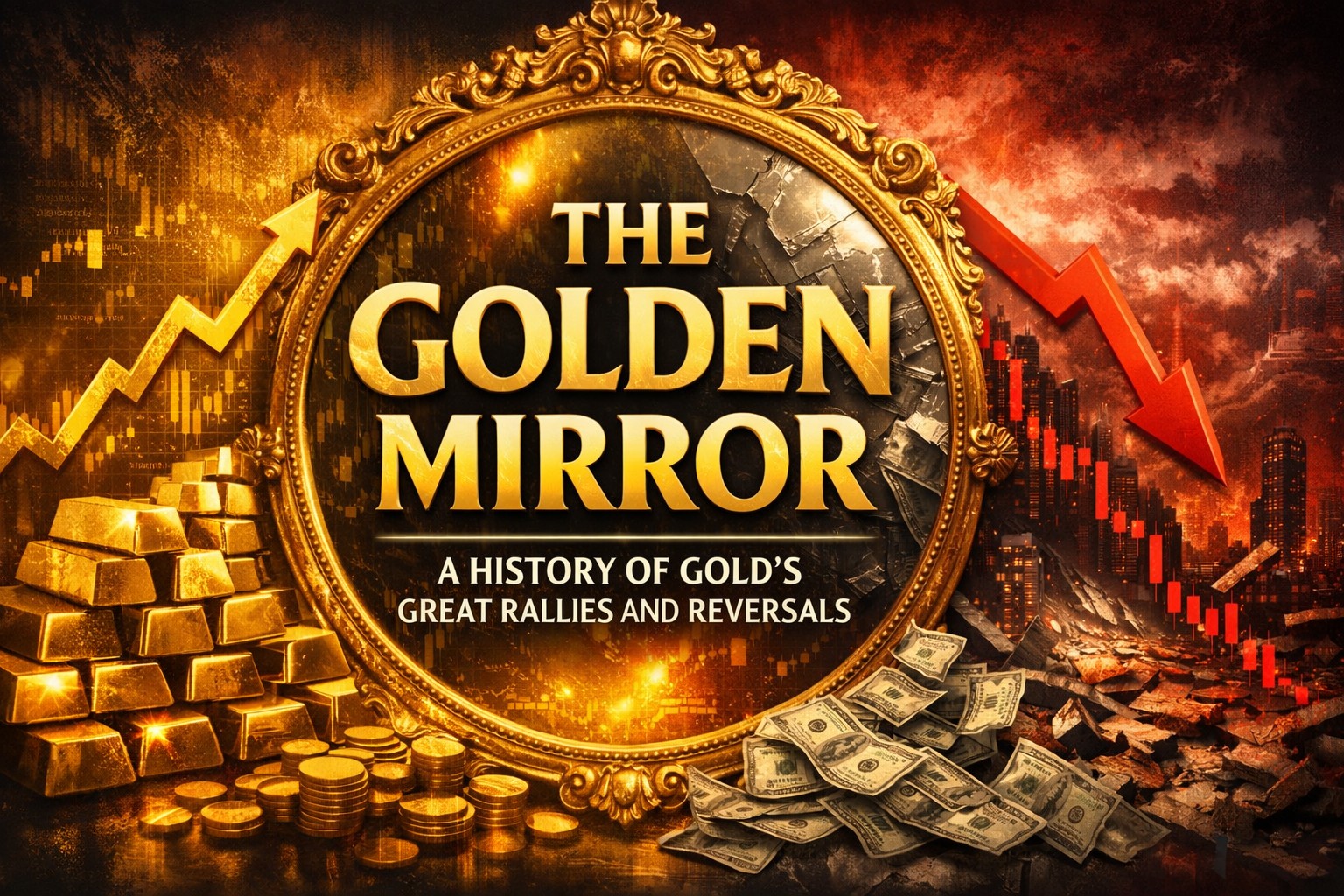
The Golden Mirror: A History of Gold’s Great Rallies and Reversals
Gold has always been more than just a precious metal—it is a mirror held up to the economic soul of the world. Every time gold surges, it reflects something deep happening beneath the surface: fear of inflation, loss of faith in currencies, panic during crises, or the feeling that the very foundations of the financial system are cracking. And every time a gold rally shatters and prices collapse, it tells a different story—one of renewed confidence, policy triumph, or simply a change in the wind that investors saw coming from miles away. Over the past fifty years, gold has staged several spectacular rallies, each followed by dramatic reversals. These are not random price movements; they are economic narratives written in the price of the metal that has guarded wealth for millennia.
The 1970s: When Gold Became a Scream Against Chaos
To understand the power of a gold rally, you must first step back to August 1971, when President Richard Nixon sat before television cameras and announced something that would reshape the global financial order. The United States, he said, would no longer convert dollars into gold on demand. The Bretton Woods system—the post-World War II arrangement that had anchored global currency to the yellow metal—was finished.[1][2]
What happened next was like a dam breaking. For decades, the official price of gold had been fixed at $35 per ounce by government decree. The moment that restraint was removed, the price started climbing—slowly at first, then with gathering momentum. By 1975, just four years later, gold had reached $184 per ounce. But that was only the beginning of the story.[3][1]
The 1970s were a decade of economic torment. The oil shocks of 1973 and 1979 sent energy prices skyrocketing. Inflation, previously a manageable nuisance, became a plague. In the United States, annual inflation rates climbed into double digits. By March 1980, the Consumer Price Index was raging at 11.6%. People who held paper money watched its purchasing power evaporate before their eyes. A dollar that could buy you a coffee today might be worth only 90 cents next month. The government seemed helpless to stop it.[4][2][1][3]
In this environment of economic chaos, gold became more than an investment—it became a survival mechanism. Real interest rates (the nominal rate minus inflation) had gone deeply negative. This meant that if you kept your money in a bank deposit earning, say, 5%, but inflation was running at 14%, you were actually losing 9% of your purchasing power every year. Who would do that? Investors, desperate to preserve wealth, turned to gold. It paid no interest, but at least it wouldn’t be consumed by inflation.[2][1][4][3]
The rally was extraordinary. Gold climbed from $35 in 1971 to $850 in January 1980—a gain of 2,329%. That is a 24-fold increase in less than a decade. Those who held gold during this period and then sold at the peak saw their wealth grow almost as dramatically as if they had struck oil in their backyard.[1][2][3]
But the very factors that had driven gold so high were about to be obliterated by one man’s determination.
The Volcker Shock and the End of an Era
In August 1979, Paul Volcker became chairman of the Federal Reserve, and he brought with him a radical idea: break inflation by any means necessary, even if it meant causing a severe recession and unemployment.[1][4][2]
Volcker raised interest rates with a ferocity that shocked the markets. The federal funds rate—the interest rate that the Fed controls—climbed toward 20% by late 1980 and early 1981. These were not the gentle, incremental hikes that central banks typically prefer; these were shock-and-awe tactics. The message was clear: holding money would now be rewarded handsomely.[4][2][1]
The impact on gold was immediate and devastating. Suddenly, real interest rates—which had been deeply negative—flipped and became sharply positive. If you could lock in a 15% return from a Treasury bond and inflation was falling, your real return would be excellent. Gold, which paid nothing, suddenly looked foolish by comparison. The opportunity cost of holding a non-yielding metal had soared.[2][5][6][7][4]
Gold peaked on January 21, 1980, at $850 per ounce. Within months, the rally was over. By 1985, just five years later, gold had fallen to around $320 per ounce—a decline of 62% from the peak. The metal would spend the next two decades in a bear market, wandering aimlessly between $300 and $400 per ounce through the 1990s, as inflation vanished and confidence in central banks and the dollar was restored.[3][8][4][2]
What had happened? The narrative had changed. Investors had feared the end of the world; Volcker had simply ended inflation instead. The world had survived, the currency had stabilized, and equities and bonds became attractive again. Gold’s moment had passed.[1][4][2]
The lesson was stark: gold rallies end when central banks regain credibility and when real interest rates turn positive.
The Long Sleep: From 1985 to 2000
For the next fifteen years, gold was the forgotten metal. As the U.S. economy boomed in the 1980s, as the Cold War ended and geopolitical tensions eased, as personal computers and then the Internet created a whole new world of investment opportunities, gold quietly slipped away from investors’ minds. It was not a scream; it was a whisper, and nobody was listening.[4][3][8]
By 2001, gold was trading around $250–$290 per ounce, barely above where it had been in the late 1970s before the great rally began. Adjusted for inflation, the metal had actually become cheaper. The world had moved on. Money was flowing into technology stocks, derivatives, and complex financial instruments that promised to transform human wealth creation. Gold was considered a relic of the past, something that your grandmother bought and that had no place in a modern portfolio.[3][8]
But the world was about to remind investors why gold mattered.
The 2000–2011 Rally: Fear Returns to the Markets
The saga of gold’s second great rally began with the dot-com crash. In 2000, the Nasdaq stock index collapsed as investors realized that many internet companies with grandiose names and no profits were, in fact, worth nothing. The dream of easy technology riches evaporated. Stocks fell 24% in 2002 alone.[9][8]
The Federal Reserve, now led by Alan Greenspan, responded by cutting interest rates sharply. The federal funds rate, which had been above 6%, was slashed to 1% by 2003. Real interest rates fell, and gold began to stir from its long sleep. In 2003, as the U.S. prepared to invade Iraq, gold climbed to $367 per ounce—the highest in six years.[3][10][8]
But the real acceleration came later, driven by a different kind of fear.
The Global Financial Crisis and the Birth of Quantitative Easing
By 2007, the world financial system was a house of cards made of subprime mortgages, derivatives, and leverage. When the cards began to fall in 2008, they fell fast. Lehman Brothers, the investment bank that had survived the Great Depression, collapsed in September 2008. AIG, a global insurer, nearly went under. Banks stopped lending to each other. The world faced the prospect of financial Armageddon.[11][12][9][13]
In this chaos, something strange happened to gold. It initially fell sharply, dropping to $692.50 per ounce in the darkest days of the crisis. Why? Because investors, facing margin calls and desperate for liquidity, sold everything—including gold. They needed cash to survive, and gold, despite its safety reputation, was one of the few things they could liquidate quickly.[12][9][13][11]
But the selling was short-lived. The Federal Reserve, terrified of economic collapse, began printing money at an unprecedented scale. Interest rates went to zero. Then came quantitative easing (QE)—the Fed began buying massive quantities of Treasury bonds and mortgage-backed securities, adding trillions of dollars to the money supply. The first round of QE ran from December 2008 to March 2010. A second round followed from November 2010 to June 2011.[10][13]
For investors, the message was clear: the central bank would not allow the system to collapse, no matter the cost. But there was a darker implication. This massive money printing, many feared, could eventually lead to inflation or currency debasement. Gold, which had been scorned just months earlier, suddenly became the insurance policy that everyone wanted.[1][9][13][10]
The rally was powerful. Gold rose from its 2008 lows of around $700 to over $1,000 by 2009. It continued higher as the recovery from the financial crisis proceeded, but the recovery proved uneven and vulnerable. Investors remained spooked by news of eurozone debt crises, Greek bailouts, and continued financial fragility.[9][8][13]
The Peak of Fear: September 2011
By mid-2011, several factors had converged to create a perfect storm of anxiety. The Arab Spring had destabilized the Middle East. The United States had downgraded its debt rating for the first time in history. Europe was gripped by the sovereign debt crisis, with Greece, Ireland, Portugal, and Spain all in severe distress. Riots had erupted in the United Kingdom. Geopolitical tensions were everywhere, and the economic recovery looked fragile.[14][8][15]
Gold, responding to all this chaos and the continued low interest-rate environment, surged to an all-time high. On September 6, 2011, gold hit $1,923.70 per ounce. From its 2001 low of around $250, this represented a gain of nearly 650% in just ten years.[8][16][14]
Investors who had suffered through the dot-com bust and the financial crisis and had lost faith in stocks were now believers in gold. Predictions began to circulate that gold would go to $2,000, $3,000, even $5,000 per ounce. The metal was going to the moon, or so the bulls proclaimed.[17][16]
They were wrong.
The Collapse: 2011–2015
What stopped the rally was not a single dramatic shock, like Volcker’s rate hike, but rather a gradual shift in expectations. After QE2 ended in June 2011, the market began to believe that the worst of the financial crisis was truly over. The U.S. economy, while weak, was no longer on life support. Corporate earnings were improving. Stock markets, after their volatile 2011, began to recover in 2012.[10][8][13]
Meanwhile, the inflation that gold bugs had predicted never materialized. Despite trillions of dollars of money printing, consumer prices remained subdued. Banks were hoarding the liquidity rather than lending it out aggressively. Workers had little bargaining power due to high unemployment. Globalization had depressed wage growth. The velocity of money—how fast money circulates through the economy—had collapsed, preventing the money supply from translating into rampant inflation.[17]
Expectations of future interest rates began to change. The Fed would eventually raise rates, the market came to believe, rather than maintain them at zero forever. Higher real rates would be coming. And if higher real rates were coming, gold would fall.[8][5][6][17][10]
The decline was relentless. By April 2013, gold had fallen to around $1,300 per ounce—a 32% decline from the 2011 peak. This was the largest annual decline since 1981, the year after Volcker broke inflation. By 2015, in the face of a strengthening U.S. dollar and Fed rate hike expectations, gold had plummeted to $1,050 per ounce—a 45% decline from the 2011 peak.[16][17][8]
Investors who had bought gold near the peak in 2011, convinced it would go to $3,000, were now sitting on losses. The narrative had shifted again. The world was not going to end. Central banks could manage the aftermath of crises. And when crisis fades, investors prefer stocks to gold.[13][17][8]
The 2018–2020 Rally: Pandemic and Panic
For the next few years, gold wandered in the wilderness. It traded between $1,050 and $1,400 per ounce, finding no clear direction. The U.S. economy was growing. The Fed was raising rates. Inflation was low. There seemed no reason for gold to surge.[10][18]
But in 2018 and 2019, new clouds gathered on the horizon. The Trump administration launched a trade war with China, imposing tariffs and threatening further economic disruption. Global growth slowed. Central banks, which had been on a tightening path, pivoted and began to cut rates again in 2019. Real interest rates fell. Once more, gold began to stir.[18][19]
By mid-2018, gold was around $1,200–$1,250. It rose steadily through 2019, reaching toward $1,500 by year-end, and then accelerated sharply in early 2020 as a new and unexpected shock hit the world.
The COVID-19 Shock
In March 2020, the world locked down. Businesses closed. Stock markets crashed. The S&P 500 fell by nearly 34% in a matter of weeks. Unemployment spiked from 3.5% to 14% in just two months. The economic damage looked potentially catastrophic.[18][20][16][21]
Gold initially fell in the early days of the panic (dropping to below $1,500) as investors, facing losses everywhere, sold gold to raise cash. But the decline was brief. As central banks and governments unleashed unprecedented stimulus—the U.S. alone passed a $2 trillion relief package—investors realized that inflation could be coming. Real interest rates were plummeting toward deeply negative levels. Risk was everywhere.[20][16][21][18]
From this point, the rally was swift. Gold surged from around $1,500 in March 2020 to an all-time high of $2,070 in August 2020—a 40% gain in just five months.[21][18][20]
What had driven this rally? Multiple factors converged: the unprecedented monetary and fiscal stimulus created the expectation that inflation would return; real interest rates were deeply negative; the U.S. dollar weakened; and investors sought safe havens from the pandemic’s uncertainty. For the first time in financial history, the price of gold briefly exceeded $2,000 per ounce.[18][20][21]
The Pullback: 2021
But a strange thing happened as 2020 turned into 2021. Vaccines were developed faster than expected. Economies began to reopen. The absolute panic of the pandemic faded. Investors, no longer convinced that the world would be destroyed, began to shift their focus to growth assets like equities, which stood to benefit more from the stimulus than gold, which paid no interest.[18][20]
By late 2021, gold had pulled back to around $1,700–$1,800 per ounce—a decline of about 13–15% from the August 2020 peak. The rally was not broken, but it had cooled. Investors were beginning to worry that central banks would raise rates to combat rising inflation, and rate expectations had become bearish for gold.[20][18]
The Current Surge: 2022–2025
The latest chapter in gold’s story began in 2022, and it is still being written. After falling from its 2020 highs, gold traded around $1,700–$1,800 per ounce through much of 2021. But in March 2022, Russia invaded Ukraine. Suddenly, the world faced not just inflation and economic uncertainty, but also geopolitical risk—actual war in Europe. Safe-haven demand surged, and gold rallied to near $2,050 per ounce.[18][15]
This should have been the beginning of a major bull market. But the Federal Reserve had different plans. Inflation, which had seemed transitory in 2021, had become persistent. In 2022, annual inflation in the United States reached 9.1%, the highest in 40 years.[18]
To fight this inflation, the Fed tightened monetary policy with the aggressiveness not seen since the Volcker era. Interest rates rose from near zero in early 2022 to above 4.25% by the end of the year. Expectations for further rate hikes mounted.[18]
Gold, caught between two forces—geopolitical fear pushing it higher and interest rate expectations pushing it lower—stumbled. By the autumn of 2022, gold had fallen below $1,650 per ounce. The narrative seemed to suggest that the Fed would succeed in controlling inflation, and if inflation fell and real rates stayed high, gold would remain under pressure.[22][15][18]
But something unexpected happened. As 2023 unfolded, inflation proved stickier than the Fed had hoped. It fell from the 9.1% peak, but settled at levels still above the Fed’s 2% target. Meanwhile, central banks around the world—particularly in emerging markets like China, Russia, and India—began buying massive quantities of gold. These purchases had a strategic purpose: to diversify reserves away from the U.S. dollar and to position themselves in a multipolar world where the dollar might not be as dominant as it had been.[23][22][18]
This central bank buying, combined with the realization that inflation might not be truly beaten, reignited the gold rally. Gold climbed from below $1,650 in late 2022 to above $2,000 once again in late 2023. In 2024, as investors bet that the Fed would eventually cut rates and as geopolitical tensions persisted (the Middle East conflict, U.S.-China tensions), gold accelerated further. By May 2024, gold hit an all-time peak of around $2,450 per ounce.[18]
But the rally did not stop there. Through 2024 and into 2025, gold has continued to climb. By early 2025, the metal had reached $3,000 per ounce—a level that seemed impossible just a few years ago. This represents a gain of roughly 50–70% from the 2022 lows, and the rally is still ongoing.[22][18]
Why Gold Rallies End: The Three Mechanisms
Looking across these four great rallies and their reversals, three fundamental mechanisms emerge—forces that appear again and again, like the unchanging laws of nature.
1. Real Interest Rates: The Fundamental Force
The most powerful driver of gold’s long-term price is real interest rates—the return you earn on safe assets after adjusting for inflation.[4][2][10][5][6][7]
When real interest rates are negative or falling, gold is attractive. You earn nothing from holding gold, but you are also not losing purchasing power like you would be holding cash. Moreover, a negative real rate environment usually comes with high inflation or inflation fears, and investors want to hedge that risk. This was the story of the 1970s and the 2000–2011 period.[2][5][6][7][4]
When real interest rates are positive and rising, gold becomes unattractive. Why hold a non-yielding metal when you can earn 5% or 6% from a Treasury bond, or even more from other assets? This is what stopped the 1970s rally when Volcker pushed rates above 20%. It is what started the decline from the 2011 peak as the market anticipated Fed rate hikes.[10][5][6][7][4][2]
The relationship is so strong that economic studies find that a 1 percentage-point rise in real interest rates can reduce real gold prices by about 13%. Conversely, falling real rates can fuel powerful rallies.[5][6][7]
This is why the current 2022–2025 rally has persisted despite some Fed rate hikes. The key is that inflation has not been fully vanquished, and with massive government debt, many investors doubt that real rates will stay permanently high. The Fed might be forced to cut rates eventually, bringing real rates back down. Until that uncertainty is resolved, the rally can continue.[1][22][15]
2. Inflation Expectations: The Psychological Force
Raw inflation data is important, but what matters for gold prices even more is what investors expect inflation to be in the future.[15][5][7][19][23]
During the 1970s, inflation was not just high—it was accelerating and seemed out of control. People expected it to get worse. Gold surged as an inflation hedge. After Volcker broke inflation, expectations shifted. People came to believe that inflation would stay low. Gold crashed.[1][4][2][3]
After the 2008 financial crisis, the Fed printed trillions of dollars. Investors feared massive inflation was coming. Gold rallied for years on this fear, even though actual inflation remained subdued. When inflation failed to materialize, the rally faded in 2011–2012.[17][10][13]
In 2020, the pandemic sparked massive stimulus. But because the world was in lockdown and economic activity had stopped, many investors thought the stimulus would not cause inflation (because there was nothing to buy). They were wrong. Supply chains broke, central banks kept money loose, and inflation eventually spiked to 40-year highs in 2022. Gold benefited from this by rising from lows around $1,700 toward $2,450 in 2024.[18][20][15]
Econometric research shows that a 1 percentage-point increase in expected inflation can boost real gold prices by roughly 37%. That is why inflation expectations matter so much.[7]
The current rally is riding on the belief that inflation will not be fully conquered, that central banks will be forced to keep real rates lower than the market initially thought, and that the old days of 2% inflation and stable growth may be gone for a generation. If that belief cracks—if data convinces investors that inflation really is under control—gold will be vulnerable.[22][19][23][7]
3. Risk Sentiment and Safe-Haven Demand: The Emotional Force
During acute crises, gold experiences surges due to flight-to-safety buying. When stocks are crashing, when the financial system looks fragile, when war erupts—gold becomes the ultimate insurance policy.[9][24][25][26][27][28]
In 2008, despite initially falling, gold eventually rose 47% as investors sought safety. In 2020, gold surged 53% in a matter of months during the pandemic panic. In March 2022, when Russia invaded Ukraine, gold spiked on immediate safe-haven demand.[18][20][9]
But these safe-haven surges often prove to be temporary. Once the crisis starts to ease—once central banks intervene, once vaccines are developed, once the acute shock passes—some of the safe-haven premium fades. Gold remains higher than pre-crisis levels, but the parabolic acceleration stops.[26][28][9][18]
This is crucial: gold can serve as a hedge and a diversifier over long periods, but it is not a perpetual safe haven. The moment investors believe the crisis is passing, some will shift capital to higher-returning assets like equities, which should benefit more from recovery and stimulus.[28][9][18][26]
The Reflected World: What Gold Tells Us About the Economy
More than anything else, gold is a barometer of doubt. Its price movements are like the fever on a sick patient’s thermometer—they do not cause the illness, but they reveal how bad the condition has become.
Gold as an Inflation Signal
When gold is making new highs despite central banks tightening policy (as in 2022–2024), it is telling the world something important: investors do not fully trust that inflation will be controlled.[22][7][19][23]
This is not idle speculation. It is a signal from people with real money at stake. In the 1970s, gold’s surge was a scream that inflation was going to destroy the currency. It was right. In 2011, gold’s peak reflected the belief that central banks would keep rates at zero forever to support growth. It was half-right and half-wrong, as the Fed did keep rates low but eventually began to raise them. In 2022–2024, gold’s surge despite Fed rate hikes signals that investors believe inflation is structurally higher than in the pre-2020 era.[19][23][22]
Gold as a Monetary System Indicator
The current rally is also notable for its reliance on central bank buying. Emerging market central banks, particularly China, Russia, and India, have been accumulating gold at a rapid pace. This is not random buying for diversification; it is strategic positioning in a world where many countries are uncomfortable with the overwhelming dominance of the U.S. dollar.[1][22][15][23]
Gold’s rally in 2022–2025 therefore reflects not just inflation fears but also a deeper shift in the global monetary system. Countries are building alternatives to dollar dominance. In this sense, gold’s rally is a signal of geopolitical transition.[22][23]
Gold as a Signal of Lost Confidence
Most fundamentally, gold rallies signal moments when confidence in the existing system—central banks, governments, paper money, the financial structure—has eroded. Every great gold rally has come during a period when people asked fundamental questions: Can I trust this currency? Can I trust this central bank? Might the system collapse?[1][4][2][5][6][7]
Conversely, long bear markets in gold—like the 1980s through the 1990s—corresponded to periods when confidence was high, when central banks had proven their competence, when growth was steady and inflation was low, and when equities offered better returns than insurance policies.[4][2][1]
What Stops a Rally? Lessons from History
If we can identify three mechanisms that drive gold higher, we can reverse them to identify what stops the rallies.
A rally stops when real interest rates turn persistently positive. This happened in 1980 with Volcker, and it would happen again if the Federal Reserve could convince the world that it would maintain real rates above 2–3% indefinitely. The challenge today is that U.S. government debt has grown so large (over $33 trillion) that running very high real rates indefinitely would be economically destructive. This is why investors doubt that the Fed can maintain Volcker-era real rates. As long as they doubt it, gold can rally.[1][4][2][10][22][5][6][7]
A rally stops when inflation expectations are thoroughly defeated. This took about four years from Volcker’s October 1979 announcement until inflation truly broke in 1984. It took about six years from the 2008 GFC crisis until investors became convinced, around 2014, that inflation would stay low. If the current inflation proves to be a one-off shock, not a regime change, then expectations could shift quickly and gold could crash. But if inflation remains sticky at 3–4% above the Fed’s 2% target, expectations will remain elevated and gold can stay high.[22][5][7][19][23]
A rally stops when risk sentiment turns decisively risk-on. When investors truly believe the crisis has passed, when equities are roaring higher, when credit spreads are tight and volatility is low, some of the safe-haven premium on gold fades. This happened in 2013–2015 after the Fed’s QE3 supported the stock market recovery. It could happen again if the economy accelerates and inflation moderates simultaneously.[9][18][15][26][28]
The Current Moment: Can This Rally Last?
Here we stand in late 2025, with gold above $3,000 per ounce and rallying for three years straight. History offers some sobering lessons for bulls.
The 1970s rally lasted nine years; the 2000–2011 rally lasted ten years. This current rally has run for three years and may have several more ahead of it. The question is what will end it.
If the Federal Reserve can convince the market that it will keep real rates persistently positive without breaking the economy, gold’s rally is over. If inflation moderates sharply while growth remains healthy, the rally is over. If geopolitical tensions ease and risk appetite returns fully to equities, part of the safe-haven premium will fade.
Conversely, the rally can continue if inflation proves stickier than expected, if the Fed is forced to cut rates due to growth concerns, if the debt burden forces the central bank to keep real rates lower than ideal, or if geopolitical tensions continue to worsen.[22][15][19][23]
What we know from history is this: all gold rallies eventually end. The 1970s rally ended. The 2000–2011 rally ended. The 2020 pandemic rally ended (though prices stayed high). None of them lasted forever. The question is not whether this rally will end, but when—and what will trigger the reversal.
Conclusion: A Story Without End, But With Cycles
Gold’s history over the past fifty years is not the history of a gradually appreciating asset, but rather the history of boom and bust cycles, each driven by fundamental forces: interest rates, inflation expectations, risk sentiment, and confidence in institutions. Each rally has told a story—of fear, hope, policy shifts, and changed perceptions. And each rally’s end has been dramatic, with investors who were certain prices would go higher finding themselves caught holding losses as the narrative suddenly shifted.
For investors, the lesson is not that gold is a get-rich-quick scheme or a perpetual insurance policy. Rather, gold is a tactical asset whose value rises and falls with the confidence cycle and the real interest rate environment. It is best held as a hedge against extreme outcomes—runaway inflation, currency collapse, geopolitical chaos—not as a core long-term position betting on endless appreciation.
For observers and students of economics, gold is perhaps more valuable as a diagnostic tool. When gold is rallying sharply, ask yourself: What is the market afraid of? What confidence has been lost? What does the world believe is going wrong? The answers to those questions often tell you more about the true state of the economy than the official statistics do.[1][4][2][5][6][7][19][23]
In the end, gold is only yellow metal. But the price of that metal reflects the hopes, fears, and doubts of billions of people trying to preserve their wealth in an uncertain world. And that, perhaps, is why gold’s story is an endlessly fascinating one, told again and again through the cycles of history.
- https://pinnacledigest.com/blog/the-same-fire-a-different-fuel-gold-1979-1980-vs-gold-2024-2025
- https://critiqueofcrisistheory.com/the-five-industrial-cycles-since-1945/from-the-1974-75-recession-to-the-volcker-shock/
- https://discoveryalert.com.au/gold-price-history-lydian-monetary-systems-2025/
- https://www.goldpriceforecast.com/explanations/paul-volcker-gold/
- https://www.goldpriceforecast.com/explanations/gold-real-interest-rates/
- https://www.bullionbypost.co.uk/index/gold/gold-price-interest-rate-relationship/
- https://www.chicagofed.org/-/media/publications/chicago-fed-letter/2021/cfl464-pdf.pdf?sc_lang=en
- https://www.weforum.org/stories/2015/07/a-brief-history-of-gold/
- https://auronum.co.uk/shining-through-chaos-golds-behavior-in-the-crises-of-the-past-30-years/
- https://www.goldpriceforecast.com/explanations/quantitative-easing/
- https://www.quantumamc.com/article/Will-2009-be-a-
- https://www.gainesvillecoins.com/blog/gold-price-2008-what-we-can-learn
- https://www.bls.gov/opub/btn/volume-2/gold-prices-during-and-after-the-great-recession.htm
- https://economictimes.com/markets/commodities/2011-gold-silver-touch-all-time-highs-amid-economic-turmoil-and-rising-inflation/articleshow/11276942.cms
- https://www.linkedin.com/posts/matt-oliver1_31-year-cycles-why-gold-follows-the-rise-activity-7341777769820790784-3e3c
- https://www.reddit.com/r/investing/comments/1k0dolf/the_last_time_gold_prices_went_this_crazy_it/
- https://slate.com/business/2013/06/gold-bubble-paranoid-investors-pushed-gold-to-1900-an-ounce-in-2011-but-the-bubble-has-burst.html
- https://preciousmetalsrefinery.com/gold-and-silver-price-trends/
- https://discoveryalert.com.au/news/gold-inflation-relationship-2025-price-movements/
- https://www.weforum.org/stories/2020/07/gold-price-covid19-fiscal-policy-response/
- https://blogs.worldbank.org/en/opendata/gold-shines-bright-throughout-covid-19-crisis
- https://acumengroup.in/golds-price-crash/
- https://www.cbsnews.com/news/how-gold-prices-reflect-inflation-expectations/
- https://papers.ssrn.com/sol3/papers.cfm?abstract_id=5338848
- https://www.lse.ac.uk/granthaminstitute/publication/safe-haven-assets-and-investor-behaviour-under-uncertainty/
- https://www.iima.ac.in/sites/default/files/2023-06/Sruthy Madhavan.pdf
- https://timesofindia.indiatimes.com/business/india-business/gold-rate-outlook-gold-silver-hit-lifetime-highs-on-fed-signals-will-inflation-data-fuel-further-gains/articleshow/125962445.cms
- https://www.sciencedirect.com/science/article/pii/S0264999321001772
- https://www.reddit.com/r/Silverbugs/comments/5pbcvi/what_caused_gold_and_silver_prices_and_other/
- https://www.reuters.com/article/business/gold-prices-to-bottom-out-in-2015-after-two-year-slide-report-idUSL6N0WT3X0/