







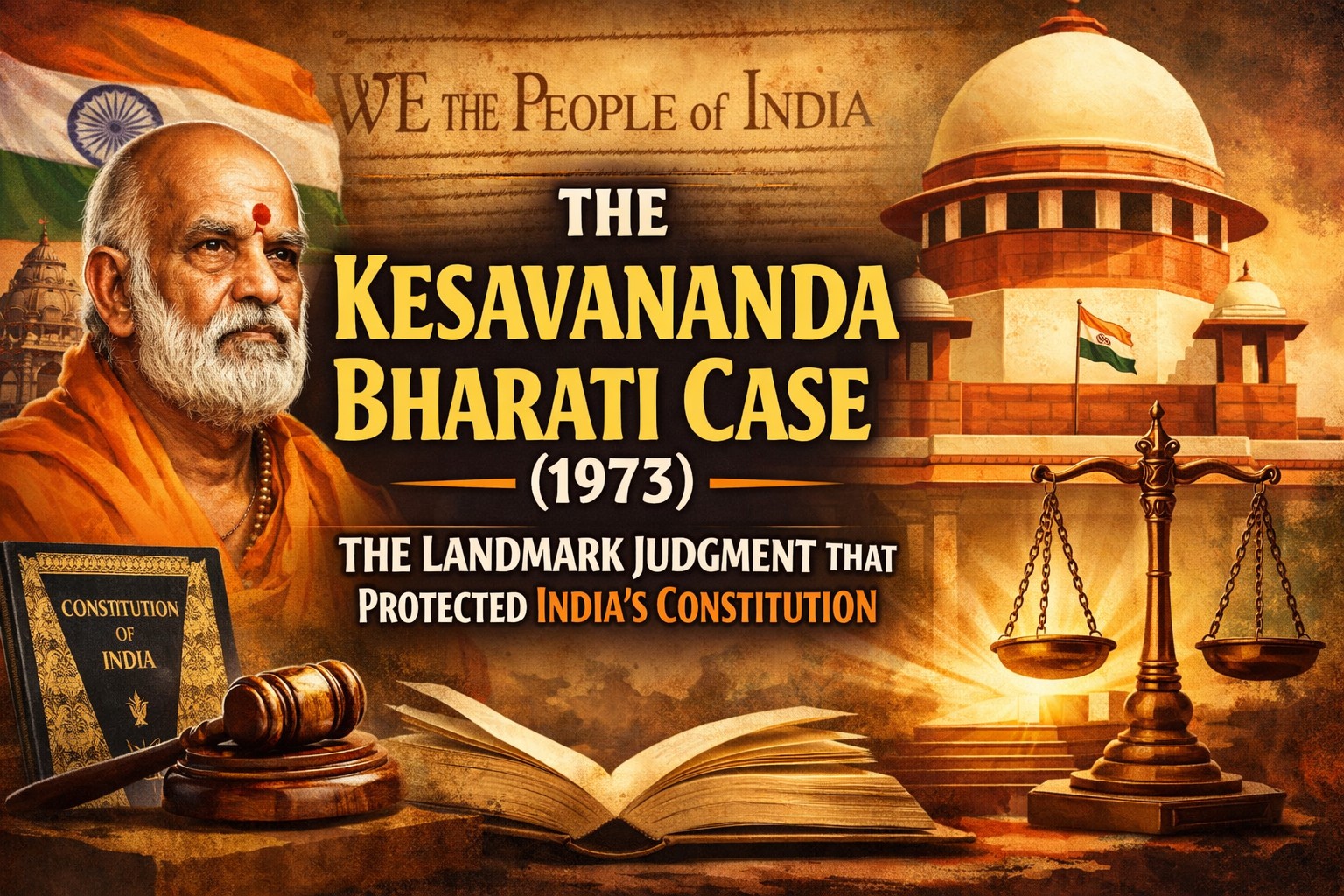
The Kesavananda Bharati Case (1973): The Landmark Judgment That Protected India’s Constitution
On April 24, 1973, the Supreme Court of India delivered a judgment that fundamentally reshaped the contours of Indian constitutional law and established a doctrine that would serve as the greatest safeguard against potential tyranny. The case of His Holiness Kesavananda Bharati Sripadagalvaru v. State of Kerala stands as one of the most significant constitutional decisions in the history of independent India, creating what is now known as the Basic Structure Doctrine—a legal principle that continues to protect the foundational integrity of the Indian Constitution to this day.[1][2]
This landmark judgment, delivered by a thirteen-judge constitutional bench after 68 days of meticulous hearing, by a narrow majority of 7:6, established that while Parliament possesses vast powers to amend the Constitution under Article 368, these powers are not unlimited. The court held that Parliament cannot alter, destroy, or emasculate the basic structure or essential features of the Constitution, even when following the prescribed procedural requirements.[3]
Historical Background and Legal Context
The Petitioner and the Challenge
The petitioner in this case was His Holiness Kesavananda Bharati, the principal of an educational institution in Edneer, Kerala. In 1970, he challenged the validity of the Kerala Land Reforms Amendment Acts of 1969 and 1971, contending that certain provisions of these acts violated his fundamental rights as guaranteed under Articles 14 (right to equality), 19(1)(f) (right to property), 25 (freedom of religion), and 26 (right to manage religious affairs) of the Constitution.[4]
However, while this petition was pending before the Supreme Court, Parliament passed three significant constitutional amendments—the Constitution Twenty Fourth, Twenty Fifth, and Twenty Ninth Amendment Acts—all of which were passed during a period of significant political tension and legislative activity aimed at expanding governmental powers.[5]
The Preceding Constitutional Controversy
To understand the significance of the Kesavananda judgment, one must appreciate the constitutional turmoil that preceded it. The issue of whether Parliament could amend fundamental rights had been a matter of considerable judicial debate since the inception of the Constitution.
In Sankari Prasad v. Union of India (1951), the Supreme Court held that the word “law” in Article 13(2) referred only to ordinary legislation, not constitutional amendments. This implied that Parliament could amend fundamental rights under Article 368.[6]
This position was reaffirmed in Sajjan Singh v. State of Rajasthan (1965), where the Court took the view that Article 368 plainly empowered Parliament to amend all provisions of the Constitution.
However, the situation changed dramatically in Golaknath v. State of Punjab (1967), where the Supreme Court, by a majority of 6:5, held that amendments to the Constitution were “law” within the meaning of Article 13(2), and therefore, if an amendment took away or abridged fundamental rights, it would be void. This decision essentially reversed the earlier position and declared that Parliament had no power to amend fundamental rights.[7]
Parliamentary Response and the Constitutional Amendments of 1971
The Golaknath decision created a constitutional crisis, as it seemed to paralyze Parliament’s ability to pursue socio-economic reforms. In response, Parliament passed three constitutional amendments in quick succession in 1971:
The Constitution (Twenty Fourth) Amendment Act, 1971: This amendment explicitly stated that Parliament could amend any provision of the Constitution under Article 368, and importantly, it added a new clause to Article 13 stating that nothing in Article 13 would apply to any amendment made under Article 368. This was a direct legislative overrule of the Golaknath decision.[8]
The Constitution (Twenty Fifth) Amendment Act, 1971: This amendment was particularly controversial. It substituted the word “amount” for “compensation” in Article 31(2), and excluded the application of Article 19(1)(f) from laws made under the amended Article 31(2). Importantly, it introduced a new Article 31C, which sought to protect laws giving effect to the directive principles specified in Article 39(b) and (c) from judicial review on the ground that they violated fundamental rights.[9]
The Constitution (Twenty Ninth) Amendment Act, 1972: This amendment added the Kerala Land Reforms Acts to the Ninth Schedule of the Constitution, thereby purporting to shield them from constitutional challenge on the ground of violation of fundamental rights.[10]
These amendments collectively represented an unprecedented expansion of governmental power and a significant curtailment of judicial review. They raised the critical constitutional question that would be addressed in Kesavananda: Did Parliament have unlimited power to amend the Constitution, or were there inherent limits on this amending power?
The Core Issues Before the Court
The Kesavananda case raised several fundamental constitutional questions:
- Nature of the Amending Power: Did Article 368, as originally framed and as amended by the 24th Amendment, grant Parliament absolute and unlimited power to amend any provision of the Constitution?
- Constitutional Supremacy: Were there implied or inherent limitations on the amending power, derived from the nature of the Constitution itself, the Preamble, or other provisions?
- Basic Structure Doctrine: Could the Constitution’s essential features—its “basic structure”—be altered or destroyed by constitutional amendment?
- Fundamental Rights: Could fundamental rights be completely abrogated through constitutional amendment, or were they protected by some overarching principle?
- Judicial Review: Could the Supreme Court review constitutional amendments to determine whether they violated the basic structure of the Constitution?
- Article 31C Validity: Was Article 31C, which sought to shield laws from judicial review, constitutionally valid, or did it delegate the amending power to state legislatures?
The Judgment and the Basic Structure Doctrine
The Majority View and the Doctrine Established
By a majority of 7:6, the Supreme Court upheld the validity of the Constitution Twenty Fourth Amendment Act, but struck down significant portions of the Twenty Fifth Amendment Act, particularly Article 31C. Most importantly, the Court established that Parliament’s power to amend the Constitution under Article 368 is limited by an inherent, implied limitation: Parliament cannot alter, destroy, or emasculate the basic structure or fundamental features of the Constitution.[11]
The Chief Justice S.M. Sikri, writing for the majority in a joint opinion with Justices Shelat, Hegde, and Grover, articulated the core principle of the doctrine:
“The expression ‘Amendment of this Constitution’ in Article 368 means any addition or change in any of the provisions of the Constitution within the broad contours of the Preamble and the Constitution to carry out the objectives in the Preamble and the Directive Principles. Applied to fundamental rights it would mean that while fundamental rights cannot be abrogated reasonable abridgements of fundamental rights can be effected in the public interest.”[12]
Components of the Basic Structure
The judgment identified several fundamental features that constitute the basic structure of the Constitution and cannot be altered:
1. Supremacy of the Constitution: The Constitution is the supreme law of the land, and no amendment can undermine its overall supremacy.
2. Republican and Democratic Form of Government: The core democratic character of the Indian polity and its republican nature cannot be altered.
3. Secular Character of the Constitution: India’s secular nature and the separation of religion from state governance form part of the basic structure.
4. Separation of Powers: The distribution of powers among the legislature, executive, and judiciary, with proper checks and balances, is an essential feature that cannot be destroyed.
5. Federal Character of the Constitution: The federal structure, with the division of powers between the Union and the States, cannot be fundamentally altered.
6. Judicial Review: The power of the judiciary to review legislative and executive action, including constitutional amendments, is a basic feature.
7. Fundamental Rights and Individual Dignity: The protection of fundamental rights and the dignity and freedom of the individual form the foundational principle upon which the entire Constitution rests. This is of “supreme importance” and cannot be destroyed by any form of amendment.[13]
The Preamble as a Source of Implied Limitations
A particularly important aspect of the judgment was its recognition of the Preamble as a source of implied limitations on the amending power. The Court held that the Preamble, despite earlier decisions suggesting it was not enforceable, serves as a crucial aid to constitutional interpretation. The Preamble embodies the vision of the Constitution makers—the ideals of justice, liberty, equality, and fraternity—and amendments cannot be made that would be inconsistent with these ideals.[14]
Justice Hegde, writing separately, emphasized:
“If on reading article 368 in the context of the Constitution the word ‘amendment’ is found to be ambiguous, one can refer to the preamble to find which construction would fit in with the preamble. Therefore, the preamble of our Constitution is of extreme importance and the Constitution should be read and interpreted in the light of the grand and noble vision expressed in the preamble.”[15]
The Decision on the Constitutional Amendments of 1971
The Twenty Fourth Amendment Act
The majority upheld the validity of the Twenty Fourth Amendment Act. The Court held that this amendment did not enlarge Parliament’s amending power but merely made explicit what was implicit in the original Article 368. The amendment clarified that the source of amending power rested in Article 368 itself and made mandatory the President’s assent to constitutional amendments. These were not new powers but clarifications of existing powers within the scope of the basic structure doctrine.[16]
The Twenty Fifth Amendment Act
The judgment had a more nuanced approach to the Twenty Fifth Amendment. The Court upheld the first part of the amendment (Section 2), which substituted the word “amount” for “compensation” in Article 31(2). However, the Court imposed a significant limitation: the “amount” could not be arbitrary, illusory, or shocking to judicial conscience. The amount must have a reasonable relationship to the value of the property being acquired, and the courts retained the power to review whether the principles for determining the amount were relevant to the subject matter.[17]
However, the Court struck down Article 31C as unconstitutional. The majority held that Article 31C, by delegating to state legislatures the power to make laws that could abrogate fundamental rights, effectively delegated the constitutional amending power to state legislatures, which violated the basic structure doctrine. Article 368 exclusively vests the amending power in Parliament, and this power cannot be delegated. Furthermore, even that part of Article 31C which purported to immunize laws from judicial review on the ground that they do not give effect to the directive principles was held unconstitutional because it allowed laws to abrogate fundamental rights with complete immunity from judicial scrutiny.[18]
The Twenty Ninth Amendment Act
The Court held that the Twenty Ninth Amendment Act, which added the Kerala Land Reforms Acts to the Ninth Schedule to shield them from constitutional challenge, would be ineffective if those acts actually abrogated or took away fundamental rights. In other words, the basic structure doctrine operates as a sword that cuts through even the Ninth Schedule immunity if the laws violate the basic structure.[19]
The Rationale and Constitutional Philosophy
Implied Limitations and Constitutional Interpretation
A central aspect of the judgment’s reasoning was the recognition of implied limitations on constitutional powers. The Court emphasized that in a written Constitution, not everything is expressly stated. Powers and limitations can be implied from the necessity of the situation or from the overall scheme of the Constitution.[20]
Justice Hegde and Mukherjea, writing separately, articulated this principle eloquently:
“A Constitution is expected to endure for a long time. Therefore, it must necessarily be elastic. Society cannot be placed in a strait jacket. When society grows, its requirements change. The Constitution and the laws may have to be changed to suit those needs. No single generation can bind the course of generations to come. Hence every Constitution wisely drawn up provides for its own amendment. However, such amendment should be within the limits of the Constitution itself.”[21]
The Tension Between Parliamentary Sovereignty and Constitutional Supremacy
The judgment grappled with a fundamental tension in constitutional democracies: the tension between parliamentary sovereignty and constitutional supremacy. The Court recognized that while Parliament is the representative of the people and has vast powers, it is not sovereign in the unlimited sense. Rather, Parliament derives its powers from the Constitution and must exercise them within constitutional limits.
Justice Hegde emphasized that:
“The amending body has been created by the Constitution itself. It can only exercise those powers with which it has been invested and if that power has limits it can be exercised only within those limits.”[22]
The Principle of Continuity and Identity
The Court held that constitutional amendments must maintain the continuity and identity of the Constitution itself. While the Constitution is meant to be flexible and capable of adapting to changing times, this flexibility cannot extend to the destruction of its fundamental character. The Constitution must remain “the Constitution” referred to in Article 368—the same instrument in substance and essential nature, even if modified in details.[23]
Judicial Review and the Role of the Courts
A crucial aspect of the judgment was the reaffirmation and indeed strengthening of the doctrine of judicial review. The Court held that:
- Judicial review is itself a part of the basic structure of the Constitution and cannot be abrogated.
- The courts have the right and duty to review constitutional amendments to determine whether they violate the basic structure.
- This judicial review does not make the system “undemocratic” because the Constitution itself, through its provisions on judicial appointment, the exclusion of the due process clause in Article 21, and other mechanisms, has built in safeguards to prevent arbitrary exercise of judicial power.[24]
The judgment thus rejected the argument that judicial review of constitutional amendments was contrary to democratic principles. Instead, the Court articulated the view that a written Constitution with a Bill of Rights necessarily implies a mechanism for protecting those rights even against constitutional amendments. This is essential to the concept of constitutionalism itself.[25]
Impact and Legacy of the Kesavananda Decision
Immediate Constitutional Consequences
The Kesavananda judgment created a new constitutional equilibrium. While it overruled Golaknath and recognized Parliament’s broad power to amend the Constitution, it also established a restraint on that power that had not existed before. This was a delicate balance that acknowledged both the need for constitutional flexibility and the need for constitutional stability.[26]
The decision provided a framework for evaluating future constitutional amendments. Any amendment that came before the Court could now be tested against the basic structure doctrine. If it violated the basic structure, it could be declared void, despite having been passed through the prescribed constitutional procedure.
Subsequent Judicial Development
The basic structure doctrine has been refined and expanded through subsequent cases:
Minerva Mills v. Union of India (1980): This case confirmed and strengthened the basic structure doctrine. The Court held that certain provisions of the 42nd Amendment that sought to curtail judicial review violated the basic structure and were unconstitutional.[27]
I.R. Coelho v. State of Tamil Nadu (2007): This landmark case applied the basic structure doctrine to laws included in the Ninth Schedule, holding that even Ninth Schedule laws could be struck down if they violated the basic structure. This significantly enhanced the scope of judicial review.[28]
S. Chandra Kumar v. Union of India (1997): The Court held that high courts have the power to review state legislatures’ laws for constitutional validity, and this power of judicial review by all courts is a basic feature of the Constitution.[29]
Global Constitutional Significance
The basic structure doctrine has gained recognition beyond India’s borders. It has influenced constitutional jurisprudence in Bangladesh, Pakistan, and Uganda. The doctrine represents an important contribution to global constitutionalism, demonstrating how a written constitution with a bill of rights can protect its own fundamental features even against attempts at formal amendment.[30]
Justice Hans Raj Khanna, who had proposed the basic structure doctrine, argued that the Constitution contains certain inherent principles and values that reflect the vision of the Constitution makers. These cannot be altered without destroying the Constitution’s very identity. This principle now stands as one of the pillars of Indian constitutional law.
Criticisms and Challenges to the Doctrine
The basic structure doctrine has faced criticism for being vague and uncertain. Critics argue that the identification of what constitutes the “basic structure” is left to the courts, which could lead to arbitrary and unpredictable judicial decisions. The doctrine’s open-ended nature—where new features can be identified as “basic” in each case—has been criticized as giving excessive discretion to the judiciary.[31]
Some argue that the doctrine is counter-majoritarian, allowing unelected judges to override the will of Parliament even when expressed through the prescribed constitutional procedure. This raises concerns about democratic legitimacy and whether the judiciary should have such extensive power to review constitutional amendments.[32]
Practical Implementation Challenges
The application of the basic structure doctrine has proven challenging in practice. Different benches have sometimes disagreed on what features constitute the basic structure, leading to inconsistency in judicial decision-making.
Conclusion: The Constitutional Legacy of Kesavananda
The Kesavananda Bharati judgment of 1973 stands as a watershed moment in Indian constitutional history. By establishing the basic structure doctrine, the Supreme Court created a constitutional mechanism to protect the fundamental features of India’s Constitution against potential legislative excess. The judgment represents a careful balance between the need for constitutional flexibility and the imperative of constitutional stability.[33]
The doctrine embodies the principle that while those entrusted with constitutional amendment powers must have the flexibility to adapt the Constitution to changing times and to pursue legitimate socio-economic reforms, they cannot use these powers to destroy the Constitution’s essential character or to transform it into an instrument of authoritarianism.
The judgment’s emphasis on the dignity and freedom of the individual, on democratic governance, on the rule of law, and on judicial review as protections against arbitrary power reflects a profound constitutional philosophy. As the Constitution makers themselves understood, the Constitution is not merely a political document but a social and legal instrument designed to protect human dignity and establish a framework for democratic governance.
Over five decades since its judgment, the basic structure doctrine continues to serve as India’s most important constitutional protection against potential tyranny. The Kesavananda decision remains relevant in contemporary constitutional debates about the limits of constitutional amendment, the role of the judiciary, and the meaning of constitutionalism itself. In an era when constitutional amendments are used to expand governmental powers, the basic structure doctrine stands as a testament to the principle that there are limits beyond which even constitutional amendments cannot go.
The brilliance of this judgment lies in its recognition that a Constitution must be both flexible and stable—capable of adapting to new circumstances while protecting its essential features. This is the legacy of Kesavananda Bharati v. State of Kerala.
[1] His Holiness Kesavananda Bharati Sripadagalvaru v. State of Kerala, [1973] Supp. S.C.R. 1. Supreme Court of India, April 24, 1973.
[2] Wikipedia. (2007). Kesavananda Bharati v. State of Kerala. Retrieved from Wikipedia.
[3] The Law Easy. (2025). Kesavananda Bharati Judgment – Basic Structure Doctrine Explained. https://www.thelaweasy.com/kesavananda-bharati-judgment
[4] Kesavananda Bharati v. State of Kerala case files and petition documents.
[5] PWOnlyIAS. (2024). Constitutional Amendments and their Impacts on the Constitution. Retrieved from https://pwonlyias.com/upsc-notes/constitutional-amendments-fundamental-rights-india/
[6] Sankari Prasad v. Union of India, [1952] S.C.R. 89. Supreme Court of India, 1951.
[7] Golaknath v. State of Punjab, [1967] 2 S.C.R. 762. Supreme Court of India, 1967.
[8] Wikipedia. (2013). Twenty-fourth Amendment of the Constitution of India. Retrieved from Wikipedia.
[9] EBC India. (n.d.). The Constitution 24th Amendment Act and 25th Amendment Act. http://ebc-india.com/lawyer/articles/71v2a3.htm
[10] Kesavananda Bharati case documents on the Twenty Ninth Amendment Act.
[11] His Holiness Kesavananda Bharati Sripadagalvaru v. State of Kerala, [1973] Supp. S.C.R. 1.
[12] Kesavananda case judgment, cited by S.M. Sikri, C.J.
[13] Ibid., on the basic structure components.
[14] Ibid., discussion of the Preamble’s role.
[15] Kesavananda judgment, Justice Hegde’s separate opinion.
[16] Ibid., on the validity of the 24th Amendment.
[17] Ibid., on Article 31(2) and the meaning of “amount.”
[18] Ibid., on the unconstitutionality of Article 31C.
[19] Ibid., on the Twenty Ninth Amendment Act and Ninth Schedule.
[20] Kesavananda Bharati judgment on implied limitations.
[21] Justice Hegde and Mukherjea separate opinion in Kesavananda case.
[22] Ibid.
[23] Ibid., on the principle of constitutional continuity.
[24] Kesavananda judgment on judicial review as a basic feature.
[25] Ibid., discussion of constitutionalism.
[26] Drishti Judiciary. (2023). Doctrine of Basic Structure. Retrieved from https://www.drishtijudiciary.com/doctrines/constitution-of-india-doct/doctrine-of-basic-structure
[27] Minerva Mills v. Union of India, [1980] 1 S.C.R. 206. Supreme Court of India, 1980.
[28] I.R. Coelho v. State of Tamil Nadu, (2007) 2 S.C.R. 287. Supreme Court of India, 2007.
[29] S. Chandra Kumar v. Union of India, [1997] 3 S.C.R. 261. Supreme Court of India, 1997.
[30] NextIAS. (2025). Doctrine of Basic Structure – Meaning, Evolution & Criticism. Retrieved from https://www.nextias.com/blog/basic-structure-doctrine/
[31] IPLeaders. (2023). Basic Structure Doctrine. Retrieved from https://blog.ipleaders.in/basic-structure-doctrine/
[32] Ibid.
[33] VajiraMandravi. (2026). Keshavananda Bharati Case 1973, Summary, Impacts. Retrieved from https://vajiramandravi.com/upsc-exam/kesavananda-bharati-case/