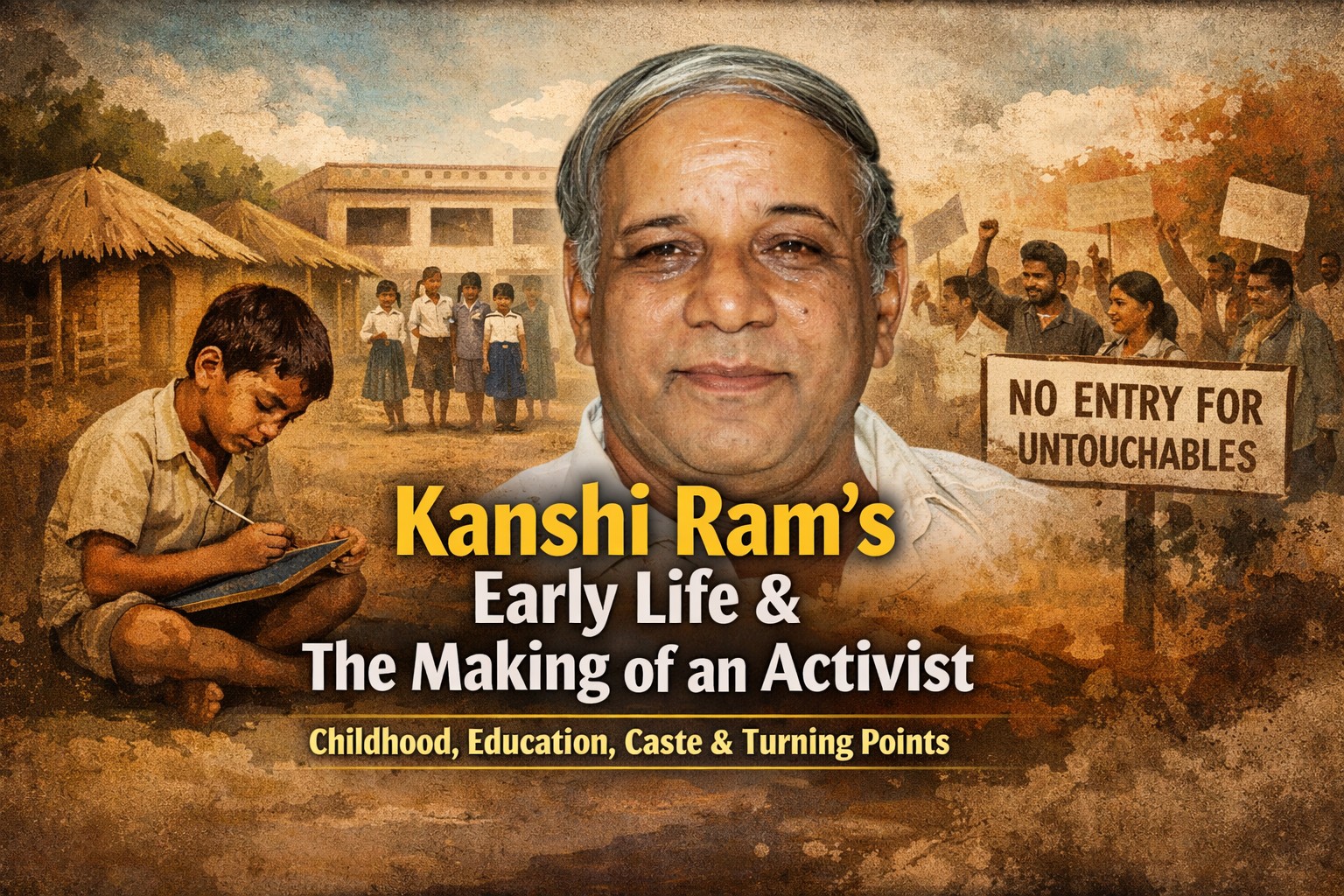
Kanshi Ram’s Early Life and the Making of an Activist: Childhood, Education, Caste, and Turning Points
Overview
Kanshi Ram (1934–2006) is widely regarded as the most influential Downtrodden (Dalit)–Bahujan political organiser after B.R. Ambedkar, yet his childhood, student days and early working life are often treated only as a prelude to his later role as founder of BAMCEF, DS-4 and the Bahujan Samaj Party (BSP).[1][2]
A closer look at his formative years shows how the social world of rural Punjab, the experience of education as a Downtrodden (Dalit), and the shock of caste discrimination in a central government laboratory gradually transformed a quiet, sports‑loving science graduate into a full‑time anti‑caste activist and political strategist.[3][4]
This article traces three interlinked themes: his childhood and family background; his education and early professional life; and the specific ways in which caste realities, discrimination and personal turning points shaped his worldview and pushed him towards activism.
It shows that while Kanshi Ram did not face the most brutal, everyday untouchability in his earliest years, he slowly came to recognise both the hidden humiliations endured by his family and the structural nature of caste power, especially once he entered state institutions as an educated employee.[4][1]
His journey from a relatively protected Ramdasia Sikh childhood to militant Bahujan politics demonstrates how individual experiences can intersect with broader historical currents to produce a distinctive style of movement‑building.
Family roots and early social world
Birth in a Ramdasia Sikh family
Kanshi Ram was born on 15 March 1934 in Pirthipur Bunga, near Khawaspur, in the Ropar (now Rupnagar) district of Punjab, then part of British India.[2][1][3]
His family belonged to the Ramdasia section of the Chamar caste, a Downtrodden (Dalit) community traditionally associated with leather work but in Punjab significantly represented among Sikhs due to large‑scale conversions over the preceding centuries.[1][4]
Several accounts describe the family as “relatively well‑off” by local Downtrodden (Dalit) standards: his father owned some land and many male relatives were in the armed forces, giving the household both a modest economic base and a strong martial ethos.[5][4]
This background meant that, unlike many landless Downtrodden (Dalit) families, they were not completely dependent on upper‑caste landlords in everyday life, even though they remained socially stigmatised by caste.[5][4]
A popular anecdote explains his name: he was reportedly called “Kanshi” because the midwife placed him in a tray made of kansa (bell‑metal) just after his birth, an image that later biographers use to symbolise his emergence from humble, village circumstances.[5]
Whether or not this story is literally accurate, it underlines how his followers sought to root his life narrative in ordinary Downtrodden (Dalit) rural experience rather than in elite urban milieus.
The Ramdasia Sikh context
Kanshi Ram’s parents were part of a wider pattern in Punjab where Downtrodden (Dalit) communities such as Chamars had embraced Sikhism in search of spiritual equality and some degree of social mobility.[4][1]
In an interview later cited by political scientist Christophe Jaffrelot, Kanshi Ram remarked that the egalitarian teachings of the Sikh gurus meant that Chamars who became Sikhs enjoyed relatively more upward mobility and faced less open discrimination than their Hindu counterparts.[1]
This did not mean that caste had disappeared; rather, it was often mediated through religious and regional specificities.
Being from a Sikh family and from a household with links to the army meant that as a child he did not always experience the overt everyday humiliations that marked Downtrodden (Dalit) lives elsewhere, and in some accounts he even recalled being largely unaware of his caste identity during his earliest school years.[1][5]
But as his later reflections make clear, this partial insulation actually sharpened his shock when he later encountered blatant caste prejudice within ostensibly modern, state‑run institutions.
Childhood temperament and interests
Biographical sketches note that Kanshi Ram was energetic, determined and fond of physical activity from a young age, developing a particular love for kabaddi and wrestling, popular sports in rural Punjab.[3][2]
Such interests not only reflected the sports culture of his milieu but also honed his stamina, discipline and competitive spirit—qualities that would later become crucial to his gruelling routine of constant travel and cadre‑building across India.[2][4]
His later admirers often cite an early self‑description in which he said he was “born and brought up among those who sacrificed themselves but never betrayed the country,” a reference to both the military tradition in his extended family and the patriotic self‑image cultivated in many Sikh households.[5]
This self‑image of sacrifice and loyalty to a collective cause would be reoriented decades later from the nation‑state in the abstract to the “Bahujan”—the oppressed majority of Downtrodden (Dalit), Adivasis, Other Backward Classes and minorities—in his political vocabulary.[4][1]
Schooling and early encounters with caste
Primary education and village schools
Kanshi Ram’s early education took place in local government schools in and around his village in Ropar district.
Sources mention Government Primary School at Milakpur and a government primary school at Malkapur (often treated as variant spellings of the same locality) located around two kilometres from his village as among his first schools.[3][2][4]
The journey to school on foot, typical of rural children at the time, already reflected a modest but determined investment in education by his family.
At these village schools he first encountered the subtle and not‑so‑subtle ways in which caste entered everyday institutional life.
A detail recurring in multiple accounts is that Downtrodden (Dalit) students were required to drink water from a separate pot, physically segregated from that used by non‑Downtrodden (Dalit) children.[2][3][4]
This practice, routine for upper‑caste teachers and students, quietly communicated to Downtrodden (Dalit) children that their bodies were considered polluting, even in a government school ostensibly open to all.
Discrimination by teachers and peers
Badri Narayan’s biography, drawing on Kanshi Ram’s own recollections, emphasises that caste discrimination at school came primarily through the attitudes of teachers and the enforcement of small but symbolically powerful rules, such as maintaining segregated water arrangements or making Downtrodden (Dalit) children sit separately.[4]
Although he was intelligent and did reasonably well in his studies, he had to navigate a classroom environment where teachers seldom challenged casteist behaviour and often reproduced it.[4]
These formative experiences did not immediately turn him into an activist, but they planted two enduring impressions.
First, that the state’s modern institutions—schools, offices, public works—were not automatically egalitarian; the prejudices of dominant castes travelled into them and reshaped their everyday functioning.[2][4]
Second, that humiliation could be normalised so thoroughly that even victims internalised it as “the way things are,” a realisation that would later inform his emphasis on consciousness‑raising among educated Downtrodden (Dalit) and Bahujans.
The canal guest‑house incident and his father’s humiliation
One episode from his school days, which he narrated later in life, had a deep emotional impact on him.
While he was still a student, his mother once asked him to carry food to his father, who was doing “begaar”—unpaid or underpaid menial labour—at the Ropar Canal Guest House.[4]
On reaching the guest house in the intense summer heat, he found his father drenched in sweat, manually pulling the rope of a hand‑operated fan to cool a senior officer sleeping inside.[4]
Kanshi Ram reportedly urged his father to rest or at least hold a small fan to cool himself with his other hand, but his father refused, explaining that he could be punished if the officer woke up and found the fan not working smoothly.[4]
For Kanshi Ram, the scene crystallised the relation between caste, power and labour: his father’s body was expendable, his exhaustion invisible, and his dignity subordinated to the comfort of an upper‑caste official.[4]
This incident revealed to him that even the limited landownership and army connections his family enjoyed did not shield them from being treated as inferiors by state officials.
Later Ambedkarite and Marxian writings would provide a vocabulary—“exploitation,” “begaar,” “oppression”—for what he had intuitively grasped that day: that caste was not only a matter of ritual pollution but also a system of economic domination and enforced servility.[4]
Higher education and a scientific career path
Secondary schooling and college education
After his primary schooling, Kanshi Ram studied at other institutions in the region, at one point attending an Islamiya school and later a DAV school, which provided exposure to diverse religious and cultural milieus.[3][2]
These experiences broadened his horizons beyond his village and acquainted him with different strands of reformist thought, though at this stage he was not yet involved in political activism.
He went on to join Government College, Ropar, where he studied science.
In 1956 he graduated with a Bachelor of Science (BSc) degree, a significant achievement for a Downtrodden (Dalit) youth from rural Punjab in the 1950s and one that opened up avenues into technical and scientific employment in the central government sector.[1][5][3]
Contemporary reports emphasise that his success was due less to privileged schooling and more to personal effort and the support of a family that valued education as a route out of traditional caste occupations.[5][2]
Training, examinations and early postings
After graduation, Kanshi Ram appears to have attended a staff college in Dehradun for further training, and he also prepared for the Public Service Commission examinations, at one stage working with the Geological Survey of India.[3][2]
These moves reflected the emergence of a new generation of Downtrodden (Dalit) youth trying to enter government service, taking advantage of reservation policies and post‑independence expansion of the state apparatus.
Within a short period he secured a position connected to the defence establishment.
One account notes that he initially joined the Survey of India on a reserved post and, in 1958, transferred to the Department of Defence Production as a scientific assistant in a munitions factory.[5]
More widely cited is that in 1957 he joined the High Energy Materials Research Laboratory in Poona (later renamed the Explosives Research and Development Laboratory, ERDL) as part of the research staff or as a junior scientist.[6][2][1][3]
Move to Poona and the Maharashtra context
The move from rural Punjab to Poona (Pune) in Maharashtra marked a decisive shift in his social and intellectual environment.
Maharashtra in the late 1950s and early 1960s was a centre of Ambedkarite activism, with strong networks of Downtrodden (Dalit) organisations, educational institutions founded by Ambedkar (such as the People’s Education Society) and, a little later, militant cultural groups like the Dalit Panthers.[7][4]
As a government scientist in Poona, Kanshi Ram was thus exposed to two contrasting worlds.
On the one hand, the world of modern science, research and defence technology, which projected itself as meritocratic and rational; on the other, a vibrant culture of Downtrodden (Dalit) assertion that questioned caste hierarchy and demanded social justice.[8][7][3]
At first he seems to have kept a distance from organised politics, focusing on his career, but the very institutions that represented modernity would soon confront him with explicit caste discrimination.
First direct encounters with institutional caste discrimination
Early impressions: limited discrimination in childhood versus shock in service
According to the Wikipedia entry drawing on interviews and secondary literature, Kanshi Ram later reflected that he had not experienced very severe caste discrimination in his childhood and youth, in part because he grew up in a Sikh family whose religious culture emphasised equality.[1]
He told Christophe Jaffrelot that “the teachings of the Sikh gurus were more egalitarian” and that converted Chamars like his family had enjoyed some degree of upward mobility.[1]
This relative insulation meant that when he encountered overt and crude caste prejudice within what he had expected to be a modern, rule‑bound scientific workplace, the shock was particularly intense.
In his own narrative, it was only in Poona—within the supposedly meritocratic defence research establishment—that he became fully aware of how deeply caste structured opportunities, recognition and basic respect.[5][1]
The Ambedkar–Buddha Jayanti holiday controversy
One of the most widely cited turning points in his life was a dispute over holidays commemorating B.R. Ambedkar and the Buddha at his laboratory.
At ERDL, Ambedkar Jayanti and Buddha Jayanti had been observed as holidays, but at some point in the late 1950s these were replaced by holidays for upper‑caste nationalist leaders like Bal Gangadhar Tilak and Gopal Krishna Gokhale.[9][3]
Upper‑caste employees quietly accepted the change, but Downtrodden (Dalit) staff saw it as a symbolic attack on their icons and assertion.[9][3]
Most Downtrodden (Dalit) employees, particularly those in lower grades, lacked the confidence or organisational backing to challenge the decision.
A Class IV Downtrodden (Dalit) employee named Deena Bhan (also written Dinabhana) protested and was suspended from service on grounds of misconduct.[6][9][3]
While many seniors stayed silent, Kanshi Ram, then in a relatively higher position, decided to support him, treating the issue not as a minor administrative matter but as a fundamental question of dignity and recognition.[9][3]
Kanshi Ram and his allies took the matter beyond the laboratory management, approaching the then Defence Minister Yashwantrao Chavan.
An inquiry was ordered, the cancellation of Ambedkar and Buddha Jayanti holidays was reversed, and Deena Bhan’s case became known among Ambedkarites as an example of successful resistance to institutional caste bias.[10][9][3]
For Kanshi Ram, the episode revealed both the vulnerability of Downtrodden (Dalit) employees in government service and the power of collective protest when backed by higher‑level political pressure.
The Deena Bhan case as moral and political awakening
The Deena Bhan episode is frequently described as the incident that catalysed Kanshi Ram’s break with a conventional career‑oriented life and propelled him toward activism.
Several sources state that he resigned his government post after becoming involved in this case, disillusioned by the casteist behaviour of his colleagues and superiors and angered by the way an honest Downtrodden (Dalit) worker had been victimised for defending Ambedkar’s honour.[6][9][5]
Whether his resignation followed immediately or after a few more years of service, all accounts agree that the case transformed his understanding of the state.
He realised that government institutions, despite constitutional safeguards, could be spaces where caste dominance was reasserted through control over symbols, holidays, promotions and disciplinary powers.[9][3]
His later emphasis on building strong organisations outside the formal state, capable of pressurising it from below, can be traced back to this experience of how vulnerable isolated Downtrodden (Dalit) employees were within the bureaucracy.
Reading Ambedkar and discovering a language for injustice
Around this time, admirers and biographical notes state that Kanshi Ram read Ambedkar’s famous text “Annihilation of Caste,” which provided him with a powerful intellectual framework to interpret what he was witnessing.[11][1]
Ambedkar’s argument that caste was not merely a social custom but a structural system of graded inequality resonated with his experiences in school and in the laboratory, where each caste location carried specific expectations and limits.[1]
Reading Ambedkar helped Kanshi Ram to connect the humiliation of his father in the canal guest house and the victimisation of Deena Bhan in ERDL with a larger historical pattern, rather than treating them as isolated injustices.[1][4]
It was also in Maharashtra that he encountered the living legacy of Ambedkar in the form of organisations, periodicals, songs and public commemorations, deepening his conviction that only organised, politically conscious struggle could counter caste domination.[7][4]
Personal struggles and inner transformations
Clash between career ambitions and moral outrage
Before these experiences, Kanshi Ram appears to have shared the aspirations of many first‑generation Downtrodden (Dalit) graduates of his time: securing a stable government job, supporting his family and possibly rising within the bureaucracy.
As a trained scientist in a defence laboratory, he occupied a relatively prestigious position compared to most people from his village.[3][5]
The Deena Bhan episode, however, posed a moral dilemma.
Supporting a suspended Class IV employee against the management risked his own career; remaining silent would have meant accepting a blatant insult to Ambedkar and to Downtrodden (Dalit) dignity.[9][3]
His decision to stand with Deena Bhan, and eventually to give up his own secure job, reveals the beginning of a shift from an individual strategy of advancement to a collective, movement‑oriented perspective.
This inner transformation was not accomplished overnight.
Accounts suggest that over several years he observed repeated instances of discrimination: Downtrodden (Dalit) workers being denied promotions, qualified Downtrodden (Dalit) women being refused appointments, and pressure on Dalit staff to stay away from trade unions or political activity.[9]
Each such incident chipped away at his faith in gradual, individual progress within existing structures and reinforced his sense that a more radical reorientation was necessary.
Emotional impact of humiliation and solidarity
The emotional dimension of these experiences was as important as the political.
Kanshi Ram had seen his father endure humiliating labour without protest for fear of reprisal; in Poona he saw a co‑worker punished for daring to protest the erasure of Ambedkar from the official calendar.[3][4]
In both cases, he confronted the pain of seeing people like himself treated as expendable and voiceless.
At the same time, the successful reversal of the holiday decision after collective action and appeal to the Defence Minister demonstrated the power of solidarity.
It showed that Downtrodden (Dalit) employees, if organised and backed by sympathetic forces, need not always suffer in silence; they could win concrete victories even within hostile institutions.[9][3]
This interplay of humiliation and empowerment fuelled his later insistence that the educated sections of the oppressed must be welded into a disciplined, mission‑oriented cadre.
Personal vows and celibate dedication
Later accounts of Kanshi Ram’s life emphasise the level of personal sacrifice he was prepared to make once he embraced activism.
A popular quotation attributed to him declares: “I will never get married, I will never acquire property, I will never visit my home, I will devote and dedicate the rest of my life to achieve the goals of the Phule–Ambedkar movement.”[7]
This statement, widely circulated among his followers, encapsulates the way his personal life became subordinated to his political mission.
Although such vows are often stylised in hagiographic narratives, they reflect the reality that he remained unmarried, lived modestly and spent decades travelling and organising rather than building a conventional family life.[7][1]
The internalisation of a quasi‑monastic ethos of service—echoing both Ambedkarite and Bhakti traditions—was itself a response to the enormity of the oppression he had witnessed and the scale of the organisational task he set himself.
From aggrieved employee to organiser of the oppressed
Early association with the Republican Party of India (RPI)
After his politicisation in Poona, Kanshi Ram initially gravitated towards the Republican Party of India (RPI), the party formed by Ambedkar toward the end of his life as a vehicle for Downtrodden (Dalit) political assertion.[1][4]
He worked with organisations linked to Ambedkar’s legacy, such as the People’s Education Society, and observed from close quarters both the possibilities and the limitations of existing Downtrodden (Dalit) politics.[4]
Over time, he became disillusioned with the RPI’s internal factionalism and its tendencies toward co‑option by the ruling Congress party.
He felt that many leaders were more interested in bargaining for positions than in building an independent, disciplined, mass‑oriented movement.[1][4]
This critique would later form the basis of his famous book “The Chamcha Age,” in which he denounced “stooge” leaders from oppressed communities who, in his view, served the interests of the upper‑caste elite.[4]
Formation of SMCEA and the seeds of BAMCEF
In 1971, in Poona, Kanshi Ram formed the All India SC/ST/OBC Minorities Communities Employees Association (often abbreviated as SMCEA), an organisation aimed not at general welfare but at politically awakening educated employees from oppressed communities.[1][4]
He had concluded from his own experience in ERDL that government employees from these backgrounds, who had benefited from reservations and education, represented a crucial potential vanguard for broader social change if they could be organised and ideologically trained.[8][4]
This association was later re‑organised and, in 1978, formally launched as the Backward and Minority Communities Employees Federation (BAMCEF).[8][1]
BAMCEF’s distinctive motto was that it was “an organisation of the employees, by the employees, but not for the welfare of the employees”—in other words, its purpose was not narrowly to improve service conditions but to transform employees into missionaries for the Phule–Ambedkar movement in their home regions.[8]
Conceptualising “non‑political roots” for political success
Kanshi Ram famously argued that those who wish to succeed politically must first build strong “non‑political roots” in society.
By this he meant an extensive network of socially conscious, ideologically committed workers embedded in various institutions—offices, schools, cooperatives—who could mobilise people beyond the electoral cycle.[8]
His own trajectory—from an individual employee shocked by discrimination to the architect of a nationwide employees’ federation—illustrates how this concept grew out of lived experience.
He had seen that isolated Downtrodden (Dalit) employees could be victimised, but that organised employees could challenge management and even influence ministerial decisions, as in the Deena Bhan case.[3][9]
BAMCEF was thus his answer to the question: how can the scattered, relatively privileged sections of the oppressed be collectivised into a force capable of reshaping politics?
From BAMCEF to DS‑4 and BSP: logical extensions of early lessons
Out of BAMCEF’s network emerged the Downtrodden (Dalit) Shoshit Samaj Sangharsh Samiti, popularly known as DS‑4, founded around 1981 as a more overtly agitational platform for the “Dalit and exploited society.”[8][1]
DS‑4 sought to take the ideas incubated within BAMCEF to the broader masses through campaigns, slogans and public actions.
Finally, in 1984, Kanshi Ram founded the Bahujan Samaj Party (BSP), explicitly aiming to convert the numerical strength of Bahujans into political power by making them aware of the “master key” of their vote.[1][4]
The journey from ERDL employee to BSP founder was not a sudden leap but the cumulative outcome of two decades of reflection on caste discrimination within state institutions, experiments with employee organising and persistent engagement with Ambedkar’s thought.
How caste realities specifically shaped his worldview
From individual injustice to structural analysis
Kanshi Ram’s own life allowed him to observe caste at multiple levels: in village schools through segregated water pots; in the canal guest‑house through his father’s unpaid labour; and in a defence laboratory through the victimisation of a colleague and the erasure of Downtrodden (Dalit) icons from official holidays.[2][3][4]
As he encountered Ambedkar’s writings and the vibrant Ambedkarite milieu in Maharashtra, he came to interpret these not as disconnected wrongs but as expressions of a systemic order of graded inequality and domination.[4][1]
This recognition pushed him beyond charity or moral reform toward the politics of power.
He concluded that unless the oppressed could control state power—or at least become a decisive force in its composition—casteist practices would continue to reproduce themselves within modern institutions regardless of constitutional ideals.[1][4]
His oft‑repeated emphasis on capturing the “master key” of political power was the political translation of this structural reading of caste.
View of the state: site of both oppression and opportunity
The Indian state, in Kanshi Ram’s eyes, was neither a neutral arbiter nor simply an enemy.
It was a contradictory space: on the one hand, it enforced caste hierarchies through biased officials, discriminatory recruitment and symbolic exclusions like the removal of Ambedkar Jayanti; on the other, it offered constitutional reservations, government jobs and legal avenues that made the rise of people like himself possible.[9][3][1]
His strategy therefore focused on transforming the social composition and consciousness of the state apparatus rather than abandoning it.
BAMCEF targeted government employees; DS‑4 and BSP sought to change who got elected to run the state; and throughout, he insisted that those who had entered the state via reservations must “pay back to society” by helping to liberate those who remained at the bottom.[8][4]
This dual view of the state—as both instrument of oppression and potential instrument of liberation—was deeply rooted in his own path from beneficiary of state employment to critic of its casteism.
Centrality of Ambedkar, Phule and the “Bahujan” idea
Kanshi Ram’s early experiences made him acutely aware that caste oppression was not confined to a single Downtrodden (Dalit) caste or region; rather, it affected a vast range of communities labelled Scheduled Castes, Scheduled Tribes and Other Backward Classes, as well as many religious minorities treated as inferior groups.[8][1]
He therefore drew on Jotirao Phule’s concept of “Bahujan”—the oppressed majority contrasted to the “Manuvadi” minority—to frame a broad alliance of castes and communities.[8][4]
Ambedkar’s insistence on annihilating caste and securing political power for the depressed classes provided Kanshi Ram with both ideological content and organisational inspiration.
The removal of Ambedkar Jayanti as a holiday in ERDL symbolised for him the upper‑caste establishment’s attempt to erase this radical legacy; restoring it became a small but significant victory in reasserting Ambedkar’s place in the public sphere.[3][9]
These influences combined to shape his worldview: caste as the central axis of Indian oppression; Bahujan unity as the path to power; and disciplined organisation as the means to realise Ambedkar’s incomplete project.
Key turning points that pushed him toward full‑time activism
1. Rural school discrimination and the canal guest‑house episode
The first cluster of turning points lay in his childhood and adolescence.
Being forced to drink from a separate water pot at school and witnessing teachers who naturalised such practices impressed upon him how early and insidiously caste shaped the psyche of children.[2][3][4]
Watching his father perform back‑breaking manual labour to fan a dozing officer at the canal guest house, unable to stop for fear of punishment, revealed the depth of servility demanded from Downtrodden (Dalit) workers in state systems.[4]
These experiences fostered in him a deep sense of injustice and a questioning attitude toward authority, even if he lacked at that stage a fully developed ideological framework.
They also produced enduring images of humiliation that he would later evoke in speeches to communicate the reality of caste to urban audiences who might otherwise treat it as an abstract concept.[4]
2. Entry into a “modern” laboratory and encounter with casteist colleagues
The second set of turning points occurred when he entered the ERDL in Poona.
Here he expected to find an environment governed by scientific norms and formal rules, but instead found that caste considerations influenced social interactions, union politics, promotions and even the celebration of holidays.[9][3][1]
He reportedly discovered that some upper‑caste colleagues, while outwardly modern and patriotic, harboured strong prejudices against Downtrodden (Dalit) and resisted any assertion of Ambedkarite identity within the institution.[3][9]
The realisation that modern education and technical expertise did not automatically eradicate casteism forced him to reconsider any naïve faith in gradual social evolution.
3. The Deena Bhan case and confrontation with management
The suspension of Deena Bhan for protesting the replacement of Ambedkar and Buddha Jayanti holidays with those of upper‑caste leaders crystallised Kanshi Ram’s emerging convictions.
Here was a concrete example of a Downtrodden (Dalit) employee punished not for incompetence but for defending the symbolic space of his community.[9][3]
Kanshi Ram’s decision to back Deena Bhan, confront the management, take the issue up to the Defence Minister and, ultimately, resign in protest, transformed him from a dissatisfied employee into a public figure within the Ambedkarite movement.[6][5][3][9]
The victory in restoring the holidays showed him that institutional decisions could be reversed when challenged by organised pressure, while his own exit underlined his unwillingness to compromise on questions of dignity.
4. Immersion in Ambedkarite literature and networks
Around the same time, Kanshi Ram’s systematic reading of Ambedkar—especially “Annihilation of Caste”—and his interaction with Ambedkarite networks in Maharashtra provided the intellectual and organisational tools to interpret his experiences.[11][1][4]
Ambedkar’s critique of caste as a system of “graded inequality” mapped perfectly onto what Kanshi Ram had observed in school, in the canal guest house and in ERDL.[1]
Participation in meetings, study circles and commemorative events also gave him a sense of belonging to a historical movement larger than his personal struggles.
The death of Ambedkar in 1956, and the perception that his political project remained incomplete, deepened his resolve to dedicate his life to carrying that legacy forward in a new phase.[7][4]
5. Disillusionment with existing Downtrodden (Dalit) parties and the decision to build new organisations
Finally, his experience within the Republican Party of India and related bodies convinced him that existing leaderships were often trapped in the logic of co‑option and patronage.
He saw that many leaders prioritised alliances with dominant parties for short‑term office over building independent power bases among the oppressed.[1][4]
This disillusionment was the immediate backdrop to his decision to form SMCEA and later BAMCEF, DS‑4 and the BSP.
In each of these initiatives, the lessons of his early life were evident: the need to anchor politics in the life experiences of the oppressed; the importance of disciplined organisation among educated employees; and the centrality of ideological clarity rooted in Ambedkar and Phule.[8][4][1]
Conclusion: From lived caste realities to a new style of Bahujan politics
Kanshi Ram’s childhood, education and early professional life chart a trajectory from relative insulation within a Ramdasia Sikh family to a radical consciousness forged in the furnace of institutional caste discrimination.
As a child he saw segregated water pots and his father’s humiliating labour for a state official; as a young scientist he witnessed the victimisation of a Downtrodden (Dalit) colleague and the erasure of Ambedkar from official recognition; as a budding activist he read Ambedkar and Phule, joined and then criticised the RPI, and finally set out to build his own organisations.[2][3][4]
Caste realities shaped his worldview in three distinct but interconnected ways.
First, they convinced him that caste was not confined to villages or rituals but permeated modern schools, offices and laboratories, making the struggle against it a central, not peripheral, task of Indian democracy.[3][9][1]
Second, they taught him that individual advancement for a few Downtrodden (Dalit) within the system was fragile and morally insufficient unless linked to a collective project of liberation for the many, leading to his emphasis on “paying back” through organised work.[5][8][4]
Third, they led him to a strategic orientation in which building non‑political roots among employees, uniting oppressed communities under the “Bahujan” banner and capturing political power through disciplined electoral mobilisation were seen as indispensable steps toward real equality.[8][4][1]
The key personal struggles and turning points of his early life—the canal guest‑house incident, school discrimination, the Deena Bhan case, his resignation from ERDL, and his break with existing Downtrodden (Dalit) parties—were not merely biographical anecdotes; they were the crucibles in which his distinctive style of Bahujan politics was forged.[9][3][4]
Out of those experiences emerged a leader who would devote his life, by his own vow, to building a movement that sought not charity or token representation but a fundamental reconfiguration of power in favour of the oppressed majority.
- Kanshi Ram – Kanshi Ram was born on 15 March 1934 into a Ramdasia Sikh family of Chamar … Kanshi Ram’s early ye…
- Kanshiram: Harbinger of change in modern Dalit history … – He grew up with a love for sports, especially kabaddi and wrestling. Kanshiram studied at the govern…
- Kanshiram’s Upper Caste Co-workers Replaced Buddha … – In 1957, Kanshiram joined the High Energy Materials Research Laboratory (renamed the Explosives Rese…
- Kanshi Ram: Leader of the masses – Born on 15 March 1934, in a “relatively well-off” family, he had his early education in the Governme…
- About Kanshi Ram Biography & Life History – Soon after his graduation, Sahib Shri Kanshi Ram Ji joined the research staff of Kirki’s Explosive R…
- “MANYAVAR KANSHI RAM SHODHPEETH” – … Kanshi Ram Ji joined the research staff of Kirki’s Explosive. Research and Development Laborator…
- Manyavar Saheb Kanshi Ram “I will never get married, … – In 1957, Kanshi Ram moved to Poona (now Pune), Maharashtra, to join the research staff at the Explos…
- Manyawar Shri Kanshi Ram Ji – … caste system. In the ordinance factory, where Kanshi Ram was working, the management cancelled t…
- Kanshi Ram gave Dalit politics ‘new Bahujan genes’. … – He started working as a junior scientist with Explosives Research & Development Laboratory (ERDL). W…
- The Miracle Of Kanshi Ram – Dalit Voice – Ambedkar Jayanti holidays were restored. This is the case which turned Kanchi Ram towards the evils …
- Kanshi Ram Facts for Kids – Kanshi Ram was born on March 15, 1934, in Ropar district, Punjab, British India. His family belonged…