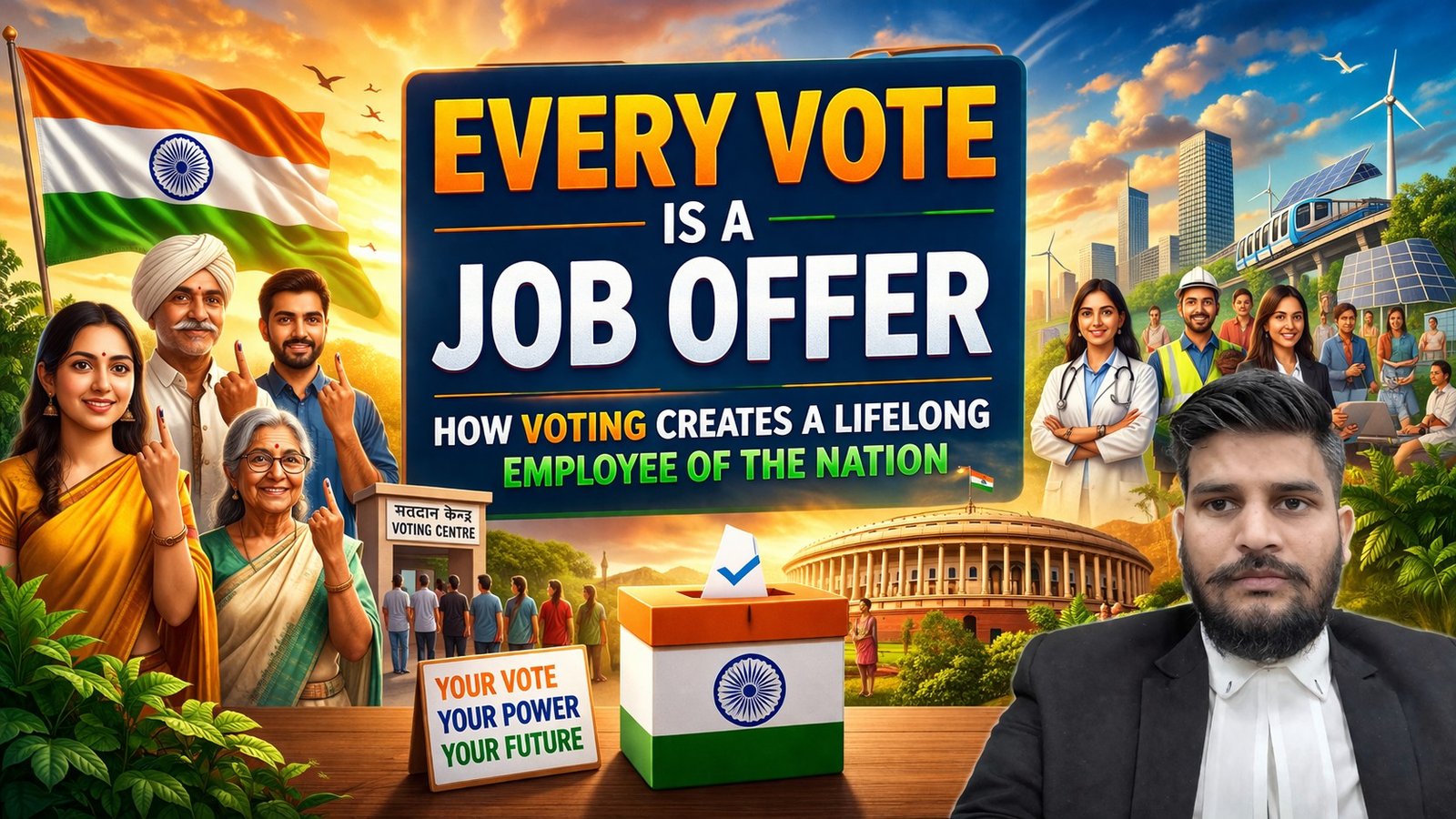
Every Vote Is a Job Offer: How Voting Creates a Lifelong Employee of the Nation
The Unseen Meaning of a Vote
Most of us are told that voting is a civic duty — a way to choose who governs us. But let’s pause for a moment and look at it from a different angle. When you cast your vote, you’re not just picking a leader; in effect, you’re offering a government job to someone. It is a position of immense responsibility, filled with privileges, benefits, and, most importantly, trust. The difference is that this “job interview” happens only once every few years — not in an office, but through the ballot box.
If you think of it this way, the entire election process starts looking quite similar to a large-scale recruitment drive. Millions of citizens collectively become a hiring committee, each voter casting one small but decisive vote of confidence. But unlike a regular hiring process, most people don’t check qualifications, work performance, or past experience; many vote casually, emotionally, or habitually. And in doing so, they may be giving a lifelong appointment to someone who might not deserve it.
The Nature of the “Government Job” We Create
An elected representative is not a volunteer; they are a paid public servant. Once they win, the nation — through taxpayers — pays their salary, provides official vehicles, accommodation, assistants, travel allowances, and countless other facilities. For an ordinary person, a government job means stability, authority, and respect. For a politician, it means all that and more — influence, decision-making power, and often benefits that continue long after their official term.
Think about it: an elected representative’s “working years” are only five, but the perks and recognition attached to that position can last a lifetime. They continue to receive protocol treatment, public acknowledgement, and often pension-like benefits. No private job in the world can guarantee such long-term security for such a short period of actual service. So every time you vote, you’re essentially signing an appointment letter that offers lifelong rewards in return for a few years of work.
The Voter as a Recruitment Board
In a corporate world, before an employee is hired, human resource departments go through interviews, background checks, reference verifications, and skill assessments. Why? Because a bad hire can harm the company’s functioning, reduce morale, or cause losses. Now imagine what happens when 125 crore voters serve as the HR department of an entire nation, but many don’t even glance at the candidate’s record.
Voting is, in principle, a recruitment test. The candidate interviews you through speeches and campaigns, promising what they can “deliver.” The voter then decides whether that person deserves to be hired for the next five years. But here’s the catch — unlike regular jobs, this one doesn’t demand advance qualifications, fixed skill tests, or post-selection monitoring. Once elected, accountability often depends on how aware and demanding employers — the citizens — remain.
So in essence, when we vote casually, we are performing a careless hiring. We hire someone without checking their résumé, reliability, or integrity. And like any bad recruitment, the cost of that decision doesn’t stay confined to one office; it affects millions.
A Job with Lifelong Benefits
Let’s imagine two people of the same age — one becomes a government employee through a hard-fought exam, the other becomes an elected representative through votes. The first works tirelessly for decades, climbing ranks, retiring after 30 or 35 years of service, and then getting a modest pension. The second works for just a five-year term but walks away with lifelong social recognition, taxpayer-funded benefits, and sometimes even security and housing privileges that never completely fade.
This is why the comparison with a “government job” is more realistic than metaphorical. The difference is not in formality; it’s in the structure of reward versus effort. A single term of winning an election transforms a person’s social and financial position permanently. And it all begins with the decision of one voter, multiplied by millions.
So the next time you think of elections as a distant political exercise, remember that you’re part of a recruitment board giving out lifetime employment — where the chosen employee gets all the benefits, even if they work sincerely for only a few years.
The Power of a Casual Vote
Many voters walk into polling booths casually, thinking: “It’s one vote; what difference does it make?” But imagine a company that hires thousands of employees by taking random opinions instead of evaluating competence. Would you trust such a company’s future? The same logic applies to democracy.
Every careless vote contributes to appointing someone who will enjoy lifetime privileges at public expense. Their decisions, diligence, and ethics will shape the quality of governance — and yet, the process of choosing them often happens without due thought. When such a person underperforms, the public bears the consequences, just as shareholders suffer when a company’s management fails.
If we link voting habits to the idea of recruitment, the seriousness of the task becomes clearer. A casual vote isn’t an expression of freedom; it’s a misuse of responsibility, leading to an undeserving job appointment.
The Merit Test That Never Happens
When we apply for a job, employers ask for degrees, references, track records, and past achievements. Shouldn’t we, as voters, demand the same from our candidates? Curiously, democracy gives us absolute freedom to hire anyone — educated or not, ethical or not — and still expect results. But such freedom is double-edged: it empowers as much as it endangers.
The difference between a voting booth and a job interview lies not in scale but in seriousness. A company may go bankrupt because of bad hiring; a country loses years of progress for the same reason. That’s how deep the connection runs.
Every vote, therefore, becomes an instrument of judgment. You decide whether someone is competent enough to manage public funds, shape policy, and represent the collective conscience of society. But if the voter doesn’t test merit, they automatically accept mediocrity.
Employment Without Appraisal
Another striking aspect of this comparison is the absence of regular performance evaluation. In most jobs, employees are reviewed quarterly, appraised annually, and can be demoted or removed for poor performance. But elected representatives face no such routine scrutiny. Their only “review” comes after five years, and even then, emotional appeals or populist rhetoric often overshadow performance.
Imagine an organization that keeps paying salaries, allowances, and benefits to employees no matter how well or poorly they perform — wouldn’t it collapse under inefficiency? That’s what happens when citizens, the employers, stop demanding measurable outcomes from those they “hire” through their votes.
So the analogy holds tighter here — voting not only hires someone for a five-year job, it does so without setting clear performance benchmarks, making it the most trust-based employment in the world.
Short Service, Long Benefits
The unique charm of an elected position lies in its asymmetric contract. The employee — the politician — works for five years but often gains privileges for life. The employer — the voter — keeps paying indirectly through taxes and compliance, but rarely has direct control. Now imagine if private employees received lifelong benefits after working for just one contract term. It would be financially impossible — yet society sustains this model in politics because citizens rarely think of it that way.
When viewed through this employment lens, it raises an important question: if this much privilege is tied to one seat of power, shouldn’t voters act as cautious employers, hiring only after serious evaluation? The moment you internalize this perspective, voting transforms from a casual right into a moral and managerial duty.
The Cost of Wrong Hiring
Hiring mistakes are costly in every field. In a company, a wrong manager might waste money or mislead a project. In governance, a wrong representative can distort priorities for millions of citizens. The damage multiplies because, unlike companies, a country can’t simply “fire” its employee mid-term. We must wait for the next election — another five years — to correct that mistake.
This waiting period is what makes responsible voting non-negotiable. The stakes are too high because elections appoint not one but thousands of people whose single signature or policy decision can affect livelihoods, rights, and futures.
If a company must be careful before hiring a CEO, shouldn’t a nation be equally cautious before choosing its leaders?
The Most Special Job Offer
When you vote, you’re issuing the most special job letter on Earth — one with unmatched power, influence, and security. This employee doesn’t just manage an office; they shape roads, schools, hospitals, and lives. Their job description includes managing fairness, opportunity, and national well-being. The salary comes from collective contribution — your taxes, your compliance, your trust.
In return, they owe you service, not dominance; representation, not exploitation. The problem begins only when the employer — the citizen — forgets the nature of this contract and treats voting as casual, or worse, emotional. Once you see it as a hiring process, everything changes.
You begin asking questions:
What has this person done? What will they do? Do they deserve the position?
That’s when democracy starts maturing into accountability.
Why This Perspective Matters
Viewing voting as a job offer reframes the entire democratic experience. It removes emotional biases and replaces them with evaluative thinking. You stop seeing politicians as saviors or celebrities and start seeing them as candidates for employment in your service. This change of mindset can restore seriousness to the very foundation of democracy.
When citizens evaluate leaders as employers evaluate employees, politics becomes more about performance than persuasion. Promises turn into measurable goals, and charisma gives way to competence. In short, we remove the mystery around leadership and restore professionalism in governance.
The Thought You Should Carry
So next time you go to vote, pause before pressing that button. Don’t think of it as choosing sides; think of it as signing an offer letter. You are appointing someone to manage national resources, make decisions affecting millions, and represent your interests. They may work for five years, but the job you grant them enriches them — and shapes your country — for much longer.
Every careless vote gives another undeserving person a lifelong government job. Every thoughtful one hires someone who might actually deserve it.
You are the employer; the ballot is your office. Choose wisely, because in democracy, recruitment is not just once in five years — it’s what decides the next five.