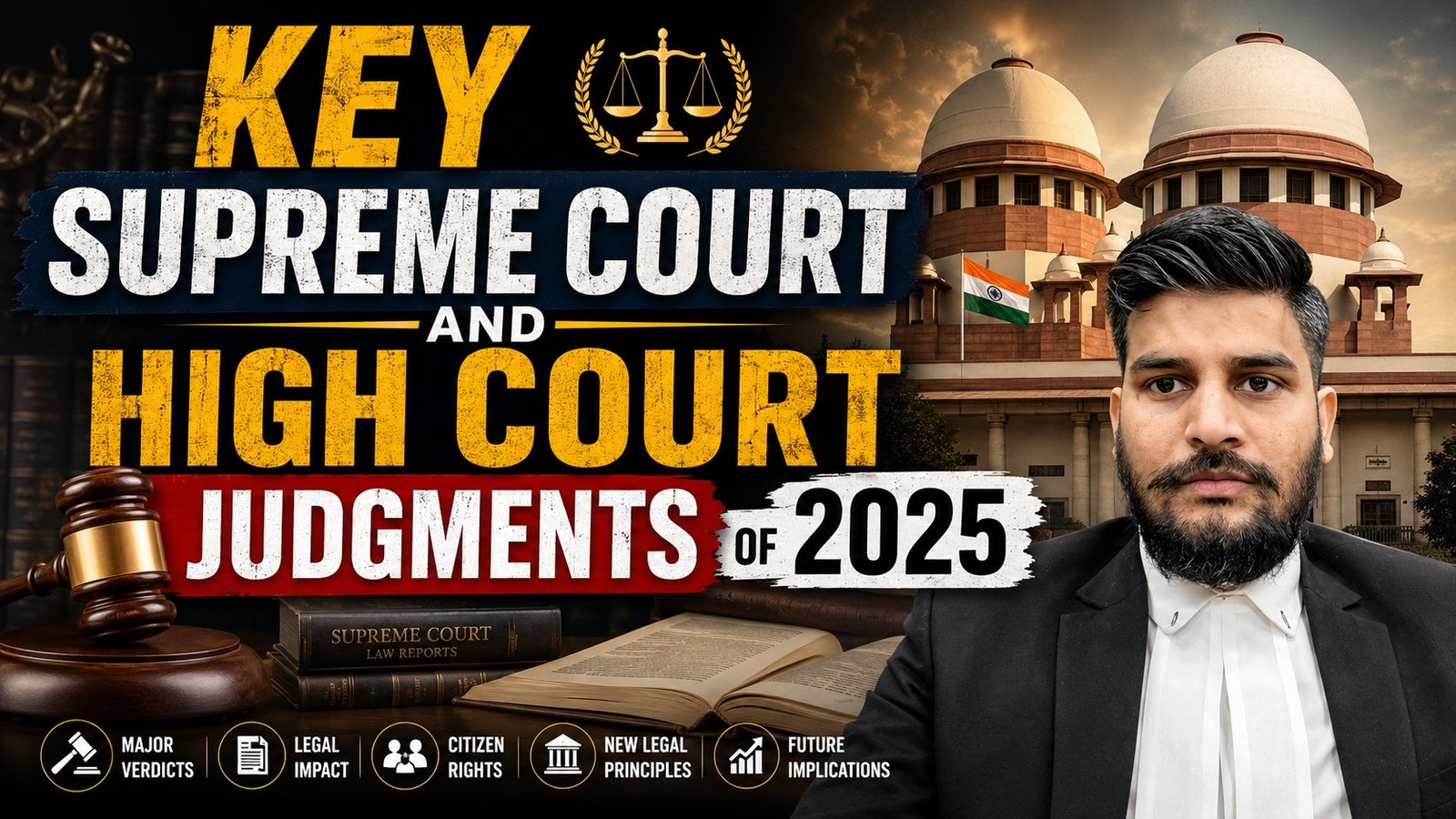
Key Supreme Court and High Court Judgments of 2025: Practical Takeaways for Indian Advocates and Law Students
| Judgment | Description |
|---|---|
| 👉 Batlanki Keshav (Kesava) Kumar Anurag v. State of Telangana & Anr, 2025 SC | The Supreme Court quashed the rape case, citing the complainant’s manipulative conduct and abuse of legal process. |
| 👉 Manzoor Ahmad Wani v. Ayaz Ahmad Raina, 2025 Jammu & Kashmir HC | The Court held that “sufficient grounds” under Order XXIII Rule 1(3)(b) Code of Civil Procedure, 1908 (CPC) must be interpreted broadly to allow withdrawal and refiling of suits in the interest of justice. |
| 👉 Under Armour INC v. Anish Agarwal, 2025 Delhi HC | The Court held that anti dissection rule is not inconsistent with ascertaining if the competing marks are similar by taking note of the dominant parts. |
| 👉 Saurabh Bhatnagar v. State of H.P. 2025 Himachal Pradesh HC | The Court stated that trial courts must not deviate from the quantity-based sentencing framework prescribed under the Narcotic Drugs and Psychotropic Substances Act, 1985 (NDPS Act), as the Legislature and Central Government have already accounted for the severity of the substance’s impact while framing the law. |
| 👉 M/S Suraj Impex (India) Pvt. Ltd. v. Union of India & Ors. 2025 SC | The Supreme Court held that the CBEC Circular dated 17th September 2010 must be applied retrospectively as it merely clarified existing notifications and did not introduce a new fiscal regime. |
| 👉 KRB Enterprises & Ors v. M/s KRBL Limited, 2025 Delhi HC | The Court held that for infringement the mark may be used in any other relation whatsoever to such goods. |
| 👉 State Represented by Inspector of Police, CBI, ACB, Vishakhapatnam v. Eluri Srinivasa Chakravarthi and others, 2025 SC | The Supreme Court held that an accused cannot be discharged under Section 239 of the Criminal Procedure Code, 1973 (CrPC) by relying on the materials submitted by the defence instead of relying on the chargesheet and list of documents submitted by the prosecution. |
| 👉 M/S Patanjali Foods Limited (Formerly Known As M/S Ruchi Soya Industries Ltd.) v. Union of India & Ors. 2025 SC | The Supreme Court held that the encashment of a bank guarantee by the Customs Department does not amount to payment of customs duty; therefore, Section 27 of the Customs Act,1962 and the doctrine of unjust enrichment do not apply, and the amount must be refunded with interest. |
| 👉 X v. FACT and Others, 2025 Kerala HC | The Court held that denial of public employment solely due to Hepatitis B infection is illegal, arbitrary, and violative of Article 14 of the Constitution of India,1950 (COI), as it amounts to unjust discrimination. |
| 👉 State v. Neeraj, 2025 Delhi HC | The Court held that the provisions under Chapter XXV including Section 328, 329 and 330 of the Criminal Procedure Code, 1973 (CrPC) are couched in mandatory language. Thus, the procedure contemplated therein is mandatory in nature…. |
These ten recent decisions collectively refine important procedural and substantive doctrines across criminal law, civil procedure, intellectual property, customs, NDPS sentencing and constitutional equality, and they offer clear strategic guidance for advocates in drafting, arguing and advising clients.
Batlanki Keshav (Kesava) Kumar Anurag v. State of Telangana & Anr., 2025 SC
The Supreme Court allowed the appeal and quashed two FIRs alleging rape on a false promise of marriage and offences under the SC/ST (Prevention of Atrocities) Act, holding that continuing the prosecution would be a travesty of justice and a gross abuse of process.[1][2][3]
The FIRs—Crime No. 751 of 2021 and 103 of 2022—contained “great variance” and “inherent contradictions”, including detailed allegations of multiple sexual incidents before the first FIR that were inexplicably omitted earlier.[2][1]
The Court considered it inherently improbable that an educated, 30‑year‑old complainant would forget such serious incidents in the first FIR and described the second FIR as “a bundle of lies full of fabricated and malicious unsubstantiated allegations”.[2]
It also rejected the caste‑based allegation raised only in the second FIR as a “sheer exaggeration”, noting the absence of any such assertion in the earlier complaint.[2]
Key doctrinal points for advocates
- The Court reiterated that consensual sexual relations which later sour, without clear evidence of deception at the inception, do not automatically constitute rape on the footing of a false promise of marriage.[2]
- Allegations under special statutes like the SC/ST Act must be carefully scrutinised at the threshold; belated embellishments without foundation in the initial complaint can justify quashing.[2]
- Defence counsel should meticulously map inconsistencies between multiple complaints and use them to demonstrate abuse of process at the 482/SLP stage, while prosecutors must ensure consistency and contemporaneous disclosure to avoid such outcomes.[1][2]
Manzoor Ahmad Wani v. Ayaz Ahmad Raina, 2025 J&K High Court
In this civil suit over possession and alleged sale of land, the plaintiff initially sued only for prohibitory injunction, later sought withdrawal under Order XXIII Rule 1 CPC to file a fresh suit including declaratory and specific performance reliefs.[4]
The defendant argued that there was no “formal defect” and that the plaintiff should have amended the plaint instead of withdrawing.[4]
Justice Sanjay Dhar held that “sufficient grounds” in Order XXIII Rule 1(3)(b) CPC must be interpreted broadly and independently of “formal defect” in clause (a), and cannot be read ejusdem generis to restrict judicial discretion.[4]
The High Court affirmed the trial court’s permission to withdraw with liberty to file a fresh suit, emphasising that failure to claim appropriate reliefs, though facts were pleaded, would likely cause the suit to fail, amounting to “sufficient ground” under clause (b).[4]
Advocacy pointers
- Clause (b) (“sufficient grounds”) is a distinct, substantive window allowing withdrawal and refiling to avoid injustice; it is not confined to technical defects like valuation or court fee.[4]
- Order XXIII Rule 1 and Order VI Rule 17 (amendment) operate in different fields; insisting that everything be done through amendment would render Order XXIII otiose.[4]
- When a plaint is structurally flawed—facts pleaded but crucial reliefs missing—plaintiff’s counsel can legitimately seek withdrawal under Rule 1(3)(b) rather than risk dismissal on technical grounds, while defendants should attack such applications by showing mala fide or abuse of process.[4]
Under Armour Inc v. Anish Agarwal & Anr., 2025 Delhi High Court (DB)
The Division Bench in FAO(OS)(COMM) 174/2024 overturned a Single Judge and held that use of the mark “AERO ARMOUR” (and “ARMR”) amounts to prima facie infringement of UNDER ARMOUR’s marks.[5][6][7][8][9][10]
The Court reaffirmed the anti‑dissection rule—marks must be compared as a whole—but clarified that this is not inconsistent with identifying and giving weight to dominant components in assessing similarity.[6][7][8][9][5]
In this case, “ARMOUR” was held to be a dominant, distinctive component of UNDER ARMOUR’s mark; the high phonetic and structural similarity between “UNDER ARMOUR” and “AERO ARMOUR”, both comprising two capitalised words with “ARMOUR” in common, created a real likelihood of confusion.[7][9][10][5][6]
The Division Bench also invoked the doctrine of initial interest confusion, holding that even brief customer confusion at the “first look” stage can constitute actionable harm.[9][10][6][7]
Anti‑dissection and dominant part – practical takeaways
- The judgment clarifies that the anti‑dissection rule does not forbid courts from examining portions of composite marks; it only requires that overall commercial impression controls the analysis.[6][7][9]
- Dominant elements like “ARMOUR” can be protected even if not separately registered, where they strongly shape consumer perception of the mark.[8][5][7][6]
- For brand‑owners, pleadings and evidence should highlight the mark’s dominant part and consumer association; for defendants, arguments that the shared element is non‑distinctive or diluted must be well‑substantiated to avoid injunctions.[10][5][7][9][6]
Saurabh Bhatnagar v. State of H.P., 2025 Himachal Pradesh High Court
The case arose from recovery of about 49–50 grams of heroin from a vehicle near Paraur village, leading to conviction of the driver, Saurabh Bhatnagar, and an eight‑year rigorous imprisonment sentence with a fine of ₹1 lakh under the NDPS Act.[11]
On appeal, Justice Rakesh Kainthla upheld the conviction but found the sentence excessively harsh for an “intermediate quantity” as defined by Central Government notifications.[11]
The Court reduced the sentence to two years’ rigorous imprisonment with a fine of ₹20,000, emphasising proportionality and reiterating that trial courts must adhere to the quantity‑based sentencing framework under NDPS unless there are extraordinary reasons to depart.[11]
Sentencing framework – guidance for trial advocacy
- The judgment underscores that the Legislature and Central Government have already calibrated sentencing ranges by quantity and type of substance, and courts should not improvise beyond this framework in routine cases.[11]
- When arguing sentence, defence counsel should foreground the quantity category (small/intermediate/commercial), lack of aggravating factors, and proportionality, while prosecution can press for maximum within the statutory range only where exceptional circumstances exist.[11]
- Appellate courts will intervene where trial courts impose sentences disproportionate to the quantity and statutory scheme, reinforcing uniformity and predictability in NDPS sentencing.[11]
M/s Suraj Impex (India) Pvt. Ltd. v. Union of India & Ors., 2025 SC
Suraj Impex, a merchant exporter of soyabean meal, claimed 1% All Industry Rate (AIR) customs duty drawback on exports under notifications issued between 2006 and 2010; the department denied benefit where Rule 18/19(2) excise rebate had been availed.[12][13][14][15]
CBEC Circular No. 35/2010‑Cus. dated 17‑09‑2010 later clarified that the customs portion of AIR drawback remained available even when excise rebates were taken, but authorities insisted the circular applied prospectively from 20‑09‑2010.[13][14][12]
The Supreme Court held that the circular is clarificatory, not substantive, and therefore must be applied retrospectively; it merely explained and reaffirmed the pre‑existing scheme, without creating any new right or obligation.[14][12][13]
Consequently, exporters like Suraj Impex were held entitled to AIR drawback on soyabean meal exports even prior to 20‑09‑2010, notwithstanding availed excise rebates.[12][13][14]
Implications for tax and customs practice
- Clarificatory circulars, especially beneficial ones, will generally be given retrospective effect, subject to their language and the underlying statutory/notification scheme.[13][12]
- When the department relies on a narrow, prospective reading of such circulars, advocates should press for purposive, fairness‑oriented interpretation, as endorsed by this judgment.[14][12][13]
- Exporters can revisit past periods to claim duty drawback where their entitlement was wrongly denied due to departmental misunderstanding of the law clarified later.[12][13][14]
KRB Enterprises & Ors. v. M/s KRBL Limited, 2025 Delhi High Court
KRBL Limited, a prominent rice company, sued KRB Enterprises, a trader in rice and coffee, alleging infringement of its “KRBL” mark and associated device by the defendant’s use of “KRB KREB”.[16]
KRB Enterprises claimed honest adoption based on family initials and argued that KRBL did not use the mark directly on goods.[16]
The Commercial Court granted an interim injunction restraining use of “KRB” or similar marks, and the Delhi High Court upheld the injunction on appeal, finding deceptive similarity and recognising KRBL’s prior rights and reputation.[16]
In a broader doctrinal articulation, a bench of Justice Navin Chawla and Justice Shalinder Kaur held that, for infringement, a mark may be used “in any other relation whatsoever to such goods” and not only physically affixed to goods.[17]
Trademark “use” and relation to goods – advocacy angles
- The decision reinforces that “use” of a mark “in relation to goods” is wide: use in advertising, business documents, packaging or trade dress can amount to infringement even if the mark is not stamped on the product itself.[17][16]
- Defendants cannot escape liability by arguing that the impugned mark appears only in their corporate or trade name or marketing materials; if consumers are likely to link the mark with the goods, infringement can be made out.[17][16]
- Plaintiffs should plead and prove all modes of use (online, offline, packaging, trade name, domain name) to substantiate “use in relation to goods”, while defendants should demonstrate absence of nexus or likelihood of confusion.[16][17]
State Represented by Inspector of Police, CBI, ACB, Visakhapatnam v. Eluri Srinivasa Chakravarthi & Ors., 2025 SC
This case concerned discharge under Section 239 CrPC at the stage of framing charges in a warrant‑case instituted on a police report.[18]
The Supreme Court analysed Section 239, which permits discharge only after “considering the police report and the documents sent with it under section 173” and hearing the accused.[18]
It held that the trial court cannot rely on materials produced by the defence at this stage to discharge the accused; the statutory text confines the evaluation to the charge‑sheet and its accompanying documents.[18]
The Court emphasised that introducing defence evidence at the pre‑charge stage would distort the scheme of the CrPC and pre‑empt a full trial.[18]
Pre‑charge stage boundaries – practical guidance
- Defence materials (documents, statements, expert opinions) can support arguments at later stages (e.g., during trial, 313 CrPC, defence evidence) but cannot be the primary basis for discharge under Section 239.[18]
- When seeking discharge, advocates must demonstrate absence of a prima facie case from the prosecution’s own materials; conversely, prosecutors should insist that the court confine itself to the Section 173 record.[18]
- The ruling protects the integrity of the charge‑framing stage and prevents mini‑trials based on disputed defence materials before evidence is formally led.[18]
M/s Patanjali Foods Limited (Formerly Ruchi Soya) v. Union of India & Ors., 2025 SC
In this long‑running customs dispute, bank guarantees furnished against disputed duty on crude soybean oil were encashed by the Customs Department after the Gujarat High Court vacated interim relief, even though the underlying demand was later held illegal.[19][20][21]
Patanjali Foods (formerly Ruchi Soya) sought refund of around ₹77 lakh, but authorities invoked Section 27 of the Customs Act and the doctrine of unjust enrichment, treating the encashed guarantee as “payment of duty” subject to refund limitations.[20][21][19]
The Supreme Court, per Justices Abhay S. Oka and Ujjal Bhuyan, held that encashment of a bank guarantee does not amount to payment of customs duty, particularly where the underlying demand is unsustainable.[21][19][20]
Accordingly, Section 27 and unjust enrichment do not apply, and the amount must be refunded with 6% interest; the Court described the encashment and retention as coercive and beyond legal authority.[19][20][21]
Bank guarantees and duty – what advocates should note
- Providing or encashing a bank guarantee is a security mechanism, not ipso facto payment of duty, especially when the levy is later invalidated.[20][21][19]
- Refund claims in such situations need not be tested through Section 27’s unjust enrichment filter; the focus is on restitution of money wrongly retained by the State.[21][19][20]
- Counsel should structure litigation strategy to preserve this distinction, and where bank guarantees are encashed coercively, rely on this precedent to secure refunds with interest.[19][20][21]
X v. FACT & Others, 2025 Kerala High Court
The appellant, ranked second in a competitive selection process for Assistant General at Fertilizers and Chemicals Travancore Ltd. (FACT), was rejected solely on the basis of medical reports finding Chronic Hepatitis B infection.[22]
Multiple medical boards successively declared him “medically unfit”, though they acknowledged that he could work with universal precautions and did not suggest inability to perform the job’s functions.[22]
A Single Judge refused to interfere with the expert medical opinion, but on appeal, the Division Bench (Justice Amit Rawal and Justice K.V. Jayakumar) held that denial of public employment solely due to Hepatitis B infection is illegal, arbitrary and violative of Article 14 of the Constitution.[22]
The Court found that FACT had misread the medical reports and had failed to show any rational nexus between the infection and incapacity to perform duties; such blanket exclusion amounted to unjust discrimination.[22]
Equality and medical conditions – advocacy implications
- Public employers cannot mechanically reject candidates on the basis of Hepatitis B status (or similar conditions) without demonstrating job‑related incapacity; blanket exclusion fails Article 14’s reasonable classification test.[22]
- Courts under Article 226 can scrutinise and correct misinterpretation of medical reports by employers; they are not bound to accept expert conclusions uncritically when constitutional rights are at stake.[22]
- Service‑law practitioners should seek detailed, functional assessments from medical boards and challenge rejections that rest only on stigma or generalised fear rather than specific inability.[22]
State v. Neeraj, 2025 Delhi High Court
Neeraj, diagnosed with severe mental retardation and having the mental age of about four years, was charged under Section 376 IPC and Section 6 of the POCSO Act for an alleged attempted sexual assault on a minor.[23]
The Sessions Court discharged him, relying primarily on a medical report from IHBAS declaring him unfit to stand trial, without following the detailed procedure under Chapter XXV (Sections 328–330) CrPC.[24][23]
On appeal, a bench of Justice Dr. Swarna Kanta Sharma held that the provisions in Chapter XXV, including Sections 328, 329 and 330 CrPC, are couched in mandatory language, and the procedure contemplated therein is therefore mandatory.[24][23]
The High Court set aside the discharge and remanded the matter for fresh decision in compliance with Section 330(3), distinguishing unsoundness of mind from mental retardation and insisting on statutory inquiry.[23][24]
Representing mentally ill/disabled accused – practice points
- Trial courts must conduct the structured inquiry under Sections 328–330 CrPC (including medical examination, determination of fitness to stand trial, and appropriate orders regarding detention or treatment) before discharging or proceeding with trial.[24][23]
- Simple reliance on a medical opinion without following statutory steps is impermissible; advocates should insist on formal compliance and, where necessary, approach appellate courts to correct shortcuts.[23][24]
- The decision promotes a balanced approach: protecting accused with severe mental conditions while ensuring that POCSO and similar prosecutions are not prematurely terminated without due process.[24][23]
Using these judgments in practice
For an Indian advocate or legal content creator, these decisions are rich source material for:
- Drafting strategies: using Batlanki Keshav for 482 petitions in sexual‑offence cases involving relationship disputes, and Eluri for resisting discharge based on defence material.[1][2][18]
- Procedural applications: invoking Manzoor Ahmad Wani to justify withdrawal and refiling of defective suits, and State v. Neeraj to ensure compliance with mental‑health procedures in criminal trials.[23][24][4]
- Substantive doctrine: applying Under Armour and KRB/KRBL on trademark confusion and “use in relation to goods”, Suraj Impex and Patanjali Foods on fiscal clarifications and bank guarantees, Saurabh Bhatnagar on NDPS sentencing proportionality, and X v FACT on equality‑based challenges to exclusionary employment policies.[5][7][10][20][21][13][6][17][19][12][16][11][22]
- https://www.casemine.com/judgement/in/6839688795341e6a51361702
- https://vestralex.com/2025/08/09/batlanki-keshav-kesava-kumar-anurag-v-state-of-telangana-anr/
- https://judgementstoday.com/judgements/olejPPvbjN/batlanki-keshav-kesava-kumar-anurag-v-state-of-telangana-anr
- https://www.drishtijudiciary.com/current-affairs/order-xxiii-rule-1-3-b-cpc
- https://www.aparlaw.com/post/trademark-protection-and-consumer-confusion-delhi-high-court-sides-with-under-armour
- https://apaaonline.org/article/unpacking-under-armour-how-the-delhi-high-court-redefined-trademark-confusion/
- https://www.sc-ip.in/post/under-armour-inc-vs-anish-agarwal-and-anr
- https://www.linkedin.com/posts/niharika-tiwari-law_under-armour-inc-vs-anish-agarwal-anr-activity-7332729724747620352-0kGE
- https://www.gnslegal.in/delhi-high-court-clarifies-trademark-tests-on-confusion-and-dominant-elements-grants-injunction-to-under-armour/
- https://www.linkedin.com/posts/s-s-rana-&-co-_brief-customer-confusion-enough-to-prove-activity-7341748185909874688-8zsd
- https://thelegalaffair.com/news/himachal-pradesh-high-court-emphasises-proportionality-in-ndps-sentencing-and-adherence-to-quantity-based-framework/
- https://www.scconline.com/blog/post/2025/06/19/cbec-circular-on-1-percent-duty-drawback-not-prospective-sc/
- https://www.linkedin.com/posts/ramakrishnan-suresh-00b89122a_suraj-impex-india-pvt-ltd-sc-judgement-activity-7332276739248705536-N0js
- https://www.legalcell.org/2025/05/ms-suraj-impex-india-pvt-ltd-v-union-of.html
- https://www.scribd.com/document/887987956/Suraj-Impex-India-P-Ltd-v-Union-of-India-2025-SCC-OnLine-SC-1226
- https://www.lawchef.com/law-update/trademark-need-not-be-in-physical-form-use-in-any-relation-to-goods-valid-delhi-hc
- https://www.drishtijudiciary.com/current-affairs/use-of-trademark
- https://www.casemine.com/commentary/in/re-affirming-the-evidentiary-boundaries-at-the-pre-charge-stage:-state-(cbi)-v.-eluri-srinivasa-chakravarthi-(2025)/view
- https://xpertslegal.com/blog/supreme-court-vindicates-patanjali-in-two-decade-customs-duty-dispute-orders-₹77-lakh-refund/
- https://www.casemine.com/commentary/in/encashment-of-bank-guarantees-is-not-“payment-of-duty”:-supreme-court-clarifies-inapplicability-of-unjust-enrichment-under-section-27-customs-act/view
- https://www.linkedin.com/posts/lexport-i-advocates-legal-consultants_supremecourt-patanjalifoods-ruchisoya-activity-7335947408444444672-jz-F
- https://www.drishtijudiciary.com/current-affairs/denial-of-public-employment
- https://www.lawchef.com/law-update/unsoundness-of-mind-vs-mental-retardation-delhi-high-court
- https://www.drishtijudiciary.com/current-affairs/unsoundness-of-mind
- https://api.sci.gov.in/supremecourt/2023/5204/5204_2023_3_1502_62129_Judgement_29-May-2025.pdf
- https://www.livelaw.in/supreme-court/2025-livelaw-sc-634-ms-patanjali-foods-limited-formerly-ms-ruchi-soya-industries-ltd-vs-union-of-india-ors-293509
- https://www.livelaw.in/supreme-court/2025-livelaw-sc-645-batlanki-keshav-kesava-kumar-anurag-vs-state-of-telangana-293787
- https://delhihighcourt.nic.in/app/showFileJudgment/VIB23052025FAC1742024_212301.pdf
- https://ssrana.in/articles/brief-customer-confusion-enough-to-prove-trademark-infringement-delhi-high-court/
- https://www.casemine.com/judgement/in/66817a68e1515b2b5345a1c7