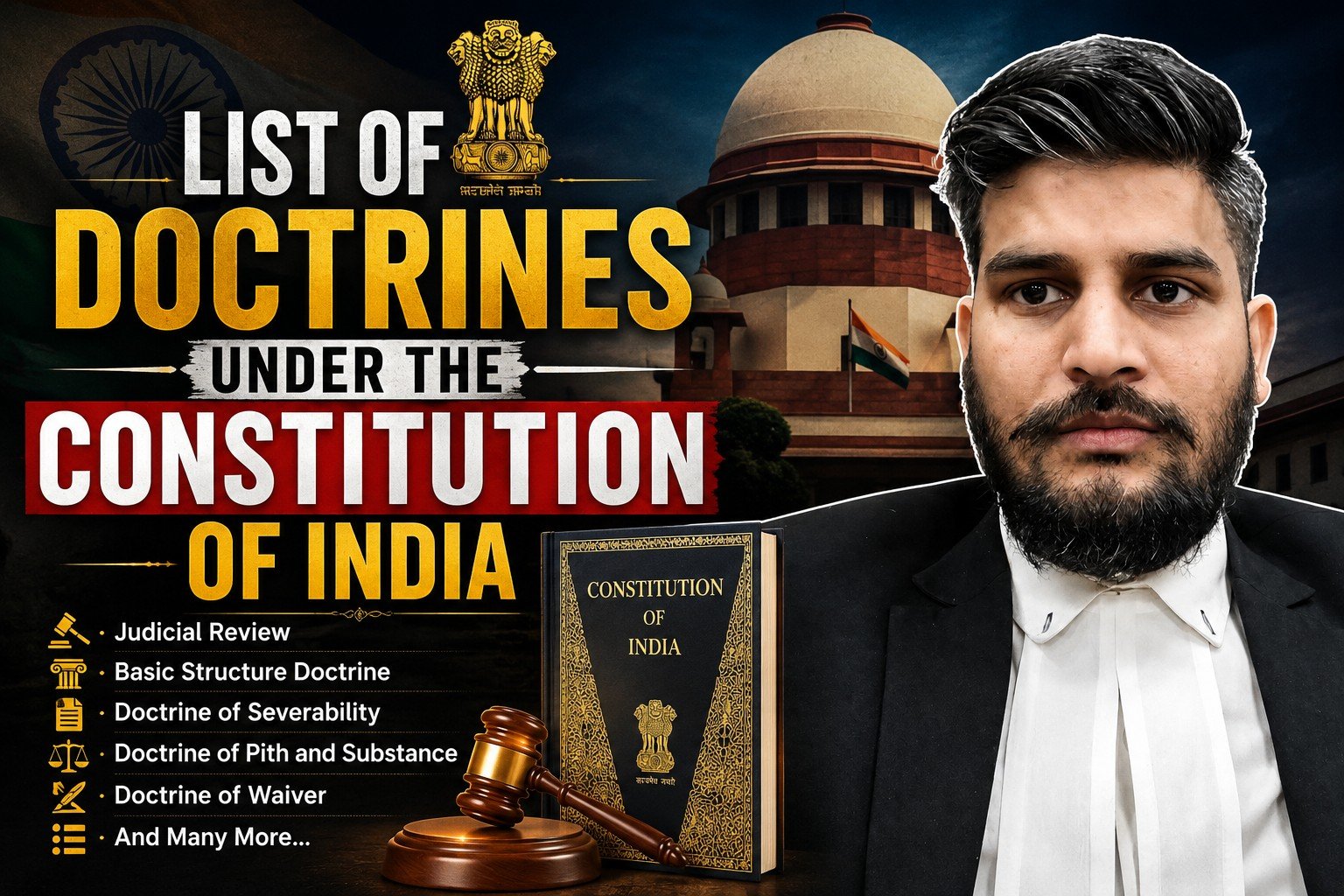
List of Doctrines Under the Constitution of India
The Constitution is the supreme law, but its broad language—“equality,” “liberty,” “reasonable restrictions,” and “public interest”—requires judicial interpretation. The Supreme Court and High Courts have therefore developed doctrines to decide constitutional validity, protect rights, maintain federal boundaries, and regulate public power.
The constitutional provisions referred to below should always be read with the text of the Constitution itself. Constitution of India
I. Interpretive Doctrines and Article 12–13
1. Ejusdem Generis — “Of the same kind”
Meaning: Where specific words are followed by general words, the general words are ordinarily confined to things of the same class as the specific words.
Constitutional relevance: It is a general rule of statutory and constitutional interpretation. It may assist in interpreting “other authorities” in Article 12, but Article 12 is not its exclusive or original source.
Application: The rule applies only where:
- The statute contains an identifiable class or genus.
- Specific words precede general words.
- The legislative context indicates that the general expression should be restricted.
- Applying the rule does not defeat the purpose of the provision.
Example: In Article 12, “the Government and Parliament of India,” “the Government and Legislature of each State,” and “all local or other authorities” must be read purposively. Courts have not limited “other authorities” mechanically; bodies substantially controlled by the State, performing public functions, may fall within Article 12.
Practical point: Ejusdem generis is an aid, not a rigid command. Constitutional provisions, especially fundamental-rights provisions, are generally interpreted broadly to advance rights rather than narrowly to defeat them.
2. Ab Initio — “From the beginning”
Meaning: An act or transaction that is void ab initio is treated in law as invalid from its inception.
Article 13 relevance: Article 13 declares that laws inconsistent with fundamental rights are void “to the extent of such inconsistency.” However, whether a law is void ab initio depends upon whether it is pre-Constitutional or post-Constitutional and on the doctrine applied.
Key distinction:
- A post-Constitution law violating fundamental rights is generally unconstitutional from enactment, subject to severability and judicial remedies.
- A pre-Constitution law inconsistent with fundamental rights is ordinarily not regarded as dead for all purposes. Under the doctrine of eclipse, it becomes unenforceable against citizens to the extent of inconsistency.
Practical point: Do not use “void ab initio” as a universal description of every unconstitutional law. Article 13 requires a more precise analysis.
3. Doctrine of Judicial Review
Meaning: Judicial review is the power of constitutional courts to examine whether legislative, executive, and administrative action complies with the Constitution.
Constitutional basis: Articles 13, 32, 136, 141, 142, 226, and 227 collectively support the constitutional-review structure. Article 32 guarantees the right to approach the Supreme Court for enforcement of fundamental rights, while Article 226 grants High Courts wider writ jurisdiction.
Scope: Courts may invalidate:
- Laws violating fundamental rights.
- Laws beyond legislative competence.
- Constitutional amendments damaging the basic structure.
- Executive action that is arbitrary, mala fide, unreasonable, procedurally unfair, or contrary to statute.
- Administrative decisions affected by irrelevant considerations or legal error.
Limits: Courts do not ordinarily decide the wisdom of policy. They test legality, constitutional compatibility, procedural fairness, rationality, proportionality where applicable, and whether the authority acted within its powers.
Leading authority: Kesavananda Bharati v. State of Kerala recognised that judicial review is part of the Constitution’s basic structure. Kesavananda Bharati judgment
4. Doctrine of Eclipse
Meaning: A pre-Constitution law inconsistent with a fundamental right is overshadowed, or eclipsed, rather than entirely erased. It remains on the statute book but cannot be enforced to the extent of its inconsistency.
Article: Article 13(1).
How it works:
- The law was valid when made.
- The Constitution comes into force.
- The law becomes inconsistent with a fundamental right.
- Its enforceability is suspended against citizens to the extent of inconsistency.
- If the constitutional impediment is removed, the law may revive without re-enactment.
Illustration: A pre-1950 law restricting a freedom later guaranteed under Article 19 may remain dormant. If an amendment removes the inconsistency, it may become enforceable again.
Limit: The doctrine is principally associated with pre-Constitution laws. It is generally not used to save a post-Constitution law enacted in direct violation of fundamental rights.
5. Doctrine of Severability
Meaning: If only a part of a statute violates the Constitution, courts strike down only the invalid portion, provided the remaining portion can function independently.
Article: Article 13.
Test for severability:
- Is the invalid portion separable in language and operation?
- Would the legislature have enacted the valid part without the invalid part?
- Does removal of the invalid portion alter the statute’s basic scheme?
- Can the remainder operate coherently and constitutionally?
Effect: The doctrine preserves legislative work where possible. Courts avoid invalidating an entire law merely because one phrase, proviso, explanation, or section is unconstitutional.
Example: If one classification in a welfare statute is arbitrary under Article 14, the court may invalidate only that classification while retaining the wider welfare scheme.
II. Equality, Administrative Fairness and Article 14
6. Doctrine of Rule of Law
Meaning: Rule of law means the supremacy of law over arbitrary power. Every person and authority, including the State, must act according to law.
Article: Article 14 is the principal constitutional foundation, though the doctrine also informs Articles 21, 32, 226, and the basic-structure principle.
Core elements:
- No arbitrary exercise of public power.
- Equality before law.
- Equal protection of laws.
- Accountability of public authorities.
- Judicial remedies against unlawful State action.
- Fair, known, and intelligible legal standards.
Indian approach: Indian constitutional law has moved beyond the narrow idea that only unequal treatment violates Article 14. Arbitrary State action itself can offend Article 14, even where no obvious comparison class exists.
7. Principle of Reasonable Classification
Meaning: Article 14 does not prohibit classification; it prohibits class legislation. The State may treat different groups differently if the classification is reasonable.
Two-part test:
- The classification must rest on an intelligible differentia distinguishing persons or things grouped together from those left out.
- That differentia must have a rational nexus with the object of the law.
Example: A law providing special safety regulations for hazardous industries may be valid because hazardous industries form an identifiable class connected to the object of protecting workers and the public.
Limit: A classification cannot be artificial, under-inclusive without justification, hostile, or based on irrelevant distinctions. A valid classification must also withstand scrutiny for arbitrariness.
8. Audi Alteram Partem — “Hear the other side”
Meaning: No person should be condemned unheard. A person affected by an adverse administrative or quasi-judicial decision should ordinarily receive notice and a fair opportunity to respond.
Constitutional relevance: Articles 14 and 21. In detention matters, Article 22 supplies specific procedural protections.
Usual requirements:
- Adequate notice of the proposed action.
- Disclosure of material relied upon, subject to legitimate confidentiality.
- Reasonable opportunity to submit an explanation.
- Hearing where facts, credibility, or serious consequences require it.
- An unbiased decision-maker.
- A reasoned decision where law requires or fairness demands it.
Exceptions: Prior hearing may be excluded where legislation clearly excludes it, urgent preventive action is necessary, public interest demands immediate intervention, or a post-decisional hearing adequately cures the situation. Exclusion is never presumed lightly.
Importance: Natural justice is not a fixed ritual. Its content depends on the statutory scheme, seriousness of consequences, and practical fairness.
9. Wednesbury Principle
Meaning: The Wednesbury principle tests whether an administrative decision is so unreasonable that no reasonable authority, properly directing itself in law, could have made it.
Article 14 relevance: In India, Wednesbury unreasonableness is used in judicial review of administrative discretion alongside Article 14’s prohibition against arbitrariness.
Grounds of challenge commonly associated with this principle:
- Reliance on irrelevant considerations.
- Failure to consider relevant considerations.
- Misunderstanding the law.
- Acting for an improper purpose.
- A decision that is irrational or perverse.
- Excessive or manifestly arbitrary exercise of discretion.
Difference from proportionality: Wednesbury review traditionally asks whether the decision is irrational; proportionality asks more closely whether the measure is suitable, necessary, and balanced in relation to its objective. Indian courts increasingly apply proportionality where fundamental rights are directly burdened.
10. Lex Non a Rege Est Violanda — “The law must not be violated even by the king”
Meaning: No ruler or public authority is above the law.
Constitutional relevance: This maxim expresses constitutionalism and rule of law under Article 14. India is a constitutional democracy, not a system of personal rule.
Application: Ministers, civil servants, police authorities, regulators, and constitutional authorities must trace their actions to lawful authority. An order cannot be sustained merely because it was issued by a powerful office-holder.
Practical point: The maxim is descriptive rather than an independently enforceable doctrine. Courts enforce its constitutional substance through judicial review, equality, due process, and remedies under Articles 32 and 226.
11. Pari Passu — “On equal footing”
Meaning: Persons or claims placed on an equal legal footing should receive equal treatment.
Constitutional relevance: It reflects equality under Article 14, though it is more frequently used in insolvency, taxation, service law, and distribution of benefits.
Application: If the State creates a benefit scheme for a defined category, similarly situated persons should generally be treated pari passu. Different treatment requires a constitutionally valid distinction.
Limit: Article 14 does not require identical treatment of materially different circumstances. Equality means equal treatment among equals, not universal uniformity.
12. Rex Quod Injustum Est Facere Non Potest — “The king cannot do what is unjust”
Meaning: Sovereign power cannot legitimise injustice or unlawful action.
Constitutional relevance: The phrase reflects the transition from monarchical prerogative to constitutional accountability. In India, State action is tested against fundamental rights, statutory limits, fairness, and judicial review.
Modern significance: The State cannot defend an unconstitutional act by invoking administrative necessity alone. A public purpose, statutory power, and fair procedure may each be required depending on the action involved.
III. Freedom, Criminal Justice and Article 19–20
13. Principle of Proportionality of Restrictions
Meaning: A restriction on a fundamental freedom must not be excessive in relation to the object sought to be achieved.
Article: Primarily Article 19, and also relevant to Articles 14 and 21.
Four broad questions:
- Does the restriction pursue a legitimate aim?
- Is it rationally connected to that aim?
- Is there a less restrictive but equally effective measure?
- Does the public benefit justify the burden imposed on the right?
Article 19 application: A restriction on speech, movement, profession, association, or assembly must fall within the constitutionally permitted grounds and must be reasonable. A measure cannot be wider than necessary merely because the objective is legitimate.
Importance: Proportionality is especially useful in cases involving censorship, internet restrictions, preventive measures, professional regulation, surveillance, and restrictions on assembly.
14. Ex Post Facto Criminal Laws
Meaning: An ex post facto criminal law retrospectively creates an offence, increases punishment, or imposes a greater penalty than was applicable when the act was committed.
Article: Article 20(1).
Constitutional protection: No person can:
- Be convicted for an act that was not an offence when committed.
- Be subjected to a penalty greater than that prescribed when the offence was committed.
What Article 20(1) does not prohibit:
- Procedural changes that do not alter substantive criminal liability or increase punishment.
- Retrospective laws that are beneficial to the accused.
- Civil, fiscal, or regulatory retrospective legislation, subject to other constitutional limits.
Example: If an offence carried a maximum three-year sentence on the date of conduct, Parliament cannot later enact a law making the same earlier conduct punishable with seven years’ imprisonment.
15. Double Jeopardy
Meaning: No person shall be prosecuted and punished more than once for the same offence.
Article: Article 20(2).
Essential conditions:
- There must have been a prior prosecution before a court or judicial tribunal.
- The person must have been punished in that prosecution.
- The later proceeding must concern the same offence, not merely the same facts.
Important distinction: Departmental proceedings, tax penalties, disciplinary proceedings, or administrative sanctions may not amount to a “prosecution and punishment” for Article 20(2), depending on their nature. The constitutional protection is not automatically triggered whenever two consequences arise from one transaction.
Criminal procedure: The broader procedural protection against repeated trial also appears in statutory criminal procedure, including the rule formerly contained in Section 300 of the Code of Criminal Procedure and now reflected in the Bharatiya Nagarik Suraksha Sanhita framework.
16. Nemo Debet Bis Vexari Pro Una et Eadem Causa — “No person should be vexed twice for one and the same cause”
Meaning: A person should not be harassed repeatedly over the same cause.
Constitutional relevance: It expresses the policy underlying double jeopardy and finality in litigation. Article 20(2) gives a specific constitutional version for prosecution and punishment for the same offence.
Scope: The maxim is wider in spirit than Article 20(2), but the constitutional guarantee must be applied according to its precise terms. Courts distinguish:
- Same facts from same offence.
- Criminal prosecution from civil liability.
- Judicial punishment from administrative action.
- Acquittal, conviction, discharge, and procedural termination.
17. Nemo Bis Punitur Pro Eodem Delicto — “No one is punished twice for the same offence”
Meaning: This is another Latin formulation of the double-jeopardy principle.
Correction: The conventional Latin phrase is generally written as nemo bis punitur pro eodem delicto. It should not be treated as a separate constitutional doctrine from Article 20(2).
Use in legal writing: It is best used to explain the rationale of Article 20(2), rather than as an independent source of rights.
18. Autrefois Convict — “Previously convicted”
Meaning: A plea by an accused person that they have already been tried and convicted for the same offence.
Constitutional relevance: It is associated with the rule against double jeopardy under Article 20(2).
Related plea: Autrefois acquit means “previously acquitted.” Both pleas are based on the finality of criminal adjudication.
Practical point: The plea succeeds only where the earlier conviction or acquittal concerns the legally same offence. A single act can, in some circumstances, constitute different offences with distinct ingredients.
19. Nova Constitutio Futuris Formam Imponere Debet, Non Praeteritis — “A new law should regulate the future, not the past”
Meaning: The ordinary presumption is that legislation operates prospectively unless its language or necessary implication shows retrospective intention.
Article 20 relevance: In criminal law, Article 20(1) gives this presumption constitutional force against retrospective criminalisation and enhanced punishment.
General legal position: Civil legislation may be retrospective if the legislature clearly intends it and if it survives constitutional scrutiny. Procedural legislation is more readily applied to pending matters, though even procedural changes may not unsettle vested rights without clear legislative language.
Drafting and interpretation: Courts presume prospective operation because retrospective laws can disturb settled expectations. That presumption is strongest in penal law.
20. Doctrine Against Self-Incrimination
Meaning: No person accused of an offence can be compelled to be a witness against himself.
Article: Article 20(3).
Requirements:
- The person must be accused of an offence.
- There must be compulsion.
- The compelled material must be testimonial in nature.
- The testimony must tend to incriminate the person.
Protection covers: Compelled oral statements, compelled confessions, and compelled production of testimonial information in circumstances falling within Article 20(3).
Generally outside the core protection: Physical evidence such as fingerprints, handwriting samples, voice samples, or bodily measurements may be treated differently because they are not always testimonial communications. The exact result depends on the nature of the compulsion and the evidentiary purpose.
Limit: Article 20(3) protects against compulsion, not voluntary statements. It also does not create a general right to refuse every investigative procedure.
21. Nemo Tenetur Se Ipsum Accusare — “No person is bound to accuse himself”
Meaning: This is the classic common-law maxim behind the privilege against self-incrimination.
Article: Article 20(3).
Correction: The phrase is commonly expressed as nemo tenetur se ipsum accusare or nemo tenetur se ipsum prodere. Both convey the principle that compelled self-accusation is prohibited.
Practical significance: The maxim supports the requirement that confessions and statements must be voluntary, while Article 20(3) provides the constitutional protection in criminal accusations.
22. Nemo Punitur Pro Alieno Delicto — “No one is punished for another’s wrong”
Meaning: Criminal liability is ordinarily personal. A person should not be punished merely because another person committed an offence.
Constitutional relevance: It reflects fairness in criminal justice and is compatible with Articles 14, 20, and 21. However, it is not a separately worded constitutional doctrine under Article 20.
Important qualification: Legislatures can create vicarious criminal liability where the statute clearly does so, especially for company officers, employers, or persons responsible for a business. Courts generally insist on clear statutory language and satisfaction of statutory conditions before imposing such liability.
IV. Life, Liberty, Environmental Justice and Article 21
23. Ubi Jus Ibi Remedium — “Where there is a right, there is a remedy”
Meaning: A legal right should ordinarily have an effective legal remedy.
Constitutional relevance: Articles 32 and 226 provide remedies for constitutional wrongs. Article 21 supplies substantive protection for life and personal liberty, but the direct constitutional remedy is primarily found in Articles 32 and 226.
Application: Courts may grant:
- Release from unlawful detention.
- Quashing of unlawful orders.
- Directions to public authorities.
- Compensation in appropriate public-law cases.
- Protection against unlawful deprivation of liberty.
- Enforcement of dignity, livelihood, health, and environmental rights where constitutionally recognised.
Practical point: Article 32 is itself a fundamental right for enforcement of fundamental rights. Article 226 is broader because High Courts may issue writs for fundamental rights and “for any other purpose.”
24. Doctrine of Rarest of Rare
Meaning: The death penalty should be imposed only in the rarest of rare cases, where the alternative option of life imprisonment is unquestionably foreclosed.
Article: Article 21, read with criminal sentencing law.
Origin: The doctrine is associated with Bachan Singh v. State of Punjab, where the Supreme Court upheld the constitutional validity of capital punishment but confined its use to exceptional cases.
Sentencing approach: Courts must consider:
- Circumstances of the offence.
- Circumstances of the offender.
- Possibility of reform and rehabilitation.
- Whether life imprisonment is inadequate.
- Mitigating and aggravating factors.
- Individualised sentencing material.
Limit: “Rarest of rare” is not a formula that automatically follows from the seriousness of an offence. The sentencing court must record a reasoned conclusion after considering both crime-related and offender-related circumstances.
25. Doctrine of Public Trust
Meaning: Natural resources such as rivers, lakes, forests, seashores, air, and ecologically sensitive areas are held by the State in trust for the public. The State cannot treat them merely as assets for private disposal.
Constitutional relevance: Article 21, read with Articles 48A and 51A(g).
Core idea: The State is a trustee, not an unrestricted owner, of essential common resources. Public access, environmental sustainability, and intergenerational equity are central considerations.
Application: The doctrine has been used to scrutinise:
- Diversion of public land.
- Commercialisation of water bodies.
- Destruction of forests and wetlands.
- Allocation of natural resources.
- Government decisions that impair public access or ecological integrity.
Limit: The doctrine does not prohibit every development project. It requires a lawful, transparent, public-interest-based decision consistent with ecological duties.
26. Precautionary Principle
Meaning: Where there is a risk of serious or irreversible environmental harm, lack of complete scientific certainty should not be used as a reason to postpone protective measures.
Constitutional relevance: Article 21, with Articles 48A and 51A(g).
Key features:
- Environmental decision-making should anticipate harm rather than only compensate after damage occurs.
- The burden may shift toward the developer or polluting activity to show that the activity is environmentally safe.
- Regulatory authorities must assess ecological risks before approving potentially harmful activities.
Application: It is relevant to industrial approvals, hazardous substances, groundwater extraction, waste management, construction near sensitive ecosystems, and air-pollution controls.
Limit: The principle requires rational, evidence-based precaution. It does not authorise arbitrary bans without a legitimate environmental basis.
27. Polluter Pays Principle
Meaning: A polluter must bear the cost of preventing, remedying, and compensating for environmental damage caused by its activity.
Constitutional relevance: Article 21 and environmental jurisprudence.
Scope: Liability can include:
- Cost of restoring damaged ecology.
- Compensation to affected persons.
- Cost of preventive and remedial measures.
- Environmental monitoring and compliance expenses.
Clarification: The principle is distinct from the rule of absolute liability for hazardous industries. Absolute liability, developed in the Oleum Gas Leak case, concerns liability for harm from hazardous activity; the polluter-pays principle focuses on allocating the financial burden of environmental damage to the polluter.
Purpose: It prevents industries from transferring pollution costs to victims, communities, or taxpayers.
V. Constitutional Remedies and Writ Jurisdiction
28. Habeas Corpus — “You may have the body”
Meaning: A writ requiring a person who detains another to produce the detained person before the court and justify the detention.
Articles: 32 and 226.
Purpose: It is the primary remedy against illegal detention by the State or, in appropriate cases, private persons.
When used:
- Illegal arrest or custody.
- Detention beyond lawful authority.
- Preventive detention that violates constitutional or statutory safeguards.
- Illegal confinement by private individuals.
- Failure to produce an arrested person before the competent magistrate within the required period.
Nature: Habeas corpus is a swift liberty remedy. Courts focus on the legality of detention at the time of judicial examination.
29. Locus Standi — “Right to bring an action”
Meaning: Locus standi concerns whether the petitioner has sufficient legal interest to invoke the court’s jurisdiction.
Articles: 32 and 226.
Traditional rule: Ordinarily, the person whose right is infringed should approach the court.
Public-interest litigation development: Courts relaxed standing where:
- A disadvantaged person cannot realistically approach the court.
- A public wrong affects a class of persons.
- There is a genuine public injury.
- The petitioner acts bona fide and has sufficient concern.
Limit: PIL is not a mechanism for private rivalry, publicity, political disputes, or service disputes of an individual nature. Courts can dismiss petitions filed for collateral purposes.
30. Mandamus — “We command”
Meaning: A writ directing a public authority to perform a public, statutory, or legal duty.
Articles: 32 and 226.
Conditions:
- The respondent must owe a public or legal duty.
- The petitioner must have a corresponding legal right or legitimate entitlement.
- The duty must be enforceable.
- The authority must have failed, refused, or unlawfully delayed performance.
Examples: A court may direct an authority to decide a pending application, consider a claim according to law, perform a statutory duty, or refrain from acting beyond jurisdiction.
Limit: Mandamus generally cannot dictate how an authority should exercise a lawful discretionary power, unless the discretion has been exercised arbitrarily, mala fide, or contrary to law.
31. Quo Warranto — “By what authority”
Meaning: A writ challenging a person’s authority to occupy a public office.
Articles: 32 and 226, though High Courts commonly exercise this jurisdiction.
Conditions:
- The office must be public.
- It must be substantive and created by the Constitution, statute, or other legal authority.
- The office-holder must lack legal eligibility or have been appointed contrary to mandatory law.
Distinctive feature: Any member of the public may generally seek quo warranto; personal injury is not essential because the issue concerns unlawful occupation of public office.
Effect: If the challenge succeeds, the court may declare the appointment invalid and restrain the person from continuing in office.
32. Certiorari
Meaning: A writ by which a superior court quashes an order of an inferior court, tribunal, or authority exercising judicial or quasi-judicial power.
Articles: 32 and 226.
Grounds:
- Lack or excess of jurisdiction.
- Error of law apparent on the face of the record.
- Violation of natural justice.
- Failure to follow mandatory procedure.
- Consideration of irrelevant material.
- Mala fides or legal perversity.
Difference from appeal: Certiorari is not a full rehearing on facts. It is a supervisory remedy directed at legality and jurisdiction.
Modern position: High Courts may also use certiorari to control administrative decisions where public-law error is established.
VI. Social Justice and Parliamentary Government
33. Doctrine of Distributive Justice
Meaning: Distributive justice aims at fair allocation of social and economic benefits, opportunities, and burdens, especially to reduce structural inequality.
Articles: Articles 38 and 39, within the Directive Principles of State Policy.
Constitutional purpose: The State must strive to promote welfare, minimise inequalities in income and status, ensure adequate means of livelihood, prevent concentration of wealth, and protect workers, children, and weaker sections.
Application: The doctrine supports welfare legislation involving:
- Labour protection.
- Minimum wages.
- Land and resource reform.
- Social security.
- Educational access.
- Reservation and affirmative-action measures, subject to constitutional requirements.
- Gender and child welfare.
Enforceability: Directive Principles are not directly enforceable in the same manner as fundamental rights, but they strongly guide legislation and constitutional interpretation.
34. Principle of Collective Responsibility
Meaning: The Council of Ministers is collectively responsible to the House of the People.
Article: Article 75(3).
Consequences:
- The ministry stands or falls together in the Lok Sabha.
- A vote of no confidence against the government ordinarily requires resignation of the Council of Ministers or dissolution of the Lok Sabha, subject to constitutional practice.
- Cabinet decisions are publicly defended as decisions of the government.
- Ministers who fundamentally disagree may resign or be removed.
Purpose: Collective responsibility ensures parliamentary accountability, cabinet unity, and democratic control over the executive.
State equivalent: Article 164(2) establishes collective responsibility of the State Council of Ministers to the Legislative Assembly.
35. Principle of Individual Ministerial Responsibility
Meaning: Each minister is individually answerable for the conduct of their department and for the lawful discharge of ministerial functions.
Article: The Constitution does not expressly formulate a detailed doctrine of individual responsibility in Article 75. Article 75(2) provides that ministers hold office during the President’s pleasure; in practice, this operates on the advice of the Prime Minister.
Forms:
- Political responsibility: A minister may resign or be removed for serious departmental failure, misconduct, or loss of confidence.
- Parliamentary responsibility: Ministers answer questions, defend policy, and account for departmental actions before Parliament.
- Legal responsibility: A minister remains subject to ordinary law, constitutional review, and criminal law where applicable.
Correction: A minister is not automatically personally liable for every act or omission within the ministry. Responsibility depends on constitutional conventions, statutory duties, knowledge, participation, and the nature of the alleged wrong.
36. Sine Die — “Without assigning a day”
Meaning: When a House is adjourned sine die, it is adjourned without fixing a date for its next sitting.
Article relevance: Article 85 deals with summoning, prorogation, and dissolution of Parliament. Adjournment sine die is normally an act of the presiding officer, not prorogation by the President.
Difference:
| Term | Meaning | Constitutional consequence |
|---|---|---|
| Adjournment | Suspension of a sitting to a specified time | House continues |
| Adjournment sine die | Suspension without a specified next date | Presiding officer may reconvene subject to rules |
| Prorogation | Formal termination of a parliamentary session | Done by the President under Article 85 |
| Dissolution | End of the Lok Sabha’s existence | Fresh general election required |
Practical point: Do not equate adjournment sine die with dissolution or prorogation.
37. Ad Hoc — “For a particular purpose”
Meaning: An ad hoc arrangement is made for a specific, temporary purpose rather than as a permanent institutional appointment.
Article: Article 127.
Constitutional application: When there is a lack of quorum of Supreme Court judges, the Chief Justice of India may, with the prior consent of the President and after consulting the Chief Justice of the concerned High Court, request a High Court judge qualified for Supreme Court appointment to sit as an ad hoc judge.
Purpose: Article 127 protects the Court’s ability to function when its strength is temporarily insufficient.
Limit: Ad hoc judges are constitutionally regulated appointments. The expression should not be used to imply an informal or unstructured appointment process.
38. Nunc Pro Tunc — “Now for then”
Meaning: An order nunc pro tunc is made now but takes effect from an earlier date to correct or record what should already have been reflected.
Article relevance: It may arise in Supreme Court proceedings, including under Article 136, but Article 136 is not the textual source of the doctrine.
Proper use:
- Correcting clerical or formal errors.
- Recording an order that was intended but omitted through court error.
- Giving effect to an earlier judicial determination where justice requires.
Limit: It cannot be used to invent a judicial decision that was never made, defeat substantive rights that have accrued, or bypass statutory limitations.
39. Stare Decisis — “Stand by decided cases”
Meaning: Courts follow binding precedent to ensure consistency, predictability, equality, and stability in law.
Article: Article 141 provides that the law declared by the Supreme Court is binding on all courts within India.
Hierarchy:
- A Supreme Court decision binds all Indian courts.
- A larger Bench of the Supreme Court prevails over a smaller Bench.
- A High Court decision binds subordinate courts within that High Court’s territorial jurisdiction.
- Decisions of other High Courts are persuasive, not binding.
Purpose: Like cases should ordinarily be decided alike. This reduces arbitrary variation and allows citizens, lawyers, and institutions to plan their conduct.
40. Obiter Dicta — “Things said by the way”
Meaning: Observations in a judgment that are not necessary to decide the dispute are obiter dicta.
Article relevance: Article 141 binds courts to the “law declared” by the Supreme Court. The binding part is usually the ratio decidendi, not every observation.
Value of obiter: A considered observation of the Supreme Court may carry substantial persuasive weight, especially where it carefully addresses an important legal question. But it does not bind in the same way as the ratio necessary for the decision.
Practical method: To identify obiter, ask whether the case would have been decided the same way without the observation. If yes, the statement is likely obiter.
41. Ratio Decidendi — “Reason for deciding”
Meaning: The ratio decidendi is the legal principle necessary to the court’s decision on material facts.
Article: Article 141.
How to identify ratio:
- Identify the material facts.
- Identify the legal issue actually decided.
- Identify the rule applied to resolve that issue.
- Exclude background remarks, hypothetical examples, and unnecessary commentary.
Importance: A case’s authority lies in its ratio, not in isolated sentences. Lawyers should not cite a judgment merely for broad language detached from the facts and issue decided.
42. Principle of Consistency of Law
Meaning: A smaller Bench should follow an earlier decision of a larger Bench. If it doubts the correctness of that decision, it should refer the issue to a larger Bench rather than disregard binding precedent.
Article: Article 141.
Bench-strength rule:
| Earlier decision | Later Bench | Proper course |
|---|---|---|
| Constitution Bench | Division Bench | Must follow |
| Three-judge Bench | Two-judge Bench | Must follow |
| Two-judge Bench | Coordinate two-judge Bench | Should follow or refer conflict |
| Smaller Bench | Larger Bench | Larger Bench may reconsider |
Purpose: The rule preserves doctrinal coherence and institutional discipline.
Practical point: A later decision does not automatically overrule an earlier decision merely because it is more recent. Bench strength and direct consideration of the issue matter.
43. Boni Judicis Est Ampliare Jurisdictionem — “It is the duty of a good judge to extend jurisdiction”
Meaning: The maxim is often cited to support a liberal approach to remedies where justice requires intervention.
Article relevance: It is sometimes invoked in connection with Article 226, but it is not a source of jurisdiction. High Courts derive writ jurisdiction from the Constitution, not from this Latin expression.
Correct position: Article 226 should be interpreted purposively to protect legal rights and prevent public-law injustice. Yet a High Court cannot enlarge its jurisdiction beyond constitutional and statutory limits merely by invoking equitable considerations.
Practical use: The maxim may support broad remedial interpretation, particularly where no equally efficacious remedy exists, but cannot override jurisdictional bars or legislative commands.
VII. Legislative Power, Federalism and Property
44. Theory of Territorial Nexus
Meaning: A State legislature may legislate with respect to persons, property, events, or transactions outside its territorial boundaries only where there is a sufficient territorial connection between the State and the subject matter.
Articles: Articles 245 and 246.
Test: The nexus must be:
- Real and not illusory.
- Relevant to the law’s object.
- Sufficient to justify the State’s connection with the transaction or subject matter.
Example: A State may tax or regulate a transaction having substantial connection with that State even if one part of the transaction occurs elsewhere.
Limit: A State cannot make laws with wholly extra-territorial operation having no meaningful nexus to the State. Parliament’s position under Article 245 is broader because Parliament may legislate for the whole or any part of India.
45. Plenary Power of Legislature
Meaning: Parliament and State legislatures possess full legislative authority within the fields assigned to them by the Constitution.
Article: Article 246, read with the Seventh Schedule.
Scope:
- Parliament has exclusive power over Union List matters.
- States have exclusive power over State List matters, subject to constitutional exceptions.
- Parliament and States may legislate on Concurrent List matters, subject to Article 254 on repugnancy.
- Parliament may receive additional power in specified situations, including national interest, emergency, international obligations, and consent of States.
Limit: Legislative power is plenary only within constitutional boundaries. It remains subject to:
- Fundamental rights.
- Distribution of legislative subjects.
- Constitutional prohibitions.
- Procedural requirements.
- Basic-structure limitations in the case of constitutional amendment.
46. Ancillary or Incidental Powers
Meaning: The power to legislate on an enumerated subject includes power over incidental, ancillary, and subsidiary matters necessary to make the main power effective.
Article: Article 246 and the legislative lists.
Example: A legislature authorised to regulate a principal subject may enact provisions for licensing, inspections, penalties, procedure, enforcement, appeals, and administrative machinery connected with that subject.
Limit: Incidental power cannot become a device to legislate substantially on a subject assigned exclusively to another legislature. The connection must be genuine and reasonably related to the authorised field.
47. Doctrine of Pith and Substance
Meaning: When a law appears to overlap two legislative fields, courts examine its true nature, object, and substance rather than its form or incidental effects.
Articles: Articles 246 and 254.
Questions asked:
- What is the law’s dominant purpose?
- What is its real subject matter?
- What is the practical effect of the legislation?
- Is any encroachment on another legislative field incidental or substantial?
Effect: If the law in pith and substance falls within the legislature’s authorised field, incidental encroachment into another field does not invalidate it.
Importance: The doctrine prevents federal legislative lists from being interpreted in a manner that makes governance impracticable.
48. Doctrine of Colourable Legislation
Meaning: What cannot be done directly cannot be done indirectly. A legislature cannot use a disguised form to achieve an object beyond its constitutional competence.
Article: Article 246 and the distribution of legislative power.
Test: The court examines the substance, not the label. The question is not whether the legislature acted with a bad motive, but whether it possessed constitutional power to enact the law.
Key point: “Colourable” refers to lack of legislative competence disguised by drafting, not necessarily to dishonesty or mala fides.
Difference from pith and substance: Pith and substance asks whether incidental encroachment is permissible; colourable legislation asks whether apparent compliance conceals an unconstitutional exercise of power.
49. Bona Vacantia — “Ownerless property”
Meaning: Bona vacantia refers to property without an owner, such as property of a person dying intestate without legal heirs.
Article: Article 296.
Constitutional rule:
- Property situated in a State generally accrues to that State.
- Property situated elsewhere accrues to the Union.
Purpose: The provision ensures that ownerless property does not remain in legal limbo.
Limit: The State or Union can claim property under Article 296 only after legal requirements for establishing absence of lawful heirs or ownership are satisfied.
50. Doctrine of Eminent Domain
Meaning: Eminent domain is the sovereign power to compulsorily acquire private property for a public purpose under authority of law.
Article: Article 300A.
Current constitutional position: No person may be deprived of property save by authority of law. The right to property is no longer a fundamental right, but it remains a constitutional right.
Requirements for valid acquisition:
- Authority of a valid law.
- Genuine public purpose.
- Compliance with statutory procedure.
- Non-arbitrariness under Article 14.
- Compensation in accordance with the governing acquisition law.
Correction: Article 300A does not expressly state “compensation.” Nevertheless, compulsory deprivation cannot be arbitrary, and acquisition statutes generally require compensation. Courts scrutinise illusory compensation, discriminatory acquisition, and deprivation unsupported by valid law.
51. Imperium in Imperio — “A State within a State” or “Sovereignty within sovereignty”
Meaning: The phrase describes an autonomous authority functioning within a larger constitutional structure.
Article relevance: It is sometimes associated with Article 324 because the Election Commission has constitutional authority to supervise, direct, and control elections.
Correct position: The Election Commission is not a sovereign entity within India. It is an independent constitutional authority whose powers must be exercised within the Constitution, election statutes, and judicially enforceable limits.
Article 324: The Commission’s role includes superintendence, direction, and control of electoral rolls and elections to Parliament, State legislatures, and the offices of President and Vice-President.
Practical point: The phrase is rhetorical. It should not be used to imply that the Election Commission is immune from judicial review or statutory regulation.
52. In Foro Conscientiae — “In the forum of conscience”
Meaning: The expression refers to moral conscience rather than a legally enforceable court or jurisdiction.
Article relevance: It is occasionally linked in notes to Article 363, but it is not an established constitutional doctrine under that Article.
Article 363 actually concerns: The bar on courts’ interference in disputes arising out of certain pre-Constitution treaties, agreements, covenants, engagements, sanads, or similar instruments involving former Indian States and their rulers, subject to constitutional qualifications.
Correction: In foro conscientiae may be useful as a philosophical expression, but it does not create a legal rule for adjudication under Article 363.
VIII. Constitutional Amendment and Basic Structure
53. Doctrine of Basic Structure
Meaning: Parliament’s power to amend the Constitution under Article 368 is wide, but it cannot alter, destroy, or abrogate the Constitution’s basic structure.
Article: Article 368.
Origin: The doctrine was formulated in Kesavananda Bharati v. State of Kerala. The Supreme Court held that Parliament may amend every part of the Constitution, including fundamental rights, but cannot damage its basic features. Supreme Court record
Features recognised in different cases include:
- Supremacy of the Constitution.
- Republican and democratic form of government.
- Secularism.
- Federalism.
- Separation of powers.
- Judicial review.
- Rule of law.
- Free and fair elections.
- Parliamentary democracy.
- Dignity and liberty of the individual.
- Unity and integrity of India.
- Limited amending power.
- Independence of the judiciary.
- Harmony between fundamental rights and Directive Principles.
What the doctrine does not mean: It does not prevent all constitutional amendments. Parliament can amend institutional structures, rights provisions, election rules, federal arrangements, and governance mechanisms if the amendment does not damage the Constitution’s essential identity.
Why it matters: The doctrine reconciles constitutional adaptability with constitutional continuity. It prevents a temporary parliamentary majority from legally dismantling the foundational commitments that make the Constitution supreme.
Key Cases for Reading and Examination Preparation
| Case | Main constitutional significance |
|---|---|
| A.K. Gopalan v. State of Madras | Early approach to personal liberty and preventive detention |
| State of Madras v. Champakam Dorairajan | Fundamental rights and Directive Principles |
| Keshavan Madhava Menon v. State of Bombay | Prospective operation and Article 13 issues |
| Bhikaji Narain Dhakras v. State of Madhya Pradesh | Doctrine of eclipse |
| R.M.D. Chamarbaugwala v. Union of India | Doctrine of severability |
| E.P. Royappa v. State of Tamil Nadu | Arbitrariness under Article 14 |
| Maneka Gandhi v. Union of India | Fair, just and reasonable procedure under Article 21; interrelationship of Articles 14, 19 and 21 |
| Bachan Singh v. State of Punjab | Rarest-of-rare doctrine in death-penalty sentencing |
| M.C. Mehta v. Union of India | Absolute liability and environmental constitutionalism |
| Vellore Citizens’ Welfare Forum v. Union of India | Precautionary and polluter-pays principles |
| M.C. Mehta v. Kamal Nath | Public-trust doctrine |
| Kesavananda Bharati v. State of Kerala | Basic-structure doctrine |
| Indira Nehru Gandhi v. Raj Narain | Free and fair elections; limits on amendment power |
| Minerva Mills v. Union of India | Limited amending power; balance between rights and Directive Principles |
| I.R. Coelho v. State of Tamil Nadu | Judicial review of Ninth Schedule laws that damage basic structure |
The transformative reading of Articles 14, 19 and 21 in Maneka Gandhi remains central to modern Indian constitutional law. Maneka Gandhi decision
Quick Revision Table
| Doctrine or maxim | Core proposition | Principal constitutional connection |
|---|---|---|
| Ejusdem generis | General words are limited by the class created by specific words | Interpretive principle; may arise in Article 12 |
| Ab initio | Invalid from inception | Article 13 |
| Judicial review | Courts test constitutionality and legality | Articles 13, 32, 226 |
| Eclipse | Pre-Constitution inconsistent law remains dormant | Article 13 |
| Severability | Only unconstitutional part is invalid where separable | Article 13 |
| Rule of law | No arbitrary power; all are subject to law | Article 14 |
| Reasonable classification | Classification needs differentia and nexus | Article 14 |
| Audi alteram partem | Fair hearing before adverse action | Articles 14, 21, 22 |
| Wednesbury | Irrational administrative action is reviewable | Article 14 |
| Proportionality | Restriction must not exceed what is necessary | Articles 19, 14, 21 |
| Ex post facto | No retrospective criminal offence or enhanced penalty | Article 20(1) |
| Double jeopardy | No prosecution and punishment twice for same offence | Article 20(2) |
| Self-incrimination | Accused cannot be compelled to testify against self | Article 20(3) |
| Rarest of rare | Death penalty only in exceptional cases | Article 21 |
| Public trust | State holds natural resources for public benefit | Article 21, Articles 48A and 51A(g) |
| Precautionary principle | Prevent serious environmental harm before it occurs | Article 21 |
| Polluter pays | Polluter bears environmental restoration cost | Article 21 |
| Habeas corpus | Remedy against unlawful detention | Articles 32, 226 |
| Mandamus | Direction to perform public duty | Articles 32, 226 |
| Quo warranto | Challenge to unlawful occupation of public office | Articles 32, 226 |
| Certiorari | Quashing unlawful tribunal or authority orders | Articles 32, 226 |
| Collective responsibility | Ministry is accountable to Lok Sabha as a whole | Article 75(3) |
| Ad hoc judge | Temporary Supreme Court judge in quorum shortage | Article 127 |
| Stare decisis | Binding force of precedent | Article 141 |
| Territorial nexus | State law needs real connection with subject matter | Articles 245–246 |
| Pith and substance | True character of legislation determines competence | Article 246 |
| Colourable legislation | Indirect exercise of forbidden legislative power is invalid | Article 246 |
| Bona vacantia | Ownerless property vests in State or Union | Article 296 |
| Eminent domain | Property deprivation requires authority of law | Article 300A |
| Basic structure | Amendment cannot destroy constitutional identity | Article 368 |
Conclusion
These doctrines should not be memorised merely as Latin phrases or one-line definitions. Their real value lies in understanding the constitutional question each answers: whether the State acted fairly, whether a law is within legislative competence, whether a right has been disproportionately restricted, whether a remedy is available, and whether an amendment preserves the Constitution’s basic identity.
For examination answers, use a four-part structure: define the doctrine, identify the constitutional article, state the governing test, and cite one leading case. For legal practice, add the facts, statutory framework, standard of judicial review, relief sought, and the precise constitutional injury alleged.