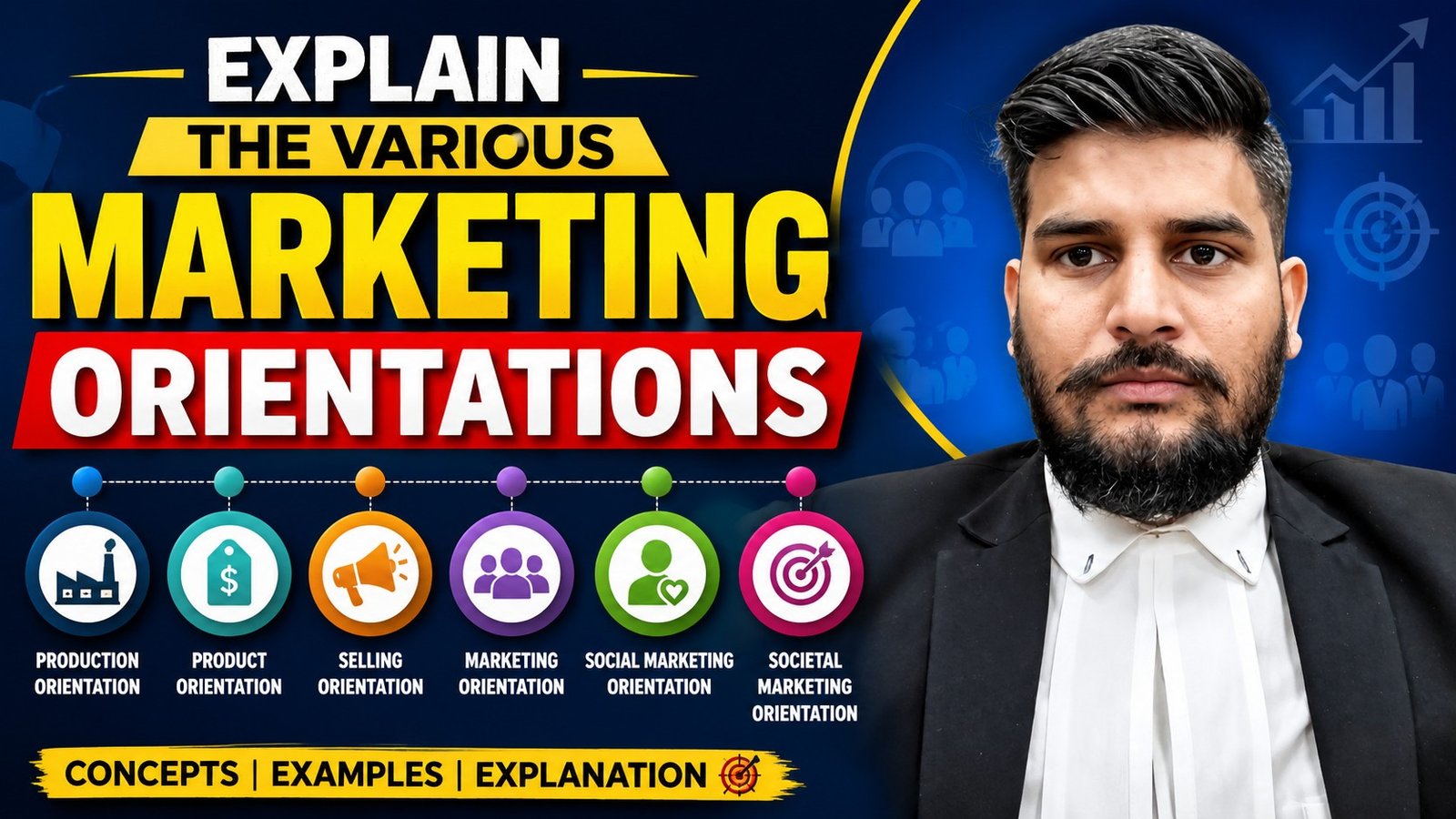
Q. Explain the Various Marketing Orientations.
Introduction
Marketing orientation refers to the business philosophy or approach that guides an organization in producing, promoting, and selling its products or services. It reflects the way a company views its customers, the market, and its role in achieving organizational objectives. Over time, different marketing orientations have evolved as businesses adapted to changing market conditions, technological advancements, and customer expectations. Each orientation represents a distinct approach to managing marketing activities and satisfying customer needs.
Various Marketing Orientations
The Production Orientation is the oldest marketing philosophy. It is based on the assumption that consumers prefer products that are widely available and affordable. Therefore, organizations following this orientation focus on increasing production efficiency, reducing manufacturing costs, and achieving economies of scale. The primary objective is to produce goods in large quantities at lower prices. This orientation is suitable when demand exceeds supply or when production costs need to be minimized. However, it often overlooks customer preferences and changing market needs.
The Product Orientation emphasizes producing high-quality products with superior features and performance. According to this orientation, customers will naturally prefer products that offer better quality and innovation. As a result, organizations invest heavily in research and development, product improvement, and technological advancement. Although this approach encourages innovation, it may lead to “marketing myopia,” where companies focus excessively on the product itself rather than understanding what customers actually want.
The Selling Orientation emerged when markets became more competitive and production exceeded demand. Under this approach, organizations believe that consumers will not buy enough products unless they are persuaded through aggressive selling and promotional efforts. Companies therefore rely on advertising, personal selling, sales promotion, and other persuasive techniques to increase sales. This orientation aims at maximizing sales volume rather than building customer satisfaction. While it may generate short-term sales, it often fails to create long-term customer loyalty.
The Marketing Orientation represents a significant shift from selling products to satisfying customer needs. Organizations adopting this philosophy begin by identifying customer requirements through market research and then develop products and marketing strategies to meet those needs. The focus is on creating customer value, achieving customer satisfaction, and building long-term relationships. This orientation recognizes that organizational success depends on understanding target markets better than competitors and delivering superior value.
The Societal Marketing Orientation extends the marketing orientation by balancing three important objectives: customer satisfaction, organizational profitability, and social welfare. It recognizes that businesses have a responsibility not only to serve customers but also to protect the environment and contribute positively to society. Organizations following this orientation adopt ethical marketing practices, promote sustainable products, reduce environmental impact, and support community welfare. This approach helps businesses achieve long-term success while fulfilling their social responsibilities.
The Relationship Marketing Orientation is a modern approach that focuses on establishing and maintaining long-term relationships with customers rather than merely completing one-time transactions. Organizations strive to improve customer satisfaction, trust, and loyalty through personalized services, effective communication, customer relationship management (CRM), after-sales support, and loyalty programs. Strong customer relationships result in repeat purchases, positive word-of-mouth, and long-term profitability.
In today’s digital business environment, many organizations also follow a Digital Marketing Orientation. This orientation utilizes digital technologies such as websites, search engines, social media platforms, email marketing, mobile applications, artificial intelligence, and data analytics to understand customer behavior and deliver personalized marketing messages. Digital marketing enables organizations to interact directly with customers, measure campaign performance, and reach global markets efficiently and cost-effectively.
Importance of Marketing Orientations
Different marketing orientations help organizations understand market conditions and adopt suitable business strategies. They improve decision-making, enhance customer satisfaction, strengthen competitive advantage, encourage innovation, build long-term customer relationships, and contribute to sustainable business growth. Modern organizations generally combine marketing, relationship, societal, and digital orientations to remain competitive in dynamic markets.
Conclusion
Marketing orientation has evolved from a production-focused philosophy to a customer-centric and socially responsible approach. While the production, product, and selling orientations primarily emphasize organizational objectives, the marketing, societal, relationship, and digital orientations focus on creating customer value, maintaining long-term relationships, and fulfilling social responsibilities. In the present competitive business environment, organizations that adopt a customer-oriented and value-driven marketing philosophy are more likely to achieve sustainable growth and long-term success.