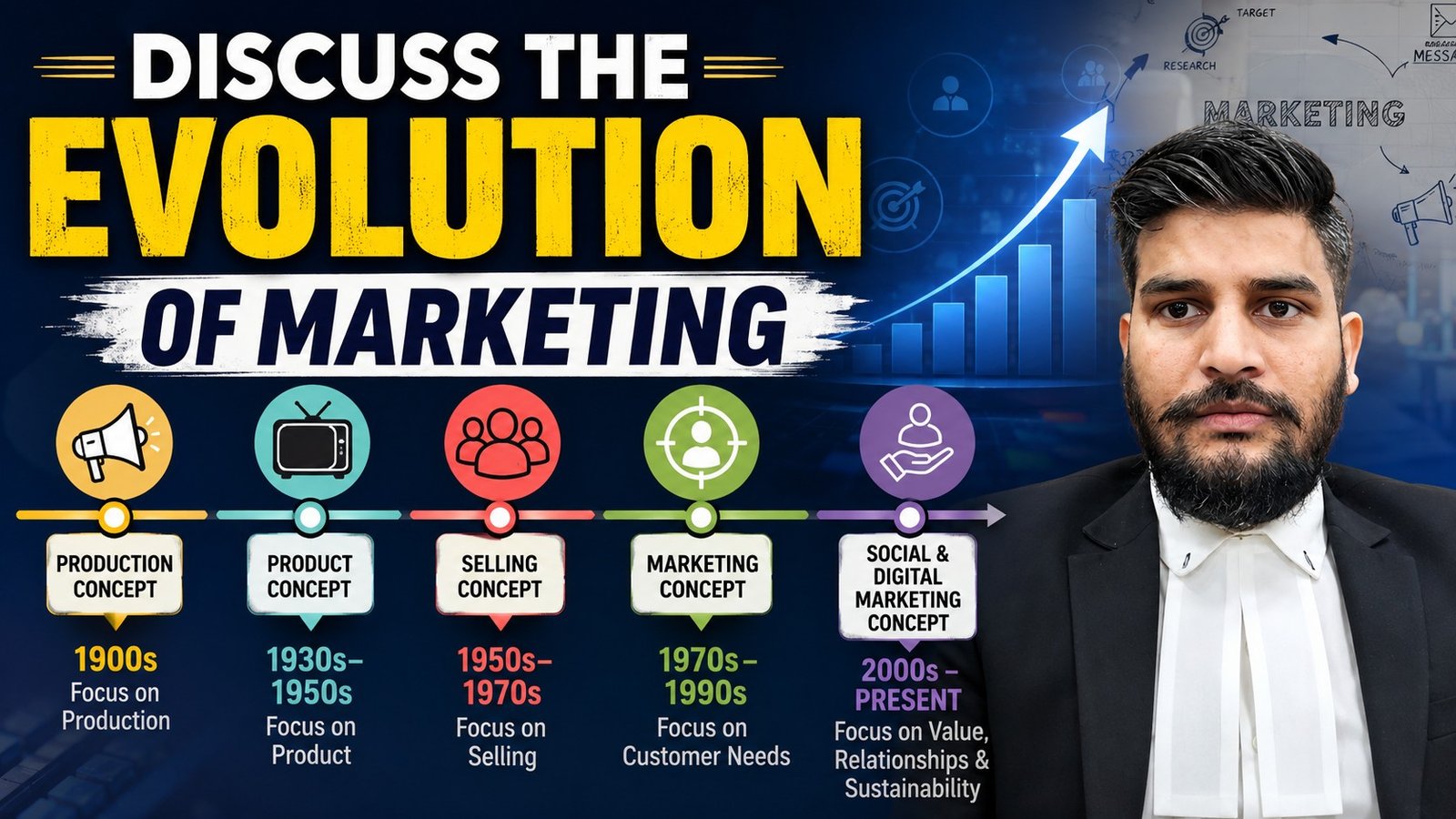
Q. Discuss the Evolution of Marketing.
Introduction
Marketing has evolved significantly over time due to changes in technology, customer preferences, competition, and business practices. Earlier, businesses focused mainly on producing goods, but today they focus on creating value and building long-term customer relationships. The evolution of marketing reflects the changing philosophy of organizations toward customers and the marketplace.
Meaning of Marketing Evolution
The evolution of marketing refers to the gradual development of marketing concepts and practices from a production-oriented approach to a customer-centric and relationship-oriented approach.
Stages in the Evolution of Marketing
1. Production Concept (Before 1930)
The production concept is the oldest marketing philosophy. It assumes that customers prefer products that are widely available and affordable.
Features
- Focus on mass production.
- Emphasis on reducing production cost.
- High efficiency and economies of scale.
- Limited concern for customer preferences.
Example: Ford Motor Company’s Model T, where standardized cars were produced in large quantities at low cost.
2. Product Concept (1930–1950)
Under this concept, companies believed that customers prefer products with the best quality, features, and performance.
Features
- Emphasis on product quality.
- Continuous product improvement.
- Innovation and technological advancement.
- Less attention to customer needs.
Limitation: A high-quality product may fail if it does not match customer expectations.
3. Selling Concept (1950–1960)
As competition increased, companies realized that products would not sell automatically. They adopted aggressive selling and promotional techniques.
Features
- Heavy advertising and sales promotion.
- Personal selling.
- Focus on increasing sales volume.
- Suitable for unsought goods such as insurance and encyclopedias.
Limitation: It focuses on selling rather than satisfying customers.
4. Marketing Concept (1960–1990)
This concept shifted the focus from selling products to satisfying customer needs. Organizations identify customer requirements first and then develop products accordingly.
Features
- Customer-oriented approach.
- Market research.
- Target market selection.
- Integrated marketing efforts.
- Profit through customer satisfaction.
Principle: “Produce what customers want instead of selling what you produce.”
5. Societal Marketing Concept (1990 onwards)
The societal marketing concept extends the marketing concept by considering the welfare of society along with customer satisfaction and business profits.
Features
- Customer satisfaction.
- Organizational profitability.
- Social responsibility.
- Environmental protection.
- Sustainable development.
Example: Companies using eco-friendly packaging and promoting green products.
6. Relationship Marketing (Modern Era)
Modern businesses focus on developing long-term relationships with customers instead of merely making one-time sales.
Features
- Customer retention.
- Customer loyalty.
- Personalized services.
- CRM (Customer Relationship Management).
- Long-term profitability.
7. Digital Marketing Era (Present)
With the growth of the internet and smartphones, marketing has become digital and data-driven.
Features
- Social media marketing.
- Search engine optimization (SEO).
- Email marketing.
- Influencer marketing.
- Artificial Intelligence (AI) and data analytics.
- E-commerce and online advertising.
Evolution of Marketing (Flowchart)
Production Concept
        ↓
Product Concept
        ↓
Selling Concept
        ↓
Marketing Concept
        ↓
Societal Marketing Concept
        ↓
Relationship Marketing
        ↓
Digital Marketing
Importance of Marketing Evolution
- Better understanding of customer needs.
- Increased customer satisfaction.
- Improved product innovation.
- Strong customer relationships.
- Sustainable business growth.
- Competitive advantage.
- Global market expansion through digital platforms.
Conclusion
The evolution of marketing shows a shift from production-oriented and sales-oriented approaches to customer-oriented, relationship-oriented, and digital marketing approaches. Today, successful organizations focus on creating value, satisfying customers, maintaining long-term relationships, and fulfilling their social responsibilities. Thus, marketing has become a strategic function essential for sustainable business success.