Wars Fought by the British in India: A Complete Historical Overview
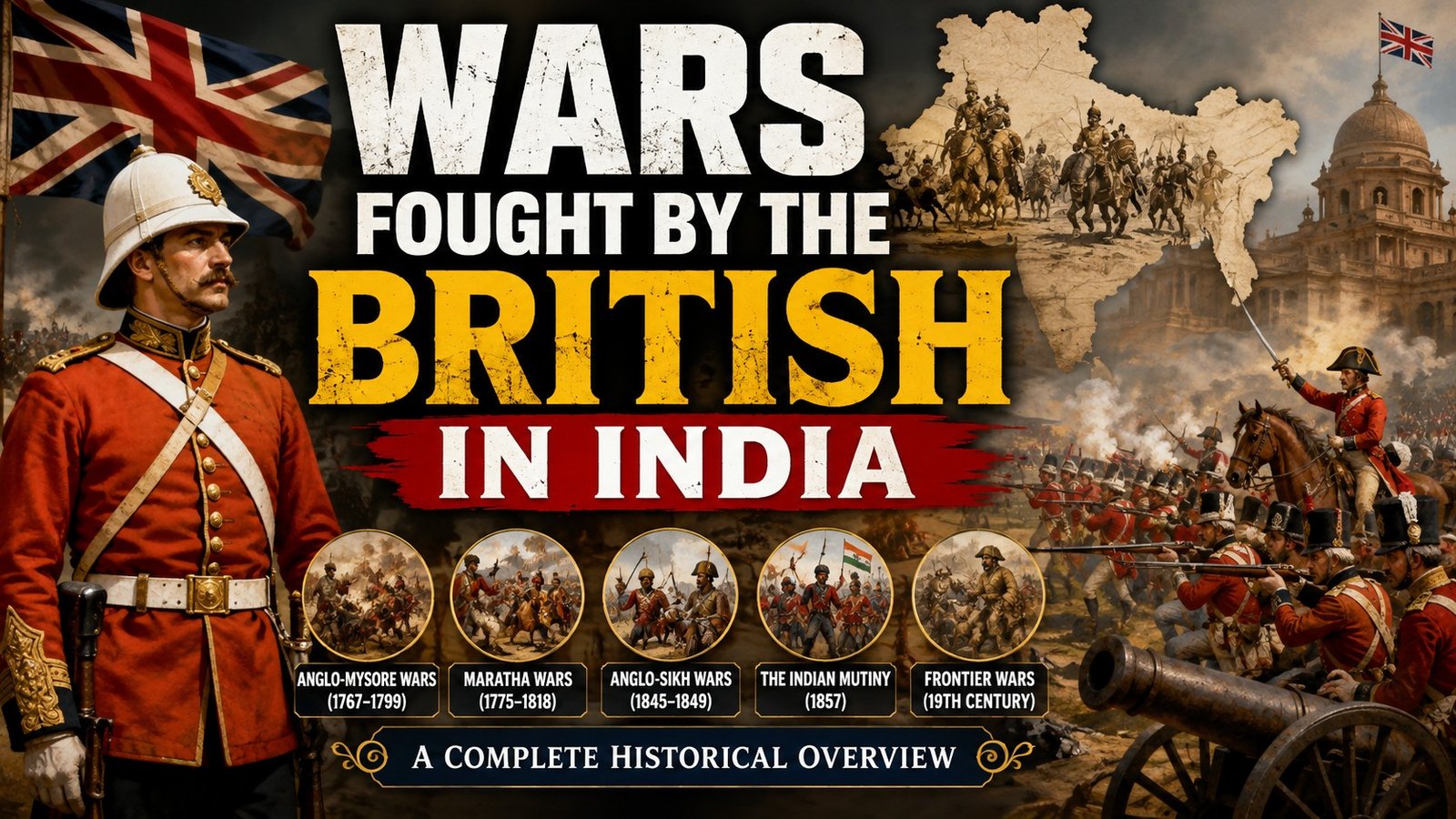
The wars fought by the British in India were not isolated military events but a continuous, century‑long process through which a trading company transformed itself into an imperial power ruling most of South Asia. These conflicts—against the Mughals, Mysore, the Marathas, Nepal, the Sikhs, Burma and many others, reshaped India’s political geography and laid the foundations of colonial rule that would later provoke the Revolt of 1857 and the nationalist struggle.[1][2][3][4]
| Timeline | War | Participants | Treaty / Result |
|---|---|---|---|
| 1746–1748 | First Carnatic War | British East India Company vs French East India Company and allied Indian rulers | Treaty of Aix-la-Chapelle; status quo largely restored. |
| 1749–1754 | Second Carnatic War | British East India Company vs French East India Company and Indian claimants in the Carnatic | No decisive treaty; British influence increased through political intervention. |
| 1756–1763 | Third Carnatic War | British East India Company vs French East India Company and allies | Treaty of Paris; French political power in India sharply reduced. |
| 1756–1765 | Bengal War / War of Plassey and Buxar | British East India Company vs Nawab of Bengal, Mughal forces, Awadh forces, and allies | Treaty of Allahabad (1765); Company got diwani rights in Bengal, Bihar, and Orissa. |
| 1767–1769 | First Anglo-Mysore War | British East India Company vs Kingdom of Mysore under Hyder Ali | Treaty of Madras; status quo restored. |
| 1775–1782 | First Anglo-Maratha War | British East India Company vs Maratha Empire | Treaty of Salbai (1782); peace restored, British gains limited. |
| 1780–1784 | Second Anglo-Mysore War | British East India Company vs Kingdom of Mysore under Hyder Ali and Tipu Sultan | Treaty of Mangalore (1784); status quo largely restored. |
| 1790–1792 | Third Anglo-Mysore War | British East India Company vs Mysore, with Maratha and Hyderabad support to British | Treaty of Seringapatam (1792); Mysore ceded territory and paid indemnity. |
| 1799 | Fourth Anglo-Mysore War | British East India Company vs Kingdom of Mysore under Tipu Sultan | Tipu Sultan killed; Mysore subdued and British control expanded. |
| 1803–1805 | Second Anglo-Maratha War | British East India Company vs Maratha Empire | Treaties of Surji-Anjangaon, Deogaon, and Rajghat; major Maratha losses. |
| 1814–1816 | Anglo-Nepalese War | British East India Company vs Kingdom of Nepal | Treaty of Sugauli; Nepal became a buffer state and ceded territory.worldhistory+1 |
| 1817–1819 | Third Anglo-Maratha War | British East India Company vs Maratha chiefs / Peshwa | Peshwaship abolished; Maratha power ended. |
| 1824–1826 | First Anglo-Burmese War | British East India Company vs Burma | Treaty of Yandabo; Arakan and Tenasserim ceded to British. |
| 1838–1842 | First Anglo-Afghan War | British East India Company vs Afghanistan | British defeat; Dost Mohammad restored. |
| 1843 | Conquest of Sindh | British East India Company vs Talpur Amirs of Sindh | Sindh annexed by the British. |
| 1845–1846 | First Anglo-Sikh War | British East India Company vs Sikh Empire | Treaty of Lahore; British influence established in Punjab. |
| 1848–1849 | Second Anglo-Sikh War | British East India Company vs Sikh Empire | Punjab annexed by the British. |
| 1852–1853 | Second Anglo-Burmese War | British East India Company vs Burma | Lower Burma annexed. |
| 1857–1858 | Revolt of 1857 | Indian rebels vs British East India Company / British forces | East India Company abolished; rule transferred to the British Crown. |
| 1863–1865 | Anglo-Bhutan War | British India vs Bhutan | Treaty of Sinchula; Duars annexed. |
| 1878–1880 | Second Anglo-Afghan War | British India vs Afghanistan | Treaty of Gandamak; British influence restored on frontier. |
| 1885 | Third Anglo-Burmese War | British India vs Burma | Upper Burma annexed; end of Burmese monarchy. |
| 1904 | Younghusband Expedition to Tibet | British India vs Tibet | Treaty of Lhasa; British commercial and strategic gains. |
Early British Presence and First Conflicts
When the British first arrived in India at the beginning of the 17th century, they came as merchants of the East India Company seeking trading privileges from the Mughal Empire, not as conquerors. Over time, however, commercial rivalry, fortification of trading stations, and attempts to secure territorial bases brought them into conflict with local rulers, especially in Bengal and the Carnatic (southeastern India).[2][5][6][1]
One of the earliest significant clashes is often grouped under the “Anglo‑Mughal War” (1686–1690), when Company forces attacked Mughal positions around Bengal and faced a strong imperial response. Though the Mughals prevailed militarily, the conflict revealed the Company’s willingness to use force to secure favorable trade terms and territorial enclaves such as Calcutta. Throughout the late 17th and early 18th centuries, smaller skirmishes and campaigns—like the Bengal “skirmishes” listed for 1686–1690 and the long “Maratha skirmishes” from 1718–1756—set a pattern of the British intervening in Indian power struggles whenever their commercial interests were threatened.[5][6][1]
The transformation from trader to territorial power accelerated in the mid‑18th century, when the Mughal Empire fragmented and regional powers such as the Nawabs of Bengal, the Nizam of Hyderabad, and the Marathas competed for supremacy. In this fluid environment, the British and their European rivals began using Indian troops to fight wars on Indian soil, heralding the era of the Carnatic and Bengal wars.[6][7][1][2]
The Carnatic Wars and the Battle of Plassey
The three Carnatic Wars (1746–1763) were fought mainly in the southeastern region around modern Tamil Nadu and Andhra Pradesh and were as much about European rivalry (Britain versus France) as Indian politics. The First Carnatic War (1746–1748) arose from the global War of Austrian Succession and involved French and British forces backing rival Indian factions in the Carnatic. The Second Carnatic War (1749–1754) saw deeper intervention in succession disputes among local rulers, allowing the British to install friendly Nawabs and expand their influence.[1][6]
The Third Carnatic War (1756–1763), which coincided with the Seven Years’ War in Europe, culminated in decisive British victories over the French and their allies, effectively eliminating French political influence in most of India. These wars gave the British their first major military foothold in the south and demonstrated the effectiveness of disciplined sepoy armies trained and commanded by European officers.[2][6][1]
Parallel to the Carnatic conflicts was the Bengal War (1756–1765), during which the famous Battle of Plassey (1757) took place. In Plassey, Robert Clive exploited divisions within the court of Siraj‑ud‑Daulah, the Nawab of Bengal, and defeated him with a relatively small force, aided by treachery among the Nawab’s commanders. Subsequent battles and political maneuvering led to the Company acquiring the diwani (revenue rights) of Bengal, Bihar, and Orissa, turning it into the de facto ruler of one of India’s richest provinces. This victory is often seen as the turning point that transformed the Company from a commercial body into a territorial power with immense fiscal resources to fund later wars.[6][1][2]
Wars Against Mysore: The Anglo‑Mysore Wars
In the latter half of the 18th century, one of the most formidable Indian states to challenge British expansion was the Kingdom of Mysore under Hyder Ali and his son Tipu Sultan. Mysore’s modernized army, use of rockets, and alliances with other powers made it a major obstacle to British dominance in South India.[8][2]
First and Second Anglo‑Mysore Wars
The First Anglo‑Mysore War (1767–1769) began when the British, alarmed by Hyder Ali’s expansion and his ability to threaten Madras, formed alliances with the Nizam of Hyderabad and the Marathas. Hyder Ali conducted rapid, daring campaigns, at one point marching close to Madras and compelling the British to negotiate from a position of weakness. The conflict ended with the Treaty of Madras (1769), which restored conquered territories on both sides and established a defensive alliance—an outcome that showed Mysore could fight the British to a standstill.[8][2]
The Second Anglo‑Mysore War (1780–1784) was triggered by renewed tensions and shifting alliances, with Hyder Ali now seen as a major threat to British trade and territory. Key battles included Pollilur (1780), where Mysore’s troops inflicted a serious defeat on the British, and Porto Novo (1781), where British forces under Sir Eyre Coote checked Mysore’s advance. Hyder Ali died in 1782, and Tipu Sultan continued the struggle until the Treaty of Mangalore (1784), which largely restored the status quo and returned most territories to their pre‑war holders. The inconclusive nature of these first two wars reinforced British determination to eventually eliminate Mysore as a rival.[2][8]
Third and Fourth Anglo‑Mysore Wars
The Third Anglo‑Mysore War (1790–1792) saw a much larger coalition against Tipu Sultan, including the British East India Company, the Nizam of Hyderabad, and the Marathas. British forces under Governor‑General Lord Cornwallis advanced towards Seringapatam, Tipu’s capital, culminating in a siege that forced Tipu to sue for peace. The Treaty of Seringapatam (1792) compelled Mysore to cede about half its territory and pay a heavy indemnity, drastically weakening the state.[8][2]
The Fourth Anglo‑Mysore War (1799) was the final confrontation, driven by British fears that Tipu was again seeking French support and rebuilding his strength. A combined British and allied army besieged Seringapatam; Tipu Sultan was killed on the ramparts during the final assault. After Tipu’s death, the British dismantled Mysore’s independent power: they restored the Wodeyar dynasty as a princely state but under stringent British control, turning Mysore into a subordinate ally rather than a sovereign rival. These four wars decisively removed one of the strongest indigenous resistances to British expansion in the south.[9][2][8]
The Anglo‑Maratha Wars and the Conquest of Central India
While Mysore challenged British power in the south, the Maratha Confederacy dominated large parts of western and central India and initially checked British influence there. The East India Company fought three major wars against the Marathas between 1775 and 1819, ultimately destroying the confederacy and establishing supremacy over much of the subcontinent.[3][10][11][7]
First Anglo‑Maratha War (1775–1782)
The First Anglo‑Maratha War arose from a succession struggle within the Maratha leadership after the death of Peshwa Madhavrao I. The British backed Raghunath Rao (Raghoba) in his bid for the Peshwaship, hoping to gain territory and influence in western India. This intervention drew them into a complex war involving multiple Maratha chiefs and shifting alliances.[10][7][3]
Despite some British successes, such as initial gains in western India, the Marathas proved resilient and inflicted setbacks like the defeat at Wadgaon. The conflict ended with the Treaty of Salbai (1782), which restored territories, confirmed the status of the existing Peshwa (not Raghunath Rao), and established a period of uneasy peace between the Company and the Marathas. This first war did not decisively favor either side but made clear that the British would be heavily involved in Maratha politics thereafter.[12][7][3][10]
Second Anglo‑Maratha War (1803–1805)
The Second Anglo‑Maratha War followed the controversial Treaty of Bassein (1802), under which Peshwa Baji Rao II accepted British protection, allowing Company troops in his territory and subordinating Maratha foreign policy to British interests. Other powerful Maratha leaders—such as Scindia of Gwalior and Bhonsle of Nagpur—considered this treaty a betrayal and resisted British interference, leading to war.[13][7][10]
British forces fought major battles at places like Assaye and Laswari, defeating Maratha armies and compelling chiefs to sign separate treaties such as Surji‑Anjangaon and Deogaon. These agreements forced Maratha rulers to cede significant territories and accept British residents at their courts, sharply reducing their independence. By the end of this war, British influence in central India had expanded dramatically.[11][3][10][13]
Third Anglo‑Maratha War (1817–1819)
The Third Anglo‑Maratha War was effectively the final showdown, coinciding with British operations against the Pindari bands who operated under Maratha patronage. Governor‑General Lord Hastings launched a large campaign; the Peshwa, Holkar, and other Maratha chiefs attempted to resist but were defeated in battles such as Khadki (near Pune) and elsewhere.[7][10]
After swift British victories, the Peshwaship was abolished, and Baji Rao II was pensioned off and sent into exile at Bithur near Kanpur. The last remaining Maratha territories were either annexed or converted into subordinate princely states, completing the destruction of the Maratha Confederacy. By 1819, British authority over most of India was firmly established, with only a few major powers—such as the Sikhs in Punjab—still retaining significant independence.[3][10][11][13][7][2]
Expansion to the Himalayas: The Anglo‑Nepalese (Gurkha) War
With the Mysore and Maratha challenges largely neutralized, the British turned their attention to the Himalayan frontier and the rising power of the Gurkha rulers of Nepal. Nepal had expanded aggressively westwards and eastwards, bringing it into conflict with British interests in border regions such as Kumaon, Garhwal, and the Terai.[14][15][16]
The Anglo‑Nepalese War (1814–1816), also known as the Gurkha War, was triggered by territorial disputes and friction between local British officials and Nepalese governors over boundary control. Governor‑General Lord Hastings ordered coordinated British offensives along multiple fronts in November 1814, aiming to capture key hill territories and push Nepal back. The war was hard‑fought: Nepalese forces under commanders like Amar Singh Thapa won several engagements, and the British suffered notable reverses before they adapted their strategy.[15][16][17][14]
Despite Nepal’s fierce resistance, the British eventually prevailed through superior numbers, logistics, and sustained pressure. The conflict ended with the Treaty of Sugauli, signed in late 1815 and ratified in March 1816. Under this treaty, Nepal ceded large territories—including Sikkim in the east, Kumaon and Garhwal in the west, and parts of the fertile Terai—to the East India Company. The Mechi River became Nepal’s eastern boundary and the Mahakali (Kali) River its western frontier, shaping the modern map of Nepal.[16][18][17][14][15]
Politically, Nepal became a British protectorate in practice: a permanent British resident was stationed at Kathmandu, and Nepal agreed to manage foreign relations through British mediation, though it retained internal independence. Impressed by Gurkha valor, the British soon began recruiting Gurkha soldiers into their army, a tradition that continues in various forms to this day. The war thus simultaneously secured British strategic control of the Himalayan foothills and turned a former enemy into a crucial military partner.[18][14][16]
Conquest of the Sikh Empire: The Anglo‑Sikh Wars
The last major independent power in North India to confront the British was the Sikh Empire, established by Maharaja Ranjit Singh in Punjab. Ranjit Singh created a strong, modern army and maintained an uneasy balance of power with the British, but after his death in 1839, political instability, court intrigues, and the growing assertiveness of the Khalsa army destabilized the kingdom.[19][20][21]
First Anglo‑Sikh War (1845–1846)
The First Anglo‑Sikh War began in December 1845 when Sikh forces crossed the Sutlej River, an act the British regarded as an offensive move justifying war. At the outset, the Sikh army was numerically strong, with around 50,000 men compared to roughly 20,000–30,000 British and allied troops, but internal rivalries and alleged treachery by commanders like Lal Singh and Teja Singh undermined its effectiveness.[20][22][19]
A series of bloody battles followed at Mudki, Ferozeshah, Aliwal, and Sobraon, in which the British finally managed to break Sikh resistance. By February 1846, Lahore had surrendered to British troops without further combat, and the Treaty of Lahore was concluded on March 8, 1846. Under this treaty, the Sikh state ceded valuable territories, including the Jalandhar Doab between the Beas and Sutlej rivers, reduced the size of its army, and agreed to pay a large indemnity. Unable to raise the full amount, the Lahore Durbar effectively sold Kashmir and adjacent hill territories to Gulab Singh under British suzerainty, carving out the princely state of Jammu and Kashmir. This first war thus partially subordinated the Sikh Empire and significantly expanded British control in North India.[23][22][19][20]
Second Anglo‑Sikh War (1848–1849)
The Second Anglo‑Sikh War erupted in 1848 after a revolt in Multan led by governor Mulraj and growing resentment at British interference in Sikh affairs, including the exile of Rani Jindan. When sections of the Sikh army joined the rebels, the conflict escalated into a full‑scale war.[21][23][19][20]
Battles at Ramnagar and Chillianwala in late 1848 and early 1849 were fiercely contested and exposed weaknesses in British generalship, but ultimately British forces under Sir Hugh Gough delivered a decisive victory at Gujrat on February 21, 1849. Following this defeat, the Sikh army surrendered at Rawalpindi, and the British annexed Punjab outright. The Treaty of Amritsar (1849) formalized the annexation and ended Sikh sovereignty, integrating Punjab into British India.[24][23][19][20]
The Anglo‑Sikh Wars thus marked the end of one of the last major indigenous powers resisting British expansion and brought the entire northwestern frontier—strategically crucial due to its proximity to Afghanistan and Central Asia—under British control. They also established a tradition of Sikh recruitment into the British Indian Army, with Sikh soldiers later playing prominent roles in colonial campaigns and world wars.[25][19][24]
Wars on the Eastern Frontier: The Anglo‑Burmese Wars
British expansion did not stop at the boundaries of the Indian subcontinent but extended eastward into Burma (Myanmar), which was eventually incorporated as a province of British India. The Anglo‑Burmese Wars were fought primarily to secure British commercial interests, control of trade routes, and strategic dominance in the Bay of Bengal.[26][1]
The First Anglo‑Burmese War (1824–1826) began after disputes over borders and Burmese incursions into territories adjacent to British‑controlled India, such as Assam and Manipur. It was one of the longest and costliest wars fought by the Company, involving difficult campaigning in jungle terrain and heavy casualties from disease. The British eventually won, forcing Burma to cede territories including Arakan (Rakhine) and Assam and agree to a large indemnity.[26][1][6]
The Second Anglo‑Burmese War (1852–1853) was sparked by commercial disagreements and British demands for better treatment of traders in Rangoon. After naval and land operations, the British annexed Lower Burma, including the important port of Rangoon, giving them stronger control over regional trade. The Third Anglo‑Burmese War (1885) completed the conquest: British forces rapidly occupied Upper Burma, deposed King Thibaw, and absorbed the entire Burmese kingdom into British India. These wars extended British rule eastwards and linked India with a wider imperial network stretching toward Malaya and China.[1][26][6]
Internal Uprisings and the Great Revolt of 1857
Even as the British fought wars against external powers, they faced significant internal resistance within India itself, culminating in the great uprising of 1857–1858, often termed the “Indian Mutiny” by British writers and the “First War of Independence” by later Indian nationalists. The Revolt of 1857 began with sepoy discontent in the Bengal army, famously triggered by the controversy over greased cartridges rumored to be coated with cow and pig fat, offending both Hindu and Muslim soldiers.[4][1]
However, the causes of the revolt were much deeper: aggressive annexation policies like Lord Dalhousie’s Doctrine of Lapse had dispossessed several princely families; heavy land revenue demands had impoverished peasants; and disregard for Indian customs and religious sensitivities had alienated wide sections of society. Political, economic, social, and military grievances combined to produce a widespread rebellion, with major centers in places like Delhi, Kanpur, Lucknow, Jhansi, and Gwalior.[4][1]
Despite initial successes in several regions and the symbolic proclamation of Bahadur Shah Zafar as emperor in Delhi, the revolt ultimately failed due to superior British military organization, lack of coordinated leadership among Indian rebels, and limited participation by some communities and regions. By 1858, British forces had recaptured rebel strongholds through brutal campaigns, and retribution against participants was severe.[4][1]
The consequences of the revolt were far‑reaching: the British Parliament dissolved the East India Company, transferred rule directly to the British Crown, and restructured the administration of India under a Viceroy representing the monarch. The Mughal Empire was formally abolished, and colonial policies were revised to avoid similar uprisings, including greater reliance on “martial races” like Sikhs and Gurkhas in the army, and more cautious treatment of princely states. At the same time, the revolt’s memory helped ignite nationalist sentiments that would grow over the following decades.[4]
Frontier Campaigns and Late Colonial Wars
Even after the major Anglo‑Indian wars and the Revolt of 1857, conflict remained a hallmark of British rule, particularly along the North‑West Frontier and other border regions of British India. Numerous campaigns were conducted against tribal communities and small polities in areas that are today part of Pakistan’s Khyber Pakhtunkhwa, Baluchistan, and the adjoining borderlands.[18][6][1]
A chronological list of British and Company campaigns in the East Indies shows frequent expeditions and operations throughout the 19th century, including the First Afghan War (1839–1842), the Sind campaign (1842–1843), the Gwalior campaign (1843), and multiple frontier expeditions against groups like the Afridis, Mohmands, and Wazirs. Many of these took place under the umbrella of British India and were fought by Indian and British troops based in the subcontinent.[6][1]
Later campaigns, such as the Anglo‑Egyptian War (1882) and the Abyssinian Expedition (1867–1868), also involved Indian troops, reflecting how the Indian army became a tool of British global strategy beyond the subcontinent. Frontier wars and expeditions continued into the early 20th century, including multiple Waziristan campaigns, which aimed to secure British control over volatile border zones. Although geographically on the edges of India, these conflicts were integral to how the British maintained their Indian Empire and guarded it against perceived external threats.[26][18][1][6]
Patterns of British Warfare in India
Across this long history—from the Anglo‑Mughal skirmishes, Carnatic and Bengal wars, through Anglo‑Mysore, Anglo‑Maratha, Anglo‑Nepalese, Anglo‑Sikh, and Anglo‑Burmese conflicts—a number of recurring patterns emerge.[25][3][1][2]
First, the British almost always entered wars under the banner of protecting their commercial interests or allied rulers, but the outcomes frequently involved territorial annexation and increased political control. In Bengal, Mysore, the Maratha regions, Punjab, Burma, and border territories, treaties concluded after wars typically forced Indian states to cede land, pay indemnities, accept British residents, or limit their armies. This converted military victories into permanent structural advantages for the British.[23][16][19][3][1][2][8]
Second, the British consistently relied on Indian soldiers—sepoys—from various communities, along with financial resources extracted from Indian territories, to fight wars both within and beyond India. For example, Gurkhas and Sikhs, once enemies in the Anglo‑Nepalese and Anglo‑Sikh wars, were subsequently recruited into the British Indian Army and used in later campaigns. This allowed the British to wage wars with relatively limited manpower from Britain itself, while making Indian society bear the human and economic costs.[14][16][19][2][8][4]
Third, diplomacy and internal divisions among Indian powers were as important as battlefield strength. In the Anglo‑Maratha Wars, the British took advantage of rivalries among Maratha chiefs; in Mysore, they built coalitions with the Nizam and Marathas; and in Punjab, they exploited court intrigues and divisions within the Sikh elite. By combining military pressure with treaties, subsidies, and political manipulation, they steadily dismantled large indigenous states.[10][7][19][20][3][2]
Finally, the progression of wars reflects a geographic expansion—from coastal enclaves to interior plains, then to the Deccan, the Himalayas, the Punjab, Burma, and beyond—until British India became a vast imperial entity spanning most of South Asia. Each major war opened the door to further penetration, culminating in a colonial system in which Indian princes and chiefs either ruled under British oversight or were replaced by direct British administration.[3][23][1][26][6]
Consequences for Indian Society and Politics
The wars fought by the British in India had profound consequences for the subcontinent’s political structure, economy, and social fabric. Politically, they destroyed or subordinated powerful indigenous states—Mysore, the Maratha Confederacy, the Sikh Empire, and Burma—replacing a mosaic of competing powers with a centralized colonial framework under British paramountcy. While many princely states survived, they did so with reduced sovereignty and under formal treaties that made them dependent on British military protection.[23][2][3][4]
Economically, territorial victories gave the British control over key revenue‑rich regions like Bengal, Awadh, the Doab, and the fertile plains of Punjab and the Terai, enabling them to reorganize land revenue systems in ways that favored imperial finances over local welfare. Peasant communities often faced heavier tax burdens and commercialization pressures, contributing to periodic agrarian distress and uprisings. The wars also opened Indian markets to British manufactured goods while undermining traditional industries, embedding India more deeply into a colonial trade network.[16][1][4]
Socially and culturally, military conquest and subsequent colonial governance altered the relationship between rulers and ruled, introduced new legal and administrative systems, and increased missionary activities and educational reforms. These changes produced tensions and anxieties, as seen in the religious and social grievances that contributed to the Revolt of 1857. At the same time, exposure to modern ideas, the spread of print, and the emergence of new elites—lawyers, journalists, and reformers—eventually nurtured the nationalist movements that opposed British rule.[4]
Legacy of the British Wars in India
The legacy of the wars fought by the British in India is complex. On one hand, they enabled the construction of a large political entity—British India—whose boundaries roughly prefigured modern India, Pakistan, Myanmar, and parts of Nepal. On the other hand, they involved immense human suffering, dislocation, and destruction, from sieges like Seringapatam to annexations like that of Punjab and Burma and the brutal suppression of the Revolt of 1857.[16][26][2][3][23][4]
For Indian nationalists in the late 19th and early 20th centuries, these wars became historical markers of both oppression and resistance. Figures like Tipu Sultan, Rani Lakshmibai of Jhansi, and the sepoy rebels of 1857 were remembered as heroes who fought against foreign domination. The Anglo‑Indian wars offered numerous examples of how fragmented leadership and lack of unity made it easier for the British to prevail, lessons that later nationalist leaders tried to address by building broader coalitions.[3][8][4]
From a legal and administrative perspective—relevant to your own professional interests—the treaties and settlement arrangements following these wars created many of the frameworks that governed land rights, princely state relations, and jurisdictional boundaries under the Raj. Understanding these conflicts thus helps explain the origin of colonial statutes, revenue systems, and political structures that continued to shape Indian law and governance well into the 20th century.[2][23][16][4]
In summary, the wars fought by the British in India were not mere military episodes but the primary instruments through which a foreign trading company conquered, reorganized, and ruled a vast subcontinent. From early skirmishes with the Mughals and Carnatic campaigns to the Anglo‑Mysore and Anglo‑Maratha conflicts, from the Gurkha and Sikh wars to the conquest of Burma and the suppression of the great Revolt, each war contributed a decisive step in building and maintaining the British Indian Empire. Their consequences—territorial, political, economic, and cultural—continue to shape South Asian history and memory, making them essential subjects for any serious study or article on India’s colonial past.[25][1][2][3][4]
- https://en.wikipedia.org/wiki/List_of_Anglo-Indian_wars
- https://en.wikipedia.org/wiki/Anglo-Mysore_wars
- https://www.britannica.com/event/Maratha-Wars
- https://www.ijcrt.org/papers/IJCRT2502289.pdf
- https://en.wikipedia.org/wiki/Category:Wars_involving_the_British_East_India_Company
- https://wiki.fibis.org/w/Chronological_list_of_Wars_and_Campaigns
- https://www.worldhistory.org/Anglo-Maratha_Wars/
- https://testbook.com/ias-preparation/ncert-notes-first-and-second-anglo-mysore-wars
- https://www.scribd.com/document/860654147/Anglo-Wars
- https://www.nextias.com/blog/anglo-maratha-wars/
- https://vajiramandravi.com/upsc-exam/anglo-maratha-wars/
- https://www.youtube.com/watch?v=A1rJg0THy30
- https://niu.edu.in/sla/online-classes/BHS-401_Anglo-Maratha-Wars.pdf
- https://www.worldhistory.org/Anglo-Nepalese_War/
- https://en.wikipedia.org/wiki/Anglo-Nepalese_War
- https://www.gktoday.in/gurkha-war-1814-1816/
- https://www.studyiq.com/articles/anglo-nepalese-war/
- https://www.globalsecurity.org/military/world/war/anglo-nepal.htm
- https://www.nextias.com/blog/anglo-sikh-wars/
- https://www.clearias.com/anglo-sikh-wars/
- https://www.youtube.com/watch?v=qHyTcnPKt8o
- https://en.wikipedia.org/wiki/First_Anglo-Sikh_War
- https://www.britannica.com/topic/Sikh-Wars
- https://theiashub.com/upsc/anglo-sikh-wars/
- https://vajiramandravi.com/current-affairs/anglo-sikh-wars/
- https://en.wikipedia.org/wiki/List_of_wars_involving_India
- http://www.britishempire.co.uk/forces/armycampaigns/indiamenu.htm
- https://www.scribd.com/presentation/963373810/The-Anglo-Mysore-Wars-a-Timeline-of-Conflict
- https://www.youtube.com/watch?v=idGHkM3g_G8
- https://pahar.in/pahar/Books and Articles/Nepal/1970 The Anglo-Gorkha War 1814-1816 by Rana s.pdf