







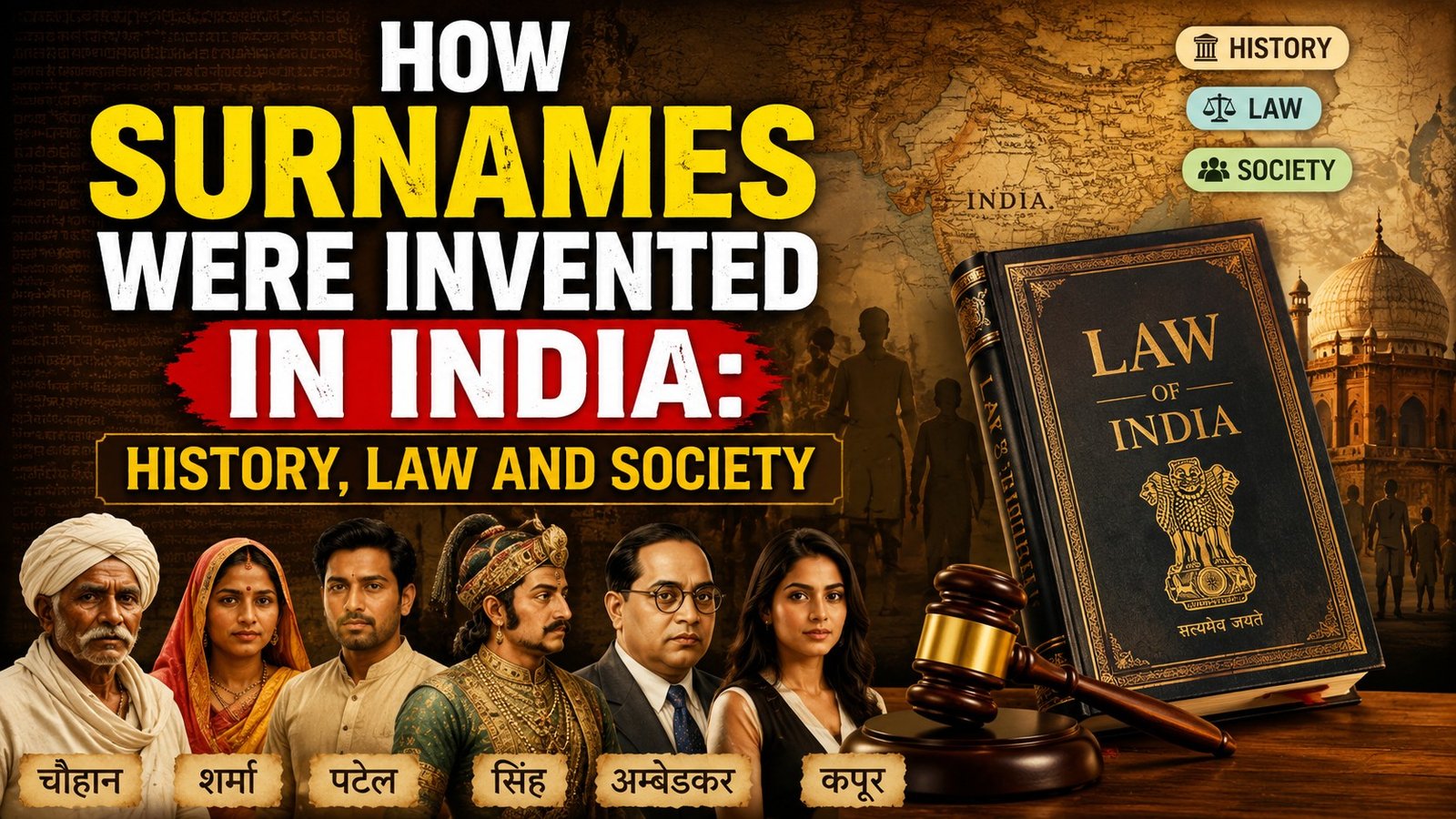
How Surnames Were Invented in India: History, Law and Society
For most of India’s ancient history, people did not use hereditary surnames in the modern sense; individuals were known by a single given name, sometimes accompanied by descriptors such as father’s name, place of origin, title or lineage (gotra). The idea of a fixed family name passed unchanged from generation to generation took shape gradually—from early lineage markers and clan names, through medieval titles and occupational labels, and finally, under the pressure of British colonial census and administrative systems in the nineteenth and early twentieth centuries.[1][2][3][4]
Today, Indian surnames encode a dense mix of information: caste and community, occupation, region, clan, and sometimes religious reform, and they function simultaneously as legal identifiers and social signals. This article traces that long journey, explains how different communities “invented” surnames in different ways, and offers a legal-constitutional perspective on names, identity and equality in contemporary India.[5][6][^7]
1. Names in Ancient India: A World Without Surnames
1.1 Single names and descriptive identifiers
In Vedic and early classical India, individuals were typically known by one principal name, such as Ashoka, Arjuna, Yājñavalkya or Kabir, without any hereditary surname attached. Royal inscriptions, religious texts and early literary sources overwhelmingly refer to famous figures by single names or by epithets that describe virtues, achievements or roles, rather than by fixed family names. For example, inscriptions and chronicles speak of “Devanampiya Piyadasi” (beloved of the gods) and “Ashoka” the king, but not “Ashoka Sharma” or “Ashoka Gupta”—forms that reflect much later naming practices.[2][6][^4]
Where more specificity was required, ancient Indian practice relied on descriptive additions:
- The father’s name (X, son of Y)
- Place of origin (X of such-and-such village or janapada)
- Titles (king, rishi, acharya, headman, etc.)
These descriptors were contextual and could change across documents; they were not stabilized as hereditary surnames passed to descendants.[6][1]
1.2 The role of lineage and gotra
Although hereditary surnames were absent, lineage was deeply important in ancient Indian society, and the gotra system provided a structured way of marking descent. Gotra refers to a patrilineal clan tracing origin to one of a group of ancient rishis (often the saptarishi), and it became central in rules governing marriage, ritual and social organization.[4][8]
In practice, a Purohit or certain Kshatriya could be described in ritual contexts by both personal name and gotra—”X of Y gotra”—signalling his place in the larger lineage network. However, gotra functioned primarily within religious and social norms; it was not usually employed as an everyday surname in civil records or introductions, nor did it necessarily operate as a hereditary family name in the modern legal-administrative sense.[7][8][^4]
1.3 Patronymics and epithets
Patronymic naming—identifying an individual by their father’s name—was widespread. Epic traditions describe heroes like “Arjuna, son of Pandu” and “Bhima, son of Pandu,” where the father’s name operates as a crucial identifier without becoming a fixed surname. Similar formulations appear in copper-plate charters and land grants, where grantees and donors are described through patronymics, titles and regions.[^1]
Epithets further enriched names: ascetics, poets and saints could be known by spiritual titles or honorifics that later blurred into community identifiers (for example, “Chattopadhyay” in Bengal combines an honorific “upadhyaya”—teacher—with a geographical marker related to the Ganga region). Yet even such elaborate names did not necessarily operate as fully stabilized surnames across generations until much later.[4][7]
2. Medieval Transformations: From Titles to Hereditary Labels
2.1 Political consolidation and land rights
Between roughly 600 CE and 1700 CE, Indian society saw increasing political centralization, the spread of feudal-style land grants, and more rigid occupational hierarchies. As rights over land, offices and ritual functions became more hereditary, the descriptors associated with these roles slowly began to harden into quasi-surnames. A village headman, accountant or priest might be known widely by a functional title, such as Deshmukh (district chief), Kulkarni (village record-keeper) or Joshi (astrologer)—that, over generations, became the family name of his descendants.[5][7][1][4]
These emergent surname-like labels still coexisted with older practices of patronymics and epithets, and they were far from universal. Many people continued to use only single names or flexible combinations of descriptors, especially in regions or communities where social mobility or local custom favoured fluid naming.[^6]
2.2 Caste identities and social markers
Medieval India also witnessed regional crystallization of caste identities and jati groupings. Names and titles increasingly reflected varna (broad caste category) and jati (sub-caste or community) affiliations. Over time, some of these identifiers stabilized into the surnames of whole communities.[7][6]
For instance, surnames like Sharma (associated with Purohits), Yadav (linked to pastoral communities and later to certain OBC groups), or Gowda (associated with landowning communities in Karnataka) reflect this process of converting caste designations into hereditary name labels. Nevertheless, these developments were uneven across the subcontinent; many regions maintained fluid naming conventions until the colonial era forced greater standardization.[5][6][^7]
2.3 Clan and lineage names
In certain Kshatriya and high-status lineages, clan names tied to legendary ancestors or prominent ruling houses gradually acquired the character of family names. Labels such as “Maurya” or “Chalukya” began as names of dynasties or ruling families and only later became more widely used as surnames among descendant or affiliated groups. Similarly, some gotra-derived identifiers and regional clan titles slowly turned into surnames as communities began to use them continuously across generations.[8][4]
The crucial point is that even in medieval times, surnames were not yet universal or legally required; they arose organically as certain social markers—titles, clans, castes, occupations—hardened into hereditary naming practices among parts of the population.[1][6]
3. Sikh Naming Reform: Singh and Kaur as Deliberate Surnames
3.1 Historical background
A major turning point for the conscious “invention” of surnames within a religious community occurred in 1699, when Guru Gobind Singh, founder of the Khalsa, introduced a revolutionary naming reform for Sikhs. He directed that all initiated Sikh men should bear the name “Singh” (lion) and all initiated Sikh women should bear the name “Kaur” (princess), appended to their given names.[9][4]
This was not simply a stylistic choice; it was a deliberate attempt to erase caste markers and create a unified Khalsa identity that transcended traditional jati labels. In effect, the Guru imposed a common surname structure—first name plus Singh/Kaur—as a symbolic leveller within the community.[9][4]
3.2 Social and legal implications
Over time, “Singh” and “Kaur” became deeply entrenched as hereditary name elements in Sikh communities, though regional and caste surnames sometimes continue to coexist. In legal documents, passports and educational records, Sikh names today commonly follow the format “Gurpreet Singh” or “Harpreet Kaur,” with Singh/Kaur functioning as surnames or middle names, depending on the jurisdiction and personal choice.[6][4]
From a legal perspective, this reform illustrates an important principle: surnames can be consciously engineered for social reform—here, to weaken caste visibility—rather than simply inherited from historical hierarchies. Yet even in Sikh practice, the tension between egalitarian surnames and traditional caste identities persists, especially where additional family names reveal older social divisions.[^4]
4. British Colonial Rule: The Decisive Push Towards Fixed Surnames
4.1 Colonial administration and the need for stable identifiers
The most decisive phase in the invention and proliferation of surnames across India came under British colonial rule, particularly from the mid‑nineteenth century onward. As the colonial state expanded systems of land revenue, taxation, policing, and, above all, census enumeration, it required individuals to have stable, recordable identities that could be tracked over time.[3][2][^4]
British officials, working with their own cultural assumptions about Western naming conventions, insisted that Indian subjects have a “family name” or “surname” that could be used consistently in official registers, legal documents and bureaucratic paperwork. This insistence transformed informal descriptors—patronymics, titles, caste labels, occupational tags or village names—into legally fixed surnames.[2][3]
4.2 The colonial censuses (1871–1931)
The censuses of British India, beginning in 1871 and continuing through successive decades, played a critical role in codifying Indian names as markers of caste and community. Enumerators often treated certain surnames as direct indicators of caste status, thereby classifying populations into rigid categories that reinforced social hierarchies.[7][4]
Researchers have shown how colonial officials like H.H. Risley used surnames, alongside physical measurements and social data, to construct elaborate theories of racial and caste difference in India, giving administrative backing to nomenclature that had previously been more fluid. Once surnames were recorded in census tables and linked to caste groups, they tended to remain fixed, because any change risked administrative confusion or legal complications.[^4]
4.3 Land laws and caste-linked naming
Colonial land legislation further tied names to caste and legal status. For instance, laws such as the Punjab Alienation of Land Act classified agriculturalist and non‑agriculturalist castes and restricted land transfer between them. Surnames became one of the key markers by which officials inferred a person’s caste category, thereby affecting their legal rights over land and resources.[7][4]
In some areas, the Criminal Tribes Act relied on caste labels and community names to stigmatize entire groups as “habitually criminal,” again using surnames among other identifiers for enforcement. Thus, the British did not merely record Indian surnames; they helped invent and solidify them as instruments of governance and social control.[^4]
4.4 From flexible naming to fixed “family name”
For ordinary Indians, the colonial demand for a stable surname meant that families had to select one descriptor—often a caste name, occupational title, village name or ancestor’s name—and freeze it as their hereditary family name. Over a generation or two, the previously flexible naming system settled into a more rigid pattern: first name + chosen surname.[3][2]
Formulas like “Narendra Damodardas Modi” (given name + father’s name + community surname “Modi,” referring to a trading group) illustrate this layered structure: some elements remain fluid (father’s name), while the community or caste label becomes the legally fixed surname used for documentation. In many regions, an earlier pattern—first name + father’s name + village or occupation—converged into first name + surname once the last element was standardized as hereditary.[3][6]
5. How Indians “Invented” Their Surnames Under Colonial Pressure
5.1 Occupational surnames
One of the most common strategies for surname invention was to adopt the traditional occupation or social role of the family as the surname. Examples include:[5][1]
- Mehta: originally meaning “head” or “chief” and later used for accountants, teachers or respected figures in various regions.[1][5]
- Kulkarni: referring to the hereditary village record-keeper in Maharashtra.[^5]
- Deshmukh: a title for local district overlords or revenue heads.[1][5]
- Kansara: associated with metal workers or brass utensil makers.
Such titles, once occupational descriptors, became fixed surnames when families started using them consistently in official records and passing them on to descendants.[5][1]
5.2 Regional and toponymic surnames
Another widespread pattern was the adoption of place-based or toponymic surnames, which link individuals to ancestral villages, towns or regions.[3][5]
In Maharashtra and parts of western India, surnames with the suffix “‑kar” often indicate origin from a particular place: Kelkar from Kel, Nagarkar from Nagar, etc. In coastal Karnataka, the surname “Padukone” refers to an ancestral village by the same name, and similar structures exist across many linguistic zones.[3][5]
These surnames were relatively neutral compared to caste labels and sometimes allowed families to foreground regional identity over strict jati identification, though in practice many toponymic surnames also became associated with specific communities.[3][5]
5.3 Caste and community surnames
A large number of Indian surnames derive directly from caste or community designations. Names like Sharma, Bhattacharya/Chattopadhyay, Rao, Iyer, Iyengar, Yadav, Jatav, Patel and countless others are historically tied to particular varna or jati groups.[6][7][^5]
In north India, surnames such as Sharma, Verma, Singh, Yadav, Gupta, and Mishra often immediately signal caste or community, and social interactions routinely rely on this implicit knowledge. In western India, labels like Patel (village headman or landowner), Desai (lord of a village or revenue officer) and Thakur (landholding or Kshatriya groups) similarly encode both caste and economic status.[6][7][4][5]
Such surnames were not always hereditary before the colonial period; they were occasionally used as titles or honorifics. Colonial administrative practice, however, encouraged people to adopt these caste labels as permanent surnames, thereby solidifying the association between name and caste.[7][4]
5.4 Clan, gotra and lineage-based surnames
In some communities, particularly among certain Purohit groups and Rajput lineages, clan or gotra names evolved into surnames. For example, Bengali Brahmin surnames such as Chattopadhyay (modern Chatterjee) or Gangopadhyay (modern Ganguly) carry both regional and ritual significance linked to the Ganga region and priestly traditions.[4][7]
Similarly, Rajput and other Kshatriya groups may use clan names derived from legendary ancestors or regional lineages as family names, reinforcing martial and aristocratic identities within the surname itself.[8][7][^4]
5.5 Creative and humorous surnames: the Parsi example
Parsi communities, particularly in western India, developed a distinct tradition of inventing surnames that are often humorous or descriptive of ancestral quirks and occupations. Well-known examples include:[^3]
- Sodawaterwala: indicating a family associated with aerated drinks or soda water.
- Daruwala: linked to trade in alcohol or gunpowder.
These creative surnames illustrate the flexibility with which communities could respond to the colonial demand for a fixed family name, turning it into a vehicle for identity, memory and even humour.[^3]
6. Regional Variations in the Evolution of Surnames
6.1 North India
In north India, especially the Hindi‑speaking belt, surnames such as Sharma, Verma, Singh, Yadav, Gupta, Mishra, Tripathi and others are strongly tied to caste and traditional occupation.[6][5][^4]
- Sharma, Mishra, Tripathi and similar surnames are typically associated with Brahmin communities.
- Yadav, Jatav, Gurjar and others point to specific OBC or Dalit jatis.
- Singh, originally a Rajput and warrior‑class title, has spread widely across castes and communities, including Sikhs and many Hindu groups.[^4]
Census practices and social norms have cemented the idea that hearing a north Indian surname often reveals, or at least hints at, the bearer’s caste, region and social position.[7][4]
6.2 Western India (Gujarat and Maharashtra)
In western India, surnames such as Patel, Desai, Shah, Joshi, Kelkar, Kulkarni, Deshmukh and others foreground landholding status, village offices, trading communities and ritual functions.[5][7][^3]
- Patel historically denoted a village headman or landholder and today is strongly associated with agricultural and mercantile communities, particularly in Gujarat.[7][5]
- Shah is widely linked to merchant and Jain communities.
- Kulkarni and Deshmukh refer back to Maratha-era offices in village administration and revenue collection.[^5]
These surnames not only reveal economic and caste positions but also tell a story about historical governance structures in the region.
6.3 Southern India
Southern Indian naming conventions historically relied more on initials, patronymics and place names than on Western-style surnames. A person could be identified as “X Y Z” where:[^6]
- X is the village or family name
- Y is the father’s name
- Z is the personal name
When interacting with colonial bureaucracy, many such names had to be compressed into first name + surname formats, leading to different families choosing different elements (village name, father’s name or lineage name) as the hereditary surname. Even today, many south Indians use initials (e.g., “M. Karunanidhi”) or different name orders, and the legal surname may not match everyday customs.[10][6]
6.4 Eastern India (Bengal and neighbouring regions)
In Bengal and neighbouring areas, surnames such as Banerjee (from Bandopadhyay), Mukherjee (from Mukhopadhyay), Chatterjee (from Chattopadhyay), and Ganguly (from Gangopadhyay) show a layered evolution. The original forms combined:[4][7]
- A regional reference (often the Ganga region)
- The honorific “upadhyaya” (teacher)
Over time, British officials, missionaries and printers anglicised these names into shorter forms like Ganguly and Chatterjee, which then became standard surnames, illustrating how colonial phonetics and spelling influenced surname evolution.[7][4]
7. Legal and Constitutional Dimensions of Surnames in India
7.1 Names as legal identity
In independent India, surnames (along with given names) have become central to legal identity in documents such as birth certificates, passports, voter IDs, Aadhaar cards, school and college records, and property papers. Statutes and rules concerning registration of births and deaths, civil procedure, evidence and revenue all presuppose a stable name by which an individual can be identified and traced.[^6]
From a legal standpoint, the surname is often treated as part of an individual’s “name” in personal law, contract and litigation, though Indian law does not universally require a surname in the strict Western sense. Many communities and individuals continue to use single names or unconventional structures, and courts generally respect local custom so long as identity is clear.[^6]
7.2 Right to change one’s name and surname
Indian jurisprudence recognizes a broad right to change one’s name—including surname—subject to reasonable procedures. Gazette notifications, affidavits and appropriate intimation to authorities allow individuals to adopt new surnames or drop old ones, which has been used by many to escape caste stigma or align identity with personal beliefs.[4][6]
Constitutionally, such change can be grounded in the rights to equality (Articles 14–15), personal liberty (Article 21) and freedom of expression, enabling individuals to resist caste‑revealing surnames if they so choose. However, practical barriers (social pressure, documentation hassles, and family expectations) may limit the widespread exercise of this right.[^4]
7.3 Surnames, caste discrimination and affirmative action
In everyday life, surnames remain powerful proxies for caste and community, often leading to prejudice, discrimination or stereotyping. Hiring decisions, housing access and social acceptance can be affected merely by the surname appearing on a form or doorplate.[7][4]
At the same time, surnames are relevant in implementing affirmative action policies: reservation benefits under Articles 15(4) and 16(4) are tied to membership of Scheduled Castes, Scheduled Tribes and Other Backward Classes, which in practice are identified through lists that reference caste names, often mirrored in surnames. Legal and administrative systems thus both combat and inadvertently reinforce caste visibility through surnames.[7][4]
7.4 Women’s surnames and marriage
Traditional practice often required women to adopt their husband’s surname upon marriage, symbolically shifting their identity from natal family to marital family. Modern law and judicial decisions increasingly affirm that women are free to retain their maiden surnames, adopt a hyphenated surname, or take their husband’s surname as they choose, underscoring autonomy in matters of identity.[^6]
These developments have particular significance in contexts such as property rights, succession, and professional recognition, where continuity of name and surname can affect documentation and legal claims.
8. Contemporary Trends: Fluidity, Hybridity and Resistance
8.1 Urbanisation and inter‑caste marriages
Rapid urbanisation, higher education and increasing rates of inter‑caste, inter‑religious and inter‑regional marriages are changing surname practices in contemporary India. Couples experiment with hyphenated surnames, choose neutral surnames, or sometimes drop caste‑revealing surnames altogether, particularly in metropolitan areas.[6][7]
In cities like Delhi, Mumbai, Bengaluru and Hyderabad, one encounters professional environments where surname no longer guarantees accurate caste inference, though social curiosity about surnames persists. This partial decoupling of surnames from rigid caste meanings reflects broader social shifts.[7][6]
8.2 Minimalist and single-name identities
Some individuals, especially artists, activists or those seeking to escape caste labels, adopt single names or minimalist naming structures, relying on legal mechanisms to formalise their choice. While bureaucratic systems often prefer first name + surname formats, Indian law allows considerable flexibility so long as documents are internally consistent.[^4]
Such practices can be read as forms of resistance against the historical function of surnames as caste identifiers, and they raise important questions about how future legal frameworks should accommodate diverse naming conventions.
8.3 Digital identity and standardisation
The digitisation of records (Aadhaar, PAN, digital land records, online education and employment portals) has increased the pressure to standardise names and surnames into uniform formats. Software systems typically demand separate fields for “first name” and “last name,” reflecting global technology assumptions rather than local naming realities.[^6]
This can create friction for individuals whose traditional names do not fit neatly into such categories, leading to informal re‑engineering of names and sometimes unintended changes in surname usage. Over time, digital practices may further shape how surnames are used and understood in India.
9. Summary: The Long Invention of Indian Surnames
The story of Indian surnames is not one of a single moment of invention but of a layered historical process:[8][1][^4]
- Ancient period: individuals primarily used single names, supplemented by patronymics, place names, titles and gotra identifiers without hereditary surnames in the modern sense.[2][8][^6]
- Medieval period: as land rights, offices and caste hierarchies hardened, certain occupational titles, clan names and caste labels began to behave like hereditary surnames for particular communities.[1][5][^7]
- Sikh reform: Guru Gobind Singh’s introduction of Singh and Kaur as common name elements for Khalsa members exemplified conscious, egalitarian surname engineering.[9][4]
- Colonial period: British administrative and census practices decisively pushed Indians to adopt fixed surnames, often solidifying caste, occupation or regional identity into hereditary family names linked to legal records.[2][3][^4]
- Independent India and beyond: surnames became central to legal identity but continued to carry the weight of caste and community, even as social reform, constitutional rights and new cultural practices encouraged experimentation, change and resistance.[4][7][^6]
Understanding how surnames were invented in India reveals not only the history of names but also the evolution of law, caste, property and equality. For legal professionals, sociologists and citizens alike, the surname is a living document of India’s journey from fluid lineage and local ties to formal identity systems—and a reminder that name and law remain deeply intertwined.
References
- “The Significance of Indian Surnames: Exploring Their Origins … – In India, surnames are often based on a person’s occupation, geographic location, clan, or caste. Fo…
- How the surnames started and what’s the point of it? – How the surnames started and what’s the point of it?
- History of INDIAN SURNAMES!!! – Why do Indians have so many unique surnames? 🤔
What do Deepika Padukone, Sourav Ganguly, Ronnie Sc…
- India’s Surnames: Caste, History & Colonial Truth | THE HOMEWORK – India’s Surnames: Caste, History & Colonial Truth | THE HOMEWORK
Did you know that simply by heari…
- Indian Last Names – Discover the most popular Indian surnames. Find your Indian last name from A to Z. Learn the meaning…
- India Naming Customs – Indian names are based on a variety of systems and naming conventions, which vary from region to reg…
- Understanding Indian Surnames: A Cultural And Historical Perspective – Indian surnames are not merely family names; they are intricate symbols of culture, history, and ide…
- Gotra — Wikipédia
- Surnames, where do they come from? – Ever wonder what your surname means? Or where it comes from? Or which generation of your ancestors c…
- Indian name – Wikipedia