The advent of Europeans in India refers to the long historical process, beginning with Vasco da Gama’s arrival at Calicut in 1498, through which European trading companies gradually transformed from commercial visitors into political rulers over large parts of the subcontinent.[1][2] What started as a search for spices and sea routes ended in nearly two centuries of British colonial dominance, leaving a deep imprint on India’s economy, society, law and polity.[2][3]
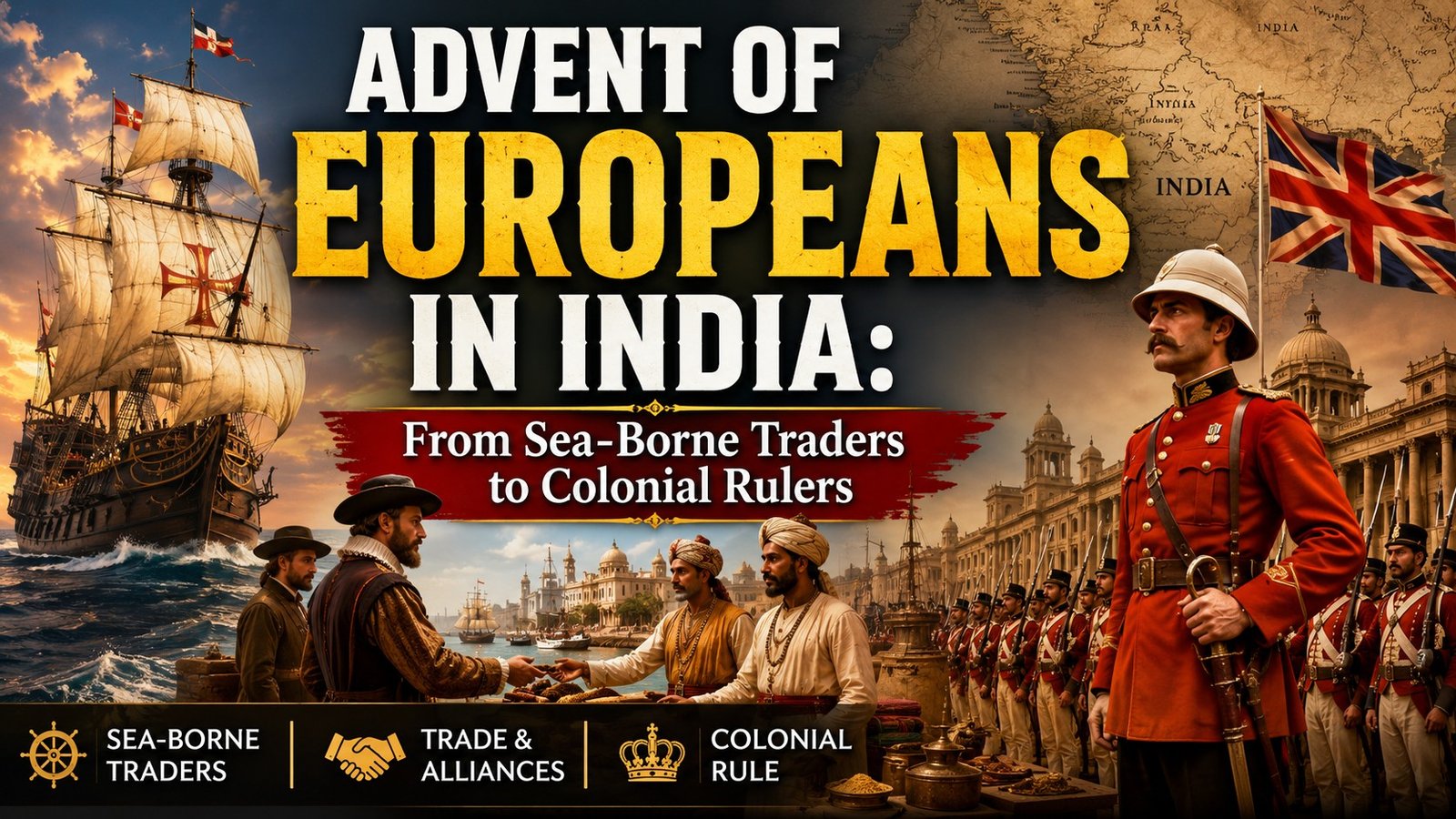
Advent of Europeans in India: From Sea‑Borne Traders to Colonial Rulers
Geographical discoveries and global context
In the fifteenth and sixteenth centuries, European states such as Portugal, Spain, the Netherlands, England and France were driven by the desire to find new sea routes to Asia, particularly to tap the lucrative spice trade centred in the Indian Ocean.[3][2] The traditional land routes through Syria, Egypt and the Ottoman-controlled regions were monopolised by Arab and Turkish intermediaries, making Asian goods expensive and encouraging Europeans to seek direct maritime access to India and Southeast Asia.[4][2] These voyages of discovery, including Columbus’s crossing of the Atlantic in 1492 and Vasco da Gama’s voyage to India in 1498, opened the way for sustained European presence on the Indian coasts.[2][3]
Motives behind the European entry into India
Economic motives were primary: European demand for Indian spices like pepper, cinnamon, cloves, and textiles such as calicoes and silks created huge profit opportunities if traders could bypass Middle Eastern intermediaries.[5][3] Political and religious motives were also significant, as Catholic powers like Portugal aimed to spread Christianity in Asia and to curb the influence of Muslim powers and Arab merchants in the Indian Ocean trade.[4][3] Later, with the rise of mercantilism and capital accumulation in Europe, trading companies increasingly sought not just commerce but monopoly rights, fortified settlements and territorial control to secure their economic interests.[6][2]
The first arrivals: Portuguese breakthrough to India
The Portuguese were the earliest Europeans to arrive in India, when Vasco da Gama sailed around the Cape of Good Hope and reached Calicut on the Malabar Coast in 1498, guided by an Indian pilot from Gujarat.[7][1][3] His arrival established a direct sea route between Europe and India, breaking the Arab monopoly over Indian Ocean trade and inaugurating the age of European maritime empires in Asia.[2][4] Vasco da Gama secured permission from the Zamorin of Calicut to trade, and on subsequent voyages the Portuguese began setting up fortified factories and asserting naval supremacy in the Arabian Sea.[8][7]
Consolidation of Portuguese power on the western coast
Within a few years of their arrival, the Portuguese established their first factory at Calicut around 1500, and by 1503 they had founded a more permanent base at Cochin, which soon became a key headquarters.[9][7] Under Afonso de Albuquerque, who was appointed governor of Portuguese India, they captured Goa in 1510 and developed it into the political and commercial centre for their possessions in India and further east in Malacca and Java.[5][4] Through fortified ports at Goa, Daman and Diu and heavily armed ships, the Portuguese imposed a system of passes (cartaz) on Indian Ocean shipping, using naval power and coercive tactics to dominate regional maritime trade.[5][4]
Portuguese commercial strategy and its wider impact
The Portuguese sought to monopolise the spice trade by controlling key ports and sea-lanes, often violently displacing Arab traders and restricting the movement of rival merchants.[10][4] Their presence brought new crops such as tobacco, maize and chillies to India, and they introduced the first printing press in Goa during the mid‑sixteenth century, contributing to cultural and technological exchanges.[11][7] However, their harsh religious policies, attempts at forced Christianisation, and reputation as maritime raiders created hostility among both major powers like the Mughals and regional rulers along the coast.[4][5]
Causes of Portuguese decline in India
By the seventeenth century, Portuguese commercial monopoly in India began to erode due to a combination of external and internal factors, including the rise of stronger local powers and new European rivals.[5][4] Maratha expansion on the western coast, the emergence of assertive regimes in Egypt, Persia and North India, and Mughal disapproval of Portuguese aggression all undermined their political position.[6][5] The union of Spain and Portugal in 1580 dragged Portugal into Spain’s wars with England and Holland, allowing the Dutch and English to learn and exploit the sea route to India, thereby breaking Portuguese exclusivity.[4][5]
Dutch arrival and commercial focus
The Dutch were among the next Europeans to appear in the Indian Ocean world, forming the Dutch East India Company (VOC) in 1602, with wide powers to wage war, make treaties, acquire territories and build forts.[12][4] Dutch traders reached India around 1605 and established their first factory at Masulipatnam on the Coromandel Coast, later expanding to Pulicat, Nagapattinam and other centres.[13][9] The Dutch primarily focused on controlling the spice trade in the Malay Archipelago, but they also competed with Portuguese and English traders along the Indian coasts, at times capturing English ships and challenging Portuguese strongholds.[6][5]
Dutch settlements and limited political ambition
In India, the Dutch set up trading posts and factories in places like Masulipatnam, Pulicat, Nagapattinam and Hugli, integrating these into their broader Indian Ocean trading network.[3][13] Despite their commercial success, the Dutch remained largely focused on trade rather than building a territorial empire in India, preferring to concentrate on the highly profitable Indonesian spice islands.[5][4] This lack of sustained political ambition in India, combined with growing Anglo‑Dutch rivalry, shaped the eventual trajectory of Dutch power on the subcontinent.[12][6]
Anglo‑Dutch rivalry and the decline of Dutch influence
The Dutch and English competed fiercely in both European and Asian waters, and the Anglo‑Dutch wars in the seventeenth century affected their operations in India.[6][5] During one phase of this rivalry, Dutch forces disrupted English communications between Surat and the rising English settlement at Bombay, even capturing English ships in the Bay of Bengal.[12][5] However, their defeat in the Battle of Hooghly in 1759 by English forces dealt a decisive blow to Dutch aspirations in India, after which they largely retreated from competition for territorial control.[12][5]
Rise of the English East India Company
English merchants formed a company to trade with the East in 1599, and Queen Elizabeth I granted a royal charter in 1600, giving the East India Company exclusive English trading rights in the East.[13][12][5] The Company’s first voyage to India led to contact with the Mughal court, and by 1608 Emperor Jahangir had permitted them to establish a factory at Surat on the western coast.[9][3] Over the next decades, the Company secured further farmans, and by 1615 it obtained broad rights for free trade within the Mughal Empire, enabling rapid expansion of its commercial operations.[3][5]
English expansion across coastal India
From their initial base at Surat, the English East India Company steadily expanded its presence, with new factories at Madras (Fort St. George) on the Coromandel Coast, Bombay on the western coast, and later Calcutta (Fort William) in Bengal.[13][2][3] The Company shifted its main headquarters from Surat to Bombay in 1687, and to Calcutta around 1700, reflecting changes in trade patterns and political priorities.[9][13] By the early eighteenth century, the Company had become the foremost European commercial power in India, though it still appeared primarily as a trading corporation rather than a sovereign authority.[10][5]
Transition from trading company to territorial power
The gradual decline of the Mughal Empire, combined with regional political instability and competition among Indian rulers, created opportunities for the East India Company to intervene in local politics.[6][5] The Company exploited rivalries among Indian rulers and French competitors, building alliances, maintaining private armies and eventually assuming fiscal and administrative powers over territories like Bengal.[10][5] The Battle of Plassey in 1757, where the Company defeated the Nawab of Bengal, marked a clear shift from commercial to political dominance, initiating a period of British control that grew over the next century.[2][5][6]
Danish arrival and limited footprint
The Danish East India Company was formed in 1616, and Danish traders arrived in India soon after, establishing their first factory at Tranquebar on the Tamil Nadu coast in 1620.[14][9][13] They later developed Serampore in Bengal as a significant base, holding it from around 1676 until 1845, and also maintained smaller outposts.[10][13] However, the Danes were never a major political force in India, and eventually they sold their Indian settlements to the English in the mid‑nineteenth century, leaving the field to the British.[13][10]
French arrival and search for influence
The French East India Company was formed in 1664 under the guidance of Colbert, and the first French factory in India was established at Surat in 1668 by François Caron.[9][2][13] The French gradually built a network of factories and settlements at Masulipatnam, Pondicherry, Mahe, Karaikal, Chandernagore, Balasore and other coastal centres, becoming serious rivals to the English in southern and eastern India.[3][10][5] By the mid‑eighteenth century, French governors like Dupleix began to pursue ambitious political strategies in the Deccan and Carnatic regions, aligning with Indian rulers and vying with the English for territorial supremacy.[15][5]
Anglo‑French rivalry and the Carnatic Wars
The struggle between English and French East India Companies erupted into a series of protracted conflicts in South India, known as the Carnatic Wars, fought roughly between 1744 and 1763.[15][2][10] In these wars, both sides intervened in succession disputes among Indian rulers, supported rival claimants and used military force to secure influence over territories and trade routes.[15][5] Ultimately, the decisive English victory over the French at the Battle of Wandiwash in 1760–63 shattered French hopes of establishing a dominant political role in India, leaving the English without serious European rivals.[15][5]
French decline and English supremacy
After their defeat in the Carnatic Wars, the French retained only a few small enclaves—such as Pondicherry and Chandernagore—and their role in India remained commercially minor and politically dependent on British tolerance.[3][10] Several factors contributed to French failure, including the superior naval power and financial strength of the English East India Company, the longer-established and better‑defended English settlements, and inadequate support from the French government.[15][5] Strategic missteps by French leaders like Dupleix, who dispersed efforts and neglected the company’s finances, further weakened the French position, allowing the English to consolidate supremacy.[5][15]
Battle of Plassey and British ascendancy in Bengal
The Battle of Plassey in 1757, fought between the English East India Company under Robert Clive and the forces of Siraj‑ud‑Daulah, the Nawab of Bengal, is a pivotal event in the advent of European political power in India.[2][5] Clive’s victory, aided by the treachery of key Bengali leaders, enabled the Company to secure control over Bengal’s revenues and administration, transforming it into a territorial power with unprecedented resources.[6][5] This success laid the foundation for subsequent British expansion into other regions, as the Company used Bengal’s wealth to finance further military campaigns and commercial monopolies.[2][6]
Expansion of Company rule and the road to Crown Raj
Following Plassey, the Company’s authority expanded through treaties, wars and annexations, including the grant of Diwani rights over Bengal, Bihar and Orissa, and later control of Mysore, the Maratha territories and other princely states.[2][6] Military victories, such as the Third Anglo‑Mysore War and later conflicts with Maratha confederacies, gradually extended Company rule over most of India, though many princely states retained nominal autonomy under British suzerainty.[6][2] The Indian Rebellion of 1857, rising against Company rule, ultimately led to the transfer of power from the East India Company to the British Crown in 1858, inaugurating the formal British Raj that lasted until 1947.[3][2]
Transformation of traditional trade networks
European trading companies, beginning with the Portuguese and followed by Dutch, English, Danes and French, reshaped India’s traditional trade networks by imposing monopolies and redirecting commerce through their controlled ports.[10][6] Ports like Calicut and Surat declined as Bombay, Madras and Calcutta rose under Company patronage, and Indian merchants often found themselves excluded from the most profitable long‑distance trades or dependent on European intermediaries.[3][6] The shift in trade routes and the capture of key export commodities by European companies contributed to deindustrialisation and the reorientation of India’s economy toward serving European markets.[3][6]
Impact on Indian manufacturing and handicrafts
European tariff and trade policies, especially under British rule, favoured the import of machine‑made textiles from Britain and undercut the competitiveness of Indian hand‑woven cloth in both domestic and foreign markets.[6][3] Skilled artisans and weavers in regions such as Bengal suffered severe decline as demand for their products shrank, and many communities experienced poverty and loss of livelihood.[3][6] India increasingly became a supplier of raw materials—such as cotton and indigo—rather than a producer of finished goods, weakening indigenous manufacturing capacity and limiting technological development.[6][3]
Changes in agriculture and rural economy
European commercial presence and later colonial rule promoted the cultivation of cash crops such as indigo, cotton and opium, often at the expense of food crops, leading to greater vulnerability to famines.[3][6] Revenue systems like the Permanent Settlement and Ryotwari altered traditional landholding structures, monetised land revenue and pushed peasants into debt to moneylenders and colonial intermediaries.[6][3] The combination of commercialisation, indebtedness and exploitation generated profound transformations in the rural social structure and aggravated socio‑economic inequalities.[3][6]
Social, cultural and religious consequences
European presence introduced new religious dynamics, particularly through Portuguese and later other missions that sought to spread Christianity in India, provoking both conversion and resistance.[4][3] Over time, British rule also led to the introduction of Western education, new legal codes, and administrative practices, which reshaped aspects of Indian society and created new classes such as English‑educated elites.[6][3] While some reforms and ideas contributed to social change and modern political consciousness, they coexisted with racial hierarchies and cultural domination inherent in colonial rule.[3][6]
Indian responses to European encroachment
Indian rulers and merchants initially engaged with European traders as one among many players in the complex Indian Ocean economy, granting concessions or resisting them depending on political circumstances.[10][5] As European companies expanded their claims and imposed monopolies, local powers—including the Mughals, Marathas and coastal kingdoms—at times challenged their fortresses, policies and aggression, such as Maratha attacks on Portuguese Goa in the late seventeenth century.[4][5] Later, widespread resistance, culminating in revolts like the Indian Rebellion of 1857, reflected deep grievances against economic exploitation, political subordination and social interference under Company rule.[2][6]
Long‑term legacy of the European advent in India
The advent of Europeans in India transformed the subcontinent from a major node in a relatively balanced Asian trade network into a colonial economy subordinated to European industrial and strategic interests.[6][3] European competition, especially the ultimate dominance of the British, reshaped India’s political map, dismantling older empires and consolidating a vast colonial state whose institutions continue to influence modern Indian administration and law.[2][6] At the same time, the encounter with European powers introduced new technologies, ideas and global linkages, which, along with Indian resistance and reform movements, helped to shape the nationalist struggles that eventually achieved independence in 1947.[2][3]
This article traces how successive European powers—Portuguese, Dutch, English, Danes and French—entered India as maritime traders, competed for control of trade routes and ports, and gradually transformed commercial footholds into far‑reaching political and economic domination, especially under the British.[10][2]
- https://vajiramandravi.com/upsc-exam/advent-of-europeans-in-india/
- https://testbook.com/ias-preparation/advent-of-european-in-india
- https://www.vedantu.com/general-knowledge/advent-of-europeans-in-india
- https://lotusarise.com/advent-of-europeans-in-india-upsc/
- https://upscwithnikhil.com/article/history/the-advent-of-european-in-india
- https://www.legacyias.com/daily-answer-writing/mains-question-02-12-2025-gs2-international-relations/
- https://www.scribd.com/document/786103682/Advent-of-Europeans
- https://www.youtube.com/watch?v=Rlit7wFrCBw
- https://www.scribd.com/document/867710747/Advent-of-Europeans-in-India-PDF
- https://www.scribd.com/document/820670423/Advent-of-Europeans-in-India
- https://www.scribd.com/document/717588878/Advent-Of-Europeans
- https://www.scribd.com/document/932340771/6061-Classroom-0-Advent-of-the-Europeans-Handout
- https://www.scribd.com/document/441389302/advent-of-european-in-India
- https://www.instagram.com/reel/DRo86C2iEaB/
- https://www.slideshare.net/slideshow/advent-of-europeans-to-india/149821680