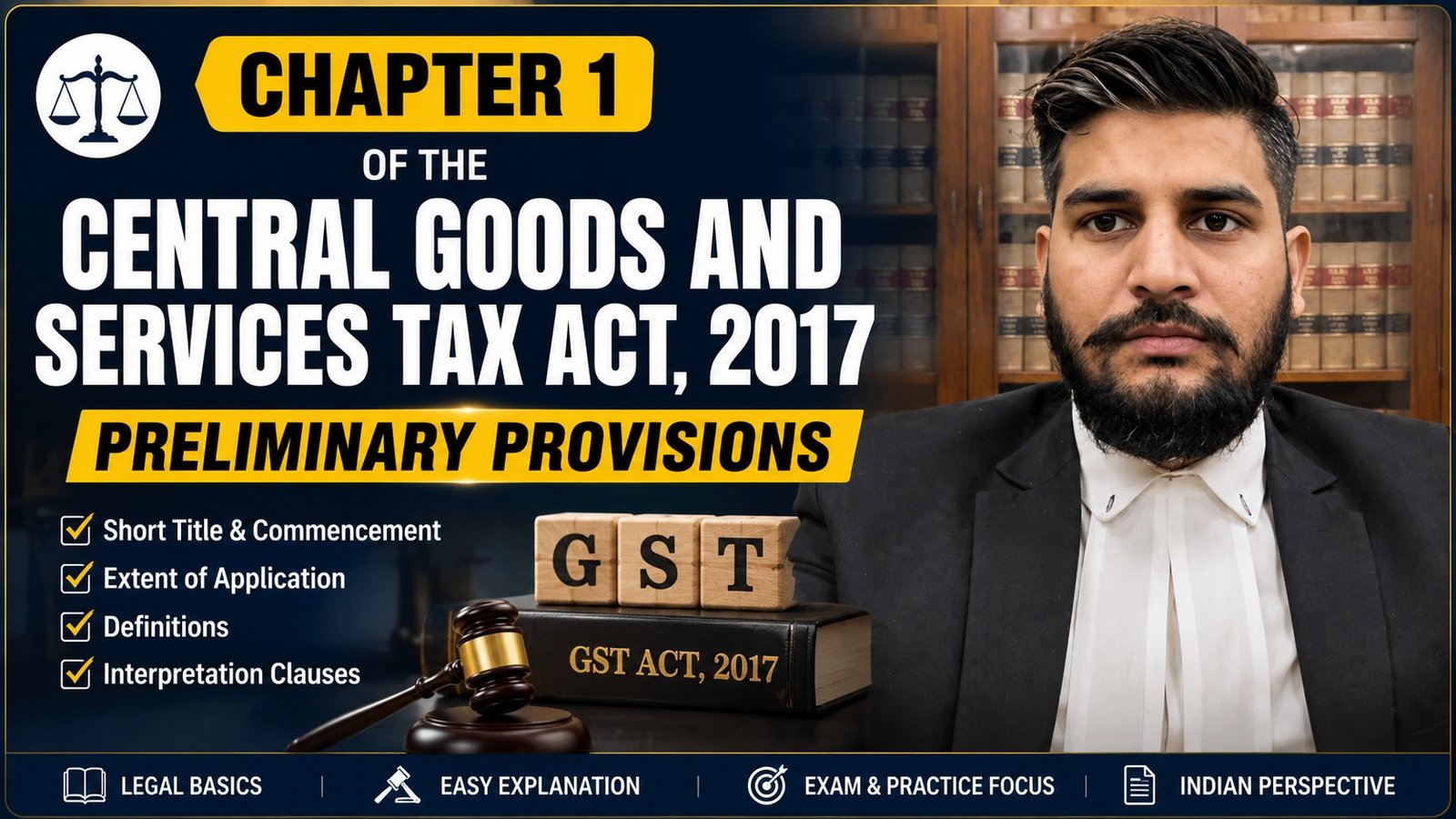
Chapter I of the Central Goods and Services Tax Act, 2017: Preliminary Provisions
Section 1: Short Title, Extent and Commencement
Section 1 of the CGST Act establishes three fundamental aspects of the legislation: its official name, territorial jurisdiction, and the mechanism for bringing its provisions into force.
Sub-section (1): Short Title
The first sub-section provides the official nomenclature of the legislation:
“This Act may be called the Central Goods and Services Tax Act, 2017.”
This designation distinguishes the CGST Act from other components of the GST legislative framework, including the Integrated Goods and Services Tax (IGST) Act, State Goods and Services Tax (SGST) Acts, and Union Territory Goods and Services Tax (UTGST) Act. The year 2017 in the title marks it as Act No. 12 of 2017, passed by Parliament during the Sixty-eighth Year of the Republic of India[2].
The CGST Act specifically governs the levy and collection of tax on intra-state supply of goods or services or both by the Central Government. This means that when both the supplier and the place of supply are within the same state or union territory, CGST applies alongside the corresponding SGST or UTGST[3].
Sub-section (2): Territorial Extent
The second sub-section defines the geographical scope of the Act:
“It extends to the whole of India.”
This provision originally contained an exception for the State of Jammu and Kashmir, reading: “It extends to the whole of India except the State of Jammu and Kashmir.” However, this exclusion was omitted through The Central Goods and Services Tax (Extension to Jammu and Kashmir) Act, 2017 (No. 26 of 2017), which came into effect on July 8, 2017[1][4].
Following this amendment, the CGST Act now applies uniformly across all states and union territories of India, creating a truly unified national market for goods and services. This territorial universality is fundamental to achieving GST’s core objective of “One Nation, One Tax,” eliminating the cascading effects of multiple indirect taxes and enabling seamless flow of input tax credit across the country.
Sub-section (3): Commencement Provisions
The third sub-section establishes the mechanism for the Act coming into force:
“It shall come into force on such date as the Central Government may, by notification in the Official Gazette, appoint: Provided that different dates may be appointed for different provisions of this Act and any reference in any such provision to the commencement of this Act shall be construed as a reference to the coming into force of that provision.”
This provision grants the Central Government flexibility to implement the Act’s provisions in a phased manner. Rather than bringing all sections into force simultaneously, the government could strategically operationalize different provisions based on administrative preparedness and practical considerations.
Phased Implementation Timeline
In exercise of powers under Section 1(3), the Central Government issued notifications implementing the CGST Act in distinct phases:
First Phase – June 22, 2017: The following sections were brought into force through Notification No. 1/2017-Central Tax dated June 19, 2017[1][7]:
- Sections 1, 2, 3, 4, 5 (Preliminary and Administration)
- Sections 10, 22, 23, 24, 25, 26, 27, 28, 29, 30 (Registration provisions)
- Sections 139, 146, and 164 (Transitional and miscellaneous provisions)
Second Phase – July 1, 2017: The substantive operational provisions were implemented, including:
- Sections 6 to 9 (Levy and collection of tax)
- Sections 11 to 21 (Composition levy, time and value of supply, input tax credit)
- Sections 31 to 50 (Tax invoice, accounts, assessment, payment)
- Sections 53 to 138 (Returns, refunds, demands, recovery, inspection, offences, appeals)
- Sections 140 to 145, 147 to 163, 165 to 174 (Transitional provisions, miscellaneous, special provisions)
This phased approach ensured that the foundational provisions, particularly definitions and registration mechanisms, were in place before the tax collection and compliance requirements became operational. It allowed businesses and tax authorities adequate time to prepare systems and processes for GST implementation.