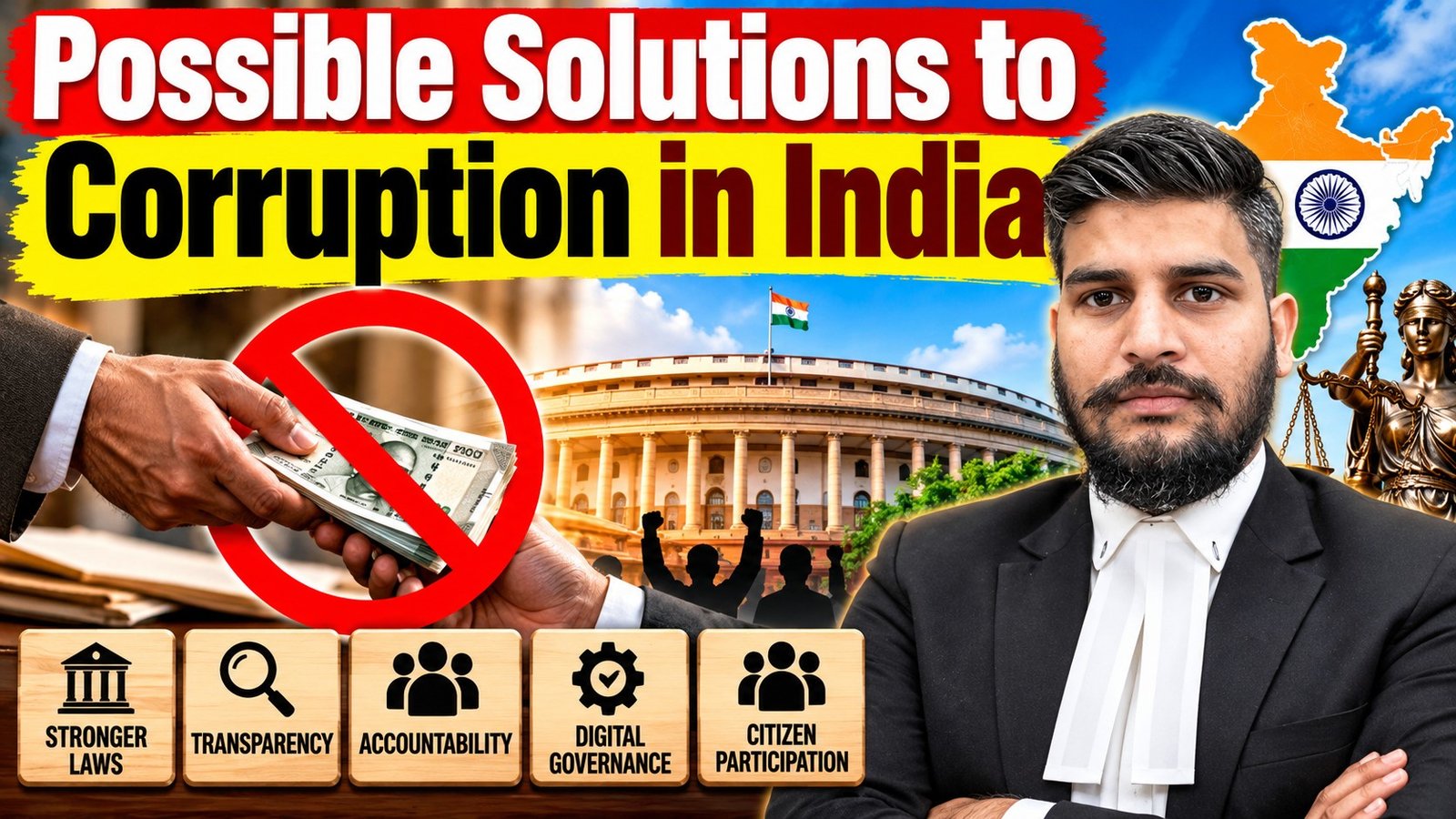
Possible Solutions to Corruption in India
The architecture of corruption in India is not merely a sequence of isolated ethical failures; it is a complex, systemic friction that distorts market efficiencies, compromises the rule of law, and fractures the social contract between the state and its citizens. To deconstruct this endemic issue requires moving beyond moralizing rhetoric and examining the mechanisms of graft through the rigorous lenses of jurisprudence, economic theory, and institutional accountability. Treating the disease of public-sector corruption demands a comprehensive, multi-layered structural overhaul that redefines the incentives governing politicians, bureaucrats, and private entities.
At the bedrock of this necessary transformation is the urgent need to fortify the republic’s law enforcement apparatus. In economic terms, corruption operates as an illegal tax, creating deadweight loss and misallocating capital away from productive investments toward rent-seeking behavior. When law enforcement is weak, the expected cost of engaging in corrupt practices plummets, creating a perverse incentive structure where graft becomes a high-reward, low-risk enterprise. To reverse this, investigatory agencies must be heavily capitalized with advanced forensic resources, digital tracing capabilities, and specialized training in complex financial crimes. More crucially, the legal framework must ensure that these agencies operate with absolute prosecutorial independence. The current structural design often leaves investigative bodies vulnerable to political capture, turning them into instruments of state coercion rather than neutral arbiters of justice. By elevating evidentiary standards and expediting trial timelines through specialized anti-corruption tribunals, the state can establish a credible deterrent, fundamentally altering the cost-benefit analysis for those contemplating bribery or embezzlement.
Parallel to the reinforcement of law enforcement is the vital expansion of institutional transparency and accountability. Information asymmetry is the breeding ground for corruption. When the mechanics of government—specifically public procurement, budget allocation, and regulatory decision-making—are obscured from public view, insiders are positioned to extract monopolistic rents. Public procurement alone constitutes a massive percentage of India’s GDP; when these contracts are awarded through opaque, discretionary processes, the economic fallout includes hyper-inflated infrastructure costs and substandard public goods. Transitioning to a paradigm of radical transparency requires more than statutory declarations; it demands real-time, open-data platforms where civil society and investigative journalists can track the flow of sovereign funds down to the final beneficiary. By dismantling the information monopoly held by the state, the public can actively audit the government, ensuring that the allocation of public resources aligns with market efficiencies and the genuine needs of the populace rather than the private interests of political syndicates.
This transparency must be operationalized through the aggressive simplification of bureaucratic procedures. The historical hangover of the “License Raj” has left behind a labyrinthine administrative state characterized by excessive red tape and discretionary chokepoints. From an economic perspective, every bureaucratic intermediary represents a potential tollbooth where transaction costs are artificially inflated through demands for speed money or facilitation payments. To dismantle this, the state must re-engineer its administrative architecture to minimize human intervention. The digitalization of government services—leveraging biometric identification, blockchain for land registries, and algorithmic processing for licenses and permits—acts as a powerful disintermediation tool. When a citizen or a business can secure a permit through an automated, time-bound digital portal rather than negotiating with a desk officer, the opportunity structure for low-level graft collapses. Simplifying the regulatory environment not only curtails petty corruption but significantly lowers the barriers to entry for micro, small, and medium enterprises, fostering a more competitive and dynamic free market.
However, systemic technological and procedural upgrades are insufficient without ironclad legal protections for those who expose internal malfeasance. The economics of whistleblowing are currently heavily skewed against the informant. In corrupt cartels, the game-theoretic equilibrium relies on a code of silence enforced through the threat of severe professional, financial, and physical retaliation. To break this equilibrium, the state must operationalize and fiercely enforce comprehensive whistleblower protection laws. A robust legal shield must guarantee absolute anonymity, immunity from retaliatory litigation, and physical security for individuals who bring evidence of graft to the public domain. Furthermore, integrating financial reward mechanisms—where whistleblowers receive a percentage of the recovered stolen public funds—can introduce a powerful economic counter-incentive, encouraging insiders to defect from corrupt networks and provide actionable intelligence to law enforcement and the press.
The efficacy of these legal and economic reforms relies heavily on the active participation of an educated, vigilant citizenry. The principal-agent problem inherent in democratic governance—where citizens (the principals) struggle to monitor and control politicians and bureaucrats (the agents)—is exacerbated by widespread civic apathy and a cultural fatalism that accepts corruption as an immutable reality. Reversing this requires aggressive, nationwide civic education campaigns that elucidate the hidden, downstream costs of corruption. Citizens must understand that a bribe paid for a hospital contract directly correlates to the lack of oxygen cylinders in the ward; they must see the macroeconomic link between grand corruption and the inflation of basic commodities. Furthermore, an independent, fiercely adversarial press is essential to this educational ecosystem. Investigative journalism bridges the gap between complex legal documents and public comprehension, transforming abstract policy failures into urgent public scandals that demand electoral and legal reckoning.
To anchor this structural reform, India’s apex anti-corruption institutions—the Central Vigilance Commission (CVC), the Central Bureau of Investigation (CBI), and the Lokpal—must be drastically empowered. Currently, these bodies often suffer from a lack of constitutional insulation, rendering them susceptible to executive interference. True institutional reform requires granting these watchdogs financial autonomy, directly appropriating their budgets through legislative mechanisms that bypass executive squeeze tactics. Furthermore, their leadership appointments must be entirely depoliticized, relying on rigorous, transparent, multi-partisan consensus to ensure only jurists and investigators of unimpeachable integrity ascend to power. Giving the Lokpal and the CBI the unrestricted mandate to initiate investigations and prosecute high-ranking officials without prior executive sanction is a non-negotiable legal prerequisite for dismantling the architecture of impunity.
Ultimately, the viability of every legislative amendment, digital upgrade, and investigative mandate rests upon the cornerstone of ethical leadership. The criminological realities of political funding and campaign finance in India remain one of the most significant barriers to clean governance. When the machinery of democracy is fueled by untraceable corporate capital and dark money, politicians become heavily indebted to crony capitalists long before they take the oath of office. Reforming the electoral ecosystem requires forcing absolute transparency in political funding and strictly enforcing the disqualification of candidates with serious criminal indictments. Political parties must be compelled by statutory law to democratize their internal structures and select candidates based on meritocratic criteria and clean legal records, effectively severing the reliance on dynastic patronage and muscle power. Only when the incentive structures within the political economy are fundamentally realigned to reward integrity over the extraction of public wealth can the Indian state begin to dismantle the entrenched syndicates of corruption and secure equitable prosperity for its citizens.