Types of Hormones and Their Role in Your Mind and Body
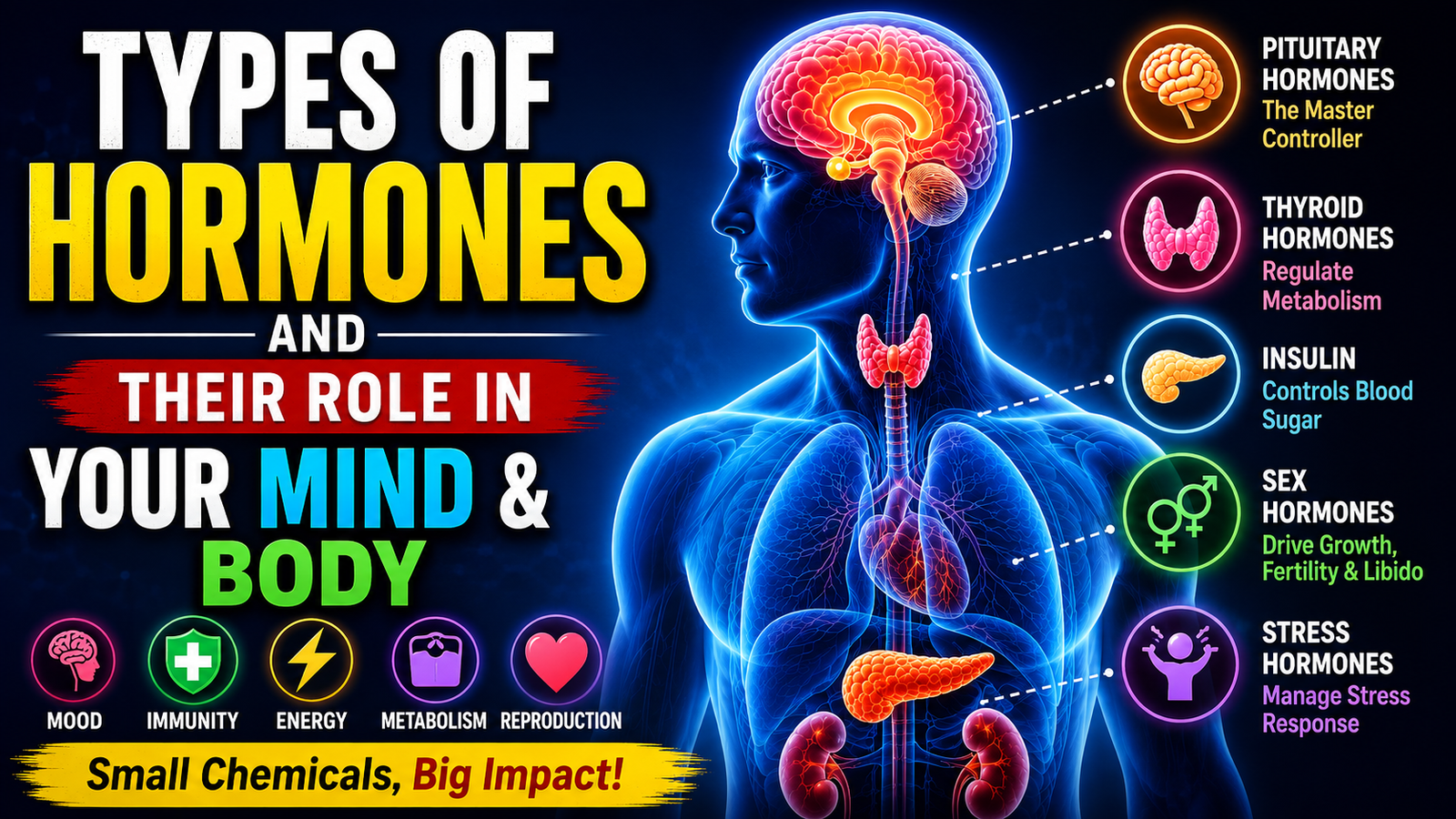
Hormones are powerful chemical messengers produced by glands that travel through the bloodstream and influence almost every system in the body, from mood and sleep to growth, metabolism and fluid balance.[1][2] Understanding them helps you see why lifestyle factors like stress, diet, sleep and exercise affect how you feel every day.[3][4]
Happy hormone – Dopamine
Dopamine is a neurotransmitter and hormone made in the brain that is strongly linked with pleasure, reward and motivation.[5][6] When you do something enjoyable, dopamine release creates a “feel‑good” signal that reinforces the behaviour and helps you feel alert, focused and driven.[5][7] Chronically low dopamine is associated with tiredness, lack of motivation and low mood, while excessively high levels can contribute to impulse problems and mania.[8][9]
Stress hormone – Cortisol
Cortisol is the main glucocorticoid (“stress hormone”) produced by the adrenal cortex, and it helps the body respond to danger or psychological stress through the fight‑or‑flight mechanism.[10][1] It mobilises energy by increasing blood glucose, supports blood pressure and suppresses inflammation, allowing you to cope with immediate challenges.[10][11] When cortisol stays high for long periods, however, it is linked with weight gain, hypertension, diabetes, anxiety, depression and disturbed sleep.[12][1][3]
Love hormone – Oxytocin
Oxytocin is a small peptide that acts both as a hormone and neurotransmitter, famous as the “love” or “cuddle” hormone because of its central role in bonding and social connection.[13][14] It is released during childbirth, breastfeeding, affectionate touch and positive social interactions, promoting trust, empathy and feelings of closeness.[13][15] Research shows oxytocin improves social approach behaviour, emotion recognition and cooperative decision‑making, and can reduce social anxiety in some people.[15][14]
Sleep hormone – Melatonin
Melatonin is produced mainly by the pineal gland in response to darkness and is a key regulator of the sleep–wake cycle and circadian rhythms.[16][17] Rising melatonin levels in the evening signal to the brain and body that it is time to feel sleepy, lower core body temperature and prepare for restorative night‑time sleep.[18][19] Light exposure at night, shift work or jet lag can blunt melatonin secretion and disrupt sleep, which is why timed melatonin supplements are sometimes used for specific sleep disorders and circadian rhythm problems.[20][4][21]
Energy hormone – Adrenaline (Epinephrine)
Adrenaline, also called epinephrine, is released rapidly from the adrenal medulla when the brain detects a threat, forming the core of the fight‑or‑flight response.[22][23] It increases heart rate and blood pressure, dilates airways, redirects blood flow to muscles and raises blood sugar so the body can either confront danger or escape it.[24][25] Once the stressor passes, adrenaline levels fall and the parasympathetic “rest and digest” system restores normal physiology, but repeated surges from chronic stress can strain the cardiovascular system over time.[23][26]
Pain‑relief hormone – Endorphins
Endorphins are opioid‑like peptides released by the hypothalamus and pituitary gland in response to pain, stress and intense exercise.[27] They reduce the perception of pain and generate a sense of well‑being or euphoria, often described as a “runner’s high” after sustained physical activity.[27] Because of these natural analgesic and mood‑lifting effects, regular exercise and laughter are practical ways to trigger healthy endorphin release.[27]
Feel‑good hormone – Serotonin
Serotonin is a neurotransmitter that carries messages between nerve cells and plays a major role in mood, sleep, appetite, digestion and sexual desire.[28][29] Normal serotonin levels are associated with feeling calm, focused and emotionally stable, whereas low levels are linked to depression, anxiety and other mood disorders.[28][30] Sunlight exposure, exercise and diets rich in tryptophan (the amino acid precursor of serotonin) can help support healthy serotonin signalling alongside medical treatment when needed.[28][31]
Hunger hormone – Ghrelin
Ghrelin is produced mainly in the stomach and is often called the “hunger hormone” because it rises before meals and signals the brain that it is time to eat.[32][33] It stimulates appetite, increases food intake and promotes fat storage, acting on the hypothalamus and reward centres to drive feeding behaviour.[34][35] Poor sleep, strict dieting and high stress can raise ghrelin levels and make weight control harder, while stable weight, adequate sleep and higher protein intake tend to keep ghrelin better regulated.[32][36]
Metabolism hormone – Thyroxine (T4)
Thyroxine, or T4, is the main hormone produced by the thyroid gland and is converted in tissues to the more active triiodothyronine (T3).[37][38] Thyroid hormones regulate basal metabolic rate, energy expenditure, cholesterol levels and both fat and carbohydrate metabolism across multiple organs.[2] Excess thyroid hormone (hyperthyroidism) leads to a hypermetabolic state with weight loss and heat intolerance, while deficiency (hypothyroidism) causes weight gain, fatigue and cold sensitivity.[2]
Growth hormone – Somatotropin (GH)
Somatotropin, commonly called growth hormone (GH), is secreted in pulses from the anterior pituitary and is crucial for linear growth in children and adolescents.[39][40] It stimulates the production of insulin‑like growth factor‑1 (IGF‑1), which promotes bone growth, increases muscle mass and influences lipid and glucose metabolism.[39][41] In adults, abnormal excess of GH can cause acromegaly and metabolic disturbances, while deficiency leads to reduced bone density, muscle mass and quality of life; medically, recombinant GH is used to treat confirmed deficiency states.[39][42]
Bone‑growth hormone – Calcitonin
Calcitonin is produced by C‑cells of the thyroid gland and helps protect the skeleton and regulate calcium by reducing bone resorption.[43][44] When blood calcium rises, calcitonin secretion increases, acting mainly on bone to slow down osteoclast activity so less calcium is released into the bloodstream.[44][43] Although calcitonin has a more modest role in day‑to‑day calcium control compared with parathyroid hormone and vitamin D, it contributes to fine‑tuning bone mineral balance.[43][44]
Fat‑burning hormone – Glucagon
Glucagon is a peptide hormone released from pancreatic alpha cells when blood glucose falls, acting as a counter‑balance to insulin.[45][46] It stimulates the liver to break down glycogen and produce new glucose, thereby raising blood sugar to protect the brain and other organs from hypoglycaemia.[45][46] Glucagon also promotes lipolysis and ketone production, mobilising stored fat as fuel, which is why it is often described as a “fat‑burning” or energy‑mobilising hormone in contrast to insulin’s energy‑storing effects.[45][36]
Blood sugar regulator – Insulin
Insulin is produced by beta cells in the pancreas and is the principal hormone that lowers blood glucose after meals.[47][48] It acts like a “key” that allows glucose to enter muscle, fat and liver cells, where it can be used for energy or stored as glycogen and triglycerides.[48][47] When insulin is insufficient or ineffective, as in diabetes, blood sugar remains high and long‑term complications can develop; conversely, too much insulin can cause dangerous hypoglycaemia.[48][47]
Water balance hormone – ADH (Vasopressin)
Antidiuretic hormone (ADH), also known as vasopressin, is released from the posterior pituitary in response to increased blood osmolarity or reduced blood volume.[49][50] It acts on vasopressin V2 receptors in the kidney collecting ducts, increasing aquaporin‑2 water channels so more water is reabsorbed back into the blood and urine becomes more concentrated.[49][50] Deficiency or resistance to ADH causes excessive urination and thirst (diabetes insipidus), while inappropriate ADH secretion leads to water retention and hyponatraemia.[49][51]
Calcium balance hormone – Parathyroid hormone (PTH)
Parathyroid hormone is secreted by the parathyroid glands in response to even small drops in ionised calcium and is the chief regulator of calcium homeostasis.[43][44] It increases bone resorption, enhances renal calcium reabsorption and promotes activation of vitamin D, which in turn boosts intestinal absorption of calcium and phosphate.[43][44] Through these coordinated actions on bone, kidney and gut, PTH raises blood calcium, and disorders of PTH secretion lead to serious problems such as hypocalcaemia or hypercalcaemia with neuromuscular and skeletal consequences.[43][44]
- https://www.ncbi.nlm.nih.gov/books/NBK538239/
- https://pmc.ncbi.nlm.nih.gov/articles/PMC4044302/
- https://health.stonybrookmedicine.edu/cortisol-explained-why-the-stress-hormone-isnt-always-the-enemy/
- https://www.nccih.nih.gov/health/melatonin-what-you-need-to-know
- https://my.clevelandclinic.org/health/articles/22581-dopamine
- https://www.healthline.com/health/dopamine-effects
- https://www.health.harvard.edu/mind-and-mood/dopamine-the-pathway-to-pleasure
- https://pubmed.ncbi.nlm.nih.gov/30481503/
- https://pubmed.ncbi.nlm.nih.gov/1347497/
- https://www.medicalnewstoday.com/articles/cortisol-and-stress
- https://pmc.ncbi.nlm.nih.gov/articles/PMC10706127/
- https://www.helpguide.org/mental-health/stress/what-is-cortisol
- https://oxytocin.org/oxy/social-bonds.html
- https://www.su.se/english/divisions/department-of-psychology/news/articles/2025-02-18-oxytocin—the-key-to-social-bonds
- https://pmc.ncbi.nlm.nih.gov/articles/PMC5573563/
- https://pmc.ncbi.nlm.nih.gov/articles/PMC13241146/
- https://my.clevelandclinic.org/health/articles/23411-melatonin
- https://pmc.ncbi.nlm.nih.gov/articles/PMC3503905/
- https://pubmed.ncbi.nlm.nih.gov/12622846/
- https://www.ncbi.nlm.nih.gov/books/NBK534823/
- https://www.ncbi.nlm.nih.gov/books/NBK11941/
- https://my.clevelandclinic.org/health/articles/22611-epinephrine-adrenaline
- https://www.ncbi.nlm.nih.gov/books/NBK541120/
- https://www.healthdirect.gov.au/amp/article/adrenaline
- https://www.health.harvard.edu/healthy-aging-and-longevity/understanding-the-stress-response
- https://www.endocrine.org/patient-engagement/endocrine-library/hormones-and-endocrine-function/adrenal-hormones
- https://www.health.harvard.edu/mind-and-mood/endorphins-the-brains-natural-pain-reliever
- https://my.clevelandclinic.org/health/articles/22572-serotonin
- https://www.sciencedirect.com/science/article/abs/pii/S1569733910700904
- https://pmc.ncbi.nlm.nih.gov/articles/PMC5606297/
- https://pmc.ncbi.nlm.nih.gov/articles/PMC4728667/
- https://www.healthline.com/nutrition/ghrelin
- https://www.yourhormones.info/hormones/ghrelin/
- https://www.ncbi.nlm.nih.gov/books/NBK547692/
- https://pmc.ncbi.nlm.nih.gov/articles/PMC3178114/
- https://pmc.ncbi.nlm.nih.gov/articles/PMC5819073/
- https://en.wikipedia.org/wiki/Thyroxine
- https://www.sciencedirect.com/topics/medicine-and-dentistry/thyroxine-metabolism
- https://go.drugbank.com/drugs/DB00052
- https://flexikon.doccheck.com/de/Somatotropin
- https://de.wikipedia.org/wiki/Somatropin
- https://ru.wikipedia.org/wiki/Гормон_роста
- https://www.ncbi.nlm.nih.gov/books/NBK279023/
- https://academic.oup.com/bja/article/85/1/29/263835
- https://www.ncbi.nlm.nih.gov/books/NBK279127/
- https://www.sciencedirect.com/topics/neuroscience/glucagon
- https://www.britannica.com/science/insulin
- https://my.clevelandclinic.org/health/body/22601-insulin
- https://pmc.ncbi.nlm.nih.gov/articles/PMC6364380/
- https://academic.oup.com/ndt/article/40/4/632/7829350
- https://journals.sagepub.com/doi/pdf/10.1258/000456307781646030
- 1000100921.jpg
- https://www.usatoday.com/story/life/health-wellness/2023/05/24/what-is-cortisol-body-too-high-stress/70232531007/
- https://www.scripps.org/news_items/8021-cortisol-and-stress-what-s-the-connection
- https://www.sciencedirect.com/science/article/abs/pii/S0006899318305973
- https://www.nationalgeographic.com/science/article/cortisol-stress-hormone-explainer
- https://www.houstonmethodist.org/blog/articles/2024/may/what-is-cortisol-the-truth-about-this-stress-hormone/
- https://www.sciencedirect.com/science/article/pii/S0306453013002369
- https://www.webmd.com/sleep-disorders/what-is-melatonin
- https://pubmed.ncbi.nlm.nih.gov/9556097/?dopt=Abstract
- https://www.sciencedirect.com/topics/neuroscience/melatonin
- https://www.nature.com/collections/hdjjeadjdd
- https://en.wikipedia.org/wiki/Ghrelin
- https://pubmed.ncbi.nlm.nih.gov/16859720/
- https://pmc.ncbi.nlm.nih.gov/articles/PMC4443295/
- https://pubmed.ncbi.nlm.nih.gov/17453675/
- https://pmc.ncbi.nlm.nih.gov/articles/PMC4049314/
- https://www.webmd.com/obesity/what-is-ghrelin
- https://www.sciencedirect.com/topics/immunology-and-microbiology/thyroxine-metabolism
- https://fr.wikipedia.org/wiki/Hormone_de_croissance
- https://www.youtube.com/watch?v=3xrW3PH0050
- https://www.youtube.com/watch?v=P1KYVtT3GCM
- https://www.youtube.com/watch?v=FzeL1fcBwnE
- https://pubmed.ncbi.nlm.nih.gov/170548/
- https://mhanational.org/resources/what-is-adrenaline/
- https://www.psychstory.co.uk/neuroscience/fight-or-flight