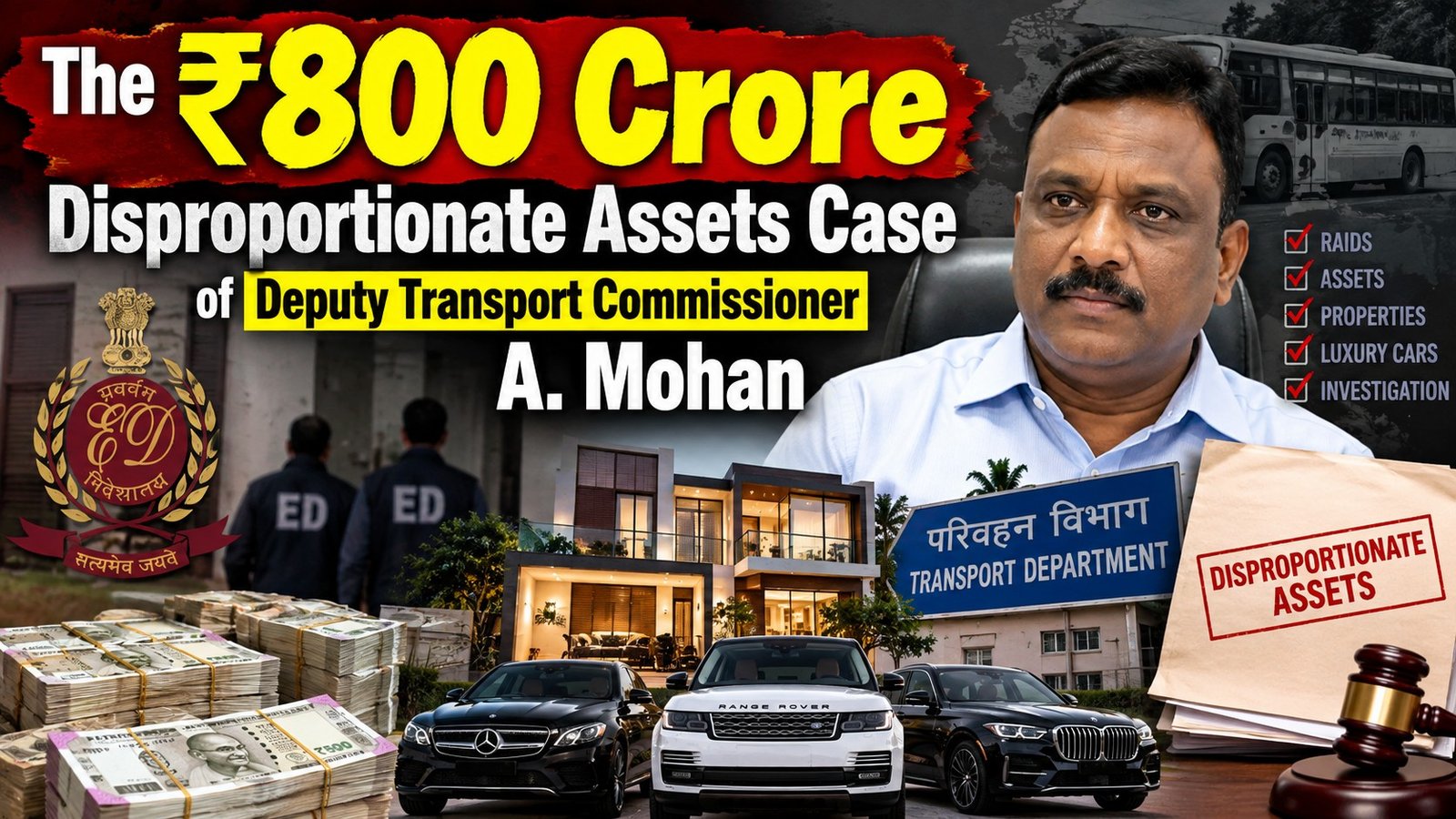
The ₹800 Crore Disproportionate Assets Case of Deputy Transport Commissioner A. Mohan (Andhra Pradesh, 2016)
Executive overview
In April 2016, the Andhra Pradesh Anti-Corruption Bureau (ACB) arrested Adimulam (also spelled Adimoolam) Mohan, Deputy Transport Commissioner posted at Kakinada in East Godavari district, after large-scale searches revealed assets whose market value was estimated at around ₹800 crore, allegedly disproportionate to his known sources of income. The case instantly became one of the most high-profile disproportionate assets matters involving a mid-level state government officer, as the scale of wealth uncovered appeared comparable to that of big industrialists rather than a Group I transport official.[1][2][3][4][5][6]
Background of the officer and the complaint
Career profile of A. Mohan
Adimulam Mohan joined the Andhra Pradesh Transport Department around 1989 and rose through the ranks to become Deputy Transport Commissioner, a Group I post, by the late 1990s. In 2014, following the bifurcation of Andhra Pradesh and Telangana, he was posted as Deputy Transport Commissioner at Kakinada, with jurisdiction over East and parts of West Godavari districts, including the crucial Kakinada port route that sees significant movement of commercial vehicles.[7][4]
Media reports and inputs from transport operators later suggested that Mohan had acquired a reputation in the region as an officer whose office could not be bypassed by truckers and transporters, with allegations that vehicles which did not “see” him or pay demanded sums would face harassment in the form of inspections, seizures, or alleged permit-related obstacles. These complaints, reinforced by political support from some local leaders, appear to have triggered closer scrutiny and a formal complaint to the ACB leading to a disproportionate assets (DA) case registration.[4][8]
Registration of disproportionate assets case
According to ACB press releases and contemporaneous news coverage, a formal DA case was registered against Mohan under the Prevention of Corruption Act, alleging possession of assets grossly disproportionate to his known sources of income. Once the case was registered, the ACB’s Central Investigation Unit, led by Deputy Superintendent of Police (DSP) A. Ramadevi, drew up a coordinated search plan covering multiple locations linked to Mohan, his relatives and alleged benamidars (name-lenders).[3][8][6][1]
The decision to conduct simultaneous searches in multiple districts and even across state borders indicates that investigators already suspected widespread property holdings and a complex layering of assets, which is typical in large DA cases where officers are believed to have siphoned off illegal gratification over many years.[5][3]
The April 2016 raids and locations searched
Multi-state search operation
The key operational phase began on 28 April 2016, when ACB teams simultaneously raided premises linked to Mohan in at least nine locations spread across Andhra Pradesh, Telangana and Karnataka. Locations included his residence and office at Kakinada (East Godavari); properties and relatives’ houses in Nellore, Prakasam and Chittoor districts; premises in Hyderabad (including upscale localities like Jubilee Hills, Panjagutta, Kompally and Madhapur); and holdings in Bellary (Ballari) in neighbouring Karnataka.[2][8][1][7][3][5]
The raids continued into the next day as volumes of documents, jewellery, cash, and property records were catalogued, and multiple bank accounts and lockers were identified for subsequent search and seizure. The fact that searches had to be extended and that several bank lockers remained unopened even after the initial operation suggested to investigators that the full extent of the wealth may be even larger than the first-day tally.[6][1][2][3]
Resistance and conduct during the raids
Reports note that Mohan initially resisted entry of ACB teams into his house and even threw his mobile phone outside, apparently in an attempt to prevent access to its data; however, the phone was recovered and taken into custody for forensic examination of communications and financial trails. Such behaviour is often cited by investigators as indicative of consciousness of guilt and forms part of circumstantial evidence in DA prosecutions.[1][3]
Despite alleged non-cooperation by Mohan and his wife during initial questioning, the searches went ahead under the authority of court-sanctioned warrants, and the officer was subsequently arrested and produced before the ACB Court in Vijayawada.[8][7][^1]
Composition and valuation of assets unearthed
Real estate and land holdings
Across news reports and ACB statements, a broad picture emerges of extensive real estate holdings in Mohan’s and his family’s names, as well as in the names of relatives and suspected benamidars:
- Around 8 open plots in Kompally, on the outskirts of Hyderabad, each measuring roughly 450–500 square yards, were identified as linked to Mohan or his family.[9][5][^8]
- Four plots in Madhapur, a prime IT hub in Hyderabad, were also traced.[2][3]
- A large house or five-storey building in posh Jubilee Hills and at least one building in Panjagutta, both high-value commercial or residential areas in Hyderabad, were seized or documented during the searches.[3][4][^2]
- Agricultural and other land totaling about 50–55 acres was identified in Nellore and Prakasam districts, with some reports specifically attributing 45 acres to Mohan and around 9.5 acres in his daughter’s name in Nellore.[5][6][^2]
- Additional house sites and about seven acres of agricultural land in Bellary, Karnataka, were found in the name of his son-in-law, which the ACB considered part of the same asset network.[9][5]
- There were also references to sites or plots at Tirupati and other urban locations in Andhra Pradesh, further indicating a wide geographic spread of real estate investments.[7][4]
These properties were acquired over many years at different book values (document values), but by 2016 their combined market value was estimated by investigators and media sources at around ₹800 crore.[2][3][^5]
Gold, silver, diamonds and cash
In addition to land and buildings, the searches yielded significant quantities of precious metals and stones:
- About 2 kilograms of gold and 5 kilograms of silver were reported as seized from Mohan’s and his relatives’ premises.[8][3][^2]
- Many diamonds, gems and other precious stones were also found, though their precise valuation was pending detailed assessment by experts at the time of initial reports.[1][3]
- Cash of around ₹83,000 was recovered on the spot, along with bank balances of a few lakh rupees and fixed deposits reportedly worth a few lakh more, all of which were to be further scrutinised.[7][3]
While the cash component appeared modest compared to the real estate portfolio, investigators suggested that the actual value locked in jewellery and bank accounts (including unopened lockers) might be substantially higher once fully assessed.[3][2]
Corporate structures and suspected money laundering
A notable feature of the case was the discovery that Mohan had floated multiple companies—variously reported as five to eight entities—in the name of his elder daughter, Tejasri. The ACB suspected that these companies were used as vehicles to convert illicit income into ostensibly legitimate business profits, effectively layering and integrating proceeds of corruption into the formal economy.[5][1][^2]
Investigator A. Ramadevi stated that, despite addresses being available in documents, the ACB teams could not trace actual functioning offices for some of these companies, strengthening the suspicion that they were shell entities or paper companies rather than genuine operating businesses. This pattern aligns with broader anti-corruption experience where corrupt officials create front companies in relatives’ names to hold property, route kickbacks, and create a façade of legitimate entrepreneurship.[1][2]
The ₹800 crore figure: document value vs market value
Official assessment and media estimates
One important nuance in the reporting of this case is the distinction between the document (registered) value of properties and their actual market value. ACB officials themselves stated that the document value of Mohan’s identified properties was around ₹100–₹120 crore. However, given the prime locations (Jubilee Hills, Madhapur, Kompally, Panjagutta, coastal and urban land in Andhra Pradesh), the market value of these holdings was estimated by investigators and media sources at roughly ₹800 crore.[8][2][^1]
Some ACB officials were initially cautious, clarifying that the final figure would only be known after all properties, ornaments, bank accounts, and lockers were fully valued and that any headline number was at that stage an estimate based on prevailing real estate prices. Nonetheless, the approximate figure of ₹800 crore quickly became the shorthand reference in national and regional media, and is reflected across major outlets such as Hindustan Times, India TV, NDTV, Deccan Chronicle and others.[6][2][7][3][^1]
Legal relevance of valuation in disproportionate assets cases
From a legal perspective, while high market-value figures create public impact, the core test in a disproportionate assets prosecution is whether the total assets of a public servant are disproportionate to his or her known lawful income, after giving due allowance for expenditure over the check period. The focus is on the ratio of assets to known income and the inability of the accused to satisfactorily explain the excess, rather than on headline valuations alone.
In Mohan’s case, the ACB’s case would revolve around demonstrating that, considering his salary and legitimate earnings as a transport officer since 1989, acquisition of such extensive and high-value property holdings could not be rationally explained without recourse to illegal gratification and abuse of official position. The discovery of shell-like companies in his daughter’s name and benami properties in relatives’ names would further support the inference that complex methods were used to conceal the true extent and origin of wealth.[6][2][5][1]
Alleged modus operandi and bribe collection
Allegations from transport operators
Subsequent analysis and reportage indicated that Mohan’s primary alleged modus operandi involved systematic extraction of bribes from transporters, particularly truck operators using routes to the Kakinada port. According to accounts attributed to operators and unnamed sources, truckers who did not pay would face heightened scrutiny, seizure of vehicles, or manufactured permit and documentation problems, effectively forcing compliance in order to maintain business.[^4]
Reports suggested that Mohan was widely disliked among operators but simultaneously seen as indispensable, because without his “clearance” operating in the region became difficult. This climate of fear and compulsion is typical in corruption rackets built around regulatory choke points—here, the transport checkposts and permit system—which allow an individual officer to exercise disproportionate power over a large economic stream.[^4]
Later social media narratives
Years later, social media posts and reels resurfaced details of the case, often with simplified or sensationalised descriptions stating that he collected around ₹3 crore in bribes every month and built an empire of 14 flats, multiple buildings in Jubilee Hills and Panjagutta, and 50 acres of land in Andhra Pradesh. These online narratives broadly mirror the asset composition reported in 2016 but are not official findings; they illustrate how high-profile DA cases become part of public discourse about systemic corruption.[10][11][^12]
While such later posts help keep public attention on the issue of corruption, legal analysis must remain anchored in the evidentiary record—ACB seizure memos, valuation reports, charge sheets and court orders—rather than retrospective social media summaries.
Procedural developments and government response
Arrest and remand
Following his arrest, Mohan was produced before the ACB Court in Vijayawada and was remanded to judicial custody, as is standard in serious DA cases where custody is sought to prevent tampering with evidence or influencing witnesses. The ACB continued searches even after his remand, particularly to open remaining lockers and examine bank accounts, to strengthen the case for prosecution under the Prevention of Corruption Act.[13][2][^1]
News reports note that he was “sent to jail” soon after the raids, indicating that the court considered the allegations and material sufficient at that stage to deny immediate release. Any subsequent bail orders, trial progress or convictions/acquittals would typically be traceable through court records or later reporting.[9][5][^6]
Government orders and departmental action
Beyond the criminal process, disproportionate assets findings usually trigger departmental proceedings under service rules. A later Government Order of Andhra Pradesh references allegations of possession of disproportionate assets against Sri Adimulam Mohan of the Transport Department, indicating that the state formally recorded and processed the case at the administrative level as well.[^14]
Such departmental actions can include suspension, withholding of increments, compulsory retirement, or dismissal from service, depending on the outcome of criminal proceedings and departmental inquiries. However, specific final punishments in Mohan’s case would require examination of detailed government orders and court judgments beyond the initial 2016 coverage.
Legal and systemic significance of the case
Illustrative case of DA prosecution against mid-level officer
The Mohan case stands out because it demonstrates that even mid-level public servants, not just top bureaucrats or politicians, can amass vast illicit wealth where there are entrenched rent-seeking opportunities and weak oversight. A Deputy Transport Commissioner, whose official salary is modest by private-sector standards, allegedly accumulating assets comparable to major businesspersons underscores the profitability of systemic corruption if left unchecked.[3][4][^5]
For legal practitioners and students, the case provides a practical example of how a DA investigation is launched, how searches are planned and conducted across jurisdictions, and how the prosecution narrative is built around unexplained assets, corporate fronts, and benami holdings linked to the accused and his close family members.[2][6][^1]
Impact on public discourse and anti-corruption policy
The extensive media coverage and the striking ₹800 crore figure contributed to public outrage and strengthened perceptions that corruption in regulatory departments such as transport can be both pervasive and extremely lucrative. It sparked debates on the need for stronger internal vigilance, transparent posting and transfer policies, rotation of sensitive posts, and robust asset disclosure and verification mechanisms for officials.[2][3]
Moreover, the case highlighted practical issues in valuation of assets in DA prosecutions, the importance of distinguishing between book value and market value, and the need to document clear, audited calculations when presenting figures to the court. For policy discourse, it reinforced calls for digitalisation of transport services, reduction of discretion at checkposts, and greater use of technology to minimise direct contact between transporters and individual officers.[7][3][^2]
Key takeaways for legal analysis and teaching
Teaching points
From a pedagogical standpoint, several doctrinal and practical points can be drawn from the Mohan case for classroom or training use:
- Elements of a DA offence: The case illustrates how investigators establish the check period, quantify assets, compute lawful income, and then show disproportion beyond a permissible margin, shifting the burden onto the accused to satisfactorily explain the excess.
- Evidence structure: The reliance on property documents, registration records, company incorporation details, bank statements, and statements of relatives and associates shows the multi-layered evidentiary matrix involved in high-value DA cases.[5][6][^1]
- Benami and shell entities: Use of relatives’ names and shell companies to hold property demonstrates how DA cases intersect with benami law and anti-money laundering concerns.
- Media vs. legal record: The divergence between cautious official statements on valuation and more dramatic media headlines teaches the importance of distinguishing sensational figures from the precise numbers that will finally appear in the charge sheet and judgment.[7][3]
Broader lessons on systemic corruption
Finally, the episode underlines broader systemic lessons: that corruption flourishes where a single official controls a high-rent regulatory bottleneck; that long tenures and concentration of power can enable entrenched illegal rackets; and that simultaneous multi-location searches are often necessary to break complex asset-holding structures. It also reinforces the need for continual strengthening of institutions like the ACB, better whistle-blower protection, and public awareness that high-profile DA cases are not isolated anomalies but symptoms of deeper governance challenges.[4][3][^5]
Seen in this light, the 2016 arrest of Deputy Transport Commissioner A. Mohan and the unearthing of assets valued at nearly ₹800 crore remain a significant case study in India’s ongoing struggle against corruption, particularly in state-level regulatory departments with high discretionary power.[6][3][^2]
- Rs 800 crore assets seized in raid on Andhra Pradesh … – Mohan, who has been arrested, has assets valued at Rs 800 crore at market value. ACB’s Central Inves…
- Rs 800 cr seized in raids on senior Andhra transport dept official – Officials said A Mohan has assets worth Rs 800 crore at market value, the document value of his prop…
- ACB raids deputy transport commissioner in Andhra … – The Anti-Corruption Bureau (ACB) today arrested a deputy transport commissioner in Andhra Pradesh af…
- AP transport official arrested for graft, owns assets worth Rs … – AP transport official arrested for graft, owns assets worth Rs 800 cr … A Mohan would allegedly co…
- Andhra officer found to have Rs.800 crore disproportionate assets – An official in Andhra Pradesh has been arrested and sent to jail for amassing wealth said to be arou…
- Arrested Andhra Pradesh Officer Found To Have Rs 800 … – An official in Andhra Pradesh has been arrested and sent to jail for amassing wealth said to be arou…
- Andhra police raids transport officer’s house, seizes assets … – Andhra police raids transport officer’s house, seizes assets worth Rs 800 crore · A deputy transport…
- AP transport official arrested with assets valued at Rs 800 cr – According to an official release from the police, a case of Disproportionate Assets was registered a…
- Andhra officer found to have Rs.800 crore disproportiote assets – HYDERABAD, April 30: An official in Andhra Pradesh has been arrested and sent to jail for amassing w…
- India Corruption Case: ₹800 Crore Assets Seized from … – A major corruption case has surfaced involving a Deputy Transport Commissioner, where authorities re…
- A post circulating online describes a major corruption case … – A post circulating online describes a major corruption case involving a Deputy Transport Commissione…
- A Deputy Transport Commissioner allegedly earning ₹3 … – A Deputy Transport Commissioner allegedly earning ₹3 crore in bribes every month while innocent peop…
- Andhra Police raids transport official, Rs 800 crore assets seized – The Anti-Corruption Branch has raided the houses of a deputy transport commissioner A. Mohan in Andh…
- Andhra Pradesh Government Order, 2016-07-15, Trb01 – Abstract: Public Servants – Transport Department – Allegations of possession of Disproportionate Ass…